
TL;DR:
- Vendor financing is a credit arrangement where sellers provide structured payment plans or loans to buyers, helping them acquire goods without an upfront payment. It is widely used across capital-intensive industries and offers faster approval times, flexible terms, and lower eligibility barriers but may come with higher interest rates and hidden costs. Small businesses should evaluate the total cost, repayment terms, supplier credibility, and available alternatives before choosing vendor financing.
Vendor financing is defined as a credit arrangement where a seller provides structured payment plans or loans directly to a buyer, enabling the purchase of goods or services without a large upfront payment. This method is also known in financial circles as "seller financing" or "trade credit," depending on the structure involved. Vendor financing is common across capital-intensive industries including healthcare, manufacturing, technology, and telecommunications. The appeal is straightforward: buyers get access to equipment or inventory now, and sellers close more sales. 37% of small and medium-sized enterprises used trade credit, a primary form of vendor financing, in Q4 2025. That figure confirms this is not a niche workaround. It is a mainstream financing tool that small business owners use every day to manage cash flow and acquire the assets they need to grow.
What is vendor financing and how does it differ from a bank loan?
Vendor financing and traditional bank loans solve the same problem but work very differently. A bank loan comes from a third-party lender with no stake in what you buy. Vendor financing comes directly from the seller, who has a clear interest in completing the transaction.

Trade credit, vendor loans, and vendor notes
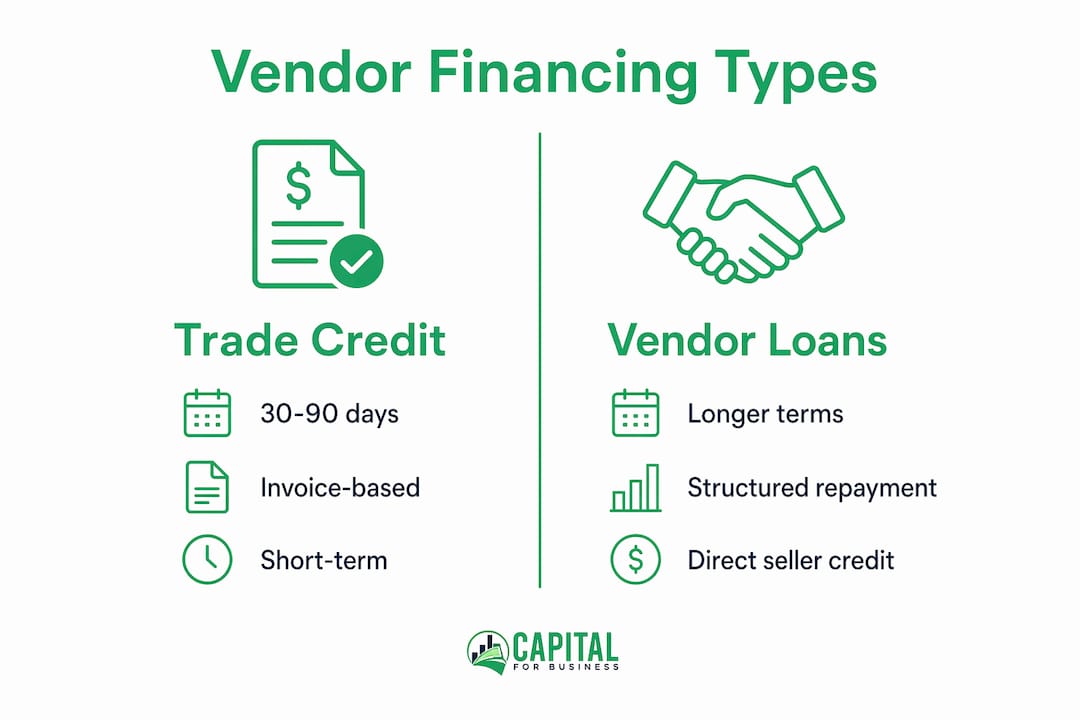
The three most common structures each serve a different purpose. Trade credit gives buyers 30 to 90 days to pay an invoice after receiving goods. It is the most common form and works well for recurring inventory purchases. A vendor loan, sometimes called a vendor note, is a more formal debt instrument with a signed agreement, a fixed interest rate, and a repayment schedule. Vendor loan maturities typically range from 3 to 5 years, while trade credit windows run 30 to 90 days. That gap in repayment length reflects a fundamental difference in how each structure fits your cash flow.
Installment plans, deferred payments, and leases
Beyond trade credit and vendor notes, sellers sometimes offer installment plans that spread payments across fixed monthly amounts. Deferred payment schedules push the first payment out by 60 to 180 days, giving buyers time to generate revenue from the asset before paying for it. Equipment leases are a related structure where the buyer uses the asset but does not own it until the lease ends or a buyout option is exercised. Each structure carries different tax, ownership, and cash flow implications, so the right choice depends on your specific situation.
Some vendor financing programs also involve a third-party lender. In these cases, the vendor partners with a finance company that funds the transaction. The buyer repays the lender, not the vendor directly. This structure gives the vendor immediate cash while the buyer still benefits from the vendor's negotiated terms.
| Feature | Trade credit | Vendor finance | Vendor loan |
|---|---|---|---|
| Repayment window | 30–90 days | Varies by agreement | 3–5 years |
| Formal agreement required | Rarely | Sometimes | Always |
| Interest charged | Rarely | Sometimes | Yes |
| Ownership transfer | Immediate | Depends on structure | At payoff |
| Best for | Short-term inventory | Equipment or large orders | Major capital purchases |
Pro Tip: Ask the vendor whether a third-party lender is involved before signing. If so, request the lender's full terms separately, since the vendor's pitch may not reflect the lender's actual rates or fees.
How does vendor financing work in practice?
The process is more direct than applying for a bank loan. Most vendor financing arrangements follow a clear sequence from initial agreement to final payment.
- You identify the purchase. You find equipment, inventory, or technology you need and confirm the vendor offers financing.
- You submit a financing application. The vendor or their lending partner reviews your business financials, credit profile, and the size of the purchase.
- Approval is issued. Some programs approve credit lines up to $3 million within 24 hours of submitting documentation. That speed is a significant advantage over traditional bank timelines, which can take weeks.
- You receive the goods or services. The vendor delivers the asset, and the financing agreement activates.
- You repay according to the schedule. Payments go to the vendor or the third-party lender, depending on the structure.
- Ownership or full access transfers. Once the final payment clears, you own the asset outright, or the lease concludes.
Vendor financing and working capital management
Vendor financing directly supports working capital management by letting you preserve cash for operating expenses while still acquiring the assets you need. A restaurant owner who needs a new commercial oven, for example, can finance it through the equipment supplier and keep cash available for payroll and food costs. A retailer can stock up on seasonal inventory through a supplier's deferred payment plan and pay once sales come in.
The key is matching the repayment schedule to your revenue cycle. If your business earns most of its income in Q4, a vendor financing agreement with payments due in november and december could create unnecessary pressure. Aligning payment timing with cash inflows is the most practical way to use this tool without straining your operations.
Pro Tip: Treat vendor financing as transaction-specific credit tied to a single purchase, not as a revolving credit line. Using it for general operating expenses outside the original agreement often leads to misaligned repayment terms and cash flow problems.
What are the benefits and drawbacks of vendor financing?
Vendor financing offers real advantages for small businesses, but it also carries risks that are easy to overlook when you are focused on closing a purchase.
Benefits worth knowing
- Faster approvals. Vendors are motivated to sell, so their approval process is typically faster and less document-heavy than a bank's.
- Flexible terms. Vendors offer more flexibility than traditional banks because they have a direct stake in completing the sale.
- Lower eligibility barriers. Businesses with limited credit history or shorter operating histories often qualify for vendor financing when banks decline them.
- Preserved cash flow. Spreading payments over time keeps working capital available for day-to-day expenses.
- Relationship-based negotiation. Because you are dealing directly with the seller, there is often room to negotiate payment timing, interest rates, or deferred start dates.
Drawbacks to evaluate carefully
- Higher interest rates. Vendor financing generally carries higher rates than traditional bank loans because vendors absorb more default risk.
- Embedded costs. Hidden fees or inflated product prices are sometimes built into vendor financing deals, making the true cost higher than the stated interest rate suggests.
- Vendor default risk. If the vendor goes out of business, the terms of your agreement may become complicated, especially if a third party is not involved.
- Relationship strain. Missing payments with a vendor you also rely on for future supply can damage a critical business relationship.
- Equity implications. In some advanced deals, particularly in startup funding or mergers and acquisitions, vendor financing may include equity swaps or stock options. Accepting equity-based terms can dilute your ownership and give the vendor a say in business decisions.
Pro Tip: Before accepting any vendor financing offer, calculate the total cost of credit, not just the monthly payment. Add up all fees, any price markup on the product, and the full interest paid over the repayment period. Then compare that number to what a small business loan or equipment financing would cost for the same purchase.
Is vendor financing a good idea for your small business?
The answer depends on four factors: the total cost of credit, the repayment terms, the vendor's credibility, and what other financing options are available to you.
When vendor financing makes sense
Vendor financing works best when you need an asset quickly, have limited cash reserves, and the vendor's terms are competitive with what a bank or alternative lender would offer. A manufacturing business that needs a new CNC machine to fulfill a contract, but cannot wait three weeks for a bank approval, is a strong candidate. A retailer who needs to double inventory before a peak season and has a supplier willing to defer payment by 60 days is another clear fit.
Vendor financing also makes sense when your credit profile makes bank approval unlikely. Many vendors focus on the value of the transaction and your relationship history rather than a credit score alone. You can learn more about equipment financing options that work alongside or as alternatives to vendor-provided credit.
When to look at other options
Vendor financing is not always the cheapest route. A common misconception is that buying directly from the seller means you get the best deal on financing. That is not always true. Banks and alternative lenders often offer lower rates, especially for businesses with solid credit and at least two years of operating history.
Ask these questions before signing any vendor financing agreement:
- What is the total cost of the purchase including all fees and interest?
- Does the product price change when financing is involved?
- What happens if I miss a payment or want to pay off early?
- Is there a prepayment penalty?
- Who holds the title or ownership of the asset during the repayment period?
- Is a third-party lender involved, and if so, what are their terms?
Read the full agreement before signing. Hidden costs in vendor finance agreements are often buried in pricing structures or fee schedules rather than disclosed as interest. A thorough review of the contract protects you from surprises that inflate the real cost of the deal.
Pro Tip: If a vendor pressures you to sign quickly or discourages you from reviewing the agreement with an advisor, treat that as a warning sign. Legitimate vendor financing programs give you time to evaluate the terms.
Key Takeaways
Vendor financing is a practical tool for small businesses, but its value depends entirely on how well the terms match your cash flow, cost tolerance, and growth timeline.
| Point | Details |
|---|---|
| Definition is specific | Vendor financing is seller-provided credit tied to a specific purchase, not a general business loan. |
| Structures vary significantly | Trade credit, vendor loans, and leases each carry different repayment windows and ownership terms. |
| Speed is a real advantage | Some programs approve credit lines up to $3 million within 24 hours, far faster than most banks. |
| Cost requires full calculation | Hidden fees and inflated product prices can make vendor financing more expensive than it appears. |
| Equity terms carry serious risk | Equity-based vendor financing can dilute ownership and give vendors influence over business decisions. |
What I've learned about vendor financing after years in small business lending
Working with small business owners across hundreds of industries since 2009, I've seen vendor financing used brilliantly and badly. The businesses that use it well treat it as a targeted tool. They identify a specific asset, confirm the vendor's terms are competitive, and align repayment with their revenue cycle. They do not use it as a substitute for a broader financing strategy.
The businesses that struggle with vendor financing usually make one of two mistakes. The first is accepting the vendor's offer without comparing it to alternatives. Vendors are salespeople first. Their financing terms are designed to close the deal, not to give you the lowest possible cost of capital. The second mistake is signing agreements without reading the full cost structure. I have seen business owners surprised by prepayment penalties, ownership clauses, and price markups that were disclosed in the contract but never discussed in the sales conversation.
My practical advice is this: use vendor financing when it genuinely fits your situation, but always know your alternatives first. A business line of credit or equipment financing from an independent lender may offer better rates with fewer strings attached. Vendor financing is not inherently good or bad. It is a tool, and like any tool, its value depends on whether you are using it for the right job.
— Capital
Financing options from Capitalforbusiness
Vendor financing is one piece of a larger funding picture. Capitalforbusiness has worked with small business owners nationwide and in Canada since 2009, offering fast small business loans and funding solutions designed for businesses that need capital quickly and on terms that actually work.
Whether you need equipment financing to complement a vendor arrangement or a working capital loan to cover operating costs while you repay a vendor note, Capitalforbusiness has options built for your situation. Explore small business loan types that fit your budget, credit profile, and growth goals. Funding up to $500,000 is available, and approvals move faster than traditional banks.
FAQ
What is vendor financing in simple terms?
Vendor financing is when a seller provides credit or a payment plan directly to a buyer, allowing the buyer to acquire goods or services without paying the full amount upfront. The buyer repays the seller over an agreed period, often with interest.
How does vendor financing differ from a traditional bank loan?
A bank loan comes from a third-party lender with no connection to the purchase. Vendor financing comes from the seller, who has a direct interest in closing the sale, which often results in faster approvals and more flexible terms but sometimes higher costs.
Is vendor financing a good idea for small businesses?
Vendor financing is a good option when you need an asset quickly, have limited cash, or cannot qualify for a bank loan. It becomes less attractive when hidden fees or inflated product prices make the total cost higher than alternative financing.
What industries use vendor financing most often?
Vendor financing is most common in capital-intensive industries such as healthcare, manufacturing, technology, and telecommunications, where equipment purchases are large and frequent.
Can vendor financing affect business ownership?
In some deals, particularly in startup funding or mergers and acquisitions, equity-based vendor financing may include stock options or ownership stakes. Accepting these terms can dilute your control over the business, so review any equity provisions carefully before agreeing.