
TL;DR:
- Supplier financing allows suppliers to receive early payment through a third-party financier based on the buyer’s credit rating. The process benefits both parties by providing suppliers with faster cash flow and lower borrowing costs while extending payment terms for buyers. It is a flexible, buyer-led tool that improves supply chain resilience and working capital management.
Supplier financing is defined as a buyer-initiated arrangement where a third-party financier pays a supplier's approved invoices early, using the buyer's credit rating to set the financing cost. Also called supply chain finance or reverse factoring, this structure gives suppliers faster access to cash without forcing buyers to pay ahead of schedule. The global supply chain finance market is growing at approximately 9.2% CAGR and is projected to reach $20.6 billion by 2034. That growth reflects how widely businesses now recognize supplier financing as a practical working capital tool, not a niche banking product.
What is supplier financing and how does it work?
Supplier financing is a working capital tool that sits at the intersection of accounts payable and trade credit. The buyer, the supplier, and a financier all participate, but the buyer drives the program. Because the financier prices the arrangement based on the buyer's credit rating rather than the supplier's, smaller suppliers gain access to capital at rates they could not obtain on their own.
The four-step process works like this:
- Invoice approval. The buyer receives goods or services and approves the invoice in their system. Approval confirms the debt is valid and the buyer will pay on the original due date.
- Invoice upload. The supplier uploads the approved invoice to a digital platform that connects all three parties. This step is voluntary. Suppliers choose which invoices to submit for early payment.
- Early payment by the financier. The financier pays the supplier a discounted amount, typically within one to two business days. The discount represents the financing cost for the period between early payment and the invoice due date.
- Buyer repayment on the original due date. The buyer pays the financier the full invoice amount on the date originally agreed. The buyer's payment schedule does not change.
Digital platforms are critical to this process. They automate invoice matching, approval workflows, and payment instructions, cutting out the manual delays that slow traditional trade finance. For a small business owner acting as either buyer or supplier, that speed is the practical difference between making payroll and missing it.
Pro Tip: If you are a supplier evaluating a buyer's program, ask whether participation is invoice-by-invoice. Voluntary, invoice-level choice protects your flexibility and lets you decide when early payment is worth the discount.

What are the key benefits of supplier financing for small businesses?
Supplier financing improves working capital for both sides of a transaction. That mutual benefit is what separates it from most financing products, which help one party at the expense of another.
For suppliers:
- Lower financing costs. Credit arbitrage lets suppliers borrow at rates based on the buyer's stronger investment-grade credit rating, often 3–4% rather than the 8–10% a mid-market supplier would pay independently. For a business carrying $500,000 in receivables, that rate difference translates to thousands of dollars in annual savings.
- Faster cash flow. Suppliers convert approved invoices to cash within days instead of waiting 60 or 90 days for standard payment. Faster cash means more capacity to buy inventory, pay staff, and take on new orders.
- Balance sheet flexibility. Supplier financing typically does not appear as debt on the supplier's balance sheet because the transaction involves selling approved receivables rather than borrowing. That distinction matters when suppliers apply for other credit.
For buyers:
- Extended payment terms without supplier strain. Buyers can negotiate longer payment windows without damaging supplier relationships, because suppliers still receive cash quickly through the financier.
- Stronger supplier relationships. When suppliers are financially stable, they deliver on time and maintain quality. Supplier financing supports supply chain resilience by removing cash pressure from the weakest links.
- No additional debt on the buyer's books. The buyer simply pays on the original due date. The arrangement does not change the buyer's debt structure.
Pro Tip: Small business owners acting as buyers should calculate the working capital freed up by extending payment terms before approaching a financier. A clear number makes the business case easier to present.
How does supplier financing compare to factoring and dynamic discounting?
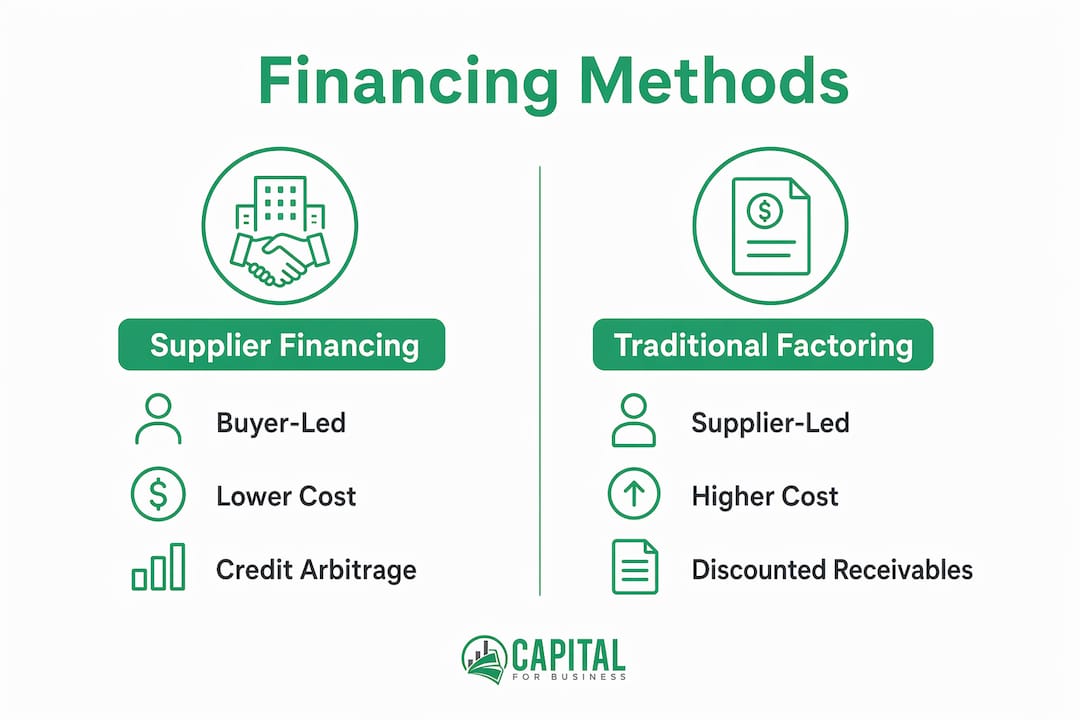
Three financing methods often get grouped together: supplier financing (reverse factoring), traditional factoring, and dynamic discounting. They solve similar problems but work very differently.
Traditional factoring
Traditional factoring is supplier-led. The supplier sells its receivables to a factoring company at a discount to get cash immediately. The factoring company then collects payment from the buyer. Because the factoring company bases its pricing on the supplier's creditworthiness, smaller suppliers with thin credit histories pay higher rates. The buyer has no involvement in setting up the arrangement.
Unlike traditional factoring, supplier financing is buyer-led, with financing cost based on buyer credit quality. That single difference is why supplier financing consistently delivers lower rates for mid-market suppliers.
Dynamic discounting
Dynamic discounting allows buyers to self-fund early payment discounts to suppliers. No third-party financier is involved. The buyer uses its own cash reserves to pay suppliers early in exchange for a negotiated discount on the invoice. This works well for buyers sitting on excess liquidity who want a return on idle cash. It does not work when the buyer also needs to preserve cash.
Side-by-side comparison
| Feature | Supplier financing | Traditional factoring | Dynamic discounting |
|---|---|---|---|
| Who initiates | Buyer | Supplier | Buyer |
| Who funds early payment | Third-party financier | Factoring company | Buyer's own cash |
| Pricing based on | Buyer's credit rating | Supplier's credit rating | Buyer's cost of capital |
| Supplier participation | Voluntary, invoice by invoice | Typically mandatory per contract | Voluntary |
| Impact on buyer's cash | None until original due date | None | Reduces buyer liquidity |
| Best for | Buyers with strong credit, suppliers needing lower-cost capital | Suppliers without strong buyer relationships | Buyers with surplus cash |
The right choice depends on which party has the stronger credit profile and which party has surplus liquidity. For most small business owners working with larger corporate buyers, supplier financing delivers the best combination of cost and flexibility. For alternative financing options beyond these three methods, the range of products available to small businesses has expanded considerably in recent years.
What should small business owners consider when choosing supplier financing options?
Choosing the right supplier financing program requires more than comparing interest rates. The structure of the program, the technology behind it, and the terms attached all affect whether the arrangement actually improves your cash position.
Financing rates and discount terms
The discount rate the financier charges determines how much early payment costs you as a supplier. Rates vary based on the buyer's credit rating, the invoice tenor, and the financier's own cost of funds. Request a clear fee schedule before committing. A rate that looks low on a 30-day invoice can become expensive on a 90-day invoice.
Supplier opt-in flexibility
Supplier financing programs are voluntary for suppliers, who choose invoice-by-invoice whether to accept early payment at a discount or wait for full payment on the original due date. Programs that require you to submit every invoice remove that flexibility. Prioritize programs that let you decide on a case-by-case basis so you only pay for early payment when you genuinely need the cash.
Platform usability and digital integration
The technology platform connecting buyer, supplier, and financier determines how fast and how accurately invoices move through the system. Ask whether the platform integrates with your existing accounting software, such as QuickBooks or Xero. Manual data entry creates errors and delays that undercut the speed advantage supplier financing is supposed to provide.
Contractual terms and exit conditions
Read the program agreement carefully before signing. Key questions include: What is the minimum participation period? What fees apply if you exit early? Are there volume commitments? Some programs designed for large enterprises carry terms that do not fit a small business's transaction volume.
Communication with your suppliers
If you are setting up a supplier financing program as a buyer, clear communication with your suppliers is non-negotiable. Suppliers who do not understand the program will not use it, and unused programs deliver no supply chain benefit. Walk suppliers through the platform, explain the discount calculation, and confirm that participation is genuinely optional. You can find practical guidance on working capital management to frame these conversations in the context of your broader financial strategy.
Pro Tip: Before enrolling in any supplier financing program, run the numbers on your three largest invoices. If the discount cost exceeds what you would pay on a short-term business line of credit, the program is not priced competitively for your situation.
Key Takeaways
Supplier financing reduces borrowing costs for suppliers, extends payment terms for buyers, and strengthens supply chain relationships by using the buyer's credit rating to fund early invoice payment.
| Point | Details |
|---|---|
| Buyer-led structure | The buyer's credit rating sets the financing cost, giving suppliers access to lower rates than they could secure independently. |
| Voluntary participation | Suppliers choose invoice-by-invoice whether to accept early payment, preserving flexibility and cash flow control. |
| Cost advantage over factoring | Supplier financing typically costs less than traditional factoring because pricing is based on buyer credit, not supplier credit. |
| Balance sheet benefit | Suppliers selling approved receivables generally do not record the transaction as debt, improving their financial ratios. |
| Platform matters | Digital integration with accounting software reduces errors and speeds up the invoice-to-cash cycle. |
Supplier financing is more than a cash flow fix
Working with small businesses across hundreds of industries since 2009, I have seen supplier financing misunderstood more often than almost any other financial tool. Business owners either dismiss it as something only large corporations use, or they treat it as a last resort when cash runs short. Both views miss the point.
Supplier financing is most powerful when you set it up before you need it. A supplier who enrolls in a buyer's program during a stable period can draw on early payment selectively during slow seasons or when a large order requires upfront inventory spend. That optionality has real value, and it costs nothing until you actually use it.
The relationship dimension also gets underestimated. Buyers who offer supplier financing programs signal financial stability and long-term commitment to their supply chain. Suppliers notice. In competitive markets where multiple buyers are chasing the same vendors, a well-structured financing program can be the reason a key supplier prioritizes your orders.
The most common mistake I see is treating supplier financing as a standalone product rather than part of a broader working capital strategy. It works best alongside a business line of credit, strong accounts receivable practices, and clear payment term policies. Businesses that integrate it into their financial planning rather than bolting it on as an emergency measure get the most consistent results.
My advice: map your cash conversion cycle first. Understand exactly how many days elapse between paying for inputs and collecting from customers. Supplier financing addresses one part of that cycle. Knowing where the gaps are tells you how much of the problem it actually solves.
— Capital
Funding solutions for small businesses from Capitalforbusiness
Supplier financing is one piece of a larger working capital picture. When your cash flow needs go beyond what a buyer's program can provide, Capitalforbusiness offers a range of funding solutions built specifically for small business owners.
Since 2009, Capitalforbusiness has helped business owners across hundreds of industries access small business loans, working capital, merchant cash advances, and equipment financing. Applications are fast, approvals come quickly, and funding reaches your account when you need it. If banks have turned you away, Capitalforbusiness works with your actual business performance, not just your credit score. Explore business funding options up to $500,000 and find the right fit for your cash flow goals.
FAQ
What is supplier financing in simple terms?
Supplier financing is an arrangement where a financier pays a supplier's approved invoices early, at a small discount, while the buyer repays the financier on the original invoice due date. It gives suppliers faster cash without changing the buyer's payment schedule.
How does supplier financing differ from a business loan?
A business loan puts debt on the borrower's balance sheet and charges interest based on the borrower's credit. Supplier financing involves selling approved receivables to a financier at a discount, and pricing is based on the buyer's credit rating rather than the supplier's.
Is supplier financing only for large companies?
Supplier financing programs are most commonly initiated by large buyers, but small business suppliers can participate in any program their buyer offers. Small businesses acting as buyers can also set up programs through specialized finance providers.
What does "credit arbitrage" mean in supplier financing?
Credit arbitrage refers to the rate difference between what a supplier would pay to borrow independently and the lower rate available through the buyer's stronger credit profile. Mid-market suppliers can access capital at 3–4% through a buyer's program instead of the 8–10% they would pay on their own.
Can a supplier decline early payment in a supplier financing program?
Yes. Participation is voluntary and suppliers choose on an invoice-by-invoice basis whether to accept early payment at a discount or wait for the full amount on the original due date.