
TL;DR:
- Bridge financing is a short-term loan used to cover a funding gap during transitions or acquisitions, typically lasting from 6 months to 3 years. It is asset-backed, quick to fund, and relies on a clear exit strategy, making it ideal for time-sensitive deals and asset stabilization. Proper use requires a well-defined plan for repayment to avoid default risks.
Bridge financing is a short-term loan that covers a funding gap between your immediate capital need and a permanent financing solution. The industry term is "bridge loan," and it describes a temporary, asset-backed debt instrument with terms typically running from 6 months to 3 years and funding timelines as fast as 7–10 business days. For small business owners and entrepreneurs managing cash flow gaps during transitions, acquisitions, or startup funding rounds, understanding what is bridge financing can mean the difference between capturing an opportunity and losing it entirely. Lenders like Anchor Commercial Capital and Revera Capital, along with instruments like convertible notes and SAFEs, have made bridge financing a standard tool in the small business capital stack.
What is bridge financing and how does it work?
Bridge financing is defined as a short-term, asset-based loan designed to provide immediate capital during a transitional period. Unlike conventional bank loans that underwrite primarily on cash flow and income history, bridge loans rely on the value of collateral, most often real estate, equipment, or receivables. That distinction matters because it opens the door for businesses that have strong assets but limited operating history or inconsistent revenue.

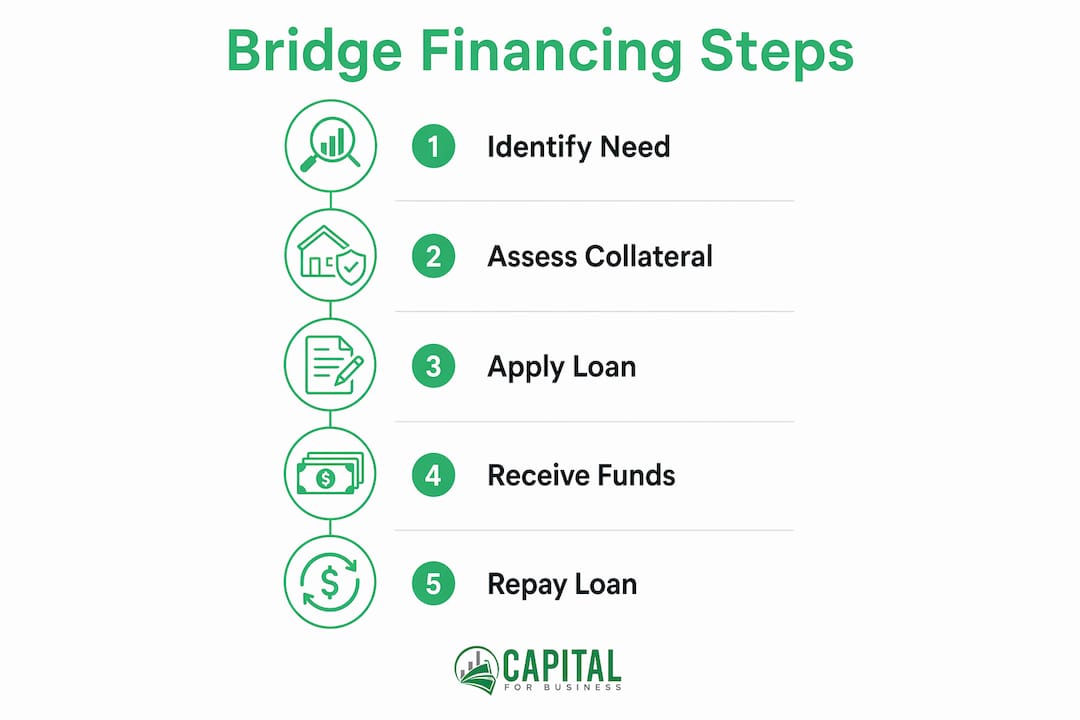
The mechanics are straightforward. A lender evaluates your collateral, approves a loan amount typically up to 75% of the asset's value, and funds the deal quickly. Repayment is interest-only during the loan term, with a balloon payment of the principal due at maturity. The exit event, meaning the sale of a property, a refinance, or a liquidity event, is what retires the principal.
Typical terms and rates
Bridge loan terms vary by lender and use case, but the standard structure for commercial real estate looks like this:
- Loan to value: Up to 75% of the property or asset value
- Term length: 6–24 months for real estate; up to 36 months for business transitions
- Interest rates: Typically 8.5%–13% for real estate; up to 15% for higher-risk business loans
- Fees: Origination points, administrative fees, and sometimes equity participation
- Prepayment penalty: None or step-down structure, giving you flexibility to exit early
For startup bridge rounds, the structure shifts. Startups often use convertible notes or SAFEs with a 15%–25% discount on the next funding round price and a valuation cap to protect founders from unfavorable dilution. These instruments carry maturities of 12–18 months and convert automatically when the next equity round closes.
Underwriting criteria
Lenders assess bridge loan applications differently from banks. Credit score requirements for residential bridge products typically start at 700, with a debt-to-income ratio below 50%. For commercial bridge loans, lenders focus more on the asset quality, the borrower's exit plan, and the loan-to-value ratio than on tax returns or profit-and-loss statements.
Pro Tip: Before applying, document your exit strategy in writing. Lenders treat a clearly defined repayment path as a primary underwriting criterion, not an afterthought.
Why use bridge financing: strategic advantages and common scenarios
Bridge loans are tactical financing tools, not emergency debt. Experts at Anchor Commercial Capital describe them as deliberate steps in a capital stack strategy, used when speed or asset condition creates a temporary mismatch between what a borrower needs and what conventional lenders will approve. That framing changes how you should think about them.
The core advantage is speed. Bridge loans compress closing timelines from the 30–60 days a bank typically requires down to 7–10 business days. In competitive acquisition environments, that speed is often the deciding factor.
Four common scenarios where bridge financing fits
-
Acquiring property before a sale closes. A business owner wants to purchase a new commercial space but hasn't yet sold their existing property. A bridge loan funds the purchase immediately, with repayment coming from the sale proceeds.
-
Funding renovations to qualify for permanent financing. A property generating below-market rents won't qualify for a conventional commercial mortgage. A bridge loan funds the renovation, the rents increase, and the stabilized asset then qualifies for cheaper long-term debt.
-
Startup bridge rounds between equity raises. A startup has a signed term sheet for a Series A but needs six months of runway to close. A bridge round using convertible notes with a 15%–25% discount avoids unfavorable equity pricing under duress and keeps the company funded without forcing a premature valuation.
-
Managing cash flow gaps during business transitions. A business acquiring another company, entering a new market, or waiting on a large receivable can use a bridge loan to cover operating costs during the transition window.
Pro Tip: Use bridge financing when you have a specific, time-bound opportunity and a clear repayment source. Treat it as a planned step, not a fallback when other options fail.
Rate-timing as a strategic move
One underused application is rate-timing. Borrowers can take a bridge loan intentionally to wait for better permanent financing conditions. This works when the bridge agreement includes extension options, which prevent a forced payoff at an unfavorable moment. If long-term rates are elevated today but expected to drop, a 12-month bridge with a 6-month extension option gives you the flexibility to refinance at a better rate without losing the asset or the deal.
What are the risks, costs, and exit strategies for bridge loans?
Bridge financing carries real costs, and those costs demand a real plan. Interest rates between 8% and 15%, plus origination points and fees, make bridge loans significantly more expensive than conventional bank financing. A borrower who enters a bridge loan without a defined exit strategy is not using a financial tool. They are taking a bet.
The exit strategy is non-negotiable
A bridge loan without a clear exit plan is the single most common cause of bridge loan defaults. Lenders ask about exit strategy during underwriting because it is the primary repayment mechanism. The three standard exit paths are:
- Asset sale: The property or business is sold, and proceeds retire the principal.
- Refinance: The asset stabilizes, qualifies for permanent financing, and the bridge loan is paid off with the new loan proceeds.
- Liquidity event: For startups, the next equity round or an acquisition closes and converts or retires the bridge debt.
Each path requires a realistic timeline and a backup plan. If your sale falls through or your refinance is delayed, you need to know whether your lender offers extension options and at what cost.
Risks vs. rewards: a direct comparison
| Factor | Risk | Reward |
|---|---|---|
| Interest rate | 8%–15% is expensive relative to bank loans | Speed and access justify the premium for time-sensitive deals |
| Short term | Balloon payment creates repayment pressure | Forces disciplined planning and a defined exit |
| Asset-based underwriting | Collateral at risk if exit fails | Opens access for businesses banks won't approve |
| Origination fees and points | Adds to total cost of capital | One-time cost spread across a short, high-value transaction |
| No income verification required | Higher lender risk, reflected in rates | Accessible for startups and transitional businesses |
Pro Tip: Model your total cost of capital before signing. Add the interest rate, origination points, and any extension fees together, then compare that number against the value of the opportunity you are capturing. If the math works, the cost is justified.
When bridge financing is the wrong choice
Bridge financing is the wrong tool when there is no clear repayment source, when the business is using it to cover chronic operating losses, or when the term is too short for the project timeline. A renovation expected to take 18 months should not be funded with a 12-month bridge loan unless an extension option is written into the agreement from day one.
How does bridge financing compare to traditional loans and other options?
Bridge financing and conventional loans serve different purposes and different borrowers. Understanding where each fits helps you choose the right tool for your situation.
Key differences in underwriting and timeline
Conventional commercial loans underwrite on cash flow, tax returns, and operating history. Bridge loans underwrite on asset value and exit strategy. That difference means a business with a strong asset but two years of uneven revenue can access a bridge loan when a bank would decline the application.
The speed gap is significant. Traditional bank loans take 30–60 days to close. Bridge loans close in 7–10 business days. For a competitive acquisition or a time-sensitive deal, that gap is decisive.
Comparison of short-term financing options
| Feature | Bridge loan | Conventional bank loan | Business line of credit | Hard money loan |
|---|---|---|---|---|
| Term | 6–36 months | 5–25 years | Revolving | 6–24 months |
| Interest rate | 8%–15% | 5%–8% | 7%–25% | 10%–18% |
| Underwriting basis | Asset value | Cash flow and credit | Credit and revenue | Asset value |
| Funding speed | 7–10 days | 30–60 days | 1–2 weeks | 5–10 days |
| Best use case | Transitional acquisitions | Stable, long-term growth | Recurring working capital | Distressed or fix-and-flip |
| Prepayment flexibility | Often yes | Sometimes | Yes | Varies |
Bridge loans and hard money loans share asset-based underwriting, but hard money lenders typically charge higher rates and focus almost exclusively on real estate. A business line of credit works well for recurring cash flow needs but does not provide the lump-sum capital a bridge loan delivers for a single transaction.
When to use bridge financing vs. permanent financing
Bridge and permanent financing are sequential, not competing. You use a bridge loan to move fast, stabilize an asset, or fund a transition. Then you refinance into permanent financing once the asset qualifies. Bridge loans cover 6–36 months at higher rates; permanent loans follow stabilization at lower rates and longer terms. The two tools work together in a planned capital strategy.
- Use a bridge loan when speed matters, the asset is in transition, or conventional lenders won't approve the deal yet.
- Use permanent financing when the asset is stable, cash flow is documented, and you want the lowest long-term cost of capital.
If you are unsure which structure fits your situation, reviewing how business loans differ from personal loans is a useful starting point for understanding underwriting criteria across loan types.
Key takeaways
Bridge financing is a short-term, asset-backed loan that provides fast capital during a transition period, with repayment tied to a defined exit event such as a sale, refinance, or equity round.
| Point | Details |
|---|---|
| Short-term by design | Bridge loans run 6–36 months and are not meant to replace permanent financing. |
| Asset-based approval | Lenders focus on collateral value and exit strategy, not income history. |
| Cost requires justification | Rates of 8%–15% plus fees are only worthwhile when the opportunity captured exceeds the total cost. |
| Exit strategy is required | A defined repayment path from day one is the single most critical factor in avoiding default. |
| Speed is the core advantage | Funding in 7–10 days versus 30–60 days for banks makes bridge loans decisive in competitive deals. |
What I've learned from watching businesses use bridge loans well and poorly
At Capitalforbusiness, we have worked with small business owners across hundreds of industries since 2009. The pattern we see most clearly is this: bridge loans work exceptionally well for borrowers who treat them as planned steps, and they cause serious problems for borrowers who treat them as a last resort.
The businesses that use bridge financing well enter the loan knowing exactly how they will exit. They have a signed purchase agreement, a refinance commitment letter, or a startup term sheet already in hand. The loan is filling a timing gap, not solving a structural problem. Those borrowers pay the higher rate willingly because the deal they are capturing is worth far more than the cost of the capital.
The businesses that struggle with bridge loans are the ones who borrow first and plan later. They assume the sale will close, the refinance will come through, or the next funding round will materialize on schedule. When one of those assumptions fails, the balloon payment arrives without a repayment source, and the situation deteriorates fast.
My honest recommendation is to treat the exit strategy as the first document you write, not the last. Before you ask what rate you can get or how much you can borrow, write down exactly how you will repay the principal and what happens if your primary plan is delayed by 90 days. If you can answer both questions clearly, bridge financing is likely a strong fit. If you cannot, the loan is not the right tool yet.
Higher-cost bridge loans are justifiable when they accelerate growth or enable profitable transitions. The cost is not the problem. The lack of a plan is.
— Capital
Ready to explore your small business funding options?
Capitalforbusiness has helped small business owners and entrepreneurs access fast, flexible funding since 2009. Whether you need a bridge loan for a property acquisition, working capital to cover a transition period, or a short-term loan to fund a growth opportunity, we offer a range of products built for businesses that banks overlook.

Our team works quickly. Many clients receive funding decisions within days, not weeks. If you are ready to see what financing options fit your situation, start by reviewing the types of small business loans available through Capitalforbusiness. For businesses that need capital fast and want a lender that understands the full picture, apply for business funding up to $500,000 today.
FAQ
What is the bridge loan definition in simple terms?
A bridge loan is a short-term loan that provides immediate capital until a permanent financing solution or repayment event occurs. Terms typically run 6 months to 3 years, with funding available in as few as 7–10 business days.
How does bridge financing work for startups?
Startups use bridge financing through convertible notes or SAFEs, which provide interim capital and convert into equity at the next funding round, typically at a 15%–25% discount on the round price.
What are the main advantages of bridge financing?
The primary advantages are speed, flexibility, and asset-based approval. Bridge loans close in 7–10 days, do not require extensive income documentation, and give borrowers time to stabilize an asset or close a deal before transitioning to permanent financing.
What does a bridge loan typically cost?
Bridge loan interest rates run from 8% to 15%, plus origination points and administrative fees. Total cost depends on loan size, term length, and lender, so modeling the full cost of capital before signing is critical.
When is bridge financing the wrong choice?
Bridge financing is the wrong choice when there is no clear repayment source, when the business is covering ongoing losses rather than a defined transition, or when the project timeline exceeds the loan term without an extension option in place.