
TL;DR:
- Hardware financing allows small businesses to spread equipment costs over time, preserving cash flow for operations. Lenders evaluate credit scores, business stability, industry risk, and collateral value to determine approval and terms. Proper preparation, complete documentation, and proactive lender communication increase chances of securing favorable equipment financing.
Upgrading or acquiring hardware is one of the most pressing financial decisions a small business owner faces. Whether you need new computers, point-of-sale systems, manufacturing equipment, or specialty tools, the price tag can feel out of reach when cash flow is tight. Many businesses that need hardware today simply cannot wait to save up the full amount, yet walking into a bank without preparation often leads to rejection. This guide breaks down every stage of the hardware financing process, from understanding what lenders actually look for, to submitting a polished application, to avoiding the mistakes that slow approvals or cause outright denials.
Table of Contents
- Understanding hardware financing basics
- Preparing your business for the financing application
- Navigating the hardware financing process: step-by-step
- Avoiding common mistakes and troubleshooting during financing
- What small businesses should focus on for sustainable hardware financing
- Resource solutions for securing your next hardware investment
- Frequently asked questions
Key Takeaways
| Point | Details |
|---|---|
| Know lender criteria | Lenders evaluate credit, business performance, time in business, industry stability, and collateral value. |
| Prepare strong documentation | Complete paperwork and clear financials boost your approval odds for hardware financing. |
| Follow application steps | Move systematically from research to application and funding to ensure success. |
| Avoid common mistakes | Prevent delays and denials by watching for incomplete information and weak collateral. |
| Treat hardware financing as ongoing | Plan for regular upgrades and maintain lender relationships for lasting growth. |
Understanding hardware financing basics
Hardware financing is a form of business lending specifically structured around the purchase or lease of physical equipment and devices. Instead of paying the full cost upfront, you spread payments over a set period, usually anywhere from 12 to 72 months, while gaining immediate access to the tools your business needs to operate. There are two primary formats: an equipment loan, where you borrow funds and own the hardware outright once the loan is repaid, and an equipment lease, where you use the hardware for a defined period and may have the option to purchase at the end. Understanding the difference between a small business loan vs equipment leasing is essential before approaching any lender, because the right structure depends heavily on your cash flow, tax strategy, and how quickly the technology you need becomes outdated.
Cash flow is the central concern for most small business owners pursuing hardware financing. Buying a server outright, for example, could wipe out your operating reserves for the quarter. Financing preserves capital and keeps you liquid for payroll, inventory, and unexpected expenses. That balance between acquiring the tools you need and maintaining financial stability is exactly why this type of funding has grown so significantly among North American small businesses.
What lenders actually evaluate
Lenders typically look at five pillars: borrower credit, business performance, time in business, industry stability, and collateral value. These factors collectively shape the terms you receive, including interest rate, loan duration, and down payment requirements. The table below summarizes what each pillar means in practical terms.
| Lender criterion | What it measures | Why it matters |
|---|---|---|
| Borrower credit | Personal and business credit scores | Signals repayment reliability |
| Business performance | Revenue, profit margins, and cash flow | Shows ability to cover monthly payments |
| Time in business | How long the company has operated | Indicates stability and survival likelihood |
| Industry stability | Sector growth trends and volatility | Affects risk assessment for lender |
| Collateral value | The hardware itself or other business assets | Provides security if the loan defaults |
Understanding these criteria before you apply allows you to address weaknesses proactively. A business with strong revenue but thin credit history, for example, can lean into its financials to offset the credit concern.
Common hardware types that qualify for financing
Most lenders will finance a wide range of business hardware. The key requirement is that the equipment must serve a legitimate operational purpose and hold enough value to function as collateral. Common examples include:
- Desktop computers, laptops, and workstations
- Point-of-sale (POS) systems and payment terminals
- Commercial printers, scanners, and imaging devices
- Manufacturing machinery and industrial tools
- Servers and networking infrastructure
- Medical or diagnostic equipment for healthcare businesses
- Refrigeration units and food service equipment
- Construction tools and heavy machinery
This variety is good news for small business owners across industries. Whether you run a restaurant, a retail shop, a construction firm, or a tech company, there is likely a financing product designed around the hardware you need most.
Preparing your business for the financing application
A strong equipment-financing application is built around the underwriter decision pillars, and the best time to start building toward them is well before you submit anything. Lenders receive hundreds of applications, and the ones that move quickly through underwriting are those that arrive complete, organized, and clearly presented. According to industry data, the majority of financing applications that fail do so not because the business is unqualified, but because the documentation is missing, inconsistent, or poorly prepared.
Paper vs. digital application methods
How you apply matters more than many business owners realize. The table below compares the two main approaches.
| Application method | Pros | Cons |
|---|---|---|
| Paper/in-person | Personal relationship with lender, ability to explain context | Slower processing, higher chance of missing pages |
| Digital/online | Faster submission, instant confirmations, easier document uploads | Less personal, fewer opportunities for back-and-forth |
Online applications through technology-driven lending platforms have made the process significantly faster for many small businesses. Decisions that once took weeks can now take days, and automated systems can flag missing information immediately so you can correct it before it becomes a problem.
Documents to prepare before applying
Having your paperwork ready in advance is one of the most impactful steps you can take. Use this checklist as a starting point, and refer to a detailed equipment financing checklist for a more thorough breakdown:
- Personal and business credit reports (pulled within the last 30 days)
- Two to three years of business tax returns
- Recent profit and loss statements (last 3 to 6 months)
- Bank statements for the past 3 to 6 months
- A formal quote or invoice for the hardware you plan to purchase
- Documentation of any collateral being offered
- Business licenses and legal formation documents
- Owner identification (driver's license, passport)
Each of these documents serves a specific purpose in underwriting. Tax returns demonstrate annual performance. Bank statements reveal cash flow patterns. The hardware quote tells the lender exactly what the funds will be used for and helps them assess collateral value.
Pro Tip: Lenders will scrutinize your industry stability more carefully if your sector has recently faced disruption. If your industry has been volatile, prepare a brief written summary of how your specific business has stayed stable or grown. A few sentences of context can make a measurable difference in how underwriters interpret your file.
Navigating the hardware financing process: step-by-step
Once your documents are ready and you understand the criteria lenders use, the actual application process becomes far less intimidating. The goal at this stage is to move through each step methodically, without skipping any phase or assuming the lender will fill in gaps on your behalf. Lenders weigh factors beyond credit score, including business performance and collateral value, so a confident, well-organized approach signals professionalism from the first interaction.
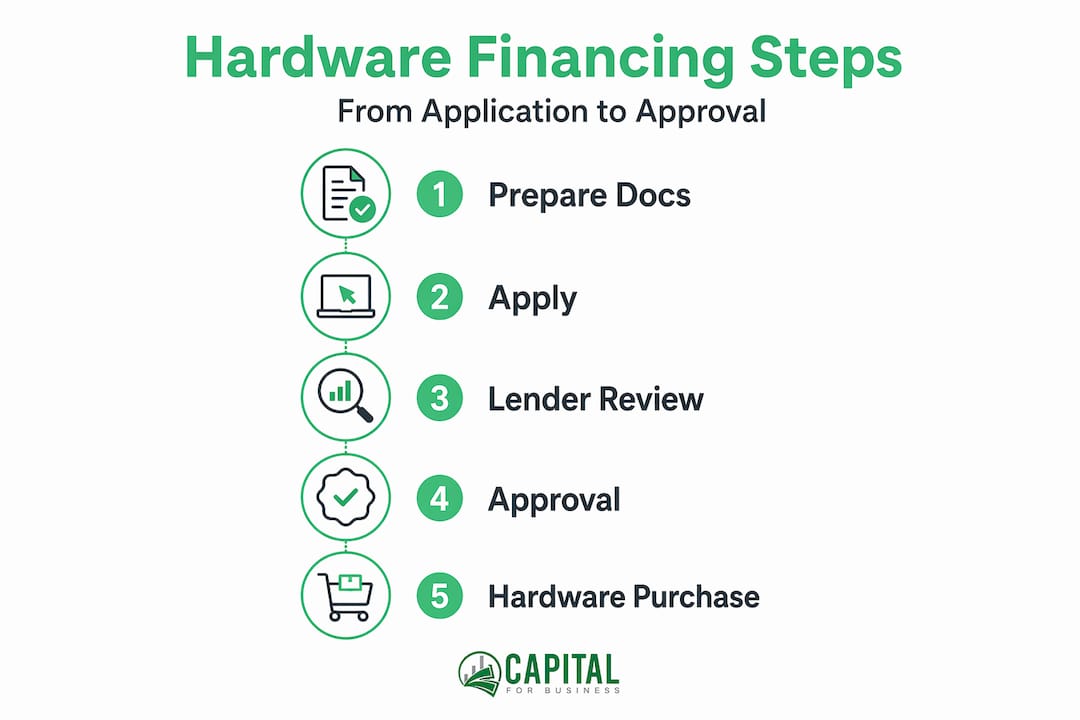
Step-by-step process to securing hardware financing
-
Research your lender options. Compare banks, credit unions, alternative lenders, and specialized equipment financing companies. Look at rates, terms, approval speeds, and industry experience. Not every lender finances every type of hardware, so confirm fit early.
-
Get a formal hardware quote. Before you can borrow, you need a documented price. Request a written quote from your hardware vendor and confirm whether the model or specifications are likely to hold value. Lenders want to know the collateral is worth securing.
-
Pull your credit reports. Check both your personal and business credit reports at least 30 days before applying. Dispute any errors. Pay down revolving balances where possible to improve your utilization ratio. Even a small score improvement can move you into a better rate tier.
-
Assemble your full documentation package. Use the checklist from the previous section and organize everything into a single folder, whether digital or physical. Label each document clearly and include a cover sheet summarizing the loan request, the hardware details, and your key financial highlights.
-
Submit your application completely. Incomplete applications are the primary reason for delays. Double-check every field before hitting submit, and confirm that all attachments have uploaded correctly if you are applying online.
-
Respond promptly to underwriter requests. After submission, an underwriter may request additional information. These requests are normal and do not indicate rejection. Responding within 24 to 48 hours keeps your application moving and signals that you are a responsive borrower.
-
Review your offer carefully before signing. When an approval comes through, read every line of the term sheet. Pay attention to interest rates, repayment schedules, prepayment penalties, and any conditions attached to the funding.
-
Receive funding and acquire hardware. Once you sign and the lender disburses funds, purchase your hardware promptly. Some lenders fund directly to the vendor, while others deposit funds into your business bank account.
You can find a detailed walkthrough of this process in our equipment financing tutorial and a thorough step-by-step equipment guide to complement each stage.
Industry stability is one of the most underrated factors in hardware financing approval. A business in a sector experiencing rapid change or regulatory uncertainty may face higher scrutiny, even if its credit score and revenue are strong. Presenting a clear picture of your market position and customer base can meaningfully support your application.
Pro Tip: Do not wait passively after submitting your application. Follow up with your loan officer every two to three business days if you have not received an update. Proactive communication demonstrates seriousness and keeps your file top of mind.
Exploring equipment financing examples from similar businesses can also help you calibrate expectations before you apply, particularly around typical loan amounts, repayment terms, and interest rate ranges for your industry.

Avoiding common mistakes and troubleshooting during financing
Even well-prepared applications can run into problems if certain errors slip through. Understanding where applications commonly go wrong allows you to take preventive action and, if needed, troubleshoot effectively when financing stalls.
Underwriter pillars must be addressed thoroughly to prevent application delays or denials. Many of the most common mistakes directly undermine one or more of those pillars.
Frequent mistakes that delay or derail applications
-
Submitting incomplete information. Missing a single document, such as a tax return or bank statement, can put your application on hold for days or weeks. Always verify that every required file is included before you submit.
-
Failing to prepare your credit in advance. Applying with unresolved negative marks, high utilization, or unfamiliar derogatory items on your credit report significantly weakens your application. Credit preparation should begin at least 60 to 90 days before you plan to apply.
-
Lacking sufficient collateral. If the hardware you are financing has a low resale value or depreciates quickly, lenders may want additional collateral. Failing to identify this gap early leaves you scrambling at the underwriting stage.
-
Ignoring industry trends in your application narrative. If your sector is in decline, or perceived to be, the lender will factor that in. Businesses that proactively address industry conditions in their application tend to fare better than those that ignore the issue.
-
Applying to too many lenders simultaneously. Multiple hard credit inquiries in a short window can lower your score, which is counterproductive when you are trying to qualify for favorable rates.
-
Misrepresenting information. Even accidental errors in reported revenue, ownership, or business age can trigger red flags that slow the process significantly or lead to denial.
Pro Tip: If your application is denied, do not resubmit immediately. Contact the lender to ask for specific feedback on why the application was declined. Use that information to correct the issue, whether it is a documentation gap, a credit concern, or a collateral shortfall, before approaching a new lender. Specialty lenders and alternative financing providers, like those offering hardware store business loans or industry-specific products, often have more flexible criteria than traditional banks.
For broader strategic guidance, reviewing business financing smart tips can help you build a longer-term financing strategy that reduces the stress of individual applications and positions your business for repeated approval success over time.
What small businesses should focus on for sustainable hardware financing
Here is a perspective that does not get discussed enough: hardware financing is not a one-time transaction. It is a recurring business function, and the businesses that handle it best treat it that way.
Most small business owners approach equipment financing reactively. A machine breaks down, a system becomes too slow, or a competitor upgrades, and suddenly there is urgency to find funding fast. That urgency almost always leads to worse outcomes: rushed applications, less favorable terms, and less time to compare lender options. The businesses that consistently secure the best financing deals are those that plan their hardware cycles in advance, just like they plan their inventory or staffing.
There is also a common misconception that chasing the lowest interest rate is always the right goal. It is not. A loan with the lowest rate but rigid repayment terms, no upgrade options, and high prepayment penalties can cost a business far more than a slightly higher-rate loan with flexible terms and an option to upgrade equipment mid-cycle. Technology evolves quickly. A POS system or server that is cutting-edge today may be outdated in three years. Financing structures that allow for mid-term upgrades or early payoff without penalties can be far more valuable to a growing business than an extra half-point reduction in interest.
Real-world experience reinforces this. Businesses that treat hardware as a core strategic investment, budgeting for it, monitoring it, and planning for its replacement, consistently report higher operational stability and less financial disruption when equipment fails or needs updating. They also build stronger lender relationships over time, because lenders recognize repeat borrowers who manage their obligations responsibly.
Exploring the full range of financing option examples available in the market gives you a clearer picture of what flexible terms actually look like across different loan structures and lenders. It also helps you ask better questions when negotiating.
One more practical recommendation: schedule a formal equipment review at least once per year. Note which hardware is aging, which is underperforming, and which is likely to need replacement within the next 12 to 24 months. Then align that review with your financing calendar. Knowing a year in advance that you will need a new server or a fleet of tablets gives you time to strengthen your credit, build your documentation, and approach lenders from a position of preparedness rather than desperation.
Resource solutions for securing your next hardware investment
Navigating hardware financing is far more manageable when you have the right resources and a lender who understands small business needs.

Capital for Business has been helping small business owners across North America access equipment financing since 2009. Whether you are just starting to explore your options or are ready to submit an application, we have resources built specifically for you. Start with our beginner's equipment guide to get a clear foundation, then explore equipment financing up to $250,000 designed for businesses that need real capital fast. If you are still weighing your overall financing strategy, our breakdown of types of easy business loans can help you identify which product fits your situation best.
Frequently asked questions
What types of hardware can be financed for small businesses?
Most lenders offer financing for essential hardware such as computers, POS systems, manufacturing machines, and specialty tools, because borrower credit and collateral value can be assessed across a wide variety of hardware categories. As long as the equipment serves a legitimate business purpose and holds resale value, it is likely eligible.
How can I improve my chances of hardware financing approval?
Strengthen your application by preparing complete documents, maintaining good credit, and proving stable cash flow and collateral value, since a strong equipment-financing application addresses every underwriter pillar before the lender even has to ask. Starting your preparation 60 to 90 days before applying gives you the best chance of presenting a compelling file.
Are newer or fast-growing businesses eligible for hardware financing?
Yes, but lenders may require additional paperwork and evidence of business stability, because lenders focus on time in business as one of the core risk indicators. Newer businesses can offset limited operating history with strong revenue, solid collateral, or a well-prepared business plan.
Can I get hardware financing with bad credit?
Specialized lenders and alternative loan products can help even if your credit score is low, provided you have cash flow or collateral, because borrower credit is one factor but collateral and industry stability are also weighted in the approval decision. Working with an alternative lender who specializes in small business funding often opens doors that traditional banks keep closed.