
Most full-service restaurants pay an effective rate on card sales that is noticeably higher than the headline rate their processor advertised. The gap comes from fees charged on tip and tax, plus recurring processor charges most owners never audit. The single highest-impact fix is to calculate your own effective rate and use that number to negotiate, or to move to interchange-plus pricing if your volume supports it.
TL;DR:
- Restaurants processing over $30,000 monthly in card sales typically have enough leverage to negotiate interchange-plus pricing and save between $500 and $1,200 a month.
- Many restaurants pay an effective rate of 3.2% to 4.0% once tip, tax, and hidden fees are factored in, despite advertised rates often being lower on paper.
- Common junk fees such as PCI compliance, statement, batch, and minimum charges can add up to $200 monthly and are often negotiable or waivable.
- Calculating the true effective rate by dividing total fees by total volume provides a more accurate basis for negotiation than relying on headline rates.
- Using real statement data, auditing recurring fees, and requesting clear interchange-plus quotes can significantly improve a restaurant's payment processing costs.
Table of Contents
- What Are Restaurant Credit Card Fees, Exactly?
- How Do You Calculate Your Effective Rate?
- Headline Rates vs. What Restaurants Actually Pay
- Which Processor Fees Are Actually Junk Fees?
- What Should You Ask For When You Negotiate?
- How Does Card Mix Affect Your Fees?
- Why This Matters More Than Most Owners Think
- Need Cash Flow Support While You Renegotiate?
- Sources
- FAQ
What Are Restaurant Credit Card Fees, Exactly?
Restaurant credit card fees are the total cost a processor deducts to accept card payments, not just the percentage printed on a rate sheet. That cost has three layers, and only one of them is up for discussion.
Interchange goes to the card-issuing bank and is set by Visa, Mastercard, and other networks. Neither is negotiable for restaurants working through any processor. The third layer, processor markup, is the fee your merchant services company adds on top, and it's where nearly all the negotiating room lives.
How that markup gets packaged determines which pricing model you're on:
- Interchange-plus shows interchange and assessments separately, then adds a fixed markup (basis points plus cents per transaction). It's the most transparent model and usually the cheapest option for restaurants doing meaningful monthly volume.
- Flat-rate charges one blended percentage regardless of card type. It's predictable and easy to understand, which suits very low-volume counter-service operations, but it overcharges most full-service restaurants once tip and tax enter the picture.
- Tiered pricing buckets transactions into "qualified," "mid-qualified," and "non-qualified" categories with vague criteria for which cards land where. It's the least transparent model, and it's the one most likely to be quietly costing you money.
If you don't know which model you're on, check your last statement. It should say.
How Do You Calculate Your Effective Rate?
Your effective rate is the only number that tells you the truth. Everything else on a rate sheet is marketing.
The formula is simple: Total processing fees ÷ Total card volume. The U.S. Chamber of Commerce lays out this same calculation as the standard way to compare pricing models on equal footing, because a headline rate means nothing once monthly fees, per-transaction charges, and card mix are added in.
Here's how to run it yourself:
- Pull three to twelve months of merchant statements. More months smooth out seasonal swings.
- Add every fee line: discount rate charges, per-transaction fees, PCI fees, statement fees, batch fees, and any monthly minimum.
- Add total card volume processed over the same period, including tips and sales tax.
- Divide total fees by total volume, then multiply by 100 for a percentage.
A $100 tipped check often becomes a $122 charged amount once a 20% tip and local tax are added. On that $122, roughly 20% to 25% of the processing fee is charged against money the restaurant never actually keeps, the tip and the tax. That's why your effective rate on food revenue almost always runs higher than the rate on your rate sheet.
Headline Rates vs. What Restaurants Actually Pay
Published card-present rates look reasonable on paper. The real number rarely matches.
Market rate checks show plans commonly advertised around 2.4% to 2.6% plus 15 cents per transaction, 2.45% plus 15 cents, or flat rates near 3.09% for pay-as-you-go setups. Those numbers describe the discount rate applied to the base sale, not what actually lands on your statement once tip, tax, and recurring fees are folded in.
A quick scenario makes the gap concrete:
- A $100 food order becomes a $122 charge with 20% tip and 8% tax added.
- At a 2.6% headline rate, the fee on the base $100 sale would be $2.60.
- Applied to the full $122 charged amount, that same 2.6% rate produces $3.17, a real-world effective rate closer to 3.17% on food revenue alone once you factor the true base.
- Add a $10 monthly PCI fee and a $15 statement fee spread across modest volume, and the effective rate climbs further, often into the 3.2% to 4.0% band restaurants report.
As a rough guide, restaurants processing above $30,000 a month in card volume usually have enough leverage to make interchange-plus pricing worth pursuing. Below that, savings still matter, but the negotiation may focus more on stripping junk fees than repricing the whole account.
Which Processor Fees Are Actually Junk Fees?
Not every line on your statement is interchange or assessments. Plenty of it is pure processor margin dressed up as compliance or overhead.
The usual suspects, and typical ranges:
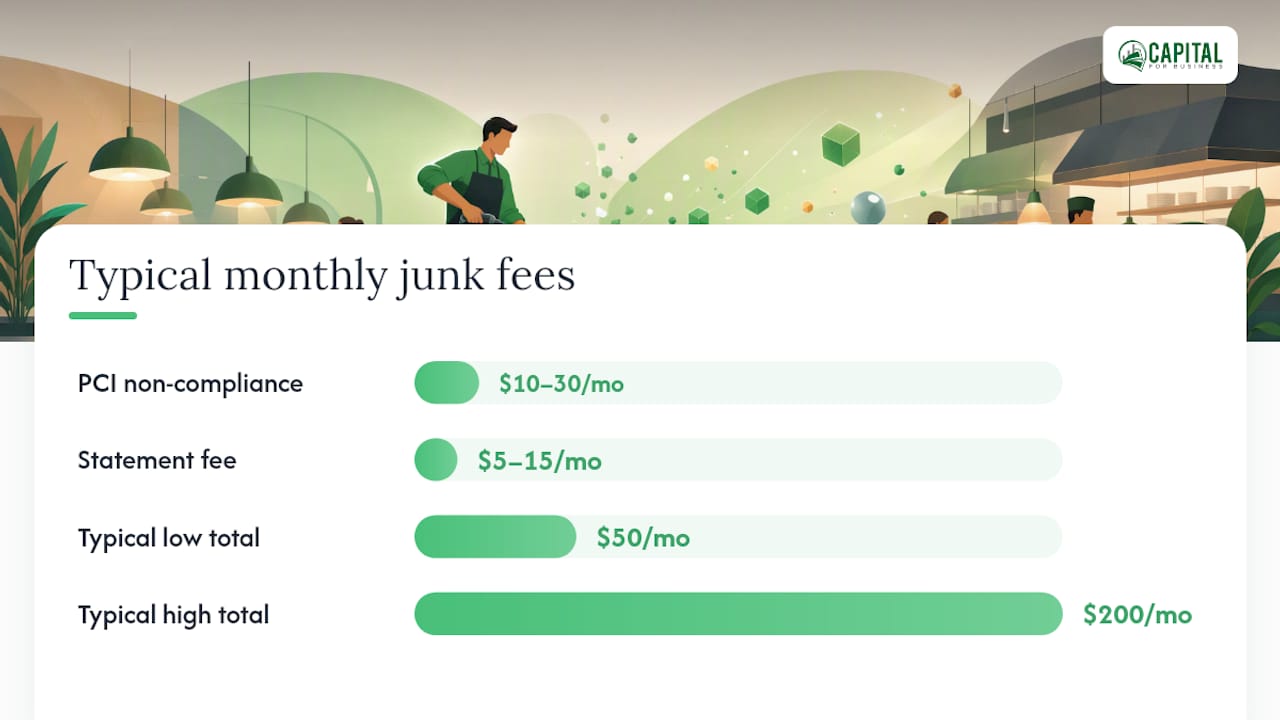
- PCI non-compliance fees: $10 to $30 a month, often charged simply because a short annual questionnaire wasn't completed.
- Statement fees: $5 to $15 a month for a paper or digital statement that costs the processor almost nothing to generate.
- Batch fees: $0.10 to $0.35 per daily settlement batch.
- Monthly minimum fees: charged when your processing volume falls below a set threshold.
- Terminal lease line items: recurring rental charges that can outlast the terminal's actual value many times over.
These fees routinely add $50 to $200 a month to an account, and most are negotiable or removable outright once flagged.
Run a short audit before you call anyone: circle every fee that isn't your discount rate, interchange, or assessments, and write down the dollar amount next to each. When you call your processor, ask directly, "Can you waive this PCI fee, and can you send me written confirmation?" Processors expect this call more often than most owners assume.
Pro Tip: Keep a folder of your last six statements and highlight every recurring fee under $30. Small charges compound fast, and a $200 monthly PCI, batch, and statement fee stack adds up to $2,400 a year for essentially nothing.
What Should You Ask For When You Negotiate?
Negotiating processing fees works best as a short, structured conversation, not an open-ended complaint.
- Bring your effective rate. State the number and the time period it covers. Processors respond faster to a specific figure than a general complaint about cost.
- Request an interchange-plus quote in writing, including the exact markup in basis points and cents per transaction, plus a complete fee schedule with no bundled "misc" line.
- Ask about card-specific handling, especially American Express acceptance costs and any surcharge applied to keyed or online transactions.
- Push for fee waivers on PCI, statement, and batch charges before agreeing to any new rate.
- Check your contract term and terminal ownership before signing anything. Leased terminals and multiyear auto-renewal clauses are the most common reason restaurants stay stuck in bad deals.
As a benchmark, restaurants processing $30,000 or more monthly can often negotiate markups in the 10 to 25 basis point range over interchange, plus a small per-transaction fee. Consultant case studies show accounts at that volume saving $500 to $1,200 a month simply by repricing and removing junk fees, without switching hardware. Renewal time, or right before signing with a new processor, is when you have the most leverage.
How Does Card Mix Affect Your Fees?
Not every swipe costs the same, and blending them together hides where your money actually goes.
Premium rewards cards and American Express carry meaningfully higher interchange than standard debit or basic rewards cards, since interchange rates vary by card type and merchant category code, and full-service restaurants with larger average tickets often see a higher blended rate as a result. Regulated debit interchange is the cheapest category by a wide margin.
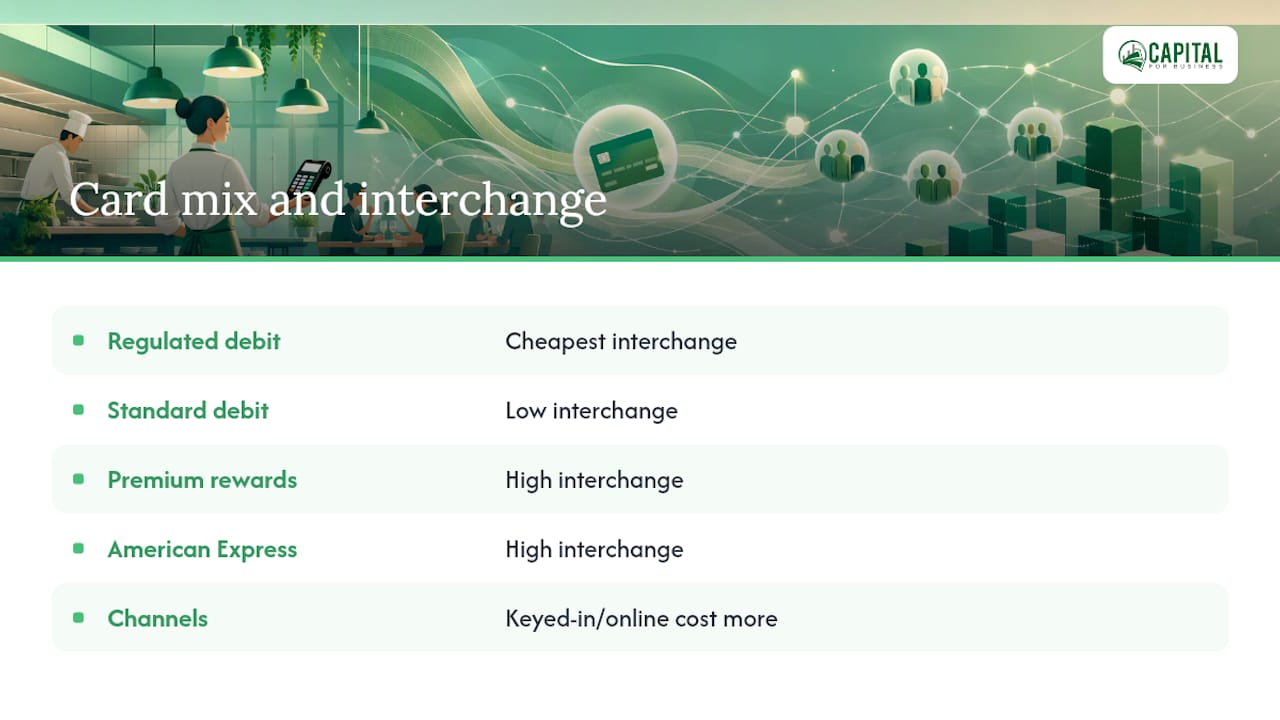
Channel matters just as much as card type. Keyed-in transactions and online orders typically carry higher rates than card-present swipes or dips, because the processor treats them as higher risk. Track these separately on your statement rather than blending them into one average.
A few operational fixes help immediately: train staff to avoid manual card entry whenever a chip or tap is available, and route online ordering through the lowest-cost gateway your point-of-sale system can integrate.
Why This Matters More Than Most Owners Think
Every basis point shaved off your effective rate drops straight to operating margin, no menu price increase required. That's the part conventional advice on this topic tends to undersell: cutting processing costs isn't a nice-to-have efficiency project, it's one of the few margin levers a restaurant controls entirely on its own timeline.
The sequence is straightforward. Measure your effective rate using real statement data, audit the recurring fee lines, and negotiate or move to interchange-plus once your volume justifies it. Restaurants that skip the math and negotiate on gut feeling almost always leave money on the table, because processors price to what a merchant will tolerate, not to what's fair.
Operators who tighten processing costs first usually need less short-term borrowing to smooth out cash flow later.
— Capital
Need Cash Flow Support While You Renegotiate?
Auditing statements and switching processors takes time, and most restaurants can't put operations on hold while they wait for a new account to activate. Some lenders offer restaurant owners a faster path to working capital than traditional banks, with funding decisions sometimes available within 24 hours instead of the weeks a bank line can take.
That speed matters most in three common situations: covering a short cash gap while you wait out a processor's contract term, buying out a leased terminal so you can switch cleanly, or consolidating multiple fee-heavy accounts into one simpler setup. Options worth exploring include working capital loans, a business line of credit for ongoing flexibility, equipment financing if new terminals or a POS upgrade are part of the switch, or a merchant cash advance for a quicker bridge.
Review the full range of funding solutions and get a same-day sense of what your restaurant qualifies for before your next processor renewal date arrives.
Sources
For readers who want to verify the numbers themselves, the U.S. Chamber of Commerce's effective-rate guidance walks through the core calculation. RestroScout's rate breakdown offers current published-rate snapshots, and Katalyst's interchange-plus analysis explains the mechanics behind bundled versus interchange-plus pricing in more depth.
- Calculate credit card fees — U.S. Chamber of Commerce
- Restaurant Credit Card Processing Fees 2026: Verified Rates | RestroScout
- Bundled vs interchange-plus payment processing — what restaurants actually pay — Katalyst
- Restaurant Payment Processing: Real Costs and Integrations (2026)
FAQ
What Is a Normal Effective Rate for a Restaurant?
Most full-service restaurants land between 3.2% and 4.0% once tip, tax, and processor fees are included, even when the advertised headline rate looks closer to 2.4% to 3.09%. Counter-service operations with lower average tickets sometimes run lower.
How Do I Calculate My Restaurant's Effective Rate?
Divide total processing fees by total card volume over the same statement period, then multiply by 100. This is the same method the U.S. Chamber of Commerce recommends for comparing pricing models on equal footing.
Is Interchange-Plus Pricing Always Cheaper Than Flat-Rate?
Not always, but it usually wins for restaurants processing meaningful monthly volume because it separates non-negotiable interchange from the negotiable processor markup. Very low-volume operations sometimes do better on a simple flat rate, since there's less markup to negotiate down.
What Junk Fees Should I Ask My Processor to Remove?
Start with PCI non-compliance fees, statement fees, batch fees, and any monthly minimum charge, which together commonly add $50 to $200 a month. Most processors will waive or reduce these once you flag them directly and ask for written confirmation.
Can Capitalforbusiness Help Me Cover Costs While I Switch Processors?
Yes. Working capital loans, business lines of credit, equipment financing, and merchant cash advances are financing options designed to bridge exactly this kind of transition, with details available on the funding solutions page.