
Most merchants pay roughly 1.5% to 3.5% of each transaction in credit card processing fees, and that cost falls entirely on the business, not the customer's bank. The fee stacks up from three separate charges: interchange to the card issuer, an assessment to the card network, and a markup from your payment processor. Online and keyed-in transactions almost always land at the higher end of that range, since card-not-present sales carry more fraud risk for everyone in the chain.
TL;DR:
- The largest component of credit card processing fees, interchange, is set by the issuing bank and is non-negotiable; understanding this helps target costs effectively.
- Online and keyed-in transactions typically cost more, with fees reaching up to 3.50%, especially for rewards, corporate, or cross-border cards.
- Interchange-plus pricing offers the most transparency and often the lowest cost for merchants with higher sales volumes, while flat-rate charging can hide hidden cross-subsidies.
- Reviewing and negotiating the processor markup is the best way for merchants to reduce costs, especially by requesting detailed statements and submitting complete transaction data.
- Merchants can legally pass some processing costs to customers through surcharges, but only if they comply with state laws and card network disclosure rules.
Table of Contents
- What Are Credit Card Processing Fees, and Who Sets Each Piece?
- How Much Do Credit Card Processing Fees Typically Cost?
- Which Pricing Model Should You Choose?
- How to Calculate Your Monthly Processing Cost
- How Can You Reduce or Offset Credit Card Processing Fees?
- Can You Legally Pass Processing Fees to Customers?
- Capital's Perspective: How We Help Merchants Control Net Processing Cost
- How Capital Can Help With Processing Audits and Funding Options
- Sources
- FAQ
What Are Credit Card Processing Fees, and Who Sets Each Piece?
Every swipe, tap, or online checkout triggers three distinct charges that get bundled into what most business owners just call "the processing fee." Knowing which piece is which matters, because only one of them is actually up for negotiation.
Interchange is the largest slice, and it goes to the customer's card-issuing bank. Visa and Mastercard publish interchange schedules that set these rates, and the Federal Reserve Bank of Kansas City's interchange fee data confirms these rates shift depending on the card type, the merchant category code assigned to your business, and how the transaction was processed.
Assessment fees go to the card network itself (Visa, Mastercard, Discover, American Express) and are typically a small, fixed percentage tacked onto every transaction regardless of card type.
Processor markup is the only layer your payment processor actually controls, and it's the only one you can negotiate. This is where competition among providers matters most.
Here's how the three pieces break down in practice:
- Interchange: set by the issuing bank, varies by card type and merchant category, non-negotiable
- Assessment: set by the card network, small and fixed, non-negotiable
- Processor markup: set by your provider, fully negotiable, and where most rate shopping actually pays off
Stripe's own breakdown of merchant fees confirms this structure and notes that optimizing how transaction data gets submitted can shift a transaction into a cheaper interchange category, even without touching your processor contract.
How Much Do Credit Card Processing Fees Typically Cost?
Average credit card processing fees run between 1.5% and 3.5% per transaction, with card-present retail sales sitting near the bottom of that range and card-not-present or keyed transactions pushing toward the top, according to NerdWallet's merchant fee data.
Industry summaries point to network-specific interchange averages ranging within a moderate percentage, depending on the card brand and how the sale is entered, based on WalletHub's rate analysis. A rewards or corporate card almost always costs more to accept than a plain debit card, because the issuer funds those rewards points through higher interchange.
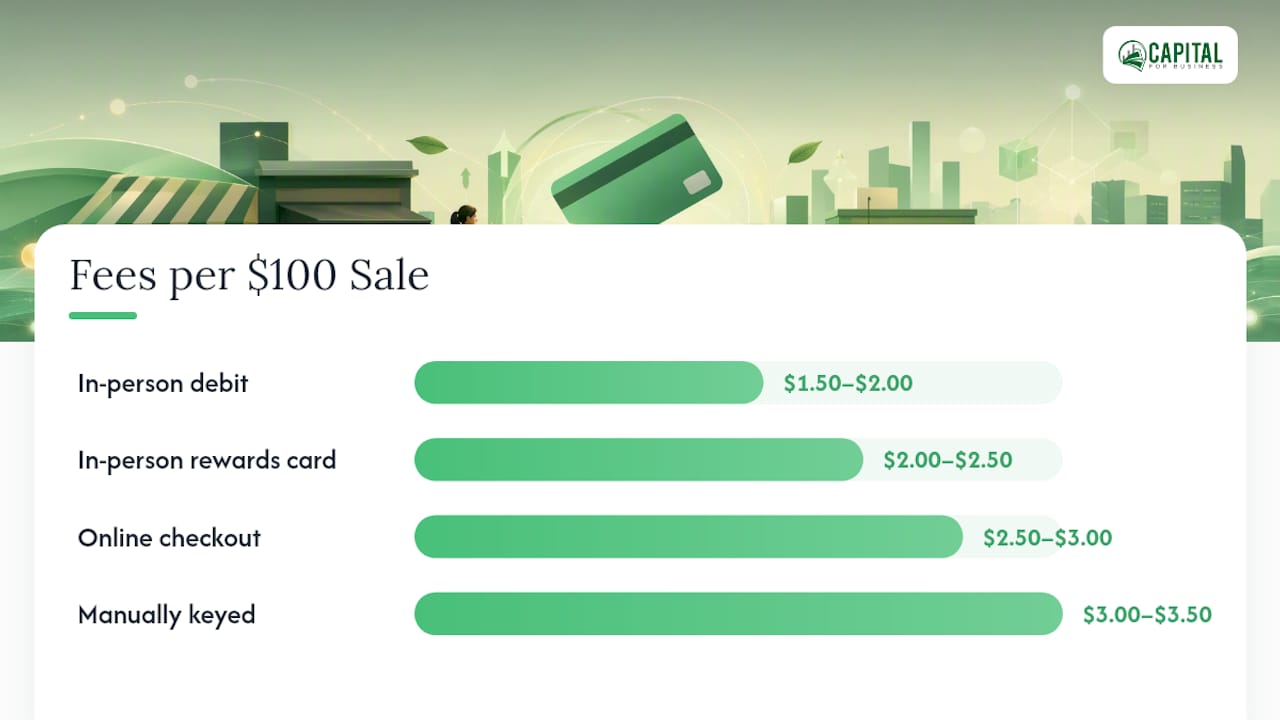
Run the math on a simple $100 sale, and the spread becomes obvious:
- In-person swipe or tap with a standard debit card: roughly $1.50 to $2.00 in total fees
- In-person swipe with a rewards credit card: roughly $2.00 to $2.50
- Online checkout (card-not-present): roughly $2.50 to $3.00
- Manually keyed transaction (phone order, no card present): roughly $3.00 to $3.50
Four factors drive most of that variance: card type (rewards and corporate cards cost more), channel (online and keyed sales cost more than swiped or tapped ones), cross-border or foreign-issued cards (which add extra fees), and your assigned merchant category code, which some processors set more conservatively than others.
Which Pricing Model Should You Choose?
Processors offer several pricing structures, and selecting the appropriate one for your sales volume helps control costs.
Flat-rate pricing charges one fixed percentage on every transaction, regardless of card type. It's the simplest option and popular with low-volume businesses using platforms like Square or Stripe, but that simplicity hides a real cost. Because the flat rate has to cover the processor's most expensive card types, cheap debit transactions end up subsidizing pricier rewards and corporate cards, a cross-subsidy effect Stripe has documented in its own merchant guidance.
Tiered pricing sorts transactions into "qualified," "mid-qualified," and "non-qualified" buckets, each with a different rate. It sounds organized, but processors control which bucket a transaction lands in, and non-qualified rates can run painfully high with little transparency into why a given sale got sorted there.
Interchange-plus pricing passes the actual interchange and assessment costs straight through, then adds a fixed markup on top. This is the most transparent model, and it's usually the cheapest option once monthly volume climbs past a few thousand dollars, because you're only paying the real card cost plus a visible fee.
Subscription or membership pricing charges a flat monthly fee instead of a percentage, then passes interchange through near cost. High-volume merchants with large average tickets often save real money here, since the fixed fee stops scaling with revenue.
Before signing with any processor, ask directly: Does your statement itemize interchange separately from your markup? Can I see a sample statement before committing? What happens to my rate if my card mix shifts toward more rewards cards?
How to Calculate Your Monthly Processing Cost
You don't need special software to estimate what you're actually paying. Four inputs get you a workable number:
- Average ticket size (your typical sale amount)
- Monthly transaction count
- Percentage of sales that happen online versus in person
- Percentage of sales paid with rewards or corporate cards versus plain debit
Multiply average ticket by transaction count to get gross monthly volume, then apply a blended rate: roughly 2% for a mostly in-person, mostly debit business, or closer to 2.8% to 3% for an online-heavy business with a lot of rewards-card traffic.
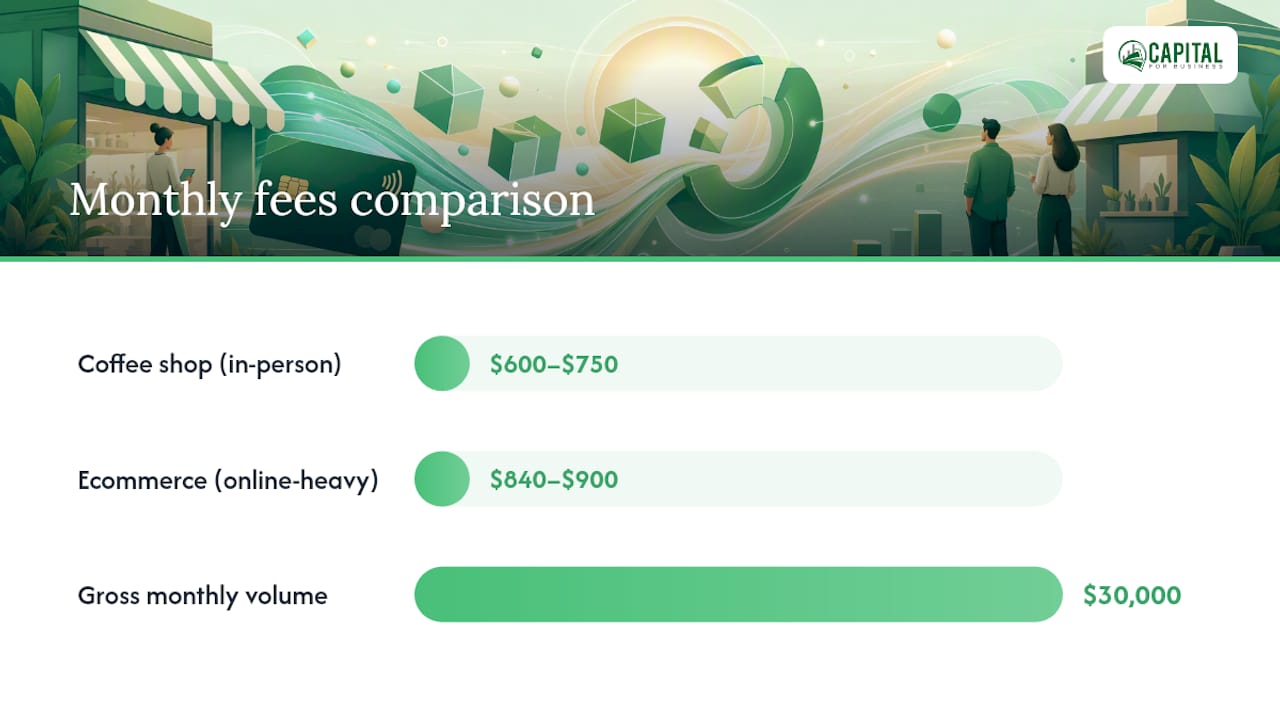
A local coffee shop doing $30,000 a month, mostly in-person debit and credit swipes, likely pays around $600 to $750 in total fees. A mid-size ecommerce shop doing the same $30,000 online, with more rewards cards and card-not-present risk, likely pays closer to $840 to $900. That gap is why channel mix matters more than most owners assume. Under flat-rate pricing, both businesses might pay the same quoted percentage regardless of this difference; under interchange-plus, the ecommerce shop's true cost shows up plainly on the statement instead of getting smoothed over.
How Can You Reduce or Offset Credit Card Processing Fees?
Lowering your effective rate rarely means switching processors every year. It usually means fixing a handful of operational habits that are quietly pushing transactions into expensive categories.
- Request an itemized statement that separates interchange, assessment, and markup, then negotiate only the markup line.
- Submit complete transaction data (address verification, order details, Level II or Level III data for B2B sales) to qualify for lower interchange tiers
- Encourage lower-cost payment methods like ACH or debit for large invoices, where a flat swipe fee beats a percentage-based one
- Cut down on manually keyed transactions, since keyed entry almost always triggers non-qualified rates
- Tighten dispute handling and documentation to reduce chargeback frequency, since disputes carry their own fees on top of the lost sale
- Consider a subscription-style plan once volume is high enough that a flat monthly fee beats a percentage cut
Improving how you route and submit transaction data tends to save more money over time than haggling over a fraction of a percent in markup, since interchange is the biggest line item on most statements. A chargeback prevention plan also protects you from a cost that's easy to overlook until it shows up as a pattern.
Pro Tip: Pull three months of statements and calculate your true blended rate (total fees divided by total card volume). If that number is more than half a point above the low end of your card mix's typical range, you have room to negotiate.
For a deeper walkthrough of these levers, Capitalforbusiness's guide to reducing processing fees breaks down each tactic by business type.
Can You Legally Pass Processing Fees to Customers?
Surcharging (adding a fee only when a customer pays by credit card) and convenience fees (a flat fee for a non-standard payment channel) are different things, and mixing them up can put you out of compliance fast.
Surcharging is legal in most states, but a handful still restrict or ban it, and Visa and Mastercard cap the surcharge amount and require specific disclosures before you can apply one. The FTC's guidance on electronic payments also outlines how disclosure rules protect consumers, and network rules require refunds to reverse the surcharge along with the sale.
Before you add a fee, confirm you have:
- Posted signage at the point of sale disclosing the surcharge
- The surcharge listed as a separate line item on the receipt
- Confirmation that your state permits surcharging (a few, like Connecticut, restrict it)
- A cash discount program instead, if your state law makes surcharging complicated
Capitalforbusiness's breakdown of surcharge versus cash discount programs walks through which option fits which state.
Capital's Perspective: How We Help Merchants Control Net Processing Cost
Most merchants have never actually read their own processing statement line by line, and that's usually where the money leaks out. Many small business owners experience a common pattern: a processor markup increases over time, or a card mix shifts toward rewards cards without noticing the rate impact.
Our view is that a rate review works best paired with a 90-day statement audit, since a single month can hide seasonal noise that a full quarter reveals. A short audit window is often enough to spot an obviously overpriced tier or a markup that no longer matches the volume you're doing.
Processing costs also don't exist in isolation. A business squeezed by high fees during a slow season sometimes needs a bridge more than it needs a renegotiated rate, and that's where financing tools like a business line of credit or working capital can smooth the gap while the rate conversation plays out.
— Capital
How Capital Can Help With Processing Audits and Funding Options
Some firms offer practical alternatives to guessing at your rate, working with small business owners across industries to help read statements rather than providing sales pitches from processor representatives.

When you request a review, ask for a blended-rate analysis and full fee itemization, the same breakdown outlined above, so you can see exactly where interchange ends and markup begins. If a temporary cash gap is what's driving the pressure to cut fees in the first place, our merchant cash advance can put working capital in your account fast, without waiting on a bank's timeline. Explore Capital for Business's credit card processing solutions and get a straightforward look at what you're actually paying, and where that number can realistically come down.
Sources
- Credit and Debit Card Interchange Fees assessed to merchants — Federal Reserve Bank of Kansas City (August 2025 update)
- Credit card payment processing fees explained: What businesses should know — Stripe
- Credit Card Processing Fees: What Small Businesses Should Know in 2026 — NerdWallet
- New rules for electronic payments that can lower costs for retailers — Federal Trade Commission
FAQ
Is It Illegal to Charge Customers a 3% Credit Card Fee?
Not in most states, but you must follow both state law and card network rules, which cap surcharge amounts and require clear disclosure before checkout. A handful of states restrict or ban surcharging outright, so confirm your state's rule before adding one.
Who Actually Pays Credit Card Processing Fees?
The merchant pays the fees, which get deducted from each sale before the funds settle into your account. Businesses can legally pass some of that cost to customers through a compliant surcharge or cash discount program, but the underlying fee is charged to the business.
Why Are Credit Card Processing Fees So High?
Fees stack three separate charges (interchange, assessment, and processor markup) into one number, and interchange alone can run over 2% for rewards or corporate cards. Card-not-present transactions cost more because issuers and networks price in the added fraud risk of online and keyed sales.
What's the Difference Between a Surcharge and a Convenience Fee?
A surcharge applies only to credit card payments and is capped by network rules, while a convenience fee applies to any non-standard payment channel, like phone or mail-in payments, regardless of card type. Both require upfront disclosure to the customer before the transaction completes.
How Can I Estimate My Business's Monthly Processing Cost?
Multiply your average ticket size by your monthly transaction count to get total volume, then apply a blended rate between 2% and 3% based on how much of your business is online versus in person. A mostly in-person, debit-heavy business will land near the low end; an online business with more rewards cards will land near the high end.