
A cash discount lowers your posted price for customers who pay cash; a surcharge adds a fee for those who pay by credit card. For most U.S. small businesses, cash discount programs carry lower legal risk nationwide, while surcharging works only in states that allow it and only after you clear card-network paperwork. Colorado, Connecticut, and Massachusetts each treat surcharges differently, so the right answer depends on where you operate.
TL;DR:
- Surcharging requires state-by-state legal checks, card network notification, and ongoing monitoring, making it more complex and higher risk for small businesses.
- Cash discounts are protected by federal law, easier to implement, and can be offered in all states, avoiding the restrictions and paperwork associated with surcharges.
- Proper signage, clear signage matching payment policies, and accurate receipt itemization are essential for compliance and customer transparency in either model.
- Surcharging cannot legally apply to debit card transactions and requires separate POS configuration, while cash discounts apply uniformly to all payment types with less operational overhead.
- Small businesses should prioritize understanding their state's rules, setting up signage, and confirming POS settings before launching their selected payment model.
Table of Contents
- Surcharge vs. Cash Discount: How a Credit Card Surcharge Actually Works
- What a Cash Discount Program Is and Why the Law Treats It Differently
- Surcharge vs. Cash Discount: Side-by-Side Differences That Matter
- Your Compliance Checklist Before Launching Either Program
- Setting Up Your Program: POS, Signage, and Staff Training
- Which Model Fits Your Business
- What We See Working (and Failing) in the Field
- Why the "Just Add a Fee" Advice Keeps Getting Small Businesses in Trouble
- How Capitalforbusiness Supports Your Pricing Transition
- Sources
- FAQ
Surcharge vs. Cash Discount: How a Credit Card Surcharge Actually Works
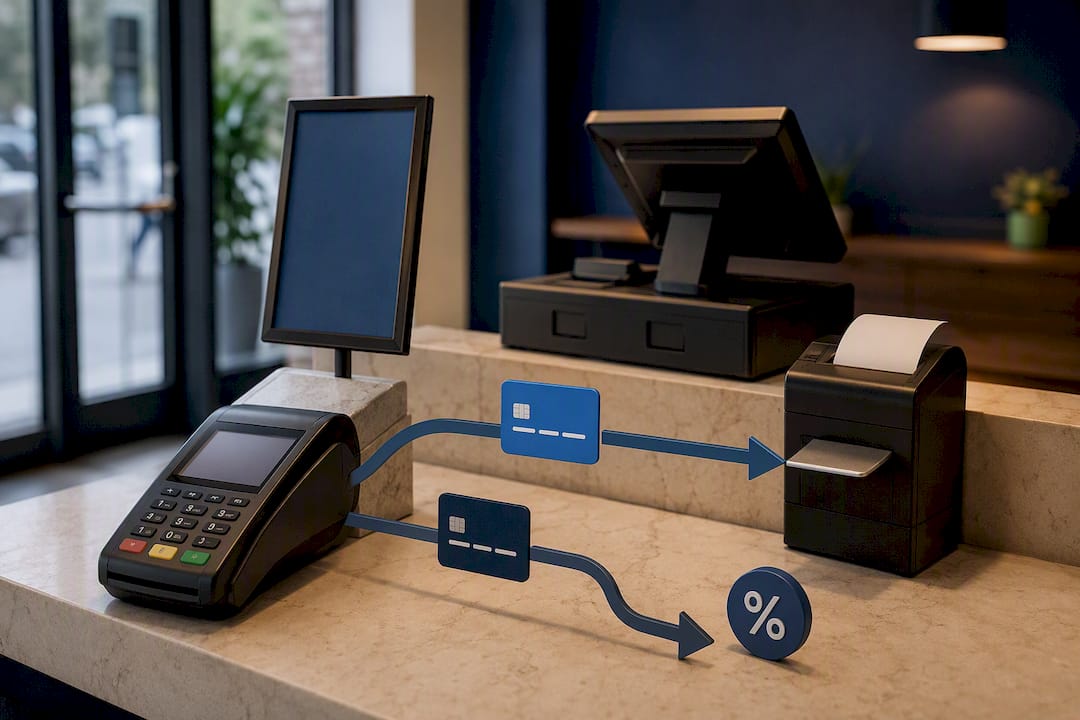
A credit card surcharge adds a percentage fee at checkout, applied only when a customer pays with a credit card. The posted price is the base price; the fee shows up as a separate line item on the receipt.
Surcharges cannot legally apply to debit card transactions regardless of branding. That distinction trips up more merchants than any other rule in this space, because a debit card swiped through a credit terminal often processes identically to a credit transaction unless your POS is configured to catch it.
Card network rules add more layers. Visa and Mastercard require merchants to notify their networks at least 30 days before surcharging begins, cap the surcharge at the lesser of actual cost of acceptance or 3%, and mandate disclosure at the point of entry, at the point of sale, and again on the printed receipt.
Merchants who skip any of these steps tend to fail in a few predictable ways:
- Charging a flat surcharge percentage that exceeds actual processing cost, which card networks and some state attorneys general treat as a hidden fee rather than a pass-through.
- Applying the surcharge to debit transactions because the POS system wasn't segmented by card type.
- Skipping signage at the door, then surprising the customer only at the register.
- Operating in a state where surcharging is restricted or banned outright without checking first.
Surcharging isn't illegal nationwide, but it's the higher-maintenance option. It demands documentation, network sign-off, and ongoing monitoring that a lot of small operators underestimate.
What a Cash Discount Program Is and Why the Law Treats It Differently
A cash discount program flips the framing entirely. The price you post, on the menu, the shelf tag, the invoice, already reflects the cost of accepting cards. Customers who pay cash get an automatic discount off that posted price, rather than paying extra for using a card.
That framing matters because federal law explicitly protects it. The Cash Discount Act of 1981 establishes cash discounts as a legitimate price reduction, not a disguised fee, provided the discount is offered to every prospective buyer and disclosed clearly. This is the legal backbone that makes cash discounting available even in states that restrict surcharging.
The catch is the classification test regulators actually use: whichever price is posted publicly determines whether your program is a discount or a surcharge, no matter what you call it on the receipt. Labeling a fee a "cash discount" while displaying the lower price on your sign is one of the most common compliance failures merchants run into, and it can invite the same scrutiny surcharging faces.
Done correctly, a cash discount program needs a few consistent pieces:
- The card price posted as the standard, regular price everywhere customers see it, on menus, price tags, and invoices.
- Clear signage explaining the discount, something like "All prices reflect card pricing. Save with cash."
- A receipt that itemizes the standard price, the discount amount, and the final price paid.
- Uniform application so every customer, not a select few, can access the discount.
The tradeoff is conversion risk; if you're wondering about payment choices, consider how relying on a personal credit card for business expenses might affect your overall costs and strategy. If your posted "card price" looks meaningfully higher than a competitor's shelf price, some customers hesitate before they read the fine print. Signage and staff framing do most of the work in preventing that friction. A guide like Capitalforbusiness's cash discount overview walks through the setup mechanics in more detail if you're weighing the switch.
Surcharge vs. Cash Discount: Side-by-Side Differences That Matter
The two models produce a similar financial outcome. What differs is legal exposure and operational overhead.
| Factor | Surcharge | Cash discount |
|---|---|---|
| Legal complexity | Higher. Governed by state law plus network rules | Lower. Backed by federal statute |
| Applies to debit cards | No, prohibited | Not applicable, applies to all payment types uniformly |
| Network registration required | Yes, 30-day advance notice | No |
| Customer perception | Fee framing, can feel punitive | Discount framing, usually better received |
| Implementation complexity | Higher: POS card-type detection, notice tracking | Moderate: pricing display and signage |
State law is where the two paths diverge hardest. Connecticut and Massachusetts ban surcharging outright, and Colorado caps it at 2%, below the card networks' own 3% ceiling. Any of these facts alone can make cash discounting the only workable option for a merchant operating there.
Your Compliance Checklist Before Launching Either Program
Skipping a step here is how well-intentioned merchants end up fielding a compliance letter six months later. Work through this in order.
- Check your state's rules first. Confirm whether surcharging is permitted, capped, or banned where you operate, and check every state if you run multiple locations.
- Notify your acquirer if you're surcharging. Visa and Mastercard require 30 days' notice before you start, and you should keep written confirmation of that notice on file.
- Set signage at the point of entry. Customers need to see the pricing policy before they reach checkout, not after.
- Match your receipt language to your program. Surcharges show as a separate line item; cash discounts show standard price, discount, and final total.
- Document everything. Retain your network notification records, the date surcharging began, and per-location notices if you operate more than one storefront.
- Get your accounting treatment right. Record the standard price as gross revenue and the cash discount as a sales reduction; sales tax is calculated on the final price paid after the discount, not the pre-discount amount.
Pro Tip: Keep a single folder, digital or physical, with your state legal check, network notification confirmation, and current signage photos. If a customer or auditor ever questions your pricing, you want that answer in thirty seconds, not thirty minutes.
Setting Up Your Program: POS, Signage, and Staff Training
Getting the paperwork right is half the job. The other half happens on your sales floor and inside your point-of-sale settings.
- Calculate your blended cost of acceptance. Weight your actual card fees by brand and by debit share, then set your cash discount or surcharge percentage close to that real number rather than a round figure that overshoots it.
- Configure your POS to separate card types. Your system needs to recognize debit versus credit at the terminal level so a surcharge (if you're running one) never lands on a debit swipe.
- Post signage at the door and at the register. Use plain language: state the policy once at entry, and reinforce it at checkout before the customer taps or swipes.
- Script the staff conversation. Front-line employees who say "you'll save 3% paying cash" get better customer reactions than staff who say "there's a fee for using your card," even when the math is identical.
- Run a two-week test before full rollout. Confirm your receipts print correctly, your POS applies the right rate to the right card type, and your processor confirms your setup matches what you filed.
Pro Tip: Ask your processor directly whether your terminal batches debit and credit transactions separately before you go live. A five-minute phone call now beats a corrected refund run later.
Which Model Fits Your Business
Your decision usually comes down to four factors: how much of your volume is debit versus credit, your average ticket size, how price-sensitive your customers are, and whether you operate in one state or several.
- Retail with high debit volume: Cash discounting fits better since debit transactions can't carry a surcharge anyway.
- Restaurants with tight margins: Either model works, but signage and staff framing determine customer acceptance more than the mechanism itself.
- B2B and professional services: Surcharging is often more acceptable to business clients used to seeing processing fees itemized on invoices.
- Multi-location or multi-state operators: Default to cash discount or dual pricing, since a single surcharge policy rarely survives contact with every state's rules.
What We See Working (and Failing) in the Field
Capitalforbusiness has advised small businesses on payments and cash flow since 2009. The recurring failure point isn't the legal research, it's the POS configuration: debit cards get surcharged by accident, or signage goes up at the register instead of the door. When state law or network requirements get complicated, loop in your processor or a business attorney before you flip the switch, not after.
Why the "Just Add a Fee" Advice Keeps Getting Small Businesses in Trouble
Most advice on this topic treats surcharging and cash discounting as a coin flip, pick whichever number sounds smaller. That framing misses the actual decision, which is about risk tolerance and operational discipline, not arithmetic. They do not produce the same legal exposure.
The overlooked issue is documentation. Merchants research the rules, then treat compliance as a one-time task instead of an ongoing habit. Card networks and state regulators care about consistency: the same signage, the same receipt language, the same posted price, every day, at every register. A program that's compliant on launch day and sloppy by month three is still a liability.
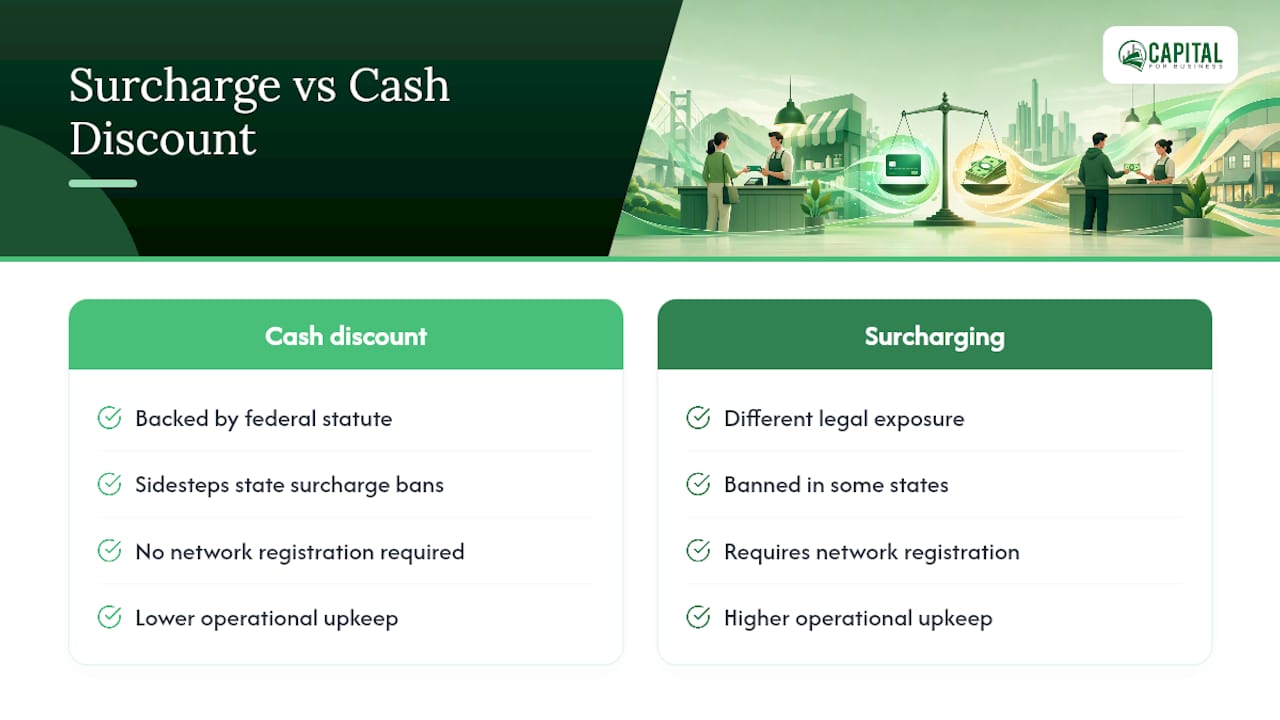
If we're being blunt: most U.S. small businesses should start with cash discounting. It's backed by federal statute, it sidesteps state-by-state surcharge bans, and it doesn't require network registration. Surcharging has its place, particularly for B2B operators with sophisticated clients, but it demands more upkeep than most owners budget for.
Prioritize the boring parts first: your state's rules, your receipt language, your signage. The pricing percentage matters far less than getting those three things right.
— Capital
How Capitalforbusiness Supports Your Pricing Transition
Switching pricing models often exposes a short-term cash gap, new signage, POS reconfiguration, staff training hours, before the savings show up. Capitalforbusiness works with small businesses nationwide on exactly this kind of transition, pairing credit card processing guidance with funding options that cover the upfront cost of getting compliant.

If your processing fees are the real problem behind the switch, a merchant cash advance can bridge the gap while you implement a new program, and a business line of credit gives you flexibility if signage, POS upgrades, or staff training cost more than expected. Capitalforbusiness has funded small businesses across dozens of industries since 2009, often stepping in when banks and credit unions say no. Reach out to talk through your options at Capitalforbusiness, and get a same-week read on what financing fits your rollout.
Sources
- 15 U.S. Code § 1666f — Cash discount protections
- Surcharging and Cash Discounting: Legal State in 2026
- Cash Discounting vs Surcharging: Which Works Best? — Fit Small Business
FAQ
Is It Legal to Charge a 3% Fee on a Debit Card?
No. Surcharges cannot legally apply to debit card transactions under card network rules, even when a debit card is processed through a credit terminal.
Can Merchants Charge a Surcharge on Credit Card Payments?
Yes, in most states, provided the merchant gives 30 days' notice to their card network, caps the fee at actual cost of acceptance or 3%, and discloses it at entry, at checkout, and on the receipt.
Is a 3% Surcharge a Lot?
It's at the top of what card networks allow, since 3% is the network-wide cap, so a 3% surcharge should only apply if your actual cost of accepting cards is close to that figure.
What's the Safer Default for a Multi-State Small Business?
Cash discounting, since it's protected under federal law and avoids the state-by-state surcharge bans and caps that complicate multi-location operations.