
Dual pricing is legal in all 50 U.S. states when you display both the cash price and the card price before the customer pays. That single requirement, pre-payment visibility of both prices, is what separates a compliant program from a surcharge violation under federal law and card-network rules. Three actions to take right now:
- Check your state's rules. Visit your state attorney general or consumer protection office (the New York Division of Consumer Protection is a useful model for format) to confirm whether your state caps or restricts surcharging, and whether any additional disclosure language is required locally.
- Update every price display. Every menu, shelf tag, product page, and POS total screen must show both prices simultaneously before the customer commits to payment.
- Confirm your POS and processor can print both prices on receipts. A receipt that shows only one price is an audit liability, even if your signage is perfect.
Pro Tip: Frame your program as a "cash discount" rather than a "card fee" from day one. That framing aligns with how federal statute and card networks describe the permitted model, and it tends to generate far less customer pushback.
Key Takeaways
Dual pricing is legal in all 50 U.S. states, but compliance depends entirely on showing both prices before payment, maintaining consistent signage, and confirming your processor supports the model end to end.
| Point | Details |
|---|---|
| Pre-payment disclosure is mandatory | Both the cash price and card price must be visible at every price appearance before the customer pays. |
| Debit cards reduce net savings | Debit interchange is already low; heavy debit volume shrinks the realized savings from dual pricing. |
| Surcharging and dual pricing are legally distinct | Dual pricing posts the card price as the standard price; surcharging adds a fee to a base price and triggers registration and cap rules. |
| Documentation protects you | Keep dated signage photos, POS screenshots, and sample receipts for at least 24 months to defend against complaints. |
| Capitalforbusiness offers turnkey support | Capital Bancard provides POS configuration, compliant receipts, signage templates, and financing for equipment upgrades. |
Table of Contents
- What is dual pricing and how does it differ from surcharging?
- Is dual pricing legal across the United States?
- What card network rules govern dual pricing programs?
- What does a compliant dual pricing disclosure checklist look like?
- How do you implement dual pricing across POS, processors, and bookkeeping?
- How do you train staff and communicate the program to customers?
- What compliance mistakes trigger enforcement or chargebacks?
- When is dual pricing not the right choice for your business?
- How much can you actually save? A simple ROI example
- A conservative, compliance-first pilot plan
- How Capitalforbusiness supports compliant dual pricing implementation
- Sources
- FAQ
What is dual pricing and how does it differ from surcharging?
Dual pricing means you post two prices for every item or service: a cash price and a card price, displayed side by side at every point where a customer sees the cost. The customer chooses their payment method knowing the full cost upfront. No surprise at the register.
The $0.25 difference covers your processing cost when the customer pays by card.
The terminology matters legally. Here is how the three common models compare:
| Model | How it works | Registration required? | Debit cards | Key compliance requirement |
|---|---|---|---|---|
| Dual pricing | Two prices posted before payment; card price is the standard price | No | Card price applies; no surcharge added | Both prices visible at every price appearance |
| Cash discount | One posted price; cash customers receive a reduction at checkout | No | Discount applies to cash/debit equally | Discount must be offered before payment, not added after |
| Surcharging | One posted price; card fee added at checkout | Yes (30+ days notice to networks) | Prohibited on debit cards | Cap applies; state restrictions vary widely |
Payment-industry comparisons consistently show that dual pricing avoids network registration and surcharge caps, making it the lower-risk path for most small merchants. The practical difference between dual pricing and a cash discount is mostly one of display timing: dual pricing shows both prices from the start, while a cash discount reduces a single posted price at the point of sale. Both are generally permitted; surcharging carries the most regulatory friction.
Is dual pricing legal across the United States?
Yes, with proper disclosure. Federal statute under the Electronic Fund Transfer Act, as analyzed by LegalClarity, permits merchants to offer a lower price for cash payment. The key legal distinction is timing and framing: showing two prices before payment is a discount structure, not a surcharge.
State law adds a layer of complexity. Several states restrict or cap surcharging, but those restrictions typically do not apply to a properly framed dual-pricing or cash-discount program because the card price is the posted standard price, not an added fee.
| State | Surcharge restriction | Dual pricing impact |
|---|---|---|
| Connecticut | Surcharging restricted | Dual pricing generally permitted with proper disclosure |
| Massachusetts | Surcharging restricted | Cash discount / dual pricing framing avoids the ban |
| Colorado | Surcharge cap applies | Dual pricing avoids cap when card price is the standard price |
| Illinois | Surcharge restrictions apply | Proper dual-price display sidesteps surcharge rules |
| New York / New Jersey | Surcharging restricted | Dual pricing permitted; both prices must be clearly posted |
The practical rule: if your card price is your posted standard price and the cash price is a discount from it, you are operating a cash-discount or dual-pricing model, not a surcharge model. That distinction holds in every state listed above. Still, always verify current rules with your state AG or consumer protection office before launch, because state legislatures update these statutes periodically.
- Consult your state's attorney general website for the current surcharge statute text.
- Look for any state-specific disclosure language requirements beyond the federal baseline.
- If you operate in multiple states, check each one individually.
What card network rules govern dual pricing programs?
Visa, Mastercard, and American Express each publish requirements for how merchants display prices and describe any price differential. The core expectation across all major networks is that the card price must be the price the merchant posts as the standard price, and any lower price for cash must be framed as a discount, not as a fee added to a base price.
The debit-card carve-out is one of the most misunderstood elements of dual pricing. Federal law prohibits surcharging on debit card transactions. Under a true dual-pricing model, the card price applies to debit as well as credit, which means you are not adding a surcharge to debit; you are simply charging the posted card price. However, your net savings are lower on debit transactions because debit interchange rates are already lower than credit rates. If your customer mix skews heavily toward debit, your realized savings from dual pricing will be smaller than the headline rate suggests.
Visa's compliance resources and Mastercard's merchant rules both require customer-facing displays and receipts to reflect the price the customer actually agreed to pay. Receipts that show only the card price without any reference to the cash alternative can trigger disputes.
Industry reporting on Visa's surcharge cap changes notes that network-level cap adjustments have pushed more merchants toward cash-discount and dual-pricing structures precisely because those models avoid the cap entirely. When the card price is the standard price, there is no surcharge to cap.
Common network violations to avoid:
- Labeling the card price as a "credit card fee" or "processing fee" added to a base price.
- Displaying only the cash price on menus or shelf tags and adding the card price at the register.
- Surcharging debit card transactions under any framing.
- Failing to disclose both prices on the customer-facing terminal screen before the transaction is confirmed.
What does a compliant dual pricing disclosure checklist look like?
Every price appearance in your business must show both prices. "Every price appearance" means more than just the register.
- Entrance signage. Post a notice at the front door or entrance stating that two prices apply: a cash price and a card price. Sample language: "We offer two prices: a cash price and a card price. The card price includes a processing cost. Ask a team member for details."
- Menu and shelf tags. Every item price must show both figures. Format: "Cash: $9.75 | Card: $10.00" or equivalent. A single price with a footnote does not satisfy this requirement.
- POS total screen. The customer-facing display must show the applicable total before the customer confirms payment. If the customer is paying by card, the card total must be visible before they tap or swipe.
- Customer-facing terminal. The terminal screen must display the card price as the amount being charged. No surprises after the customer has already committed.
- Receipts. Print both prices on the receipt: the cash price and the card price actually charged. This creates an audit trail and reduces chargeback risk.
- E-commerce product pages. Display both prices on the product page and at checkout. If you offer ACH as a "cash equivalent" payment method, label it clearly and show the lower price alongside the card price.
For documentation, keep the following for at least 24 months:
- Photographs of your entrance signage and menu/shelf tags (date-stamped).
- POS configuration screenshots showing dual-price setup.
- Sample receipts showing both prices.
- Staff training records and any written training materials.
Pro Tip: When a consumer complaint or card-network inquiry arrives, your documentation is your defense. A folder of dated photos and POS screenshots can resolve most disputes before they escalate.
How do you implement dual pricing across POS, processors, and bookkeeping?
POS configuration
Your POS system must support item-level dual pricing, not just a blanket percentage applied at checkout. Systems that apply a flat percentage at the end of the transaction can create rounding inconsistencies and make item-level receipt disclosure harder to verify. Confirm with your POS vendor that:
- Each item can carry both a cash price and a card price.
- The customer-facing display updates in real time based on the selected payment method.
- Receipts can be configured to print both prices.
Processor and gateway selection
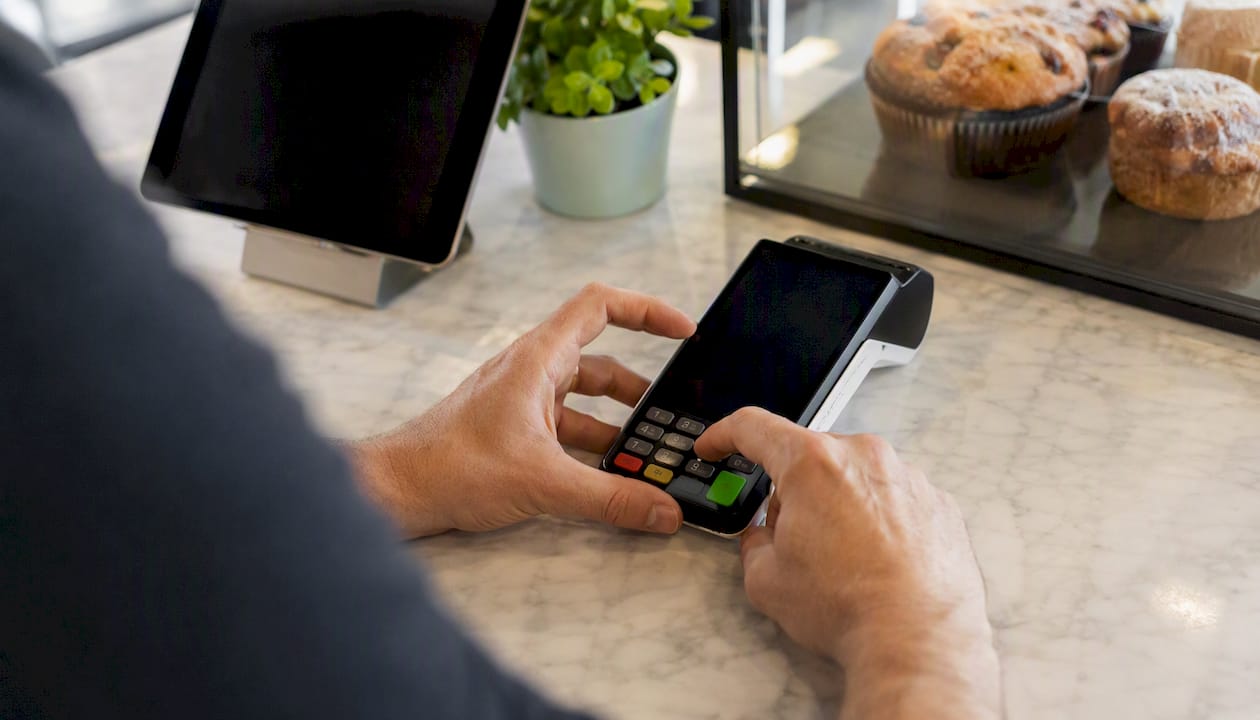
Not every processor supports dual pricing natively. Some require a separate module or a specific terminal firmware version. For e-commerce, ACH bank transfer is the most common "cash equivalent" option; it carries lower processing costs and qualifies for the cash price in most dual-pricing setups. Confirm your gateway supports ACH and that the checkout flow clearly labels the price difference before the customer submits payment.
Bookkeeping and reporting
Track card and cash sales separately in your accounting system from day one. Your card sales will record at the card price; your cash sales at the cash price. The difference is not revenue; it is a processing cost offset. Set up two sales categories or use a payment-method tag in your accounting software so reconciliation is clean. For tax purposes, report gross revenue at the price actually received for each transaction type.
PCI DSS compliance
PCI DSS standards apply to your terminals and payment gateways regardless of your pricing model. Switching to dual pricing does not change your PCI scope. Confirm your terminals are on the current approved device list and that your gateway maintains its PCI certification. Protecting customer payment data is a baseline obligation that runs parallel to any pricing strategy you adopt.
How do you train staff and communicate the program to customers?
Staff confidence is the single biggest factor in whether customers accept dual pricing without friction. A cashier who hesitates or gives a vague explanation creates doubt; a cashier who explains it in one clear sentence closes the conversation.
Suggested staff script: "We offer a small discount for cash payments. The price you see on the tag is the card price; if you pay cash, it's [cash price]."
That framing keeps the emphasis on the discount the customer can receive, not on a fee being charged. It also aligns with the cash-discount framing that card networks and federal statute recognize.
- Train every customer-facing team member before launch, not after the first complaint.
- Post a one-page reference card at each register with the script and the most common customer questions.
- Brief your team on what to do if a customer disputes the price: show them the posted signage, offer the cash price if they have cash available, and escalate to a manager if the dispute continues.
For customer-facing communications beyond the register:
- Website: Add a short FAQ or notice on your payment/checkout page explaining both prices.
- Receipts: Include a one-line note: "Cash price available for cash or ACH payments."
- Social media: A brief post announcing the program before launch reduces surprise and positions it as a benefit to cash-paying customers.
For a pilot rollout, start at one location or one product category. Measure customer complaints, average transaction value, and the percentage of customers choosing cash over card for 30–60 days before expanding. The payment friction guide from Capitalforbusiness covers common points where customer payment decisions shift, which is useful context for setting realistic expectations.
What compliance mistakes trigger enforcement or chargebacks?
Most enforcement actions and chargebacks in dual-pricing programs trace back to a small set of recurring errors.
Red flags that attract scrutiny:
- Labeling the card price as a "credit card fee" or "processing surcharge" rather than the standard posted price.
- Displaying only the cash price on menus or product pages and revealing the card price only at the register.
- Applying the card price to debit transactions while calling it a surcharge in any internal or customer-facing documentation.
- Receipts that show only one price, with no reference to the dual-pricing structure.
- Menus or shelf tags that have not been updated after the POS was reconfigured.
State AG enforcement typically begins with a consumer complaint. Investigators request receipts, photographs of signage, and POS configuration records. If your documentation shows a consistent gap between what was posted and what was charged, you face both a state consumer protection action and potential card-network fines.
If you discover a disclosure gap after launch, correct it immediately: update all signage and POS displays the same day, document the correction with date-stamped photos, and review the past 30 days of transactions for any customer who may have been charged without proper pre-payment disclosure. Proactive correction before a complaint arrives is treated more favorably than reactive correction after one.
When is dual pricing not the right choice for your business?
Dual pricing works best when a meaningful share of your transactions are credit card payments with relatively high interchange rates. Several scenarios exist where the math or the customer experience argues against it.
- High debit card volume. Debit interchange is already low (often under 1% for regulated debit under the Durbin Amendment). The savings on debit transactions under dual pricing are small, and the operational complexity may not be worth it.
- Low average ticket. On a $5.00 transaction, the price difference between cash and card is a few cents. Customers notice the friction; the savings are minimal.
- High e-commerce share without ACH adoption. If your online customers rarely use ACH and almost always pay by card, the "cash" option generates little uptake and the dual-price display adds checkout complexity without meaningful savings.
- Highly competitive retail environments. If your competitors do not use dual pricing and your customers are price-sensitive, the card price premium can push sales to competitors even when the difference is small.
- Service businesses with long-term contracts. Repricing mid-contract is legally and operationally complicated. Dual pricing is easier to implement cleanly at the start of a new contract cycle.
To test before committing: run a 30-day pilot on a subset of products or at one location. Track conversion rate, average order value, and the percentage of customers who switch to cash.
How much can you actually save? A simple ROI example
The formula is straightforward:
Monthly card volume × effective processing rate × percentage of card volume that shifts to cash = monthly savings
Worked example for a small retail business:
- Monthly card volume: $30,000
- Effective processing rate: 2–3% (use 2.5% for this example)
- Monthly processing cost without dual pricing: $750
- Estimated cash shift: 30% of card volume (conservative)
- Monthly savings: $30,000 × 2.5% × 30% = $225/month, or $2,700/year
Sensitivity factors to watch:
- Debit share: if 40% of your card volume is debit, your effective savings rate on those transactions is lower because debit interchange is already reduced.
- Customer pushback: even a 5% drop in transaction volume from customers who leave rather than pay the card price can offset savings quickly on low-margin products.
- Implementation costs: new terminals, POS configuration fees, and signage printing are one-time costs that reduce first-year net savings.
The cash discount program guide from Capitalforbusiness walks through additional scenarios and implementation cost estimates that can help you build a more precise projection for your specific business.
A conservative, compliance-first pilot plan
The merchants who run into trouble with dual pricing are almost never the ones who planned carefully. They are the ones who flipped the switch on a new pricing model without updating every price display, without briefing staff, and without confirming their processor could handle the receipt formatting.
A 30–90 day pilot at one location or one product category is the right starting point. The KPIs to track are simple: conversion rate at the piloted location versus a control location, average order value, card-versus-cash payment split, and customer complaint volume. If conversion holds and cash uptake is meaningful, expand.
The minimal pilot checklist: entrance signage updated, item-level dual prices on all tags in the pilot area, POS configured and tested, receipts showing both prices, and every customer-facing team member briefed with a one-line script. Keep all documentation for at least 12–24 months. State AG offices and card networks can request records well after a complaint is filed, and a clean paper trail is your strongest protection.
Industry context on network cap changes and broader business financing trends both point in the same direction: merchants are looking for ways to reduce payment costs without alienating customers, and a well-run dual-pricing program is one of the cleaner options available. The key word is "well-run." A compliant program that your staff can explain in one sentence and your customers can see before they pay is worth far more than a technically correct setup that confuses everyone at the register.
How Capitalforbusiness supports compliant dual pricing implementation
Reducing processing costs through a compliant dual-pricing program is a concrete, measurable goal. Capitalforbusiness, through its Capital Bancard credit card processing service, gives small business owners a direct path to implementation without having to coordinate a POS vendor, a processor, and a compliance consultant separately.

Capital Bancard's offering includes POS configuration for dual-price display, compliant receipt formatting that prints both prices, signage templates that meet card-network disclosure requirements, and bookkeeping integration support. For businesses that need to upgrade terminals or fund the rollout, Capitalforbusiness also offers working capital funding up to $500,000 to cover equipment and setup costs without disrupting cash flow.
The compliance advantage of working with a provider that understands both card-network rules and state-level requirements is real: you avoid the configuration errors that trigger fines and chargebacks, and you get a setup that is auditable from day one. To get started, visit the Capital Bancard processing page and request a consultation. A team member will assess your current processing setup and walk you through what a compliant dual-pricing rollout looks like for your specific business.
Sources
The sources below are the primary references for the rules covered in this guide. For state-specific questions, your state attorney general or consumer protection office is the first place to check, because state statutes on surcharging and price display are updated more frequently than federal guidance.
- Law
- What Is Dual Pricing Credit Card Processing and Is It Legal? - LegalClarity
- Pcisecuritystandards
- Usa
This article provides general information about dual pricing compliance in the United States and is not a substitute for legal or professional advice. Consult your state attorney general's office or a qualified payments attorney to confirm current rules for your specific situation.
FAQ
Is dual pricing legal in the United States?
Yes. Dual pricing is legal in all 50 states when both the cash price and the card price are displayed before the customer pays, consistent with federal statute and card-network requirements.
Is it illegal to charge a higher price for debit card payments?
You cannot add a surcharge to a debit card transaction under federal law. Under a dual-pricing model, the card price is the posted standard price for all card types, including debit, so no surcharge is being added; the card price simply applies.
Can merchants charge 2–3% extra on credit card payments?
Merchants can post a card price that is 2–3% higher than the cash price under a dual-pricing or cash-discount model, provided both prices are visible before payment. Surcharging credit cards above network caps or without proper registration is a separate, more restricted practice.
What is a simple example of dual pricing?
A merchant posts two prices on its menu, for example: cash and card prices displayed side by side. The customer sees both prices before ordering, chooses their payment method, and pays the corresponding price. That is dual pricing in its simplest form.
What is the difference between dual pricing and a cash discount program?
Dual pricing posts both prices from the start at every price display. A cash discount program typically posts one price and reduces it at checkout for cash-paying customers. Both models are generally permitted under federal law and card-network rules, but dual pricing's upfront display makes it easier to satisfy pre-payment disclosure requirements consistently.