
Business line of credit rates for well-qualified small businesses typically run from roughly 7% to 25% APR, but that headline number rarely tells the full story. Fees layered on top can push your effective cost significantly higher than the rate on the offer letter.
- Well-qualified borrowers (strong credit, 2+ years in business, solid revenue): expect APRs in the 7%–15% range, with bank and credit union products at the lower end.
- Higher-risk or newer businesses using online alternative lenders: APRs can climb to 25%–60% or more, depending on credit profile and product structure
- Common fees that change effective cost: annual maintenance fees, per-draw fees (often 1%–3% of each withdrawal), non-utilization fees, origination fees, and renewal fees
Before you submit a single application, pull your last three months of bank statements, a year-to-date profit and loss statement, and your business and personal credit reports. Then get two or three written offers and calculate the effective annualized cost for each, not just the APR.
Key Takeaways
Effective annualized cost, not headline APR, is the single most reliable metric for comparing business line of credit offers.
| Point | Details |
|---|---|
| Rate ranges vary widely | Well-qualified borrowers typically see 7%–15% APR; higher-risk profiles can face 25%–60% or more. |
| Fees change the real cost | Draw fees, annual fees, and non-utilization fees can push effective cost well above the stated APR. |
| Effective cost formula | Divide total annual costs (interest + fees) by average balance to get a true comparison number. |
| Secured lines cost less | Pledging collateral typically reduces your margin by two to four percentage points versus unsecured. |
| Capitalforbusiness | Offers LOCs up to $250,000 with fast decisions and options for businesses banks often decline. |
Table of Contents
- How are business line of credit rates actually quoted?
- What factors determine your specific rate?
- What fees raise the true cost of a business LOC?
- What rate ranges should you expect by lender type?
- How does a line of credit compare to a term loan?
- How do you shop and negotiate for a better rate?
- A worked example: comparing two real offers
- What Capitalforbusiness has seen work since 2009
- Capitalforbusiness offers flexible LOC options for small businesses
- Sources
- FAQ
How are business line of credit rates actually quoted?
The interest rate is the base cost of borrowing. The APR folds in certain fees to give a broader annual cost figure. For revolving credit, though, APR can still understate your true cost because it does not always capture recurring draw fees or maintenance charges that hit every time you access the line.
Most business lines of credit carry a variable rate, structured as an index plus a margin. The index is typically the Wall Street Journal Prime Rate; the margin is the lender's markup based on your credit profile. If Prime is 7.5% and your margin is 3%, your rate is 10.5%. When the Federal Reserve moves rates, your index moves with it, and so does your payment.
Interest accrues daily on the outstanding balance, not on the full credit limit. Draw $30,000 on Monday and repay $20,000 by Friday, and you owe interest on $30,000 for five days and on $10,000 afterward. That daily mechanic makes draw timing a real cost lever.
When reviewing any offer, look for these terms in writing:
- Index: which benchmark rate the lender uses (Prime, SOFR, or other)
- Margin: the lender's fixed markup above the index
- Floor: the minimum rate even if the index drops
- Cap: the maximum rate even if the index spikes
- Fixed-rate option: whether you can lock a draw at a fixed rate
- Renewal conditions: whether the margin resets at renewal
What factors determine your specific rate?
Lenders price risk. The more predictable your repayment looks, the lower the margin they charge. Here are the primary factors they evaluate:
- Personal and business credit scores: most banks want a personal score above 680; online lenders often go lower but charge more
- Time in business: two years is the common threshold for competitive rates; under one year typically means higher cost or limited options
- Annual revenue and cash flow: lenders want to see consistent deposits and a debt-service coverage ratio above 1.25x
- Collateral: a secured line backed by receivables, inventory, or equipment carries a lower rate than an unsecured line of credit
- Industry risk: lenders assign higher margins to industries with volatile revenue or high failure rates
- Personal guarantee: most small-business LOCs require one, which affects your personal credit exposure
- Loan size: larger lines sometimes carry lower margins because fixed costs are spread over more principal
Pro Tip: The three fastest ways to improve your rate before applying are: pay down any delinquent accounts to clean up your credit report, document three to six months of consistent revenue deposits in your business bank account, and offer collateral if you have it. Each one can reduce your margin by a meaningful amount.
What fees raise the true cost of a business LOC?
Common fees on a business line of credit include:
- Annual or maintenance fee: typically $0–$200 per year, charged regardless of usage
- Origination fee: usually 1%–3% of the credit limit, paid at closing
- Draw fee: 1%–3% charged each time you access funds
- Non-utilization fee: a penalty for leaving the line unused, often 0.25%–0.5% of the undrawn balance annually
- Renewal fee: charged when the lender extends the line for another term
- Prepayment penalty: less common on LOCs, but worth confirming
Lenders commonly add these fees on top of the stated APR, which is why comparing headline rates across offers can mislead you. The right comparison metric is effective annualized cost.
Simple formula:
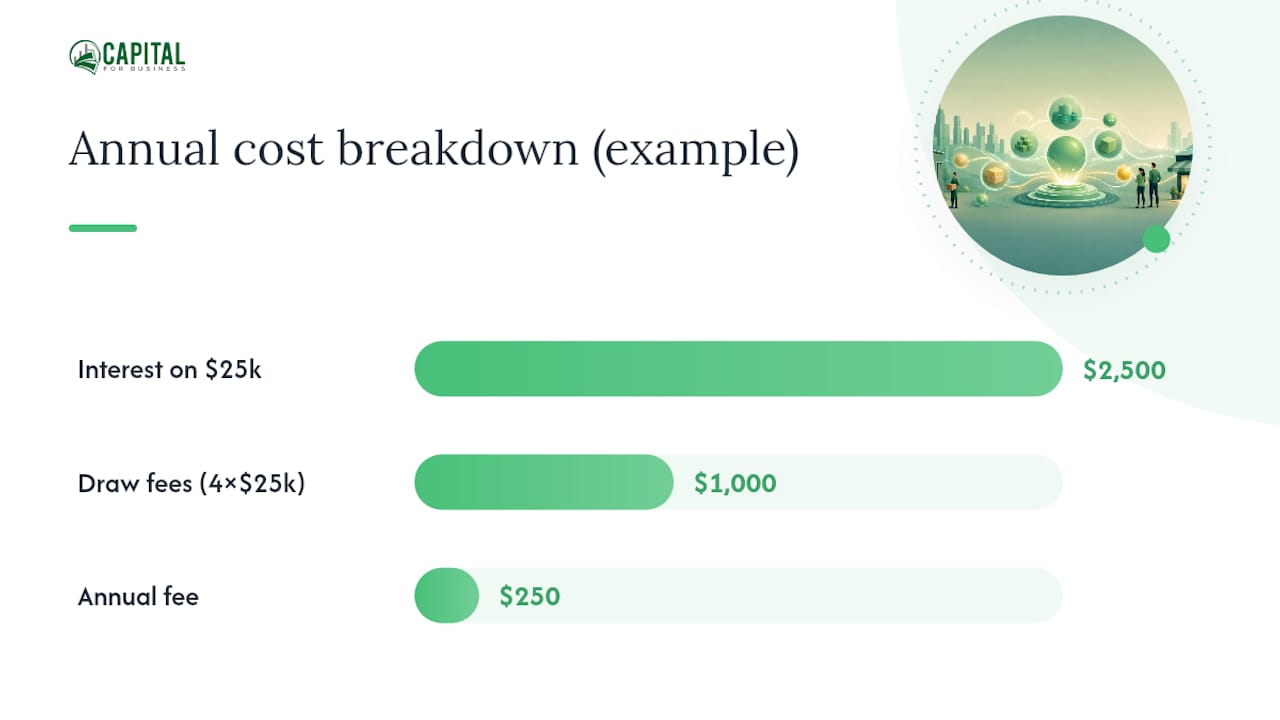
For a $100,000 line with an average drawn balance of $25,000, a 10% APR, a $250 annual fee, and a 1% draw fee on four draws of $25,000 each:
A line with low usage and high fees can cost far more than its APR suggests.
What rate ranges should you expect by lender type?
Market-rate data shows fixed-line medians near 7.20% and variable-line medians in the high 7%–8% range for qualified borrowers, though individual offers vary widely.
| Lender type | Typical APR range | Fee profile |
|---|---|---|
| Bank or credit union | 7%–15% | Low to moderate annual fees; minimal draw fees |
| SBA-backed line (CAPLine) | Prime + 2.25%–4.75% (policy-set) | Origination and guarantee fees apply |
| Online alternative lender | 15%–50%+ | Higher draw fees; may include factor-rate pricing |
| Marketplace or fintech lender | 10%–25% | Variable; often includes maintenance and draw fees |
Rates shift with monetary policy. When the Federal Reserve raises the federal funds rate, Prime follows, and every variable-rate LOC tied to Prime adjusts upward. Borrowers who locked fixed-rate draws before a rate cycle benefited; those on fully variable lines saw payments rise.
How does a line of credit compare to a term loan?
A term loan is generally cheaper for a large, sustained draw because you borrow the full amount once and repay on a fixed schedule. A line of credit costs less when your needs are recurring, variable, or short-term, because interest accrues only on what you draw.
| Feature | Business line of credit | Business term loan |
|---|---|---|
| Purpose | Ongoing, flexible cash-flow needs | One-time, defined purchase |
| Payment structure | Variable; pay interest on drawn balance | Fixed principal + interest payments |
| Rate characteristics | Usually variable; index + margin | Often fixed; set at origination |
| Collateral tendency | Secured or unsecured | Usually secured for larger amounts |
| Best use case | Payroll gaps, inventory, seasonal swings | Equipment, expansion, real estate |
Many businesses use both: a term loan for equipment or expansion and a LOC for day-to-day cash flow. That combination often produces the lowest blended cost.
When a LOC makes more sense:
- Covering seasonal payroll or inventory build-up
- Bridging a 30–60 day gap between invoicing and payment
- Managing unpredictable operating expenses
When a term loan fits better:
- Purchasing equipment with a defined cost
- Funding a one-time expansion or renovation
- Refinancing existing higher-cost debt at a fixed rate
How do you shop and negotiate for a better rate?
Document checklist
Organize these before you apply to speed underwriting and improve your negotiating position:
- Last 3 months of business bank statements
- Year-to-date profit and loss statement
- Business and personal credit reports
- Most recent two years of business tax returns (if requested)
- Accounts receivable aging report (for secured lines)
Negotiation steps
- Ask the lender to break out the margin separately from the index so you know exactly what they control.
- Request a fee waiver on the annual maintenance fee, especially if you plan to draw frequently.
- Ask for pricing on both a secured and unsecured structure; the rate difference often justifies pledging collateral.
- Confirm the floor and cap on the index so you know your worst-case rate.
- Ask whether the margin resets at renewal and under what conditions.
- Get the full fee schedule in writing before signing anything.
Red flags to watch for: fees not disclosed until the day of funding, non-utilization fees above 0.5%, automatic renewal penalties with no opt-out window, and vague language about which index the rate is tied to.
Pro Tip: Bring two or three written competing offers to your preferred lender. A documented alternative is the single most effective tool for getting a margin reduction or a fee waiver. Lenders with discretion on pricing will often match or beat a credible competing offer.
A worked example: comparing two real offers
Scenario: $100,000 line, average drawn balance $25,000, four draws per year of $25,000 each.
- Offer A: 10% APR, $250 annual fee, 1% draw fee per withdrawal
- Offer B: 8% APR, $1,000 annual fee, no draw fee
Offer B is cheaper for this draw pattern despite the higher annual fee, because the absence of draw fees saves $1,000 per year. If you drew more frequently, say eight times per year, Offer A's draw fees would double to $2,000 and Offer B would pull further ahead. Run this math for your own expected draw pattern before choosing.
What Capitalforbusiness has seen work since 2009
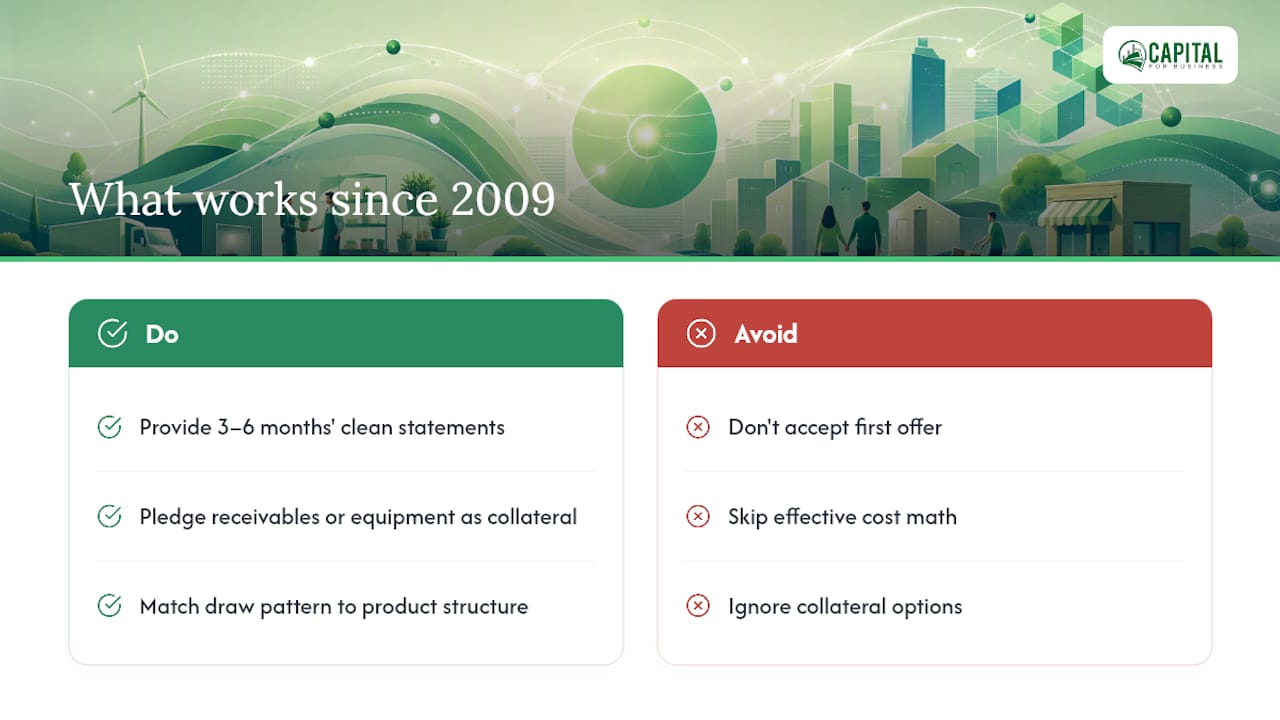
Since 2009, Capitalforbusiness has worked with small business owners across hundreds of industries, and two patterns consistently produce better LOC pricing. First, businesses that clean up their bank statements before applying, specifically three to six months of consistent deposits with no unexplained gaps, routinely see lenders offer lower margins. Second, owners who pledge receivables or equipment as collateral often drop their margin by two to four percentage points compared to an unsecured offer.
Internal data from Capitalforbusiness shows that 62% of businesses using lines of credit report improved cash flow. That outcome is not automatic. It follows from matching the right draw pattern to the right product structure, which is exactly where preparation and comparison shopping pay off.
The businesses that struggle are usually those who accepted the first offer without calculating effective cost. A 9% APR with heavy draw fees can cost more than a 13% APR with no fees at moderate utilization. The math in this article is not complicated, but most borrowers skip it.
Capitalforbusiness offers flexible LOC options for small businesses
Since 2009, Capitalforbusiness has helped small businesses across the United States access revolving lines of credit up to $250,000, with funding that moves faster than a traditional bank and terms built around real business cash flow. Whether you need to cover a payroll gap, stock up for a busy season, or keep a cushion for unexpected expenses, the application process is straightforward and decisions are made quickly.
Rates and terms vary by credit profile and underwriting, but Capitalforbusiness works with businesses that banks often turn away, including those with shorter operating histories or mixed credit. To see what you qualify for, start your pre-qualification today. There is no obligation, and knowing your options costs nothing.
Sources
- Average Business Line of Credit Interest Rates | Bankrate
- Term Loan vs Line of Credit: Which is Better for Your Business?
- Business Line of Credit vs. Loan: Which Is Right for Your Business? | Brevo Capital
- Average Business Loan Rates for 2026 | LendingTree
FAQ
What is a typical business line of credit rate?
Well-qualified small businesses typically see APRs between 7% and 15% from banks and credit unions. Online alternative lenders charge more, often 15%–50%+, depending on credit profile and product structure.
How do fees affect the effective cost of a business LOC?
Draw fees, annual maintenance fees, and non-utilization fees can push your effective annualized cost well above the stated APR. On a $25,000 average balance with a 10% APR and moderate fees, effective cost can reach 15% or higher.
What documents do lenders require for a business line of credit?
Most lenders request the last three months of bank statements, a year-to-date profit and loss statement, and business and personal credit reports. Tax returns and accounts receivable aging reports may also be required for larger lines.
When is a line of credit better than a term loan?
A line of credit works better for recurring, variable needs like seasonal payroll, inventory gaps, or short-term cash flow. A term loan is usually cheaper for a single large purchase such as equipment or a facility expansion.
Can Capitalforbusiness help if my bank declined my application?
Yes. Capitalforbusiness works with small businesses that traditional banks often decline, including those with shorter operating histories or mixed credit profiles, offering lines of credit up to $250,000 with fast underwriting decisions.