
TL;DR:
- Most small businesses prefer non-bank lenders in 2026 due to faster approval and better access. Artificial intelligence is revolutionizing underwriting, enabling approval in days and improving success rates. Proper preparation and understanding current macro trends are key to obtaining smarter funding.
Most small business owners assume the bank is the first and best place to go for a loan. That assumption is now outdated. In 2026, 74% of small businesses prefer non-bank lenders over traditional banks, choosing speed and accessibility over institutional prestige. The financing landscape has shifted faster than most guides acknowledge, and the owners who adapt early are the ones securing capital while others wait weeks for a bank decision. This article breaks down the real data behind today's lending market, compares your best funding options, and gives you a clear framework for positioning your business to get funded faster and smarter in 2026.
Table of Contents
- The new lending landscape: Non-bank lenders and shifting preferences
- Approval requirements and fast funding: What has changed in 2026?
- The role of credit cards, government programs, and alternative products
- Key economic and regulatory trends shaping financing in 2026
- Our perspective: How to position your business for smarter funding in 2026
- Unlock the right financing for your business's growth
- Frequently asked questions
Key Takeaways
| Point | Details |
|---|---|
| Non-banks now dominate | Most small businesses in 2026 prefer non-bank lenders for speed, flexibility, and easier approval. |
| AI speeds up funding | Technology-driven lenders offer approvals and funding in just days, outpacing banks’ lengthy processes. |
| Choose the right product | Align your funding choice—credit card, government loan, or alternative product—with your business’s real needs. |
| Track big-picture trends | Stay aware of Fed policy and market shifts to seize the best financing costs and conditions in 2026. |
| Preparation boosts success | Organizing documents for AI systems and applying for enough funding increases approval odds. |
The new lending landscape: Non-bank lenders and shifting preferences
The way small businesses access capital has changed dramatically. Traditional banks, once the default choice, are now losing ground to fintech platforms, alternative lenders, and even credit cards. This is not a fringe trend. It reflects a structural shift in what small business owners actually need and what legacy institutions consistently fail to deliver.
The numbers tell a clear story. Banks are losing $130B in SMB market share to credit cards carrying 18 to 36% rates and to alternative lenders. The reason is straightforward: small business owners want the trust of an established institution combined with the speed of a fintech. Banks have delivered only the former. Alternative lenders have stepped in to provide both speed and higher approval rates, filling the gap banks created through slow decisions and high credit requirements.
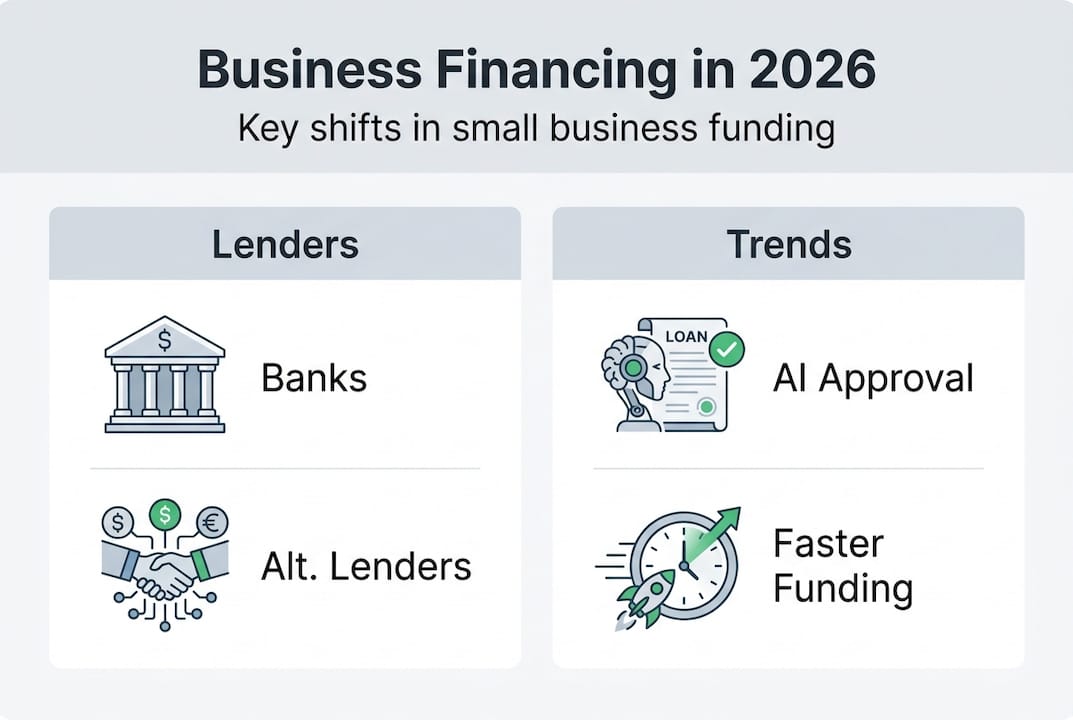
Here is a direct comparison of what you can expect from each type of lender:
| Feature | Traditional banks | Alternative lenders |
|---|---|---|
| Avg. approval time | 2 to 6 weeks | 1 to 3 days |
| Min. credit score | 680+ | 600+ |
| Min. time in business | 2+ years | 6 to 12 months |
| Approval rate | 25 to 30% | 45 to 55% |
| Rate range | 6 to 12% | 10 to 40% |
So why are so many owners still defaulting to banks first? Habit, mostly. And a mistaken belief that a bank loan carries more legitimacy. In practice, non-bank lender options have matured significantly. They offer structured repayment terms, transparent fee disclosures, and real support for businesses that do not yet meet a bank's rigid criteria.
The key pain points with banks are well documented:
- Slow decisions: Many applicants wait 4 to 6 weeks, only to receive a rejection.
- High credit bar: A 680 minimum score excludes a large share of viable businesses.
- Rigid requirements: Banks typically require 2 years of financials, collateral, and a strong debt service coverage ratio.
- Limited flexibility: Loan structures rarely adapt to a business's actual cash flow pattern.
"Small and medium-sized businesses want what banks have always offered in terms of trust and relationship, but they now expect the speed and simplicity of a fintech. The lenders who deliver both are winning."
For a business owner running lean operations, a 6-week wait is not just inconvenient. It can mean missing a contract, a vendor discount, or a seasonal inventory opportunity. Alternative lenders and fintechs are winning the market because they respect the pace of real business. Understanding 2026 lending trends helps you stop applying to the wrong lenders and start targeting the ones most likely to say yes.
Approval requirements and fast funding: What has changed in 2026?
Now that we have sketched the broad shifts in lender types, let's get specific about what approval now looks like and how technology is making fast funding possible.
The single biggest change in 2026 is the role of artificial intelligence in underwriting. 46% of firms use AI in their lending processes, and the impact on speed is dramatic. Alternative lenders using AI-driven systems achieve a median funding time of 1.8 days, compared to weeks at traditional banks. AI reviews bank statements, revenue trends, payment history, and even industry data simultaneously. It removes the bottleneck of manual underwriting without sacrificing accuracy.

For applicants, this changes what matters most. A loan officer used to make judgment calls. Now, an algorithm does much of the initial screening. That means your documentation must be clean, consistent, and formatted correctly. Gaps, inconsistencies, or missing data will slow down or disqualify your application even if your business is fundamentally sound.
Here is a data table summarizing 2026 approval benchmarks:
| Lender type | Approval rate | Min. credit score | Min. time in business | Funding speed |
|---|---|---|---|---|
| Traditional bank | 25 to 30% | 680+ | 2 years | 2 to 6 weeks |
| Alternative lender | 45 to 55% | 600+ | 6 to 12 months | 1 to 3 days |
| Fintech platform | 50 to 60% | 580+ | 3 to 6 months | Same day to 2 days |
Some common mistakes can derail an otherwise strong application. First, many owners apply for exactly what they think they need, leaving no buffer. If costs rise or a second round of financing is needed quickly, they are back at the beginning. A smarter approach is to request 10 to 25% more than your minimum need, ensuring flexibility. Second, many applicants misread their own approval odds, wasting time at banks that are unlikely to approve them.
Here is a practical checklist for a 2026 loan application:
- Pull your business credit report and resolve any errors at least 60 days before applying.
- Prepare 3 to 6 months of business bank statements in PDF format.
- Have your most recent 2 years of business tax returns ready.
- Create a one-page business summary showing revenue trends and use of funds.
- Document any existing debts, leases, or obligations clearly.
- Research the specific lender's approval criteria before submitting.
Pro Tip: AI underwriting systems flag inconsistencies between your bank statements and your stated revenue. Before you apply, reconcile your records so the numbers match exactly. A clean, consistent financial picture moves faster through automated review than a manually explained discrepancy.
The technology in lending space continues to evolve, and smart funding tips 2026 now emphasize preparation for algorithmic systems as much as relationship building. Owners who treat their documentation as a product to be optimized, not just a requirement to satisfy, tend to move through approval faster and get better terms. You can also explore streamlined finance options designed to cut unnecessary steps from the process entirely.
The role of credit cards, government programs, and alternative products
With requirements and timelines clear, the next puzzle is picking the right financing route. Let's compare key options and how they serve different business types.
Credit cards have become a dominant source of short-term business financing. 50% of SMBs use credit cards for business expenses, despite carrying rates of 18 to 36%. For cash flow gaps that resolve in 30 days, a business credit card can be a practical tool. But using it as a substitute for real capital is expensive and risky. High-rate revolving debt compounds quickly and can erode margins that were already thin.
Government programs remain a strong option for businesses that qualify. In Canada, the CSBFP offers up to $1.15M per loan and directs 74% of its funding to startups less than one year old. That is a striking figure. It means brand-new businesses have a real, government-backed path to substantial capital. Notably, 75.8% of CSBFP borrowers would have been denied financing elsewhere, which underscores how meaningful this program is for early-stage companies. In the US, SBA loans continue to serve established businesses with competitive rates, though the approval process is more involved.
Here is a breakdown of the most relevant financing products in 2026:
- Business credit cards: Best for short-term gaps and daily operating expenses. Rates of 18 to 36% make them costly for large amounts or longer terms.
- SBA loans: Strong for established US businesses with solid credit. Longer approval timelines but competitive rates. Review SBA loan updates for current terms.
- CSBFP loans: Canada's primary government program, ideal for startups and small operators who cannot access traditional bank loans.
- Merchant cash advances: Repayment tied to daily card sales, making them flexible for businesses with variable revenue. Best for short-term needs.
- Invoice financing: Leverages unpaid invoices as collateral. Useful for B2B businesses waiting on slow-paying clients. Learn more about invoice finance as a practical tool.
- Equipment financing: Purpose-specific loans for purchasing machinery, vehicles, or technology. The equipment itself often serves as collateral, lowering the credit bar.
- Business line of credit: A revolving credit facility that lets you draw and repay as needed. Ideal for managing seasonal revenue swings. Explore funding options for growth to compare structures.
Pro Tip: Do not choose a financing product based solely on speed of approval. Match the product to the purpose. Equipment financing for a piece of machinery, a line of credit for ongoing cash flow, and an SBA loan for long-term expansion are each the right tool for a specific job. Mismatching the product to the need costs more in the long run.
Key economic and regulatory trends shaping financing in 2026
Understanding products is just half the story. In 2026, macro trends set the tone for what owners can expect from lenders and rates.
The Federal Reserve's policy direction is arguably the most important external factor for small business borrowers right now. A falling Fed rate is expected to lower borrowing costs heading into 2026, which is genuinely good news for business owners who have been sitting on the sidelines due to rate concerns. Lower rates reduce monthly payments, improve debt service coverage ratios, and make lenders more willing to approve borderline applications.
At the same time, the lending picture is mixed. Recent monthly data shows gains in small business lending volume, but year-to-date figures remain below prior-year levels. Recovery is underway but uneven. Some sectors have rebounded strongly while others are still seeing tighter credit conditions. This means you should not assume favorable macro trends will automatically translate into easy approvals in your specific industry.
Business optimism is lagging. Revenue and employment metrics have held steady for most businesses, but expectations are the lowest since 2020. Owners are cautious, and that caution sometimes leads to under-borrowing at exactly the wrong time. When rates fall and lenders compete for quality borrowers, waiting for confidence to return can mean missing the best window.
Here are the top macro trends to monitor when planning a 2026 financing application:
- Fed rate direction: Track the Federal Open Market Committee meeting schedule. Rate cuts typically lower the prime rate, which directly affects variable-rate business loans.
- Sector-specific credit conditions: Some industries face tighter lending standards than others. Know where your industry stands before applying.
- Inflation and input costs: Rising costs remain the top operational challenge for business owners, compressing margins and affecting debt service capacity.
- Alternative lender market share: Alt lenders continue to grow their share of small business financing, meaning more competition and, often, better terms for borrowers.
- Government program updates: Both the SBA and CSBFP adjust their programs periodically. Check for updated limits, eligibility rules, and guarantee percentages. Review current financing rates to stay informed.
"Rising costs are the number one challenge facing small businesses today, and they are shaping every financing decision owners make." — Federal Reserve Small Business Credit Survey, 2026
The practical implication is direct: apply for financing before rates bottom out, not after. Locking in favorable terms early gives your business the capital it needs to grow while your competitors wait for certainty that may never fully arrive. Understanding financing for business growth in this macro environment means reading the signals and acting on them rather than reacting after the fact.
Our perspective: How to position your business for smarter funding in 2026
Most financing guides tell you to chase the lowest interest rate. That advice sounds logical, but in practice, it leads owners to the wrong lenders. A 6% bank loan that takes 8 weeks to process and carries a 25% approval rate is not a better deal than a 15% alternative loan that funds in 2 days if you need capital now. The rate is one variable. Speed, approval likelihood, and flexibility are equally important, and often more so.
At Capital for Business, we have worked with thousands of business owners across hundreds of industries since 2009. What we see consistently is that the businesses that thrive are not always the ones with the lowest borrowing costs. They are the ones that accessed capital at the right moment and used it effectively. Timing and readiness matter more than rate optimization.
Building a fintech-ready financial profile is now a practical priority, not a nice-to-have. That means maintaining clean, reconciled books, documenting revenue trends monthly, and establishing a relationship with at least one alternative lender before you urgently need one. Diversifying your funding sources, rather than relying on a single lender or product type, gives you resilience when conditions shift.
Do not wait for business optimism to return before seeking capital. The owners who secure funding when conditions favor borrowers are the ones positioned to take advantage of growth opportunities when they appear. More financing insights can help you build a specific plan.
Pro Tip: Set a monthly calendar reminder to review Fed rate announcements and your own cash position together. Timing a financing application to coincide with a rate cut can meaningfully lower your borrowing cost without changing any other element of your plan.
Unlock the right financing for your business's growth
The trends are clear: faster approvals, more accessible products, and a market that increasingly rewards prepared borrowers. If you have read this far, you already understand more about the 2026 financing landscape than most of your competitors do. The next step is turning that knowledge into action.
At Capital for Business, we specialize in connecting small business owners with financing that fits their actual situation, not just their credit score. Whether you need to explore easy loan types that match your business stage or you are ready to secure working capital to cover immediate operating needs, we move quickly and work transparently. Since 2009, we have helped business owners in hundreds of industries access the capital they need when banks could not deliver. Visit Capital for Business to review your options and connect with a financing specialist who understands your goals.
Frequently asked questions
What type of lender is fastest for business funding in 2026?
Alternative lenders and fintechs, using AI underwriting, typically fund in about 1.8 days on average, far faster than traditional banks which can take several weeks.
How have approval rates changed at banks vs non-bank lenders?
In 2026, banks approve 25 to 30% of applicants requiring 680+ credit, while alternative lenders approve 45 to 55% of applicants with credit scores as low as 600 and as little as 6 months in business.
What government programs are most active for small businesses in 2026?
The CSBFP in Canada and SBA loans in the US are the leading programs. The CSBFP offers up to $1.15M per loan and directs the majority of its funds to newer businesses.
Are interest rates for small business loans going up or down in 2026?
Rates are expected to decrease as the Fed eases monetary policy, which should lower borrowing costs and improve loan accessibility for small businesses throughout 2026.
What are the most common mistakes when applying for business financing?
The most frequent mistakes are applying for too little capital and submitting documents that are inconsistent or incomplete. Apply 10 to 25% more than your minimum need and ensure your financial records are clean and reconciled before submitting to any lender.