
TL;DR:
- SBA loan rates in 2026 comprise a base rate and a lender spread, affecting total costs.
- New rate options like SOFR and Treasury yields provide potential savings compared to Prime-based rates.
- Understanding rate structures and choosing the right index can lead to significant interest savings.
If you've tried to figure out your SBA loan rate lately, you're not alone in feeling confused. The rules changed significantly in 2026, and many small business owners are still working with outdated assumptions about how these rates are set. The WSJ Prime Rate sits at 6.75% as of April 2026, but that's only part of the picture. New base rate options, lender spreads, and regulatory updates all factor into what you'll actually pay. Understanding the full structure isn't just useful trivia. It could save you thousands over the life of your loan and help you make smarter decisions about when and how to borrow for your business.
Table of Contents
- How SBA loan rates are set in 2026
- Current SBA loan rates: What you'll actually pay
- Why SBA rates change: Market factors and what's new in 2026
- Choosing the best SBA loan for your business needs
- Why understanding SBA rate structures can give you an edge
- Get help finding your best loan rate
- Frequently asked questions
Key Takeaways
| Point | Details |
|---|---|
| 2026 rule changes | SBA lenders can use several base rates with a Prime-based cap, adding flexibility for borrowers. |
| Current Prime benchmark | The WSJ Prime Rate is 6.75% as of April 2026 and acts as the ceiling for SBA rates. |
| Alternatives often lower | Alternatives like SOFR or Treasuries are typically lower than Prime, but all rates are capped. |
| Know your rate components | SBA loan rates include a base (like Prime) plus a lender’s spread—knowing both is key to better borrowing. |
| Compare and negotiate | Understanding rate structures helps you secure the best loan for your business needs in 2026. |
How SBA loan rates are set in 2026
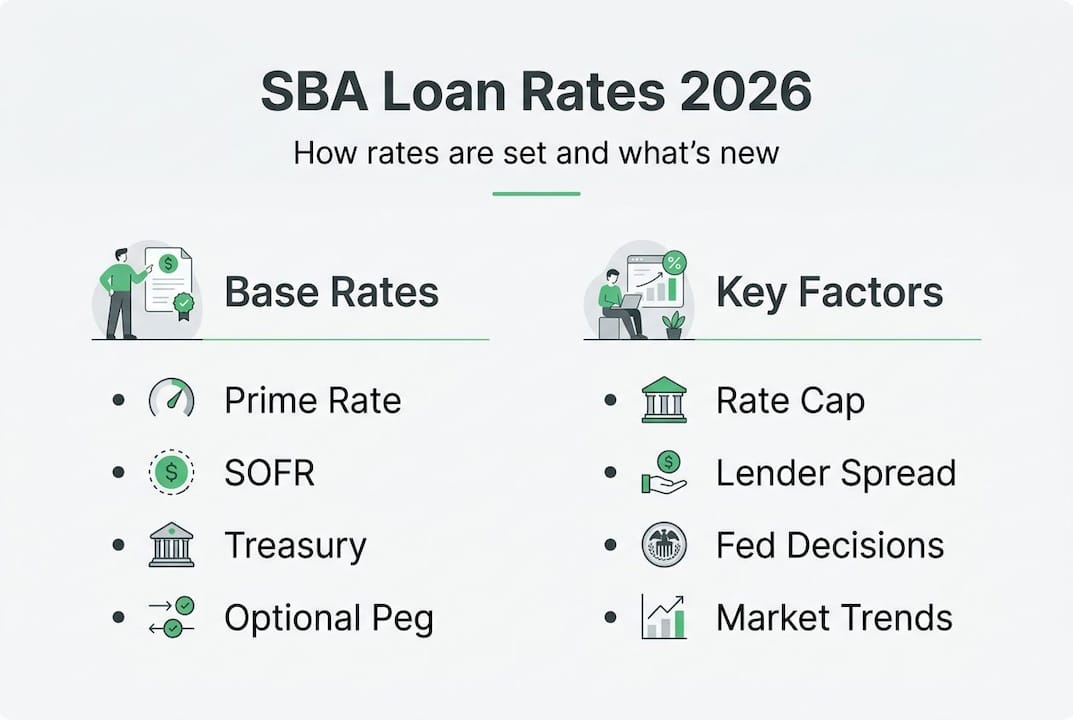
SBA loan rates aren't pulled from thin air. Every rate you're quoted is built from two core components: a base rate and a spread. The base rate is a market benchmark, an index that reflects broader economic conditions. The spread is the additional percentage a lender adds on top of that base. Together, they form your total interest rate.
For years, the Wall Street Journal Prime Rate was the only base rate option for SBA 7(a) variable loans. That changed in 2026. Thanks to SBA rule changes that took effect March 1, 2026, lenders now have more flexibility in which index they use. This is a significant shift that directly affects what rate you're offered.
As of March 1, 2026, SBA 7(a) variable rates can be based on any of the following:
- WSJ Prime Rate: Currently 6.75%
- 30-day SOFR (Secured Overnight Financing Rate): Approximately 3.65% to 3.67%
- 5-year Treasury yield: Approximately 3.92%
- 10-year Treasury yield: Approximately 4.30%
- SBA Optional Peg Rate: 4.50%
Each of these indexes moves differently. Prime tends to follow Federal Reserve decisions closely, while Treasury yields respond to bond market activity. SOFR tracks short-term lending conditions between banks. Knowing which one your lender is using matters because it determines how your rate could shift over time.
Here's a quick overview of how these base rates compare:
| Base rate | Approximate rate (2026) | Sensitivity |
|---|---|---|
| WSJ Prime Rate | 6.75% | High (Fed-driven) |
| 30-day SOFR | ~3.66% | Moderate |
| 5-yr Treasury | ~3.92% | Moderate |
| 10-yr Treasury | ~4.30% | Lower |
| SBA Optional Peg | 4.50% | Fixed quarterly |
The SBA still enforces a cap on how much lenders can charge. For most 7(a) loans, the maximum spread above Prime is set by loan size and term. Lenders can't simply pile on fees or margins beyond what SBA rules allow. This cap protects you from rate gouging, even when market conditions are volatile.
Pro Tip: Before signing any loan agreement, ask your lender directly which base rate index they're using. This one question can help you predict how your payments might change and compare offers more accurately across lenders.
Current SBA loan rates: What you'll actually pay
Now that you know how rates are selected, let's see what those numbers actually look like for new SBA loans.
The WSJ Prime Rate is 6.75% as of April 2026. Most SBA 7(a) variable-rate loans are still quoted using Prime as the base. Lenders then add their spread, which typically ranges from 2.25% to 2.75% depending on loan size and term. That puts most borrowers in the 9.00% to 9.50% range when using Prime.

Here's how the total estimated rate looks across different base rate options, using a typical lender spread of 2.75%:
| Base rate | Base rate % | Lender spread | Estimated total rate |
|---|---|---|---|
| WSJ Prime | 6.75% | +2.75% | 9.50% |
| 30-day SOFR | 3.66% | +2.75% | 6.41% |
| 5-yr Treasury | 3.92% | +2.75% | 6.67% |
| 10-yr Treasury | 4.30% | +2.75% | 7.05% |
| SBA Optional Peg | 4.50% | +2.75% | 7.25% |
Those differences are real money. On a $500,000 loan over 10 years, the gap between a 9.50% rate and a 6.41% rate could mean tens of thousands of dollars in additional interest payments.
To walk through a sample calculation:
- Start with your chosen base rate (e.g., 30-day SOFR at 3.66%)
- Add the lender's spread (e.g., 2.75%)
- Your starting interest rate is 6.41%
- Confirm whether the rate is fixed or adjustable, and how often it resets
- Factor in any SBA guarantee fees, which are separate from the interest rate
One important nuance: even though lower base rates like SOFR look attractive, the SBA still caps the maximum rate at Prime plus the allowed spread. So if SOFR plus a lender's margin somehow exceeded that cap, the cap would apply. In practice, SOFR-based rates are well below the cap right now, making them genuinely favorable.
Expert insight: In high-Prime environments like the current one, flexibility in choosing your base rate is more valuable than ever. The new 2026 options give borrowers real leverage, but only if they know to ask for them. Timing your loan application with awareness of business loan timing can make a meaningful difference in your total borrowing cost.
Why SBA rates change: Market factors and what's new in 2026
Having seen current rates, you might wonder why they change and especially what's new this year.
SBA loan rates don't move on their own. Several forces drive them up or down:
- Federal Reserve policy: When the Fed raises or lowers the federal funds rate, Prime typically follows within days. This is the single biggest driver of SBA variable rates.
- Treasury yields: These reflect investor expectations about inflation and economic growth. When yields rise, Treasury-based SBA rates rise too.
- Economic cycles: During recessions, rates often fall as the Fed tries to stimulate borrowing. During growth periods, they tend to climb.
- Inflation expectations: High inflation usually leads to higher rates as the Fed tightens monetary policy.
- Lender risk assessments: Individual lenders adjust their spreads based on your creditworthiness, industry risk, and loan structure.
What's genuinely new in 2026 is the addition of alternative base rates for SBA 7(a) loans. The SBA added SOFR, Treasury yields, and the Optional Peg as approved benchmarks. This was partly a response to the global transition away from LIBOR and partly an effort to give small businesses more options in a high-Prime environment.
The numbers make the case clearly. While Prime is at 6.75%, the 30-day SOFR sits near 3.66%, a gap of more than 3 percentage points. For a business borrowing $300,000, that difference compounds into significant savings over a 7-year term.
What stays the same is the protection built into the system. All lenders must follow the SBA's rate caps regardless of which base rate they choose. This prevents any lender from using a low base rate as a bait-and-switch while stacking on an oversized spread. The cap is tied to Prime plus the maximum allowed margin, so the ceiling is clear and consistent.
Staying current on lending trends in 2026 and broader 2026 financing trends can help you anticipate rate movements before they affect your loan.
Pro Tip: When comparing lenders, don't just ask for the rate. Ask which base rate index they're using and what their spread is. Two lenders quoting the same total rate might be using very different structures, and one could be far more favorable if rates shift.
Choosing the best SBA loan for your business needs
Armed with a clear view of the rates, your next step is picking the right loan product and rate structure for your goals and risk level.
Not all SBA loans work the same way. Here's a quick breakdown of the main options:
- SBA 7(a) loans: The most common type, used for working capital, equipment, real estate, and refinancing. Variable rates are standard, though fixed-rate options exist for some structures.
- SBA 504 loans: Designed for major fixed assets like commercial real estate or heavy equipment. These typically carry fixed rates tied to Treasury yields, making them predictable.
- SBA Express loans: Faster approval, smaller amounts (up to $500,000), and slightly higher rates. Good for businesses that need speed over the lowest possible cost.
- SBA lines of credit: Revolving access to funds, usually variable-rate. Useful for managing cash flow gaps rather than one-time purchases.
The rate structure you choose matters as much as the rate itself. Here's how to think through it:
- Fixed-rate loans lock in your payment. They're ideal if you expect rates to rise or if your cash flow is tight and you need predictability.
- Variable-rate loans can start lower but fluctuate. They work well when rates are expected to drop or when you plan to pay off the loan quickly.
- Index-based rates (SOFR, Treasuries) offer a newer option with potentially lower starting points, but you need to understand how often they reset.
With SBA 7(a) variable rates now tied to multiple market indexes, the decision is more nuanced than it used to be. Matching your loan structure to your business timeline is critical.
Common mistakes to avoid:
- Choosing a variable rate without understanding how often it adjusts
- Ignoring SBA guarantee fees when comparing total loan costs
- Focusing only on the interest rate while overlooking prepayment penalties
- Picking a loan term that's too long, which increases total interest paid
- Not exploring all funding options in 2026 before committing to one product
Your risk tolerance and project timeline should guide the decision. A 10-year expansion loan calls for different thinking than a 2-year equipment purchase. Review 2026 financing tips to match your strategy to current market conditions.
Why understanding SBA rate structures can give you an edge
Most small business owners approach SBA loans with one question: what's the rate? That's understandable. But it's also the reason many businesses end up paying more than they need to.
The real advantage doesn't come from finding the lowest number on a rate sheet. It comes from understanding how that number was built. When you know the base rate, the spread, and the cap structure, you can ask better questions. You can push back on a lender's spread if it seems high. You can choose a base rate index that fits your outlook on the economy. You can spot when a lender is using a low teaser rate that could reset unfavorably.
Businesses that focus only on the headline rate often miss the bigger picture. A loan with a slightly higher rate but no prepayment penalty might save you more money if you plan to pay it off early. A loan tied to SOFR might look great today but requires you to understand how that index behaves over time.
We've seen this pattern repeatedly at Capital for Business. The clients who get the best outcomes aren't always the ones who got the lowest rate. They're the ones who understood the structure well enough to negotiate from a position of knowledge. Staying informed about loan policy updates is part of that process.
This proactive approach separates high-growth businesses from those that simply react to whatever terms they're offered. Rate literacy is a real competitive advantage, and it costs nothing to develop.
Get help finding your best loan rate
Navigating SBA loan rates in 2026 is more complex than it used to be, but that complexity also creates real opportunity for businesses that are prepared.
At Capital for Business, we work with small business owners every day to compare SBA options, alternative lending products, and easy small business loans that fit their specific situation. Whether you're looking for the lowest rate, the fastest approval, or the most flexible terms, our team can help you find the right match. Explore our full range of business funding solutions or connect directly with a lending specialist through Capital for Business to get started. The 2026 rate environment rewards informed borrowers. Let us help you be one of them.
Frequently asked questions
What is the SBA loan rate based on as of 2026?
SBA 7(a) variable rates can now be based on Prime, SOFR, Treasury yields, or the SBA Optional Peg, but the total rate is capped at Prime plus a set spread to protect borrowers.
How often do SBA loan rates change?
SBA loan rates can adjust monthly or quarterly depending on the lender's chosen base rate and loan terms, since benchmarks like the WSJ Prime Rate respond to Federal Reserve decisions that occur throughout the year.
What's the current Prime Rate for SBA loans in 2026?
The WSJ Prime Rate as of April 2026 is 6.75%, which serves as the most common base rate for SBA 7(a) variable loans.
Are alternative base rates lower than Prime right now?
Yes, options like 30-day SOFR and Treasury yields are currently well below Prime, but the final rate is still subject to the SBA's maximum cap tied to Prime plus the allowed spread.
Can I negotiate my SBA loan rate?
You can't change the base rate index or the SBA's cap, but you may be able to negotiate the lender's spread within SBA-allowed limits, especially if you have strong credit and a solid business history.