

The fastest way to reduce credit card processing fees is to run a statement audit, switch flat-rate or tiered pricing to interchange-plus, and move large invoices to ACH. Layer in cash-discount pricing where your state allows it, submit Level 2 or Level 3 data on B2B transactions, and tighten fraud controls to cut chargebacks. Each of these targets a different part of your bill, and together they attack the number that actually matters: your effective rate.
Your effective rate is total processing fees divided by total card volume, multiplied by 100. A retailer running $50,000 a month with $1,500 in fees has a 3% effective rate, well above the typical benchmark most healthy retail accounts should see. E-commerce merchants tend to run higher, since card-not-present transactions carry steeper interchange.
- Pull your last three processor statements and calculate your effective rate today.
- Circle every fee line you don't recognize. Call and ask what it is.
- Ask your processor for interchange-plus pricing in writing.
- If you invoice B2B clients over $500, ask about ACH.
Pro Tip: Do the effective rate math before you call your processor. A number in hand changes the conversation from "can you lower my rate" to "here's what I'm paying and here's what I expect."
Table of Contents
- What Determines Your Credit Card Processing Fees Reduction Strategy?
- Which Tactics Cut Processing Costs the Most?
- How Do You Put These Fee Reduction Tactics Into Action?
- What Should You Negotiate When Comparing Processor Quotes?
- Are Surcharges and Cash Discounts Legal for Small Businesses?
- When Does Switching Processors Actually Pay Off?
- How Capital for Business Helps You Lower Processing Costs
- How Small Businesses Can Cut Card Processing Costs Fastest
- Why the Standard Advice on Processing Fees Falls Short
- Get Help Lowering Your Card Processing Costs
- Sources
- FAQ
What Determines Your Credit Card Processing Fees Reduction Strategy?
Every card swipe generates three separate charges, and only one of them is negotiable. Interchange goes to the cardholder's bank and is set by Visa, Mastercard, Discover, and American Express based on card type, transaction method, and your merchant category code. Assessments are small network fees, also fixed. Processor markup is the only piece your sales rep actually controls, and it's where most of the negotiating room lives.
This structure explains why two businesses with identical volume can pay wildly different effective rates. A restaurant swiping cards in person with debit and standard credit cards pays less in interchange than an online retailer taking card-not-present rewards cards, because rewards cards and remote transactions carry higher interchange categories by design. Card-present transactions also settle at lower rates than typed-in or online entries, since the network assumes less fraud risk when a physical card is present.
Track this monthly, not annually.
- Interchange: set by card networks, non-negotiable, varies by card type and transaction method
- Assessments: small flat network fees, non-negotiable
- Processor markup: the fee your provider adds on top, fully negotiable
- Seasonal shifts: holiday spikes in rewards-card usage or online orders can push your effective rate up temporarily even with no pricing change
Which Tactics Cut Processing Costs the Most?
Not every fix delivers the same payoff, and knowing where to start saves you weeks of fiddling with settings that barely move the needle.
- Switch to interchange-plus pricing. This is generally the single highest-impact move for merchants processing over $10,000 a month, since it strips out the padded markup hidden inside flat-rate and tiered plans. Real-world estimates put the savings around $90 a month at that volume level, and savings scale up from there as volume grows.
- Audit your statements line by line. PCI non-compliance fees, batch fees, and "reporting" fees show up more often than they should, and many are simply mistakes or leftovers from an old plan.
- Route large invoices through ACH. Card networks charge interchange as a percentage, but ACH transfers typically carry flat or capped fees, which makes them dramatically cheaper on a $5,000 invoice than a 2.5% card swipe.
- Submit Level 2 or Level 3 data on B2B and commercial-card transactions. Adding fields like tax amount, customer code, and line-item detail can shave roughly 0.5% to 1.0% off interchange per transaction, which adds up fast for businesses with heavy commercial-card volume.
- Add a cash-discount or surcharge program. Cash discounting offers a lower price for cash or debit and a higher listed price that reflects card acceptance costs, and it's legal nationwide when priced and disclosed correctly. Surcharging works differently and carries state-by-state restrictions, so confirm your state's rules before adding a card surcharge line.
- Tighten fraud and chargeback controls. Using AVS, CVV verification, and 3D Secure on card-not-present sales reduces disputes, and fewer chargebacks means fewer chargeback fees and less risk of your account getting flagged as high-risk.
- Batch daily and favor card-present entry. Processors often charge more for late batch settlement, and manually keyed transactions settle at a higher interchange tier than a tapped or swiped card.
Moving from flat-rate to interchange-plus also unlocks something most merchants never realize they're missing: debit routing. Flat-rate plans usually don't pass along the savings from routing debit transactions through the cheapest available network, while interchange-plus accounts on a routing-capable gateway capture that savings directly.
How Do You Put These Fee Reduction Tactics Into Action?
Turning a priority list into lower bills takes a few concrete tasks, not a vague commitment to "watch fees more closely."
- Build a monthly effective rate tracker. Set up a simple spreadsheet with columns for total card volume, total fees, effective rate, and a note field for anything unusual that month (a big online sale, a new client on ACH, a spike in chargebacks).
- Run the statement audit script. Call your processor and ask directly: "What is this PCI compliance fee for, and can it be waived if I complete the SAQ?" Ask the same question for any batch fee, statement fee, or line marked "misc" or "other."
- Turn on ACH acceptance. Most gateways and processors support ACH as an add-on. Ask for the flat-fee structure (often a small fixed fee or a fee capped at a low dollar amount) rather than a percentage rate, and negotiate that cap down if you send high volume.
- Enable Level 2/3 data fields. Your invoicing or POS software needs to support tax amount, invoice number, customer reference, and line-item detail. If it doesn't, ask your processor which upgrade or plugin adds this, since it's often a checkbox setting rather than a system overhaul.
- Adjust your POS and gateway settings. Confirm daily batch closing is automatic, turn on AVS and CVV requirements for card-not-present sales, and ask your processor whether debit routing is active on your account. Test any change on a slow day before rolling it out at full volume.
- Effective rate tracker: volume, fees, rate, notes
- Statement audit: PCI fee, batch fee, statement fee, misc/other line
- ACH setup: flat fee or capped fee, minimum invoice size to route through ACH
- Level 2/3: tax amount, invoice number, customer code, line-item detail
- POS settings: daily batch close, AVS/CVV on, debit routing confirmed
What Should You Negotiate When Comparing Processor Quotes?
That transparency is the entire point. You can see exactly what the processor keeps, versus a flat-rate plan that blends everything into one number you can't take apart.
Before signing anything, get these items itemized in writing:
- Monthly minimum or account fee
- Batch fee and statement fee amounts
- Chargeback fee per dispute
- Early termination fee and contract length
- PCI compliance fee and how to waive it
When negotiating, bring your documented monthly volume and effective rate to the table, ask for interchange pass-through pricing specifically, and request that any junk fees be waived outright rather than reduced. If a processor insists on tiered pricing, ask them to itemize which transactions fall into which tier and why.
Pro Tip: Run the numbers before you switch. Weigh that against any switching costs or early termination fee on your current contract.

Are Surcharges and Cash Discounts Legal for Small Businesses?
Cash-discount programs are legal across the country when structured as dual pricing, meaning you post a card price and a lower cash price with clear signage, rather than tacking on a hidden fee at checkout. Surcharging, which adds a fee specifically for card use, faces restrictions in some states, so confirm your state's rules before adding a surcharge line item.
PCI compliance status matters more than most merchants realize. Completing the annual Self-Assessment Questionnaire typically removes the monthly non-compliance fee your processor charges, often within one billing cycle.
- Post signage at the register and online disclosing dual pricing or surcharge amounts.
- Notify your processor before launching a cash-discount or surcharge program.
- Complete your PCI SAQ annually to avoid recurring non-compliance fees.
- Consult your processor or an attorney for state-specific edge cases. General guidance isn't a substitute for legal advice on your specific situation.
When Does Switching Processors Actually Pay Off?
Switching only makes sense when the total cost of ownership drops, not just the headline rate. Compare your true effective rate, monthly platform fees, reconciliation overhead, and any volume-based pricing tiers you'd lose by switching.
Prioritize processors that support Level 2/3 data, ACH or pay-by-bank acceptance, debit routing, and clear dispute management reporting. Watch for red flags: vague tiering structures, bundled "service fees" that aren't itemized, long early termination fees, or chargeback policies that penalize you beyond the dispute itself.
- Negotiate with your current processor first using your documented effective rate.
- Request a written quote itemizing interchange, assessments, and markup separately.
- Simulate your actual monthly fees against last year's statements before committing.
- Switch only if net savings clearly exceed any termination or setup costs.
How Capital for Business Helps You Lower Processing Costs
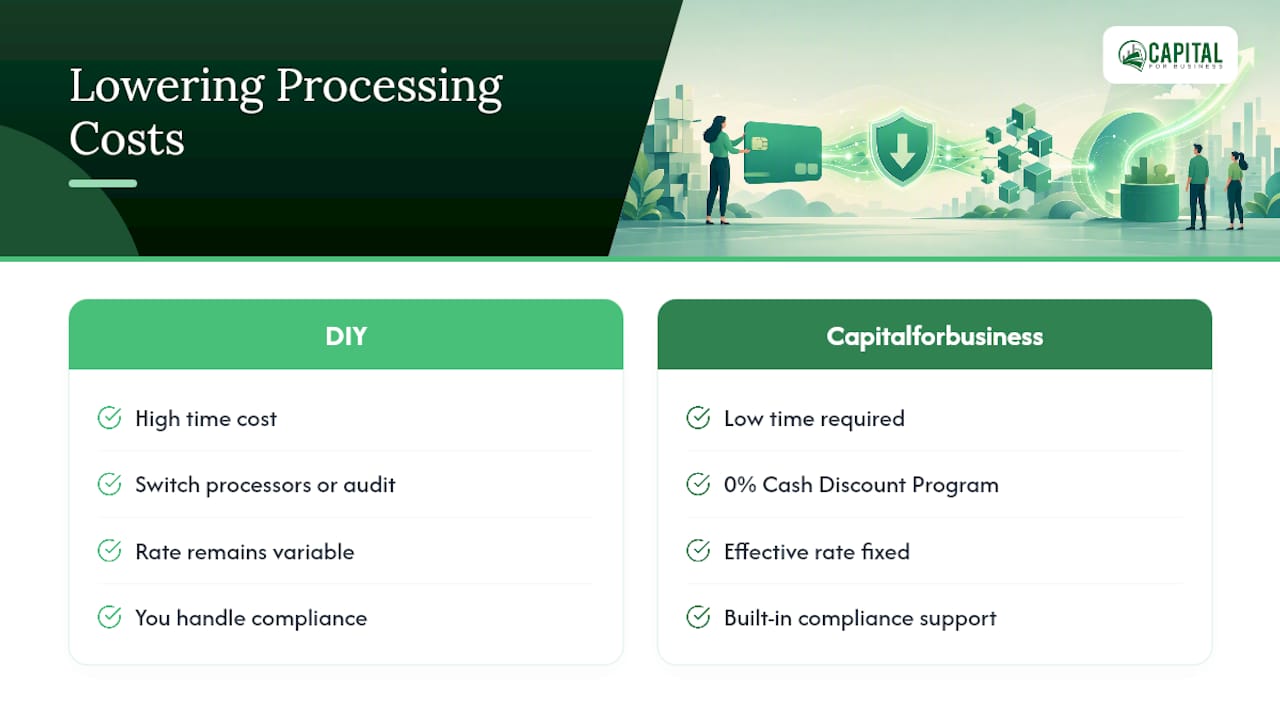
Capital for Business offers credit card processing solutions built around the 0% Cash Discount Program, which shifts card acceptance costs into the listed price rather than your bottom line, often bringing your effective rate close to zero on qualifying transactions. The program includes compliance support and transparent statement reporting, so junk fees don't quietly creep back in.
- Full setup support for compliant signage and disclosure
- Ongoing PCI compliance guidance
- Support for ACH acceptance alongside card processing
- A dedicated point of contact instead of a call center queue
| Point | Details |
|---|---|
| Cash discount programs | Can bring effective rate near zero on qualifying card transactions when structured correctly. |
| Compliance support | Includes PCI guidance and statement transparency to prevent junk fees from returning. |
How Small Businesses Can Cut Card Processing Costs Fastest
Combining a statement audit with a switch to interchange-plus pricing and ACH for large invoices typically delivers the fastest measurable drop in effective rate.
| Point | Details |
|---|---|
| Track your effective rate monthly | Divide total fees by total card volume every month to catch creeping costs early. |
| Audit statements for junk fees | PCI, batch, and reporting fees are often mistakes or leftovers from an old plan. |
| Move big invoices to ACH | Flat or capped ACH fees beat percentage-based card fees once ticket size climbs. |
| Use Level 2/3 data for B2B | Adding invoice detail can cut interchange by roughly 0.5% to 1.0% per transaction. |
| Capital for Business cash discount | The 0% Cash Discount Program can push effective rate near zero on qualifying sales. |
Why the Standard Advice on Processing Fees Falls Short
Most guides treat fee reduction as a single decision: find the cheapest processor and sign. That advice ignores the part that actually saves money over time, which is measurement. A merchant who tracks effective rate monthly catches a creeping markup in week one. A merchant who signs a new contract and walks away doesn't notice until the damage compounds over a year.
The other blind spot is treating cash-discount programs as a gimmick rather than a legitimate structural fix. Done correctly, with proper signage and processor notification, it addresses the root cost rather than shaving a fraction of a point off markup through negotiation. Negotiating interchange-plus pricing matters, and so does cleaning up junk fees. But for a business tired of watching card fees eat into margin every month, a program built to bring the effective rate near zero solves the problem at the source instead of managing it indefinitely. Start with the audit and the math. Then decide whether restructuring how you accept cards makes more sense than continuing to negotiate around the edges.
— Capital
Get Help Lowering Your Card Processing Costs
Auditing statements and switching pricing models yourself takes time most business owners don't have between running daily operations and managing cash flow. Capitalforbusiness built its credit card processing and 0% Cash Discount Program specifically for owners who want the effective rate fixed, not just explained.

Unlike a straight processor swap, this approach restructures how card acceptance costs hit your bottom line in the first place, with compliance support built in so signage and disclosure requirements are handled correctly from day one. If cash flow is part of what's driving your fee concerns, Capitalforbusiness also offers working capital funding to bridge the gap while you implement changes. Reach out to discuss your current statements and find out what your effective rate could look like under a cash-discount structure.
This article is general information, not a substitute for advice from a qualified financial advisor. Consult a qualified financial professional about your own circumstances before acting on anything here.
Sources
These sources cover the legal and regulatory backdrop referenced throughout this guide, along with tactical breakdowns worth bookmarking.
- How to Reduce Your Credit Card Processing Fees | U.S. Chamber of Commerce
- How to Actually Lower Your Credit Card Processing Fees | Merchant Alternatives
- FTC guidance on electronic payments
FAQ
Is It Illegal to Charge a 3% Credit Card Fee?
It depends on your state and whether the fee is structured as a surcharge or built into cash-discount pricing. Surcharging above the rate your card brand allows, or surcharging in a state that restricts it, can violate both state law and your processor agreement, so confirm your state's specific rules before setting a fee.
Does Paying Twice a Month Lower Processing Fees?
Payment frequency to your processor doesn't directly lower your fees. What matters is your effective rate, driven by pricing model, card mix, and transaction type, not how often you settle payroll or bills elsewhere.
What Company Has the Lowest Credit Card Processing Fees?
No single processor has the lowest fees for every business, since your effective rate depends on your card mix, transaction type, and pricing model.
Can Merchants Charge a 2% Surcharge on Credit Card Payments?
Merchants can surcharge in most states as long as the fee doesn't exceed the cap set by card network rules and state law, and proper signage discloses the charge. A handful of states restrict or ban surcharging outright, so verify your state's current rules before adding one.