
TL;DR:
- Microloan lending provides small loans up to $50,000 for entrepreneurs who cannot access traditional bank financing. It combines flexible credit standards, nonprofit support, and manageable repayment terms to help early-stage and underserved businesses secure capital. This approach emphasizes mentorship and tailored financing for small needs, fostering long-term growth and financial discipline.
Microloan lending is defined as the practice of offering small loans, typically up to $50,000, to entrepreneurs and small business owners who lack access to traditional bank financing. The SBA Microloan program is the most widely recognized example in the United States, with an average loan size of around $13,000. What is microloan lending beyond a simple dollar figure? It is a funding model built around accessibility, where credit flexibility, nonprofit lender support, and manageable repayment terms combine to give early-stage and underserved businesses a real path to capital. If you have been turned away by a bank or simply need a smaller, targeted injection of funds, microloans for small businesses may be exactly the right fit.
What is microloan lending and how does it work?
Microloan lending works by connecting borrowers with nonprofit intermediary lenders who receive funding from programs like the SBA and then distribute it to qualifying small businesses. The process differs from a standard bank loan in one critical way: the lender is not just a source of money. Nonprofit intermediaries provide technical assistance and business counseling alongside the loan itself, helping borrowers build the skills to use the capital well.

Loan amounts, rates, and repayment terms
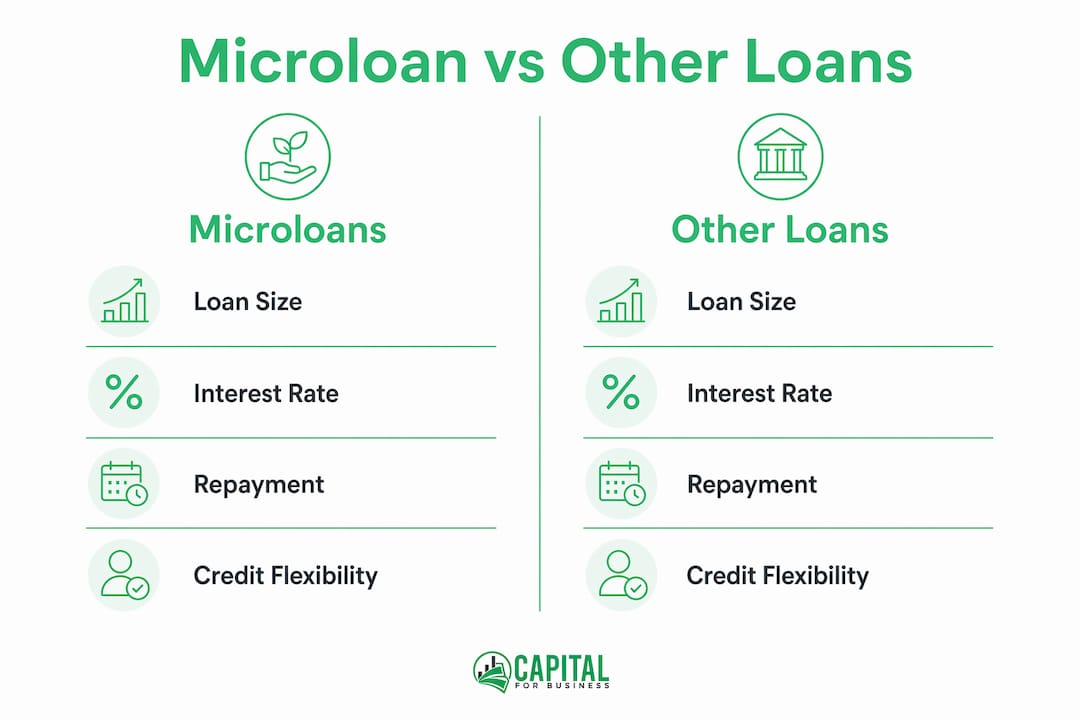
The SBA Microloan program caps loans at $50,000, with the average disbursement sitting near $13,000. Interest rates typically fall between 5% and 13%, and repayment terms extend up to six or seven years. That structure makes microloans far more affordable than credit cards, which commonly carry rates of 20%–30%. You can review current SBA rate benchmarks to compare where microloan rates stand today.
Credit score flexibility
Many successful microloan borrowers carry credit scores near 600, well below the 700+ threshold most traditional banks require. That flexibility opens the door for startups and newer businesses that have not yet built a strong credit profile. Lenders compensate for lower scores by requiring business counseling and, in some cases, collateral or a personal guarantee.
How funds are disbursed
Some microlenders do not deposit funds directly into your account. Instead, they pay vendors directly to make sure the money goes toward the stated purpose. This approach reduces the risk of budget overruns and keeps projects on track. It also means you need to plan your spending carefully before the loan closes.
Typical timeline
Funding via SBA microloans takes roughly 4–6 weeks from application to disbursement. That timeline depends on how prepared you are and how quickly the intermediary lender processes your file. Having your documents ready from day one shortens the wait considerably.
Pro Tip: Before you apply, ask your prospective microlender whether they disburse funds directly to you or to your vendors. That single detail shapes how you plan your budget and which expenses you can cover.
What are the benefits and potential drawbacks of microloans?
Microloans carry a distinct set of advantages that traditional loans simply cannot match for early-stage businesses. They also come with real limitations worth understanding before you commit.
Top benefits of microloans for small businesses
- Lower loan thresholds. Microloans are sized for real, specific needs. If you need $8,000 for equipment or $15,000 for inventory, you are not forced to borrow $100,000 and carry unnecessary debt.
- Hands-on lender support. Nonprofit microlenders provide mentorship and strategic spending advice that traditional banks do not offer. That guidance often matters more than the money itself.
- Better rates than credit cards. SBA microloan rates of 5%–13% compare favorably to credit card rates that routinely exceed 20%. The savings on interest alone can fund additional growth.
- Accessible credit standards. Borrowers with scores near 600 qualify regularly. This makes microloans one of the few formal lending products available to businesses that are still building their financial history.
- Poverty and income impact. An Aspen Institute study found that more than 50% of microloan recipients escaped poverty within five years, with household assets growing by nearly $16,000 and reliance on public assistance dropping by more than 60%. That data confirms microloans do more than fund a purchase. They change financial trajectories.
Potential drawbacks to consider
Microloans are not a universal solution. The loan cap of $50,000 limits their usefulness for businesses that need significant capital for major expansion. Some lenders also restrict how you can use the funds, prohibiting purchases like real estate or debt refinancing. You may be required to attend business counseling sessions before approval, which adds time to the process. And while credit standards are flexible, lenders still evaluate your creditworthiness, your business plan, and sometimes your personal finances.
Understanding these limits helps you decide whether a microloan fits your current phase of growth or whether a different product makes more sense.
How do microloans compare to other small business funding options?
Choosing the right funding product depends on your loan size, credit profile, how quickly you need funds, and whether you want lender support. The table below compares microloans with four common alternatives.
| Funding type | Typical loan size | Interest rate range | Repayment term | Credit requirement | Lender support |
|---|---|---|---|---|---|
| SBA Microloan | Up to $50,000 | 5%–13% | Up to 7 years | ~600+ | Yes, nonprofit mentorship |
| Bank term loan | $50,000–$500,000+ | 6%–12% | 1–10 years | 700+ | Minimal |
| Credit card | Up to $25,000 | 20%–30% | Revolving | 650+ | None |
| Merchant cash advance | $5,000–$500,000 | Factor rate varies | 3–18 months | 500+ | None |
| Business line of credit | Up to $250,000 | 8%–24% | Revolving | 600+ | Minimal |
Microloans sit in a specific niche. They are best for businesses that need less than $50,000, want structured repayment, and benefit from lender guidance. Bank term loans offer larger amounts but require stronger credit and more documentation. Credit cards are fast but expensive. Merchant cash advances work well for revenue-generating businesses that need speed, not mentorship. A business line of credit offers flexibility but typically requires a more established financial track record.
The key differentiator for microloans is the support layer. No other product on this list pairs capital with structured business counseling. For a first-time entrepreneur or a business in its early years, that combination has measurable value. You can also explore small business lending technology to understand how modern platforms are changing access to all of these products.
Pro Tip: If your immediate need is under $25,000 and you want guidance alongside funding, a microloan almost always beats a credit card on both cost and support. Run the numbers on total interest paid over 12 months before you decide.
What practical steps can entrepreneurs take to secure a microloan?
Securing a microloan requires preparation. Lenders evaluate your business plan, your credit, and your readiness to use the funds responsibly. The steps below give you a clear path from interest to approval.
- Check your credit score first. Pull your personal and business credit reports before you apply. Scores near 600 are workable, but knowing your number lets you address any errors or outstanding issues in advance.
- Define your loan purpose clearly. Microlenders want to know exactly what the money will fund. Whether it is equipment, inventory, working capital, or marketing, a specific use case strengthens your application and speeds up underwriting.
- Prepare a written business plan. Most microlenders require a business plan that covers your revenue model, target market, and financial projections. Keep it concise but specific. Vague plans raise red flags.
- Gather your financial documents. Collect at least two years of tax returns if available, recent bank statements, a profit and loss statement, and any existing debt schedules. Having these ready before you contact a lender saves weeks.
- Find a qualified nonprofit intermediary. The SBA maintains a directory of approved microloan intermediaries by state. Organizations like Accion Opportunity Fund and local community development financial institutions (CDFIs) are common options. Each lender has its own focus areas and eligibility criteria, so research two or three before applying.
- Complete required business counseling. Many SBA microloan intermediaries require counseling sessions before or during the application process. These sessions are not a formality. They help you refine your plan and demonstrate to the lender that you are serious about using the funds well.
- Submit your application and follow up. Once submitted, stay in contact with your lender. Respond to document requests within 24 hours. Delays on your end extend the 4–6 week timeline.
- Understand the disbursement method. Ask upfront whether funds go to you or directly to vendors. If the lender pays vendors, confirm which suppliers they will work with and what documentation those vendors need.
The entrepreneurs who move through this process fastest are the ones who treat the application like a business presentation, not a form to fill out. Every document and every answer should tell a coherent story about your business and your plan.
Key takeaways
Microloan lending is the most accessible formal financing option for early-stage entrepreneurs, combining affordable rates, flexible credit standards, and nonprofit mentorship that traditional bank loans do not provide.
| Point | Details |
|---|---|
| Microloan definition | Small loans up to $50,000 designed for entrepreneurs who cannot access traditional bank financing. |
| SBA program terms | Average loan of $13,000, rates of 5%–13%, repayment up to 7 years. |
| Credit flexibility | Borrowers with scores near 600 qualify regularly, well below the 700+ bank standard. |
| Nonprofit support | Lenders provide mentorship and counseling, not just capital, improving long-term business outcomes. |
| Application readiness | Prepare a business plan, financial documents, and complete required counseling to speed up the 4–6 week process. |
Why microloans deserve more attention than they get
At Capitalforbusiness, we have worked with small business owners across hundreds of industries since 2009. One pattern shows up consistently: entrepreneurs overlook microloans because they assume the loan amounts are too small to matter. That assumption costs them.
A $13,000 microloan at 8% interest over five years costs far less in total than $13,000 carried on a business credit card for 18 months. The math is not close. Yet we regularly see business owners reach for a credit card because the application is faster and the process feels familiar. Familiarity is not the same as smart financing.
The nonprofit support layer is the part most people underestimate. When a lender sits down with you to review your spending plan and challenge your assumptions, that conversation has real value. It is the kind of feedback that a bank loan officer will never give you. Some of the most financially disciplined business owners I have encountered built that discipline through the counseling process attached to their first microloan.
The loan size limit is real, and it matters. If you need $200,000 to open a second location, a microloan is not your answer. But if you need $20,000 to buy equipment, hire a part-time employee, or bridge a seasonal cash gap, a microloan sized to that specific need is almost always the better choice over a larger loan that leaves you carrying unnecessary debt.
My honest recommendation: explore microloans early in your growth planning, not as a last resort. The businesses that use them strategically tend to graduate to larger financing products with stronger credit profiles and better financial habits. That is not a coincidence.
— Capital
Ready to explore your small business funding options?
Microloans are one piece of a broader funding picture. Capitalforbusiness has helped small business owners nationwide access the right capital at the right time since 2009, from working capital and equipment financing to merchant cash advances and lines of credit.
If you are still mapping out which loan type fits your business phase and growth goals, start with a clear overview of your options. Capitalforbusiness makes it straightforward to compare products and find funding that fits your actual needs, not just what a bank is willing to offer. Explore the full range of easy small business loans available to you, or connect with our team directly to discuss what your business qualifies for today.
FAQ
What is the microloan definition in simple terms?
A microloan is a small business loan, typically under $50,000, offered to entrepreneurs who do not qualify for traditional bank financing. The SBA Microloan program is the most common example in the United States.
Who qualifies for microloans?
Most microloan programs accept borrowers with credit scores near 600, making them accessible to startups and businesses with limited credit history. Lenders also evaluate your business plan, intended use of funds, and willingness to complete required business counseling.
How does a microloan work compared to a bank loan?
A microloan works through nonprofit intermediary lenders that provide both capital and business support, while a bank loan provides funds only. Microloans carry lower credit requirements, smaller loan amounts, and structured repayment terms up to seven years.
How long does it take to get a microloan?
The SBA microloan process typically takes 4–6 weeks from application to funding. Applicants who prepare their documents and complete counseling requirements in advance move through the process faster.
Can microloan funds be used for any business expense?
Not always. Many microlenders restrict fund use to specific purposes such as equipment, inventory, or working capital. Purchases like real estate or refinancing existing debt are commonly excluded. Always confirm permitted uses with your lender before applying.