

An MCA renewal is a new merchant cash advance that pays off what you still owe on your current one and sends you the difference. It is a new contract with its own pricing, not an extension of the old one. That means the number that matters is not the headline amount on the offer. It is what reaches your bank account after the payoff, set against what you will repay in total. For a contractor, restaurant owner or shop owner who is partway through an advance and has just received a renewal offer, that is the comparison to make before signing.
We fund merchant cash advances at Capital for Business, so this guide walks through the renewal the way we would explain it to an owner across the table: when the offer comes, how the math works, what the contract should say, and what to do if the payments are already heavy.
TL;DR
- A renewal is a new advance. Your remaining balance is paid off from the new funds, and you receive the rest.
- Compare net proceeds against total repayment on the new contract, not the headline amount.
- A merchant cash advance carries a fixed fee (a factor), so paying it back early does not reduce the cost the way it would on an interest-bearing loan.
- Check the payment adjustment clause, any confession of judgment, and whether the new advance would stack on top of other financing.
- If renewing keeps resetting your balance, a term loan or line of credit may fit your cash flow better.
Table of Contents
- What an MCA renewal actually is
- When renewal offers typically arrive
- How the payoff and the net proceeds are calculated
- What a renewal costs, and how to compare it
- Contract terms to read before you sign
- The risk to watch: renewing in a cycle
- Renewal, refinancing and other ways to restructure
- How to decide: a short routine
- Our perspective
- Looking at a renewal or a new advance with us
- FAQ
- Sources
What an MCA renewal actually is
A merchant cash advance is not technically a loan. The FTC's 2020 staff perspective on small business financing describes it as a purchase of a business's future receivables, repaid daily, where the business owes the advance plus a factor, often between 20% and 50% of the amount advanced. The same paper notes these advances are usually repaid within a few months to a year.
Because the term is short, many owners reach the point where the advance is largely paid down while the business still needs working capital. That is when a renewal offer appears. In practice, a renewal works like this:
- The provider reviews how the current advance has performed and offers a new advance.
- The new advance is used first to pay off the remaining balance on the old one.
- Any funds left over are paid to you.
- A new factor, a new total repayment amount and a new remittance schedule begin.
The difference from taking a second, separate advance is what happens to the old balance. In a renewal the old balance is closed out with the new money, so you carry one obligation. With a separate advance, both stay open and both draw on your receipts. That second situation is called stacking, and we cover it below because it is the main risk to avoid.
When renewal offers typically arrive
There is no federal rule that sets a threshold for renewal. Eligibility comes from the contract and from the provider's own underwriting, so the point at which you qualify varies from one provider to another. What owners tend to see is an offer once a meaningful share of the current advance has been repaid and the payment history has been steady.
What providers generally look at is the same material they looked at the first time:
- Recent bank statements showing deposits and daily balances
- Card processing volume, if the advance is repaid through card sales
- Whether payments have been made on schedule
- Any other financing that now sits against the same revenue
Our own underwriting guide explains that small firms should bring three to six months of statements, and the same preparation helps on a renewal. Having clean, recent statements ready means you can review an offer at your own pace instead of reacting to a deadline.
A renewal offer does not oblige you to take it. If the advance is on track and you do not need more capital, you can let it run to completion. If you do need capital, the offer is one option among several, and it is worth comparing it with the alternatives described later.
How the payoff and the net proceeds are calculated
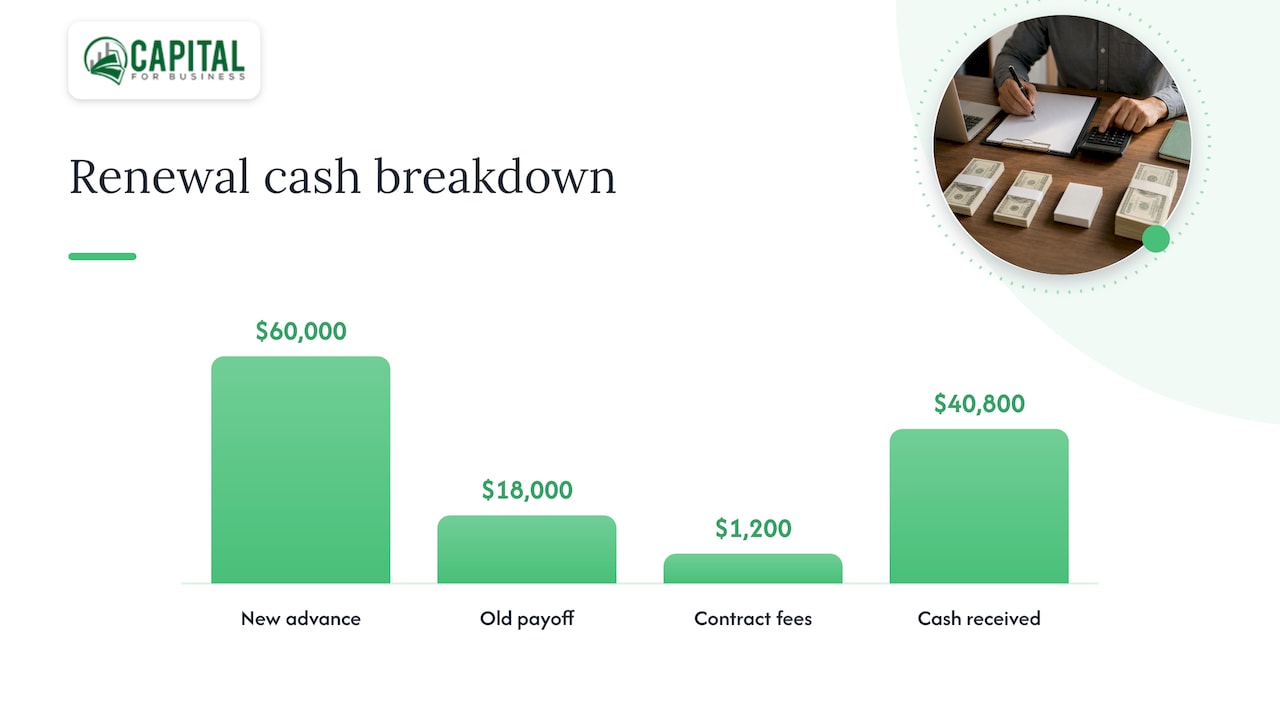
This is the part that surprises owners most. A renewal offer might say $60,000, but you will not receive $60,000. The payoff of the old advance comes out first.
Here is a worked example with round numbers, for illustration only:
| Line | Amount |
|---|---|
| New advance (headline amount) | $60,000 |
| Remaining balance on current advance | $18,000 |
| Fees stated in the new contract | $1,200 |
| Cash you actually receive | $40,800 |
Now look at the other side. If the new advance carries a factor of 1.25, the total you owe on the new contract is $75,000, whatever the speed of repayment. The question for your business is whether $40,800 of working capital justifies a $75,000 obligation, and over what period.
Two checks make this concrete:
- Ask for the payoff figure in writing. The balance should be the amount still owed on the old contract, not the original total.
- Divide the net proceeds into the total repayment. In the example, $75,000 against $40,800 means you repay about $1.84 for each dollar that reaches you. The factor on the headline amount looks lower than that, because part of the new advance went to the old balance.
That second number is the honest cost of the new money. It is the one to compare with any other offer, including a term loan or a line of credit.
Why early payoff does not save money
Owners used to personal credit often assume that paying early cuts the cost, as it does when interest accrues daily. The FTC staff paper cautions that small business owners may assume business financing products accrue interest and offer prepayment savings, and it points to Federal Reserve staff research finding that some small businesses wrongly assumed they would save money by repaying MCAs early. In fact these products require fixed fees regardless of how quickly they are repaid.
That has a practical effect on a renewal. If your current advance has a fixed total, the unpaid portion of the fee is still part of what has to be settled when the new advance closes. Ask the provider whether any discount applies to early settlement, and have the answer written into the new contract rather than assumed.
What a renewal costs, and how to compare it
Pricing on a renewal is set on the new advance. The factor, the term and the daily or weekly remittance can all differ from your original contract. Put the two side by side before you decide.
| What to compare | Current advance | Renewal offer |
|---|---|---|
| Funding amount | ||
| Factor rate | ||
| Total to repay | ||
| Fees | ||
| Payoff of old balance | ||
| Net cash to you | ||
| Daily or weekly payment | ||
| Expected term |
Fill in every row. If a row is blank on the offer, ask for it. A provider that is confident in the terms will state them plainly.
It also helps to convert the cost to something you can set against a loan. The FTC paper notes that MCAs typically have estimated APRs in the triple digits. A short term with a fixed fee produces a high annualized figure even when the dollar fee seems modest, and that is why dollar cost, net proceeds and payment size are the more useful comparisons for an owner. Our guide to cash advance fees for small business owners breaks down what each fee line means.
Disclosure rules in some states
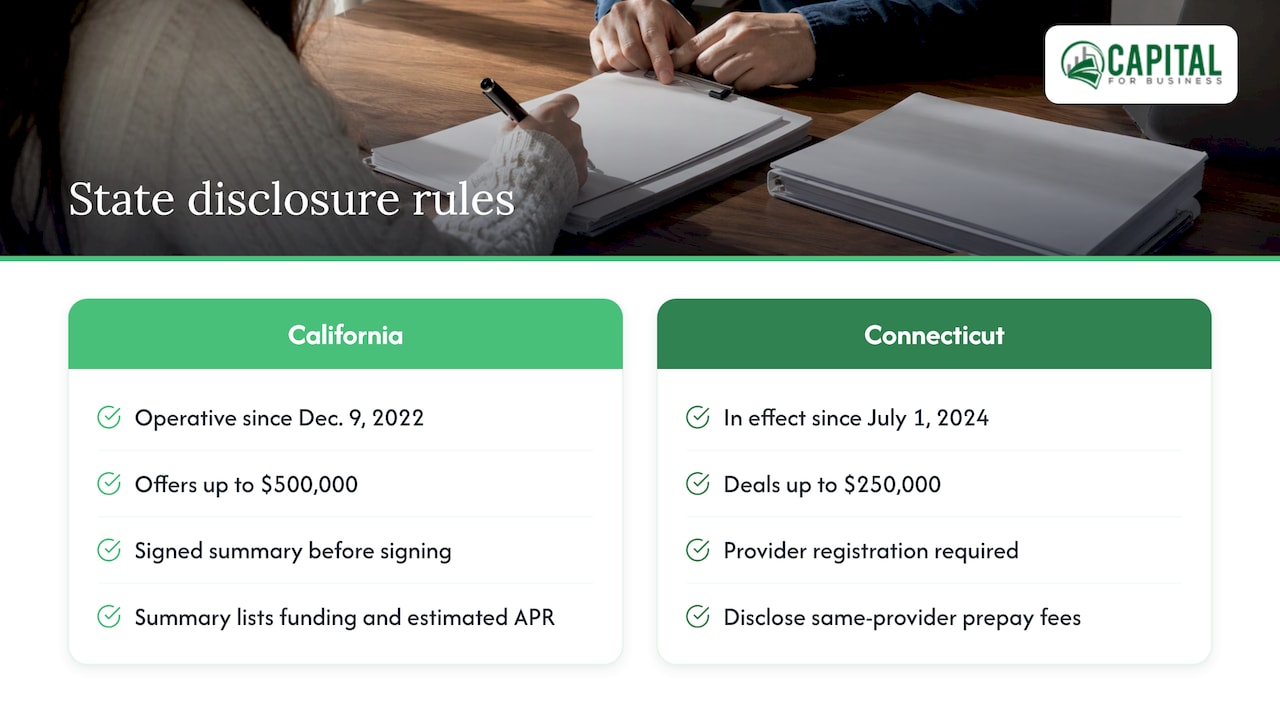
Some states require providers to put the key numbers in front of you before you sign. California's SB 1235 has been operative since December 9, 2022. Under the Department of Financial Protection and Innovation's regulations, offers of $500,000 or less must come with a signed summary showing the funding provided, the estimated APR, the finance charge in dollars, the estimated total payment, the estimated payment and term, and the prepayment cost.
Connecticut has a similar commercial financing law, in effect since July 1, 2024, covering deals up to $250,000. According to a state-by-state summary from a law firm, it requires registration and, for renewals, disclosure of prepayment charges when a new financing pays off an existing financing from the same provider.
These rules are specific to those states. If your business operates elsewhere, the same figures are still the ones to ask for. Use that list as your own checklist, whatever state you are in.
Contract terms to read before you sign
A renewal is a fresh contract, so every clause applies again. Four deserve particular attention.
Payment adjustment when sales change
Most MCAs are repaid as a share of daily receipts or as a fixed daily debit with a reconciliation provision, a clause that lets you ask the provider to adjust payments when revenue falls. The FTC staff paper says it would be concerning and potentially unlawful if providers fail to adjust payment amounts to reflect a decrease in sales. For a seasonal business, this clause matters a great deal. A landscaping company in January or a flower shop after Mother's Day has very different deposits than in peak weeks.
Before you sign, ask how and when you can request an adjustment, what documents are needed and how fast the provider responds. A Senate Banking Committee letter of May 22, 2024 observes that reconciliation mechanisms are sometimes rarely used in practice, so a clear written process is the thing to look for.
Confession of judgment
A confession of judgment (COJ) is a clause in which the business owner waives the right to contest a collection lawsuit. The FTC paper explains that its Credit Practices Rule generally does not apply to small business contracts, and that New York has enacted a law prohibiting creditors from using COJs against small businesses outside the state. If a renewal contract contains one, read it closely and have an attorney review it.
Personal guarantee and security
Check whether the contract carries a personal guarantee, a lien on business assets, or a UCC filing (a public notice that a lender has a claim on your business property). These can differ between your original contract and the renewal.
Prepayment and renewal language
Look for how the contract treats a future renewal and any prepayment cost. The same questions you asked this time will come up again at the next offer.
The risk to watch: renewing in a cycle
The FTC staff paper warns that businesses desperate for funding can be pushed to renew their advances or to take out multiple MCAs at the same time, which can encumber the same receipts. The Senate Banking Committee letter goes further. It describes a troubling similarity to payday lending, where repeated rollovers keep borrowers in a cycle of debt.
We read that as a signal to watch your own numbers. Each of these is a sign that renewals are replacing a plan rather than supporting one:
- Your net proceeds shrink with each renewal because the payoff grows.
- Daily payments take a larger share of deposits than they did at the start.
- You are using new funds mostly to cover the old payments.
- Another provider has an advance open against the same receipts.
If you see two or more of these, step back from the renewal and look at the structure of your financing. Our piece on loan stacking risks explains how multiple obligations compound on a small business.
Renewal, refinancing and other ways to restructure
These three terms are used loosely, so it helps to separate them.
- Renewal: a new advance from the same provider that pays off the old one and sends you the remainder.
- Refinancing: moving the balance to a different product or provider, often a term loan or line of credit with a lower cost over a longer period.
- Restructuring: changing the payment terms of your existing advance, such as a smaller payment over a longer time, usually negotiated after payments have become hard to meet.
Which fits depends on the reason you are looking. If you need capital for a specific purpose and your payments are comfortable, a renewal can be a straightforward way to get it. If the daily debit is straining your cash flow, a longer-term product with a single predictable payment may suit you better.
Which Capital for Business products fit
We offer several alternatives to a repeat advance. The listed starting prices are published on our site:
| Product | Listed price | Typical fit |
|---|---|---|
| Business Term Loans | from 7% | A defined project with a set repayment schedule |
| SBA Loans | from 6% | Longer-term growth where you can wait for the process |
| Business Line of Credit | from 1.2% per month | Recurring or uneven cash needs, drawn as needed |
| Equipment Financing | from 0.8% per month | A truck, an oven, an HVAC machine or other equipment |
| Working Capital Loans | from 1.5% per month | Operating expenses and short-term gaps |
| Merchant Cash Advance | from 1.15 one-off | Fast access tied to your sales |
A line of credit, for example, lets you draw only what you need. Equipment financing ties the loan to the asset you are buying, so a contractor replacing a skid steer does not have to use a revolving advance for a purchase that lasts years. Our overview of different types of small business loans shows how these compare.
How to decide: a short routine
Use this order when a renewal offer lands in your inbox.
- Get the payoff figure. Confirm the remaining balance on your current advance in writing.
- Calculate net proceeds. Subtract the payoff and fees from the new funding amount.
- Compute dollars repaid per dollar received. Total repayment divided by net proceeds.
- Compare the payment. Convert the daily or weekly remittance to a monthly figure and set it against your average monthly deposits.
- Read the clauses. Adjustment, COJ, guarantee, prepayment, renewal language.
- Check for other obligations. Any other advance or loan against the same receipts?
- Ask for alternatives. If a term loan or line of credit would cost less for the same purpose, compare it side by side.
When you do this with us, our team can walk through the numbers with you. We work with owners across construction, restaurants, retail, HVAC, plumbing, electrical and other trades, and the same method applies to each. Our merchant cash advance workflow guide shows what to expect from application to funding.
Our perspective
We have worked with business owners in hundreds of industries since 2009, and the pattern behind a good advance is simple: the money should have a job, and the repayment should fit the way the business earns.
A renewal can fit that pattern when the first advance did its job and the next need is clear, for instance a second truck once the first is paying for itself. It works least well when it is used to make a payment feel smaller for a few weeks.
That is why we put the numbers on the table: net proceeds, total repayment and payment size. Our merchant cash advance is listed from 1.15 one-off, and the products next to it, from equipment financing at 0.8% per month to term loans from 7%, exist so an owner can match the product to the purpose instead of using one tool for everything.
Our positioning is to fund quickly, as soon as 24 hours, for a broad range of credit profiles, and to offer flexible terms when banks and credit unions turn an applicant down. If you are weighing a renewal, we will help you set it next to the other options so the decision rests on your own figures.
Capital
Looking at a renewal or a new advance with us
If you are comparing a renewal with other ways to fund your next step, our merchant cash advance offers funding of up to $500K, and our funding solutions page lists the working capital, line of credit, equipment and term options in one place. We work with owners in the United States and Canada, and we cover a broad range of credit profiles, including bad credit.

To see which product matches your revenue and your purpose, start from our home page and share your recent statements. Our guide on using a merchant cash advance for growth is a good companion when you are planning what the funds will do.
FAQ
When can I renew a merchant cash advance?
It depends on your contract and the provider's underwriting. Offers usually come after a good share of the advance has been repaid on schedule. Ask your provider in writing what balance and payment history it requires, since no federal rule sets a fixed percentage.
Is a renewal the same as a second advance?
No. A renewal pays off the old advance with the new funds, so you have one obligation. A second advance runs alongside the first, which is stacking and can put two providers' payments against the same receipts.
Does paying early reduce what I owe?
Usually not. According to the FTC staff paper, MCAs require fixed fees regardless of how quickly they are repaid. Ask whether any early settlement discount exists and have it written into the contract.
What should I ask for before I sign a renewal?
Ask for the payoff figure, the net amount you will receive, the total repayment, the payment amount and term, and the process for adjusting payments when sales fall. In California and Connecticut, certain disclosures are required by law for covered offers.
What if the payments are too heavy?
Look at the structure rather than another renewal. A term loan, a line of credit or equipment financing may spread the cost over a longer period with one predictable payment. We can review your statements and show you what fits.
Sources
- FTC Strictly Business Forum Staff Perspective, February 2020
- U.S. Senate Banking Committee letter on merchant cash advances, May 22, 2024
- California DFPI, SB 1235 regulations, Title 10 CCR
- Merchant Cash Advance Laws by State (2026)