
MCA consolidation only helps when it replaces your merchant cash advances with genuinely cheaper financing, and it only makes sense once you've compared total repayment, not just the payment schedule. Most products marketed as "consolidation" are actually reverse consolidation, which usually raises your total cost while leaving the original advances in place. If you're evaluating an offer, start with an SBA or term loan buyout, or a negotiated settlement, before signing anything that quotes a factor rate without a total repayment figure.
TL;DR:
- True consolidation involves a lender paying off your existing MCAs with a documented full payoff and releasing UCC liens, not just refinancing or adding new advances.
- Reverse consolidation typically reduces daily cash flow pressure but often increases total repayment costs by layering obligations and keeping original advances active.
- Always compare total repayment amounts, including APR and total dollar owed, against your current MCA costs before accepting any consolidation offer.
- Negotiating directly with funders or pursuing SBA or bank loans can be cheaper alternatives if consolidation offers do not meet the total-cost or repayment criteria.
- Prioritize written payoff letters and lien releases and conduct math checks by requesting payoff figures, converting payments, and stress-testing repayment capacity before signing any agreements.
Table of Contents
- What Is MCA Consolidation, Really?
- How Each Offer Type Actually Behaves
- When Consolidation Helps: A Practical Checklist
- How to Run the Math: Step by Step
- Alternatives If Consolidation Isn't the Right Fit
- How Capital for Business Helps You Evaluate Your Options
- The Real Problem With Consolidation Marketing
- Get Your MCA Stack Reviewed Before You Sign Anything
- Sources
- FAQ
What Is MCA Consolidation, Really?
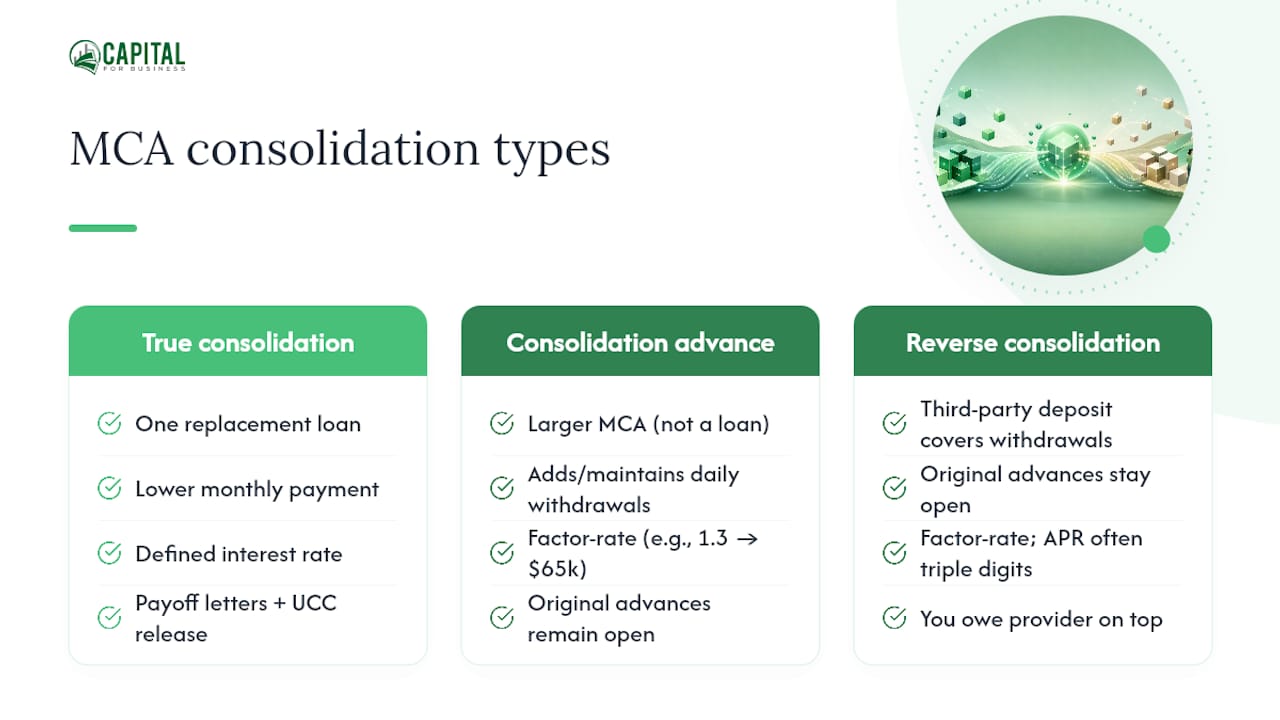
True consolidation means a lender pays off your existing merchant cash advances in full and replaces them with one loan, usually carrying a lower monthly payment and a defined interest rate instead of a factor rate. "Pays off" isn't marketing language here. It means you get a payoff letter from each MCA funder confirming the balance is satisfied, and a UCC lien release filed to clear your business assets of that funder's claim, according to guidance from the MCA Guide.
A consolidation advance, on the other hand, is just a bigger MCA. It still buys a slice of your future receivables. It doesn't retire your existing debt. It stacks on top of it or refinances one advance into a larger one with the same purchase-of-receivables structure, same daily withdrawals, same factor-rate math.
Reverse consolidation is different again: a third-party lender deposits funds into your account to cover your existing MCA withdrawals, smoothing your daily cash flow. The original advances stay open, and you now owe the reverse consolidation provider on top of them.
Factor rates confuse this whole picture. A factor rate of 1.3 on a $50,000 advance means you repay $65,000, but that number alone tells you nothing about the annualized cost. Converted to APR, many MCAs and reverse consolidation products land in triple digits, a fact worth confirming before you sign anything, according to attorney analyses of reverse consolidation structures.
How Each Offer Type Actually Behaves
You can usually identify what you're being offered by watching how the money moves and what happens to your existing balances.
- True loan or SBA buyout. The lender wires funds directly to your MCA funders, you receive payoff letters, and UCC liens get released. Payments shift from daily or weekly withdrawals to one fixed monthly payment.
- Consolidation advance. You get a lump sum, but your old advances often stay active unless you use the proceeds yourself to pay them off. Withdrawals remain daily or weekly, and a new UCC lien gets filed alongside (or instead of) the old ones.
- Reverse consolidation. A new funder deposits cash to cover your existing MCA payments. You now have two obligations layered together, plus an additional lien, even though your day-to-day cash flow feels lighter.
Picture a business with a substantial debt spread across multiple MCAs, all withdrawing daily. A true SBA buyout might convert that into a single manageable monthly payment. A reverse consolidation might significantly reduce the felt daily pressure but increase total repayment by a large amount because you're now servicing two cost structures at once, a pattern documented by MCA Settlement Reviews.
When Consolidation Helps: A Practical Checklist
Before you accept any offer labeled "consolidation," run it through four tests. Skipping any one of them is how business owners end up worse off than when they started.
- Total-repayment test: Add up every dollar you'd owe under the new product and compare it directly against what you'd owe paying off your current MCAs as-is. If the new number is higher, the offer isn't consolidation. It's refinancing at a markup.
- Cash-flow test: Convert every payment cadence, daily, weekly, or monthly, into the same unit so you can compare apples to apples. A payment that looks small daily can equal a brutal monthly figure once you do the math.
- Documentation test: Insist on payoff letters and a written commitment to release UCC liens on your existing advances. The Federal Trade Commission advises borrowers to demand this kind of clarity from any lender before signing.
- Eligibility and timing test: SBA and term loans take longer to underwrite and require stronger financials. If you don't qualify yet, settlement or legal counsel may serve you better than a rushed, expensive reverse consolidation.
Pro Tip: Ask every prospective lender one direct question: "If I add up every payment I'll make under this offer, what's the total dollar figure, and will my existing MCA liens be released?" A lender offering true consolidation will answer both parts without hesitation.
How to Run the Math: Step by Step
The math isn't complicated, but it takes discipline to actually do it instead of just reacting to a lower weekly number.
- List every active MCA with its remaining balance, factor rate, and withdrawal frequency. Request payoff letters from each funder so you know the exact amount needed to clear them.
- Get the new offer's total repayment figure. If it's quoted as a factor rate, multiply it by the funded amount to find total dollars owed, then convert that into monthly and daily equivalents so it matches your current cadence.
- Compare the two totals side by side, and stress-test the comparison against a revenue dip. If sales drop 20% for two months, can you still cover the new payment?
- Request an APR equivalent if the offer only quotes a factor rate, and get written confirmation of how UCC liens will be handled.
The MCA Consolidation Loans review from MCA Settlement Reviews frames this as the single decisive metric: total repayment dollars plus a cash-flow cadence your business can actually survive. Vendors love to talk about smaller weekly payments. They talk a lot less about what you'll owe by the time the term ends.
Alternatives If Consolidation Isn't the Right Fit
If the math doesn't work, or you don't qualify for a true buyout yet, you still have real options, some more painful than others but often cheaper in the long run.
- Negotiate directly with your MCA funders. Ask for a reduced lump-sum payoff or a revised payment cadence. Funders would often rather collect a discounted amount now than risk collecting nothing later.
- Settlement. This can meaningfully cut what you owe, but expect trade-offs: settled debt may trigger tax consequences, and it can affect your credit standing. Get every term in writing before you pay anything. Industry sequencing advice generally favors settling distressed accounts before pursuing refinancing, according to Business Lending Blueprint.
- SBA 7(a) or bank term loan buyout. This is typically the lowest-cost long-term fix for businesses that qualify, per SBA program guidelines and broader financing overviews from NerdWallet.
- Legal counsel or bankruptcy as a last resort. Both carry long-term borrowing consequences, so involve an attorney before you're out of other options, not after.
How Capital for Business Helps You Evaluate Your Options
Capital for Business has worked with small business owners since 2009, funding merchant cash advances and the term financing that eventually replaces them. That dual vantage point matters: we've seen which consolidation offers actually reduce total cost and which ones just repackage the same debt.
A typical engagement starts with a cash-flow review and document gathering, your active MCA balances, payoff letters, and revenue statements. From there, we match you with lending options suited to your numbers, whether that's a merchant cash advance replacement or a path toward SBA and term loan financing. For a deeper look at how repayment mechanics work day to day, our MCA workflow guide walks through the funding cycle in detail.

The Real Problem With Consolidation Marketing
The conventional pitch focuses on relief: smaller payments, less daily stress, one simple bill. That framing isn't dishonest exactly, but it's incomplete in a way that costs business owners real money.
What gets underestimated is how often "lower weekly payment" and "lower total cost" point in opposite directions. A reverse consolidation can genuinely save a business from a cash-flow crisis this month while adding tens of thousands of dollars in obligations over the following year. Both things can be true at once, and a rushed decision under pressure tends to weight the wrong one.
Prioritize the total-repayment math and demand written lien releases over any promise about smaller weekly payments. When the numbers are unclear, or a lender won't answer directly, gather your payoff letters, run the checklist, and talk to a lender or attorney you trust before signing anything.
— Capital
Get Your MCA Stack Reviewed Before You Sign Anything
Capital for Business gives you a direct alternative to guessing your way through a reverse consolidation pitch: a cash-flow review that actually compares total repayment across your options, not just the payment schedule on offer this week.

Our team looks at every active advance you're carrying, matches you against term loan, SBA, or working capital options you may qualify for, and helps you negotiate directly with funders when refinancing isn't yet realistic. We've built this process around one question: does this offer actually lower what you owe? If you're carrying stacked MCAs and need a clear answer, apply for a free review and get a real comparison before your next payment cycle hits.
Sources
- MCA Debt Consolidation 2026: SBA, Term Loans, Reverse | MCA Guide
- Loans - Small Business Administration
- MCA Consolidation Loans: What They Fix, What They Hide (2026) | MCA Settlement Reviews
- FTC — Credit and loans resources
FAQ
Is MCA debt consolidation legit?
True consolidation, where a loan pays off your MCAs in full with documented payoff letters and lien releases, is legitimate and often beneficial for qualifying borrowers. Reverse consolidation is legal but frequently increases total cost, so treat marketing claims skeptically and verify the total repayment figure yourself.
What is MCA loan consolidation?
MCA loan consolidation refers to replacing one or more merchant cash advances with a single loan, ideally at a lower cost and with a fixed monthly payment instead of daily or weekly withdrawals. It only qualifies as true consolidation if the new financing actually pays off and closes your existing advances.
How do you get out of MCA debt?
Start by requesting payoff letters from every active MCA funder, then compare total repayment costs across an SBA or term loan buyout, a negotiated settlement, and any consolidation offer you're considering. Capital for Business can review your full MCA stack and match you with financing options based on that comparison.
What is an MCA debt collector?
An MCA debt collector is a party, sometimes the original funder, sometimes a third party, that pursues repayment on a defaulted or delinquent merchant cash advance, often through UCC lien enforcement or legal action. If you're contacted by one, request written documentation of the debt and consult an attorney before agreeing to new terms.