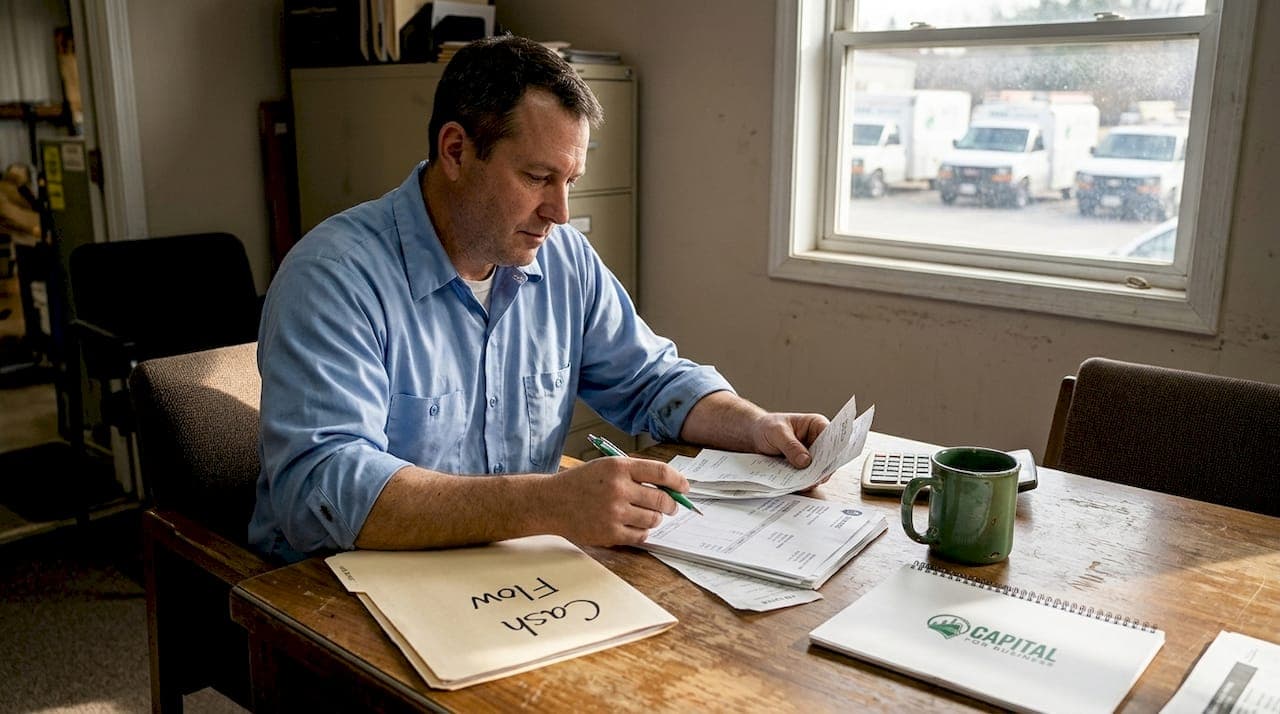
Running an HVAC business means managing unpredictable cash flow almost every day. You finish a major commercial installation, send the invoice, and then wait 30 to 90 days for payment while payroll, parts, and fuel costs keep coming. Receivable cycles of 30 to 90 days create real pressure on working capital, especially heading into slow seasons. Merchant cash advances (MCAs) can bridge that gap fast, but they carry serious costs and operational risks that every HVAC owner needs to understand before signing anything. This guide walks you through the full MCA workflow, from preparation to execution to long-term optimization.
Table of Contents
- Understanding MCAs and HVAC business cash flow challenges
- Preparing to apply: What HVAC owners need before starting the MCA workflow
- Step-by-step merchant cash advance workflow for HVAC companies
- Optimizing MCA use: Monitoring, pitfalls, and alternatives for HVAC
- Get tailored HVAC business financing solutions
- Frequently asked questions
Key Takeaways
| Point | Details |
|---|---|
| MCAs fill short-term gaps | Merchant cash advances provide fast financing but are expensive and risky if not used carefully. |
| Preparation is critical | Gathering the right documentation and assessing cash flow prevents costly missteps before starting the MCA workflow. |
| Know the workflow steps | Follow a structured, step-by-step approach to maximize funding efficiency and minimize surprises. |
| Monitor and seek alternatives | Constantly track repayments, avoid stacking, and compare MCAs to factoring or credit lines to improve financial stability. |
Understanding MCAs and HVAC business cash flow challenges
A merchant cash advance is not a loan in the traditional sense. A lender provides a lump sum of capital upfront, and you repay it by surrendering a fixed percentage of your daily revenue, called the holdback, until the total repayment amount is met. The total you repay is calculated using a factor rate, typically between 1.2 and 1.5, meaning a $50,000 advance at a 1.4 factor rate costs you $70,000 in total repayments.
The appeal is obvious: fast approval, minimal paperwork, and no collateral requirement. Learning the MCA basics helps you see why these products attract small business owners who cannot wait weeks for a bank decision. MCA approval rates reach 70 to 85%, but up to 30% of borrowers struggle during low-revenue months, and annualized costs often exceed 80%.
For HVAC companies specifically, the mismatch between how MCAs work and how HVAC revenue flows is a serious concern. MCAs present elevated risk in seasonal businesses because daily debits continue even when revenue drops in spring or fall shoulder seasons. Explore using MCAs for HVAC carefully before committing.
Here are the core operational pitfalls HVAC owners face with MCAs:
- Daily ACH pulls reduce your bank balance every business day, regardless of whether you collected payments that week
- MCA stacking occurs when owners take a second or third advance to cover the first, creating a debt spiral
- Confession-of-judgment clauses allow lenders to freeze assets without a court hearing if you default
- Margin compression happens when holdback percentages eat into already thin HVAC profit margins
- Bankruptcy exposure increases significantly when multiple advances layer on top of each other
Treat an MCA as a last-resort bridge for a specific, short-term cash need, not as a recurring growth tool. If you find yourself renewing advances repeatedly, that is a signal to explore HVAC business funding options that better match your revenue cycle.
Preparing to apply: What HVAC owners need before starting the MCA workflow
With the basics and risks in mind, here is how to prepare your HVAC business to navigate the merchant cash advance application smoothly. Preparation reduces the chance of accepting a bad offer under pressure.
Gather these documents before you contact any lender:
- Last 4 to 6 months of business bank statements
- Sales records showing monthly revenue trends
- A list of outstanding receivables and their aging (30, 60, 90 days)
- Current debt obligations, including any existing advances or loans
- Business license and basic entity documents
Here is a quick overview of what most MCA lenders require from HVAC applicants:
| Requirement | Typical threshold |
|---|---|
| Time in business | 6 to 12 months minimum |
| Monthly revenue | $10,000 or more |
| Credit score | 500 to 600 minimum (varies) |
| Bank statements | 3 to 6 months |
| Existing advances | Disclosed upfront |
Before you apply, run through this readiness checklist:
- Can your business cover daily ACH withdrawals during your slowest month?
- Do you have a specific use for the funds that will generate returns faster than the MCA cost?
- Have you calculated the effective annual percentage rate (APR) of the offer?
- Are you free of existing MCA obligations, or have you disclosed them fully?
The HVAC receivable cycle of 30 to 90 days often mismatches the daily repayment structure of MCAs, which is why this checklist matters. Review MCA approval requirements to benchmark what lenders will evaluate.
Pro Tip: Before signing any MCA offer, divide the total repayment amount by the advance amount, subtract 1, and annualize that figure based on the expected repayment term. If the effective APR exceeds 80%, compare invoice factoring as an alternative. Factoring converts your receivables into immediate cash without daily debits.
Step-by-step merchant cash advance workflow for HVAC companies
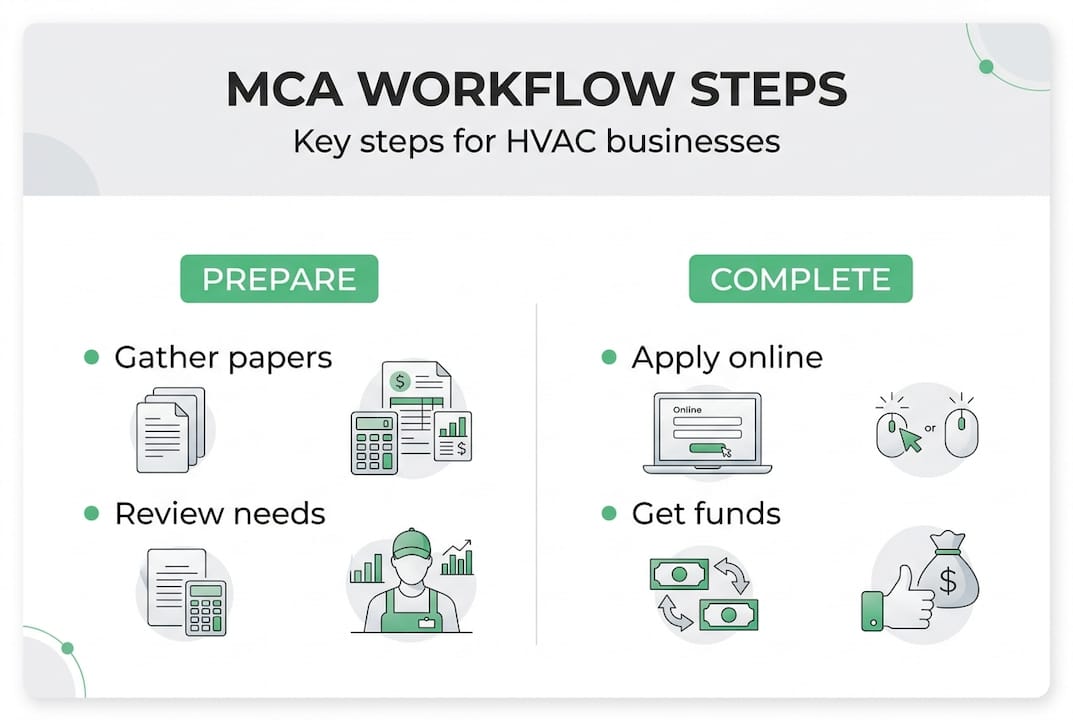
Once your documentation is organized and your risks assessed, you are ready to follow a proven MCA workflow. Here are the steps in sequence:
- Evaluate your specific cash need. Define the exact dollar amount required and the purpose, such as purchasing equipment, covering payroll, or buying parts inventory. Vague funding goals lead to overborrowing.
- Assess your future revenue. Review your pipeline of signed contracts and seasonal booking trends. Estimate your lowest expected monthly revenue over the repayment period.
- Submit your application. Provide all required documents to one lender at a time. Applying to multiple lenders simultaneously can trigger multiple hard inquiries and signal desperation.
- Review all offers carefully. Compare factor rates, holdback percentages, total repayment amounts, and contract terms. Do not focus only on the advance amount.
- Examine legal clauses. 85% of MCAs include fixed daily repayments, and many contain confession-of-judgment clauses that allow asset freezes without court proceedings. Have a business attorney review the contract if possible.
- Sign and set up repayment logistics. Confirm the daily ACH amount and ensure your operating account maintains a buffer to avoid overdraft fees.
- Allocate funds immediately. Deploy capital to the specific purpose you identified in step one. Avoid using MCA funds for general expenses that do not generate revenue.
Here is a comparison of key MCA contract terms to evaluate:
| Contract term | What to look for | Red flag |
|---|---|---|
| Factor rate | 1.2 to 1.35 is reasonable | Above 1.45 is very costly |
| Holdback percentage | 10% to 20% of daily revenue | Above 25% strains cash flow |
| Repayment term | 6 to 18 months | Under 4 months is aggressive |
| Confession of judgment | Absent or limited | Present without negotiation |
| Prepayment discount | Available | No discount option |
Learn how MCAs benefit operations when deployed strategically for specific, revenue-generating purposes.
Pro Tip: Apply for only one MCA at a time. Taking multiple advances simultaneously, known as stacking, dramatically increases your daily repayment burden and is one of the leading causes of MCA-related financial distress for HVAC contractors.
Optimizing MCA use: Monitoring, pitfalls, and alternatives for HVAC
Having completed your MCA funding, here is how to maximize benefits, avoid the biggest risks, and plan for healthier long-term financing.
Ongoing best practices once your advance is active:
- Track daily withdrawals against your actual daily deposits every week, not monthly
- Forecast revenue weekly using your job schedule and signed contracts to anticipate low-cash periods
- Avoid renewing early. Lenders often offer early renewals before you finish repaying, which resets the cost clock and increases total expense
- Maintain a cash buffer equal to at least two weeks of daily ACH payments in your operating account
The most dangerous pitfalls to watch for include asset freezes triggered by confession-of-judgment clauses, margin compression when holdback percentages exceed your net profit margin on jobs, and bankruptcy exposure from stacked advances. MCA debt relief programs exist specifically for HVAC businesses that have layered high-cost advances and need restructuring support.
Calculate your effective APR and margin impact before signing any MCA. If the daily repayment exceeds your average daily net margin, the advance will cost you more than it generates.
If you are already managing stacked advances, contact a business finance advisor immediately. Consolidation or restructuring may reduce your daily payment burden before the situation escalates.
For HVAC businesses with invoice-heavy operations, factoring and lines of credit are often better fits than MCAs. Here is a quick comparison of alternatives:
- Invoice factoring: Converts outstanding receivables into immediate cash. No daily debits. Cost is typically 1% to 5% of invoice value per month.
- Business line of credit: Draw only what you need, when you need it. Interest accrues only on the drawn balance. Better for recurring seasonal gaps.
- Working capital loans: Fixed monthly payments with lower annualized rates than MCAs. Requires stronger credit but offers more predictable repayment.
Explore alternative HVAC loans to find the product that matches your revenue cycle and risk tolerance.
Get tailored HVAC business financing solutions
Navigating MCA offers, contract terms, and repayment logistics is complex, especially when you are also managing technicians, equipment, and customer schedules. Capital for Business has worked with HVAC contractors since 2009, helping owners access MCAs for HVAC growth and a full range of financing products designed for businesses like yours.

Our team can walk you through the complete MCA workflow, analyze your specific cash flow situation, and match you with vetted funding options that fit your revenue cycle. Whether you need a merchant cash advance, a business line of credit, or invoice financing, we move quickly and transparently. Visit our HVAC MCA funding page to start a conversation with a financing specialist who understands the HVAC industry.
Frequently asked questions
What documents do HVAC companies need to apply for an MCA?
You will need recent bank statements, sales history, outstanding receivables, and a list of current debt obligations. MCA lenders evaluate sales history and business bank records to determine eligibility and advance amounts.
How fast can an HVAC business get funded with an MCA?
Many HVAC MCAs fund within 1 to 3 business days after application and approval. Approval rates of 70 to 85% mean most applicants with consistent revenue receive a decision quickly.
What is the biggest MCA risk for HVAC contractors?
Stacked advances, high daily withdrawals, and legal clauses that may freeze assets are the main risks. Confession-of-judgment clauses and stacking can lead to asset freezes and serious financial distress.
Can MCA debt relief help HVAC firms that took multiple advances?
Yes, relief programs exist specifically for high-cost stacked MCA situations. Relief programs for stacked advances can help restructure repayment terms before the situation reaches a crisis point.
Are there better alternatives than merchant cash advances for HVAC cash flow?
Invoice factoring, business lines of credit, and working capital loans are safer options for many HVAC models. Factoring suits invoice-heavy businesses while lines of credit offer more flexibility for recurring seasonal gaps.