
Loan stacking is high-risk for most small businesses. Taking on multiple loans at once raises monthly debt service, can violate the terms of the contracts you've already signed, and often damages your access to credit for years afterward. If you're currently weighing a second, third, or fourth loan offer, the immediate move is simple: stop, list every obligation you already carry, and run a 90-day cash-flow projection before signing anything new.
- Debt service adds up faster than revenue typically does.
- Many loan agreements contain clauses that prohibit additional borrowing without disclosure.
- Credit reporting delays mean lenders may not see your other loans for weeks.
Quick fact: Reuters reporting found that many online lenders' algorithmic underwriting and soft credit inquiries let borrowers secure new loans before existing obligations show up elsewhere.
TL;DR:
- Loan stacking can lead to rapidly increasing debt payments that quickly surpass business revenue, risking default and long-term credit damage.
- Soft credit inquiries and reporting delays of up to 45 days allow multiple loans to be taken out before any lender is aware of existing obligations.
- Concealing or misrepresenting existing debt on new loan applications can constitute fraud and trigger legal consequences under various contractual clauses.
- Taking on multiple loans diminishes future approval prospects by increasing the total debt-service ratio, often ruling out responsible funding options for months.
- The safest approach involves consolidating debt with a single, well-structured product based on actual cash flow, instead of stacking multiple high-cost, short-term loans.
Table of Contents
- What Is Loan Stacking and How Does It Happen?
- Financial Risks to Borrowers: Cash Flow, Interest, and Default
- Why Loan Stacking Threatens Lenders and the Broader Market
- When Does Loan Stacking Cross a Legal Line?
- How Do Soft and Hard Inquiries Reveal Loan Stacking?
- Safer Alternatives and an Action Checklist
- How Loan Stacking Damages Your Reputation and Credit
- Does Loan Stacking Hurt Your Chances of Future Approval?
- Regulatory Measures and Industry Efforts to Curb Stacking
- Predatory Lending and the Gaps That Let Stacking Slip Through
- Strategies to Avoid Loan Stacking Risks
- Publisher Perspective: Lessons From Underwriting and Responsible Funding
- How Capital for Business Offers Responsible Alternatives to Stacking
- Key Takeaways
- Sources
- FAQ
What Is Loan Stacking and How Does It Happen?
Loan stacking means taking out multiple business loans or lines of credit from different lenders within a short window, often without disclosing the other debts to access more capital than any single lender would approve. It's not always intentional fraud. A business owner might apply to three online lenders in one week simply because each application takes ten minutes and approval feels uncertain. The trouble starts once two or three of them say yes.
The mechanics come down to timing. A soft credit inquiry doesn't affect your score and often doesn't alert other lenders the way a hard inquiry does. Combine that with reporting delays of days or weeks, and you get a window where a lender has no way of knowing you were just funded elsewhere.
- Day 1: You apply to Lender A and get approved within hours; funds hit your account by Day 2.
- Day 2: The new debt hasn't yet appeared on your credit file, so you apply to Lender B.
- Day 4: Lender B approves you too, unaware of the loan from two days earlier.
- Day 10 to 14: Both loans finally show up on your credit report, by which point you're already carrying two full payment schedules.
Financial Risks to Borrowers: Cash Flow, Interest, and Default
Stacked loans don't just add up. They compound. A single $50,000 term loan might carry a manageable monthly payment. Layer a merchant cash advance and a short-term online loan on top, and you can end up owing three separate daily or weekly drafts pulling from the same revenue stream.
- Monthly (or daily) debt service climbs faster than most owners expect, since each new loan is priced against your gross revenue, not your remaining cash after existing payments.
- APRs and factor rates don't average out. They stack, meaning your effective cost of capital across all loans combined can run well above what any single lender quoted you.
- Missed payments trigger collections, UCC liens against business assets, and in serious cases, personal liability if you signed a personal guarantee.
Factor rates on merchant cash advances typically run higher than a term loan's APR, and when that cost sits on top of two other repayment schedules, cash flow can collapse within a single bad month. A restaurant owner who takes an MCA to cover a slow season, then stacks a second MCA when the first one bites into daily revenue, often finds both providers pulling from the same merchant account on the same days, according to MoneyCrashers' analysis of stacking risks. That's the vicious cycle lenders and financial advisors warn about most.
Pro Tip: Add up every daily or weekly debit tied to your existing loans and compare that total against your average daily deposits for the last 90 days. If the math is close, a new loan won't fix the shortfall. It will accelerate it.
The endpoint for chronic over-borrowing is rarely dramatic. It's a slow squeeze: late fees stack onto missed payments, one lender files a UCC lien, another calls the loan due in full, and personal guarantees turn a business failure into personal financial exposure. Concepts from financial risk management, particularly liquidity risk, explain why: a business with three overlapping repayment schedules has almost no buffer left when one revenue month underperforms.
Why Loan Stacking Threatens Lenders and the Broader Market
Stacking doesn't only hurt the borrower. It distorts risk for everyone in the lending chain. When a business takes on more debt than its cash flow can service, the odds of default rise across every loan it holds, not just the last one signed.
- Charge-offs climb when lenders can't see a borrower's full debt picture at underwriting, and industry reporting has tied rising stacking activity to elevated loss rates among online lenders, per Lendio's guide to loan stacking.
- Underwriting gaps, largely the product of speed-focused approval processes and incomplete cross-lender data sharing, let stacked applications slip through before anyone catches them.
- Lenders respond by tightening approval criteria, slowing funding timelines, or pricing risk higher across the board, which raises costs for responsible borrowers too.
Reuters reporting describes stacking as a genuine threat to online lenders, noting that fast approvals and soft inquiries have let borrowers pile up debt before it becomes visible to competing lenders.
This is why serious lenders now dig deeper than a credit pull. Capitalforbusiness looks at aggregate debt-service ratios and alternative data like bank deposits and merchant card volume, because a credit report alone often tells only part of the story.
When Does Loan Stacking Cross a Legal Line?
Loan stacking itself isn't illegal. It becomes a legal problem the moment a borrower misrepresents or conceals existing debt to get a loan approved. Lying on an application about your current obligations, or actively hiding a recent loan from a new lender, can constitute civil or even criminal fraud depending on the amounts involved and the state.
Most lending contracts anticipate this risk directly. Common clauses include:
- Negative pledge or "no additional debt" clauses that prohibit borrowing from another lender without written consent.
- Blanket UCC liens on all business assets, which can put a second lender's collateral position at risk the moment they discover an earlier lien.
- Cross-default provisions, where defaulting on one loan automatically triggers default on another.
According to MoneyCrashers, violating these clauses typically gives the original lender the right to call the loan due immediately, refer the account to collections, or pursue legal action. Before signing a new loan, reviewing your existing contract language for these provisions can save you from an escalation you didn't see coming.
How Do Soft and Hard Inquiries Reveal Loan Stacking?
Detection comes down to two types of credit checks. A soft inquiry, common with many online lenders during pre-qualification, doesn't appear on your public credit report and doesn't alert other creditors. A hard inquiry does both, and it's the type traditional banks and SBA lenders typically run before final approval.
- You submit an application, and the lender runs a soft inquiry to pre-qualify you without affecting your score.
- If you accept an offer, some lenders convert to a hard inquiry, which then reports to the bureaus.
- That new debt typically takes one to two reporting cycles, often 30 to 45 days, to actually appear on your credit file.
That lag is exactly the window Reuters flagged when it reported that online lenders' rapid, algorithm-driven approvals let borrowers stack loans before the first one shows up anywhere else.
Safer Alternatives and an Action Checklist
Before applying for another loan, it's worth asking whether a single, larger, better-structured product could solve the problem instead of adding to it. A business line of credit gives you revolving access to funds without the fixed daily payments of a stacked MCA. A single term loan sized to your actual need, equipment financing tied to a specific purchase, or refinancing existing high-cost debt into one payment can all replace the impulse to stack.
When comparing offers, look past the headline number:
- Compare APR or factor rate, not just the payment amount, across every offer.
- Check the term length and any prepayment penalties buried in the fine print.
- Confirm the lender is licensed by searching NMLS Consumer Access before you sign anything.
Pro Tip: Before applying anywhere new, write down every loan you currently hold, its balance, and its payment schedule on one page. If you can't fit it on one page, that's usually a sign you already have too many.
How Loan Stacking Damages Your Reputation and Credit
The credit score damage from stacking rarely comes from one bad decision. It comes from the compounding effect of several small ones. Each hard inquiry shaves a few points off your score, and multiple inquiries within a short window signal risk to anyone pulling your file afterward.
The bigger hit tends to come later. Once payments on stacked loans get tight, missed or late payments start reporting to business and personal credit bureaus alike, especially when you've signed a personal guarantee, which most alternative lenders require. A single 30-day late payment can sit on your report for years and drag your score down well after you've caught up on payments.
Reputational damage compounds the financial hit. Vendors who extend trade credit, landlords reviewing a lease renewal, and even future lenders reviewing your bank statements can all see the pattern of multiple daily debits hitting your account. That pattern alone, independent of your actual credit score, reads as financial distress to anyone underwriting your next request. A business that looks strapped for cash struggles to negotiate favorable terms anywhere, whether that's a supplier discount or a lease extension.
The irony is that stacking, done to solve a short-term cash crunch, often creates a longer-term credibility problem that outlasts the original shortfall by months or years.
Does Loan Stacking Hurt Your Chances of Future Approval?
Yes, and often more severely than borrowers expect. Once a lender's underwriting process flags your aggregate debt-service ratio, meaning the total percentage of monthly revenue already committed to existing loan payments, a new application becomes much harder to approve regardless of how strong your business fundamentals otherwise look.
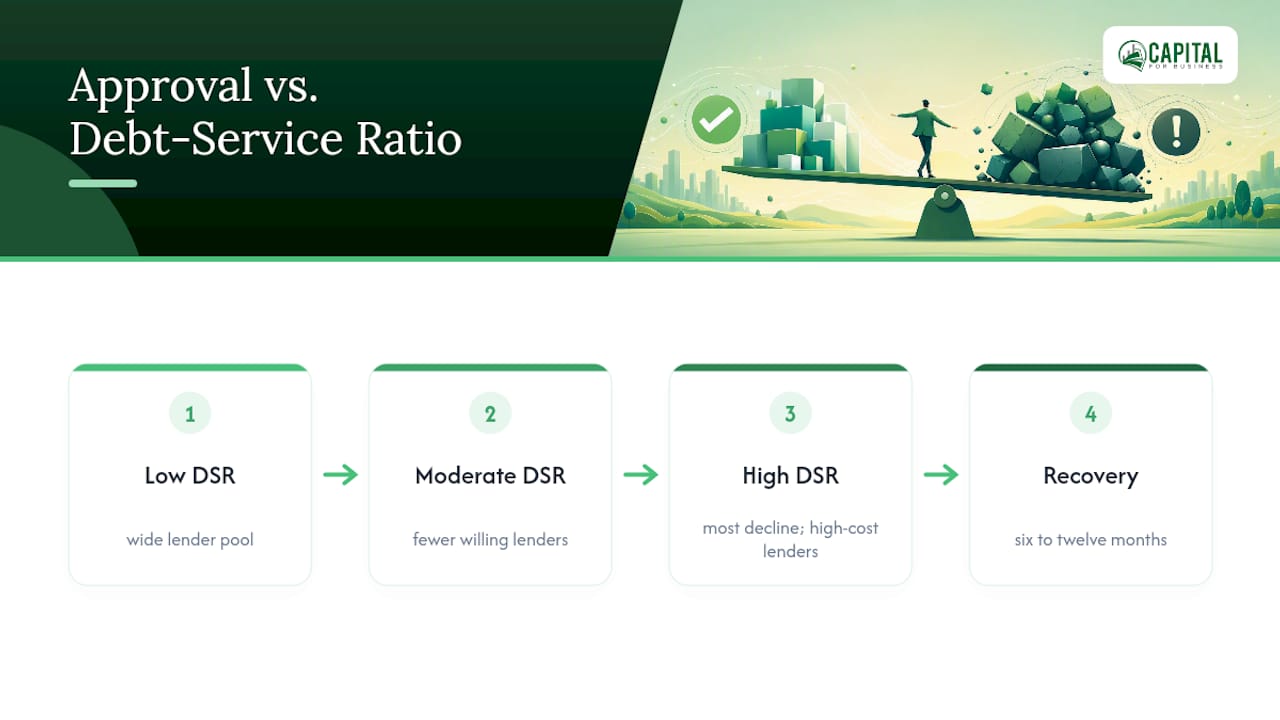
Underwriting teams at responsible lenders don't just check whether you can make one more payment. They calculate your total committed debt against total incoming revenue, and most have an internal threshold beyond which they simply won't approve additional funding no matter how compelling your application looks. If you're already directing a significant portion of monthly revenue toward existing debt service, many lenders will decline outright rather than add to that load.
This creates a narrowing effect. Every stacked loan you take now reduces the pool of lenders willing to work with you later, pushing you toward higher-cost, less regulated options simply because they're the ones still willing to say yes. That's the trap: the borrowers who most need affordable financing options are often the ones stacking has priced out of them.
Rebuilding approval odds after a stacking episode takes time, typically six to twelve months of consistent, on-time payments and a demonstrated reduction in total debt load. Lenders want to see the trend line improving before they extend new credit, not just a snapshot that looks stable today.
Regulatory Measures and Industry Efforts to Curb Stacking
No single federal law bans loan stacking outright, but the regulatory and industry response has been building for years. The FTC's consumer credit resources give borrowers a way to understand their rights around credit inquiries and to dispute inaccurate reporting tied to predatory lending practices. NMLS registration checks let borrowers verify whether a lender is actually licensed to operate in their state before signing anything.
On the industry side, responses have taken a few forms:
- Some alternative lending platforms have started sharing data more actively to flag borrowers with multiple recent applications.
- Lenders increasingly write explicit anti-stacking clauses into contracts, including blanket liens that make a second lender's position riskier and less attractive.
- Underwriting has shifted toward alternative data, bank deposit history, merchant processing volume, and real-time cash-flow analysis, rather than relying solely on credit bureau reports that lag behind actual borrowing activity.
None of this fully closes the detection gap yet. Reporting delays between origination and bureau updates still create windows measured in weeks, and no universal, real-time database currently tracks small-business borrowing the way mortgage underwriting tracks consumer debt. Until that changes, the burden of avoiding stacking largely falls on borrower discipline and lender diligence rather than a regulatory backstop.
Predatory Lending and the Gaps That Let Stacking Slip Through
Not every lender pushing a fast approval is predatory, but the fastest-moving corners of online lending are where detection gaps concentrate. A predatory lender's business model can actually benefit from a borrower who's already overextended, since default fees, renewal offers, and aggressive collection tactics generate revenue independent of whether the original loan ever gets repaid cleanly.
The detection gap comes down to three failures working together: soft inquiries that don't alert other creditors, reporting delays that hide new debt for weeks, and underwriting models tuned for speed over depth. A lender approving applications in minutes typically isn't cross-referencing bank statements against every other possible outstanding obligation in real time. That's not always negligence. It's often a deliberate tradeoff for conversion speed, and predatory operators exploit that tradeoff deliberately.
Warning signs worth watching for include lenders who don't ask about existing debt at all, offers that arrive within minutes with no documentation review, and contracts that bury confession-of-judgment clauses or daily ACH draft terms in dense fine print. MoneyCrashers points to these tactics as common precursors to the debt cycle that traps stacked borrowers.
The practical defense is the same regardless of intent: verify licensing through NMLS, read every clause about additional borrowing before you sign, and treat any offer that skips a real look at your finances as a red flag rather than a convenience.
Strategies to Avoid Loan Stacking Risks
Avoiding stacking starts before you ever fill out a second application. The discipline is straightforward, even if it takes more patience than clicking "approve" on a same-day offer.
Start with a single source of truth. Keep one running document listing every loan, its balance, its payment schedule, and its maturity date. Before considering any new financing, update that document and calculate your current debt-service ratio against trailing 90-day revenue. If that ratio is already climbing, the answer is rarely another loan. It's restructuring or refinancing what you have.
Disclose everything, every time. When you apply for new financing, list every existing obligation even if the lender doesn't explicitly ask. Undisclosed debt discovered later is what turns a risky decision into a contractual or legal problem.
Build a relationship with one primary lender rather than shopping every cash crunch to a new platform. A lender who understands your full financial picture can offer a consolidated solution, whether that's a larger single loan or a revolving line, instead of layering yet another product on top of what you already owe.

Finally, loop in a financial advisor or accountant before signing anything that involves a personal guarantee or a blanket lien. A second set of eyes on the contract terms catches problems most owners miss when they're focused on getting cash in the door quickly.
Publisher Perspective: Lessons From Underwriting and Responsible Funding
Capitalforbusiness has worked with small business owners since 2009, across working capital loans, business lines of credit, and merchant cash advances. The pattern we see most often isn't reckless borrowing. It's a business that took a reasonable first loan, hit a cash-flow gap, and reached for a second one without checking whether the combined payments actually fit their revenue.
Underwriting that looks at total debt service, not just the application in front of it, catches that problem before it becomes a default. Business owners who need capital deserve a lender that asks the harder questions upfront rather than approving quickly and letting the math sort itself out later.
— Capital
How Capital for Business Offers Responsible Alternatives to Stacking
Capitalforbusiness structures financing around what your business can actually repay, not just what you can get approved for today. Instead of layering a third loan onto two you're already servicing, our team looks at your full debt picture and builds one plan, whether that's a working capital loan, a business line of credit, equipment financing, or a merchant cash advance, sized to your real cash flow rather than your immediate panic.

We've spent years assessing sustainable debt capacity for business owners banks and credit unions turned away, and that experience shapes how we underwrite: aggregate debt service first, product fit second. If you're currently juggling more than one loan or considering a new one to cover a shortfall, talk to our team before you sign anything else. Check your options and apply for working capital funding to see what a single, right-sized plan looks like for your business.
Key Takeaways
Loan stacking raises debt service and default risk faster than most small business owners expect, and it often costs more in lost future credit access than the capital it provides.
| Point | Details |
|---|---|
| Verdict on stacking | Loan stacking is high-risk for most small businesses due to compounding payments and contract violations. |
| Detection window is real | Soft inquiries and reporting delays of 30 to 45 days let stacked loans slip through before lenders notice. |
| Legal risk hinges on disclosure | Concealing existing debt on a new application can constitute fraud, even though stacking itself isn't illegal. |
| Future approval odds shrink | Lenders calculate aggregate debt-service ratios, and existing stacked debt can block new financing for months. |
| Safer path exists | Capitalforbusiness builds one consolidated plan, working capital, lines of credit, or equipment financing, sized to actual cash flow instead of stacked products. |
This article is general information, not a substitute for advice from a qualified financial advisor. Consult a qualified financial professional about your own circumstances before acting on anything here.
Sources
- Should You Use Loan Stacking to Fund Your Business? | NerdWallet
- Latest threat to online lenders: 'stacking' of multiple loans | Reuters
- Loan Stacking - What It Is and Why It’s Dangerous for Your Business | MoneyCrashers
- Credit and loans | Consumer Information | FTC
FAQ
What Is Loan Stacking?
Loan stacking is taking out multiple business loans or lines of credit from different lenders within a short window, often without disclosing the other obligations, to access more total capital than a single lender would approve.
What Is the $100,000 Loophole for Family Loans?
This refers to an IRS provision allowing family members to make interest-free or below-market loans without triggering imputed interest income rules in certain cases; it's a personal tax provision, not a small-business lending strategy, and doesn't apply to commercial loan stacking.
What Are the 3 C's Lenders Use to Measure Borrower Risk?
Lenders commonly evaluate character, capacity, and collateral, meaning your payment history and reputation, your cash flow available to repay debt, and the assets available to secure the loan if you default.
What Is the Riskiest Type of Loan for Small Businesses?
Merchant cash advances and short-term high-frequency loans tend to carry the highest effective cost and risk, since factor rates and daily or weekly repayment schedules can strain cash flow faster than traditional term loans with monthly payments.
Can Capitalforbusiness Help if I'm Already Juggling Multiple Loans?
Yes. Capitalforbusiness reviews your full debt picture and can structure a working capital loan or line of credit sized to consolidate or replace higher-cost stacked debt with one manageable payment.