
A factor rate is a fixed multiplier that tells you your total payback on a merchant cash advance; APR is an annualized percentage that spreads borrowing costs across a full year, letting you compare loans of different lengths. Neither number alone tells you the full story. To judge an MCA against a term loan or line of credit, convert the factor rate into an effective APR, or hold both offers to the same repayment term and compare total payback dollar for dollar.
TL;DR:
- Shorter repayment periods on the same factor rate drastically increase the effective APR, making quick payback much more expensive annually.
- Upfront fees deducted before funding do not alter the factor rate but raise the actual cost and effective APR for the borrower.
- Converting a factor rate to APR requires knowing the repayment term, with shorter terms resulting in significantly higher annualized costs.
- Merchant cash advances generally apply a fixed total payback, which does not decrease with early repayment unless explicitly offered by the lender.
- Comparing MCA offers fairly requires aligning assumptions on sales levels and repayment timelines, as differences can inflate or deflate the true cost.
Table of Contents
- What Is a Factor Rate, and How Do Lenders Quote It?
- What APR Actually Measures
- Factor Rate vs. Interest Rate vs. APR: What Actually Changes
- How to Convert a Factor Rate to an Effective APR
- Worked Examples: What Factor Rates Look Like as APR
- Building a Checklist to Compare MCA and APR Offers Fairly
- Capital for Business Experience With MCAs and Working Capital
- When an MCA Makes Sense, and When It Doesn't
- Compare Your Options With Capital for Business
- Sources
- FAQ
What Is a Factor Rate, and How Do Lenders Quote It?
A factor rate is a decimal, usually between 1.1 and 1.5, that a lender multiplies against the amount you're borrowing to set your total payback. Borrow $50,000 at a 1.3 factor rate and you owe $65,000 total, full stop. There's no interest accruing month to month, no amortization schedule, no shrinking balance. The number is fixed the moment you sign.
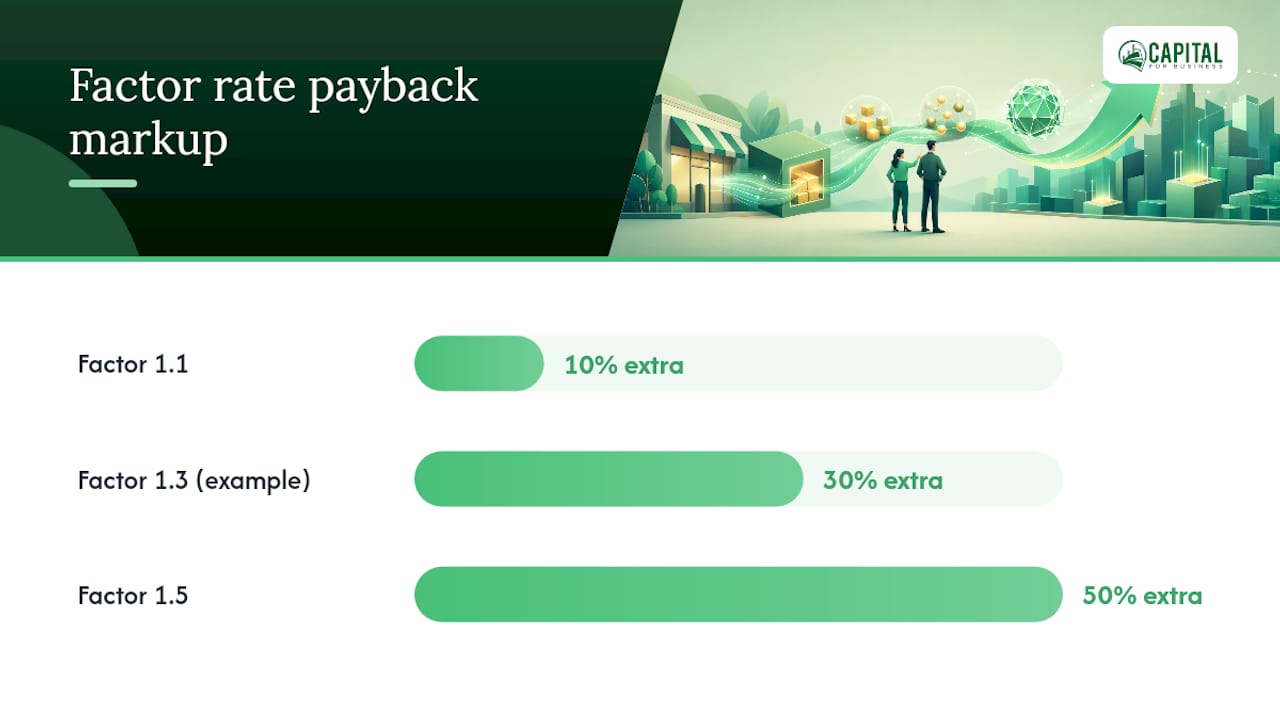
That simplicity is also the trap. A factor rate looks like a small fee (1.3 sounds a lot friendlier than "40% annualized"), but it says nothing about time. A 1.3 factor rate on a 12 month repayment is a very different animal than the same 1.3 on a 4-month repayment, even though the multiplier is identical.
Merchant cash advances and short term products typically fall in the 1.1 to 1.5 range, though riskier profiles or shorter terms can push past that. A few things to keep in mind when you're reading a factor rate on paper:
- The factor rate applies to the full advance amount, not a declining balance, so it doesn't shrink as you repay.
- Some lenders deduct an origination fee before you ever see the funds, which lowers your net proceeds without changing the factor rate itself.
- A "low" factor rate paired with a short repayment window can cost more, annualized, than a "high" factor rate paired with a longer one.
- Factor rates are rarely disclosed as APR because MCAs are typically structured as a sale of future receivables, not a loan, which sidesteps standard lending disclosure rules.
What APR Actually Measures
APR converts a loan's interest and required fees into a single annualized percentage, which is why it's the standard yardstick for comparing loans of different sizes and lengths. Under Truth in Lending Act guidance, lenders offering regulated credit products disclose APR so borrowers can compare offers on equal footing. It bundles interest with mandatory charges like origination fees, giving you one number instead of a pile of line items, which is useful to compare different loan costs and fees as explained in Title Loan Rates & Cost — APR, Fees, State Caps.
APR also behaves differently over time than a factor rate. Because it's calculated as a rate accruing against your outstanding balance, paying off an APR loan early usually reduces the total interest you owe, unless the lender has built in a prepayment penalty. That's a real cost advantage for borrowers who expect to pay down debt faster than scheduled.
Where APR gets tricky is at the short end of the spectrum. A $5,000 loan repaid in eight weeks can show an APR north of 100% even when the actual dollar cost is a few hundred dollars, because the formula is annualizing a short burst of cost over a full year. A few practical notes:
- APR fits cleanly with fixed schedule, amortizing loans like term loans, SBA loans, and lines of credit.
- It can overstate the "feel" of cost on very short term products, which is why total dollar cost still matters alongside the percentage.
- Required fees folded into APR give you a cleaner comparison than a rate that excludes them.
Factor Rate vs. Interest Rate vs. APR: What Actually Changes
The differences between a factor rate and APR go beyond how each number is written. They change how the cost behaves once money starts moving.
Units and presentation. A factor rate is a decimal multiplier (1.25, 1.4) applied once to the principal. APR is a percentage rate, annualized, and meant for year-over-year comparison.
Term length changes the real cost. A factor rate doesn't move regardless of repayment speed, but a shorter term always produces a higher effective APR. Squeeze the same total cost into three months instead of twelve, and the annualized rate roughly quadruples. This is the single biggest reason MCA factor rate comparisons trip people up: the number on the paperwork never adjusts for how fast you're actually repaying it.
Early payoff plays out oppositely. Paying off an MCA early usually doesn't reduce the dollar amount owed, since the total payback was locked in at signing, unless the lender specifically offers a prepayment discount. An APR loan, by contrast, typically rewards early payoff with less accrued interest.
Collection mechanics differ too.
- MCAs are usually collected as a percentage of daily or weekly card sales, often called a holdback, which means your payment shrinks in slow months and grows in strong ones.
- APR loans (term loans, SBA loans, lines of credit) usually carry fixed scheduled payments regardless of how sales perform that week.
- A variable holdback can stretch or compress your actual repayment timeline, which changes the effective APR even after the deal is signed.
How to Convert a Factor Rate to an Effective APR
Converting a factor rate to an annualized figure isn't complicated once you have the repayment term. Here's the sequence:
- Calculate total payback. Multiply the principal by the factor rate. A $20,000 advance at a 1.3 factor rate produces a $26,000 total payback.
- Find the total cost. Subtract principal from total payback: $26,000 minus $20,000 equals $6,000 in cost.
- Calculate the cost fraction. Divide cost by principal: $6,000 divided by $20,000 equals 0.30, or 30%.
- Annualize it. Multiply the cost fraction by 12 divided by the number of months to repay, then convert to a percentage. Repaid over 6 months, that's 0.30 × (12 ÷ 6) = 0.60, or a 60% effective APR.
Quick reference: according to the conversion method outlined by LendingTree, this annualizing step is what turns a flat multiplier into a number you can genuinely stack against a bank loan's APR, though it remains an approximation whenever repayment is tied to revenue rather than a fixed calendar.
Two caveats matter here. First, if fees are deducted upfront, your actual net proceeds are lower than the stated principal, which quietly raises your real cost fraction. Second, MCA repayment tied to a percentage of sales means the "months to repay" figure is an estimate, not a guarantee. Slow sales stretch the timeline and lower the effective APR; fast sales compress it and raise the effective APR. Treat the converted number as a working estimate, not a locked figure.
Worked Examples: What Factor Rates Look Like as APR
Numbers make this concrete faster than formulas do. Here's $10,000 borrowed at two common factor rates, across three repayment terms.
Factor rate of 1.25 (total cost: $2,500)
- 3 months: cost fraction 0.25 × (12 ÷ 3) = 100% effective APR
- 6 months: 0.25 × (12 ÷ 6) = 50% effective APR
- 12 months: 0.25 × (12 ÷ 12) = 25% effective APR
Factor rate of 1.35 (total cost: $3,500)
- 3 months: 0.35 × (12 ÷ 3) = 140% effective APR
- 6 months: 0.35 × (12 ÷ 6) = 70% effective APR
- 12 months: 0.35 × (12 ÷ 12) = 35% effective APR
Statistic worth sitting with: the identical factor rate produces wildly different annualized costs depending purely on speed of repayment. A 1.25 factor rate repaid in 3 months costs four times more, annualized, than the same 1.25 repaid over 12 months.
Now add an origination fee. Say Example A's $10,000 advance carries a 7% upfront fee ($700), deducted before funds hit your account. You net $9,300, but you still owe the full $12,500 total payback on the 1.25 factor rate. That fee doesn't show up in the factor rate at all. It quietly lowers what you actually received while your repayment obligation stays the same, which pushes your true effective APR higher than the clean math above suggests.
Building a Checklist to Compare MCA and APR Offers Fairly
Before you can compare a merchant cash advance to a term loan or line of credit, you need the same numbers from every lender on the table. Request these figures explicitly, in writing, from each offer:
- The exact amount advanced (not the amount requested, the amount actually funded after any deductions).
- The stated factor rate or APR, written out plainly.
- Every fee itemized separately: origination, administrative, underwriting, or processing charges.
- The lender's assumed monthly sales figure and repayment term, since this drives the annualized cost.
- The holdback percentage and whether it adjusts during slower sales months.
- The early settlement or prepayment terms, including whether paying early reduces the total owed.
Once you have those figures from two or more lenders, run them against the same assumed sales level and repayment horizon. Comparing a 6 month projection against another lender's 9-month projection isn't a fair fight. Aligning the assumptions before comparing total payback or effective APR is what turns a confusing stack of paperwork into an actual decision.
Watch for red flags while you're at it: fees that aren't itemized anywhere in the disclosure, sales assumptions that look unrealistically optimistic, no early settlement language at all, or a holdback percentage that the lender admits can shift during slow months without a clear formula.
Pro Tip: Run the numbers twice, once assuming your best sales month and once assuming your worst. If the effective APR swings wildly between those two scenarios, the offer is more sensitive to your cash flow than the sales pitch let on.
Capital for Business Experience With MCAs and Working Capital
Some lenders have experience working with small business owners in various industries to provide merchant cash advances, working capital loans, lines of credit, and equipment financing. That history means the numbers above aren't abstract, they're the same math applied every day to real applications from owners deciding between a fast MCA and a slower, cheaper bank product.
A few resources worth using as you evaluate your own offers:
- The merchant cash advance product page walks through eligibility and typical use cases for an MCA specifically.
- Five real MCA examples show effective APRs ranging from roughly 40% to 200%, mapped against the business situations that justified them.
- A step-by-step MCA workflow guide breaks down what happens from application to funding.
If you're mid-negotiation with a lender right now, request a personalized quote and run your own numbers against the checklist above before signing anything. The math takes ten minutes; a bad repayment structure can cost you months of tight cash flow.
When an MCA Makes Sense, and When It Doesn't
A high effective APR isn't automatically a bad decision. If you need a short-term bridge, an emergency repair, or capital to capture a fixed-window opportunity like a bulk inventory discount, an MCA's speed can outweigh its cost. The math above should confirm your gut feeling, not just talk you out of it.
If you're financing something that needs years to pay off, or you have the discipline and cash flow to pay down debt early, an APR-based loan almost always ends up cheaper. Factor rate products trade cost for speed and easier qualification, which is exactly why they're common among businesses that can't yet qualify for traditional bank financing. Quantify total payback, stress test both your best and worst sales months, and let the number, not the sales pitch, make the call.
— Capital
Compare Your Options With Capital for Business
If a merchant cash advance is starting to look expensive once you've run the effective APR math, you have real alternatives, and Capital for Business gives you a faster path to compare them than shopping banks one by one. We offer Merchant Cash Advances from a 1.15 factor rate, Working Capital Loans from 1.5% per month, and a Business Line of Credit from 1.2% per month, so you can weigh a fixed advance against a revolving, lower-cost option side by side.

Some lenders approve a broad range of credit profiles and funding can sometimes move quickly once paperwork is in. If you want to see exactly where you land, request a personalized quote today and run your specific numbers, term length and all, before you commit to any offer.
Sources
Save these for double checking your own math:
- What Is a Factor Rate and How Do You Calculate It? | Bankrate
- What Is a Factor Rate? How Do You Calculate It? | NerdWallet
- Truth in Lending Act explainer | FIN-ED
Keep every lender disclosure on file and use the same sales assumptions across offers before you compare them.
This article is general information, not a substitute for advice from a qualified financial advisor. Consult a qualified financial professional about your own circumstances before acting on anything here.
FAQ
What Is the Difference Between an APR and a Factor Rate?
A factor rate is a fixed decimal multiplier applied once to your principal to set total payback, while APR is an annualized percentage that reflects yearly cost, including fees. You can convert a factor rate into an effective APR by annualizing the cost fraction over your actual repayment term.
What Is a Factor Rate in an MCA?
A factor rate in a merchant cash advance is the multiplier, typically between 1.1 and 1.5, that determines your total payback amount. Multiply the amount advanced by the factor rate to get the dollar figure you owe in total, regardless of how fast you repay it.
How Do I Convert a Factor Rate to APR?
Calculate total payback (principal times factor rate), subtract principal to get total cost, divide that cost by principal to get a cost fraction, then multiply by 12 divided by your repayment months. That final number, converted to a percentage, is your effective APR.
What Are Typical MCA Rates?
Capital for Business offers Merchant Cash Advances starting from a 1.15 factor rate, with the exact rate depending on your business's sales history and profile.
Does Paying Off an MCA Early Save Money?
Usually not, since the total payback on a factor rate product is fixed at signing unless the lender specifically offers a prepayment discount. This differs from most APR loans, where early payoff typically reduces the total interest owed.