

Working capital loan rates vary widely depending on loan type and your business's financial profile. SBA loans and bank lines land at the low end; merchant cash advances and factor-rate products often land at the high end once you convert their pricing into a true annual rate. The single move that protects you: compare every offer by APR or APR-equivalent, never by the "starting rate" a lender advertises.
TL;DR:
- Comparing all working capital offers by APR or APR-equivalent helps avoid hidden costs, especially with products like merchant cash advances that only show factor rates.
- SBA loans and bank lines usually offer the lowest rates but have longer approval times, whereas invoice financing and merchant cash advances provide faster funding at higher effective costs.
- Improving your credit score, increasing your time in business, and providing collateral can significantly lower your loan rates, with SBA-backed loans often having interest rate caps.
- Payment frequency and loan structure affect total cost, with shorter-term products or daily payments typically increasing cash flow strain despite appearing cheaper on paper.
- Always request and compare total dollar repayment amounts, not just rates, and consider how billing cycles align with your cash flow before choosing a lender.
Table of Contents
- How Much Does Working Capital Cost by Loan Type?
- How Do Lenders Set Your Working Capital Loan Rate?
- APR vs Factor Rate: How to Compare Offers Correctly
- How to Compare Working Capital Offers Step-by-Step
- Estimate Your Monthly Payments and Total Cost
- How to Qualify for Lower Working Capital Loan Rates
- Capital For Business's Perspective: How We Price and Serve Working Capital Needs
- How Capital For Business Can Help With Your Next Funding Move
- Sources
- FAQ
How Much Does Working Capital Cost by Loan Type?
Rate spreads across working capital products are wide enough that two businesses borrowing the same $50,000 could pay wildly different amounts for it, depending entirely on which product they choose. Here's how the major categories stack up.
SBA loans and bank lines of credit sit at the bottom of the cost curve. The SBA's 7(a) program caps how much a lender can mark up its base rate, which keeps pricing predictable and generally lower than most alternatives. The tradeoff is speed. Bank and SBA underwriting can take several weeks to a couple of months, since lenders verify tax returns, collateral, and business history in detail.
Online term loans and business lines of credit occupy the middle ground. These lenders move faster than banks, often funding within a few business days, and price risk into a moderate APR range rather than the lowest-in-market rate. A business line of credit works well here because you only pay interest on what you draw, not the full approved limit.
Invoice financing and merchant cash advances price differently altogether. Instead of a stated APR, these products use factor rates or discount fees, and when you do the math into an annualized figure, the effective cost is often the highest of any working capital option. What you get in exchange is speed, sometimes funding within 24 to 48 hours, and underwriting based more on revenue and receivables than credit score.
The right match depends on why you're borrowing:
- Planned capital needs (inventory buildup ahead of a busy season, equipment upgrades, opening a second location) favor slower, cheaper options like SBA loans or term loans, since you have time to wait for approval.
- Emergency or opportunity funding (a payroll gap, a bulk-discount deadline, a sudden repair) favors lines of credit or merchant cash advances, where cost takes a back seat to how fast money hits your account.
- Recurring cash-flow gaps tied to slow-paying customers point toward invoice financing, which advances cash against unpaid invoices rather than adding new debt to your balance sheet.
Working capital loans exist specifically to smooth these operational gaps, and Investopedia's definition of the category confirms what shows up in practice: terms and pricing vary enormously by product, so the label "working capital loan" tells you almost nothing about cost until you know the structure behind it.
How Do Lenders Set Your Working Capital Loan Rate?
Every lender runs the same basic calculation: how likely is this business to repay, and how much cushion do we need to price in if it doesn't? Four inputs drive that math more than anything else.
- Credit score. Most lenders draw a line somewhere around 650 to 680 for their better pricing tiers; scores below that push you toward higher-rate or alternative products.
- Time in business. Two years of operating history is a common threshold. Businesses under that mark often qualify only for revenue-based or merchant cash advance products.
- Annual revenue and debt service coverage ratio (DSCR). Lenders want to see enough monthly cash flow to cover the new payment plus existing debt, usually with room to spare.
- Collateral. Secured loans, backed by equipment, receivables, or real estate, price lower than unsecured products because the lender has recourse if you default.
Statistic to know: SBA-backed loans carry interest rate caps tied to a base rate plus a lender margin, which is a big reason they're consistently among the best-priced options for businesses that can tolerate a longer approval timeline.
Rates also move with the broader market. Many lenders peg their pricing to the prime rate, then add a margin based on your risk profile. When prime rises, variable-rate lines and loans reprice with it; fixed-rate term loans lock in your cost but may start higher to compensate the lender for that certainty. J.P. Morgan's explanation of working capital facilities breaks down how cash-flow-based lending differs from asset-based lending on this point. Cash-flow lenders price primarily off your revenue trends; asset-based lenders price off collateral value, which can mean a lower rate even with a thinner credit file.
Loan amount and term length matter too. Larger loans with longer terms tend to earn better per-dollar pricing because origination costs get spread out, while short-term products compress a lot of cost into a small window, which is exactly why factor rates can look deceptively low.
APR vs Factor Rate: How to Compare Offers Correctly
Lenders don't all quote pricing the same way, and that inconsistency is where most business owners get burned. You need to translate every offer into one common language before you compare them.
Three pricing formats show up most often:
- APR (annual percentage rate) bundles interest and most fees into a single annualized number. This is the standard for term loans, SBA loans, and lines of credit, and it's the easiest format to compare directly.
- Factor rate is a flat multiplier, common on merchant cash advances, expressed as a decimal like 1.25 or 1.40. Multiply your advance amount by the factor rate to get your total repayment; the rate itself never changes even if you pay it off faster.
- Flat fee is a fixed dollar charge on top of principal, often disclosed as a percentage of the loan amount rather than annualized. It's common on some short-term products and invoice financing arrangements.
To convert a factor rate into an approximate APR, use this method, adapted from the approach Mercury outlines in its working capital guide:
- Calculate total repayment: advance amount × factor rate.
- Subtract the advance amount to find the total cost in dollars.
- Divide that cost by the advance amount to get the cost as a percentage.
- Annualize it by dividing by the repayment term in months, then multiplying by 12.
A $25,000 advance at a 1.35 factor rate over 9 months costs $8,750 in fees. The factor rate alone never revealed that.
Pro Tip: Always ask the lender for the total dollar cost of the loan in writing, not just the rate. A $2,500 origination fee on a $50,000 loan adds roughly 5 percentage points to your effective APR before a single interest payment is made.
Payment frequency changes the math further. Daily or weekly automatic debits, common on merchant cash advances, pull cash out of your account faster than a monthly amortizing loan, which strains cash flow even when the stated cost looks comparable on paper.

How to Compare Working Capital Offers Step-by-Step
Once you have two or three offers in hand, run them through the same checklist so you're comparing structure, not just headline numbers.
- APR or APR-equivalent for every offer, converted using the factor-rate method above if needed.
- Total repayment amount in dollars, not percentages, since dollar figures are harder to obscure.
- Payment frequency, daily, weekly, or monthly, and how that lines up with your revenue cycle.
- Origination and administrative fees, deducted upfront or rolled into the balance.
- Collateral or personal guarantee requirements, and what happens to that asset if you default.
- Prepayment penalties or covenants, including any restriction on taking on additional debt.
The decision often comes down to a simple tradeoff between speed and cost. If you're bridging a short, well-defined gap, like covering payroll until a large invoice clears, paying a premium for 48-hour funding can be the right call even at a high effective APR, since the alternative cost of a missed payroll run is worse. If you're financing a planned expansion with a six-month runway to close the deal, it almost always pays to wait for SBA or bank pricing.
Watch for red flags in the contract itself: confessions of judgment clauses, daily debit structures with no cap on withdrawal amounts, or automatic renewal terms that lock you into a new advance before the first one is paid off. Before signing with any online lender, check its registration through NMLS Consumer Access to confirm it's a licensed lender in your state.
Pro Tip: Ask every lender the same direct question: "What is my total repayment amount in dollars, and what is that as an annualized rate?" A lender that hesitates to answer plainly is telling you something about how the offer is structured.
Estimate Your Monthly Payments and Total Cost
Numbers on a term sheet mean more once you see them applied to real dollar amounts. Here are three common working capital scenarios.
- $50,000 SBA or bank term loan at 9% APR over 12 months. Using standard amortization, the monthly payment lands around $4,375, with total interest of roughly $2,500 over the life of the loan. This is the cheapest structure of the three, and it reflects the pricing advantage SBA-backed products typically carry.
- $50,000 line of credit draw at a variable 12% APR, interest-only for 6 months, then amortizing. During the interest-only period, monthly payments are about $500. Once amortization kicks in for the remaining 6 months, payments rise to roughly $8,650 a month to clear the balance. That jump catches a lot of borrowers off guard if they don't plan for it.
- $25,000 merchant cash advance at a 1.35 factor rate, repaid over 9 months. Total repayment is $33,750, meaning $8,750 in fees. Converted to an annualized figure using the method in the previous section, that's an effective APR of roughly 47%, even though the "1.35" on the term sheet never uses the word "percent."
Statistic to know: the difference between scenario one and scenario three, on comparable loan amounts, is a fee spread of several thousand dollars. That gap exists entirely because one product prices in APR and the other prices in a factor rate that obscures the annualized cost. Mercury's scenario modeling shows the same pattern holds across most factor-rate products once you run the conversion.
How to Qualify for Lower Working Capital Loan Rates
Rate offers aren't fixed the moment you apply. A few weeks of preparation before you approach a lender can move you into a meaningfully better pricing tier.
Start with documentation. Lenders move faster and price more favorably when you arrive with a complete file:
- Bank statements for the last 3 to 6 months, showing consistent deposit activity.
- Business and personal tax returns for the last two years.
- A current profit and loss statement and balance sheet.
- Merchant processing statements if a meaningful share of revenue runs through card payments.
- Accounts receivable aging report, especially if you're considering invoice financing.
On the financial side, three levers move the needle most. Improving your DSCR, even modestly, by paying down a revolving balance before applying can shift you into a better tier. Reducing existing outstanding debt lowers your overall leverage, which underwriters weigh heavily. And if your time in business falls short of a lender's cutoff, alternative evidence like signed contracts, purchase orders, or a franchise agreement can sometimes substitute for a longer track record.
Adding collateral or applying through an SBA product is worth the extra paperwork when the rate difference is large and you can absorb the longer timeline. For a business that can wait six to eight weeks for funding, the interest savings on a $100,000 loan often outweigh the convenience of a faster, unsecured alternative by a wide margin.
Capital For Business's Perspective: How We Price and Serve Working Capital Needs
Since 2009, Capital For Business has worked with small business owners across hundreds of industries, and the pattern we see most often isn't a business with bad credit. It is a business with a good track record that simply doesn't fit the timeline a bank needs to approve a loan. That's the gap we built our lending process to fill.
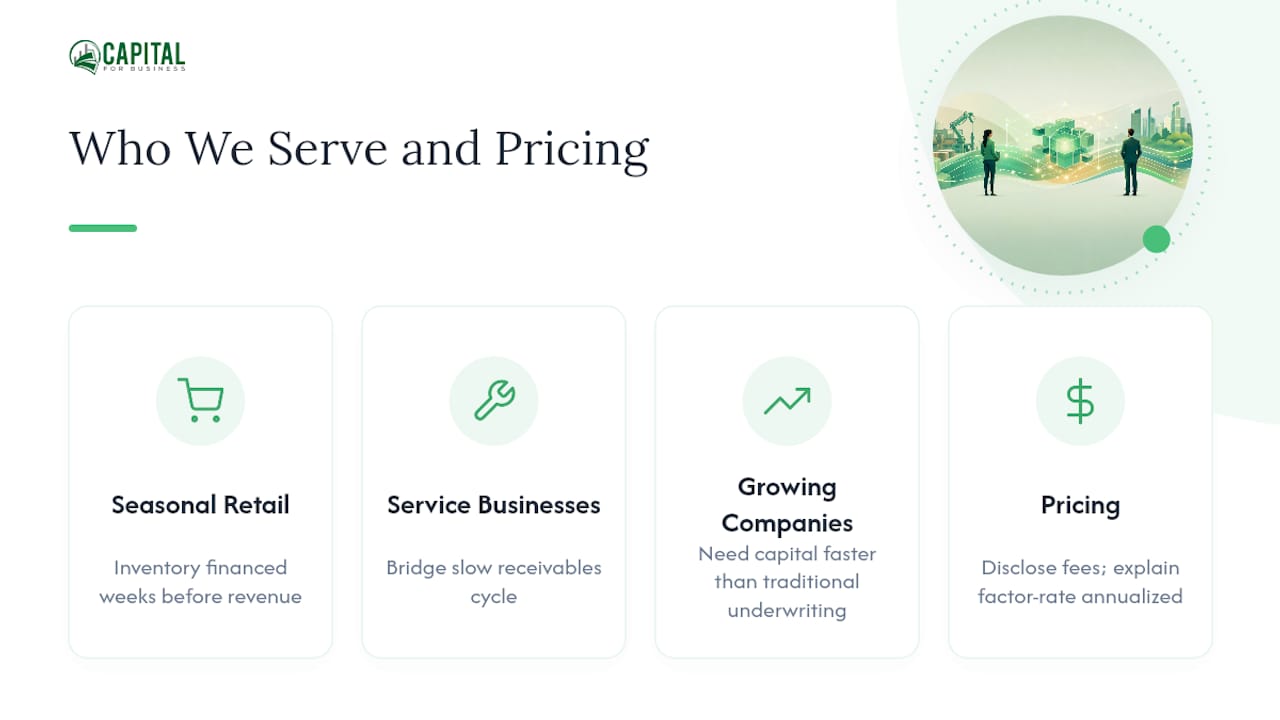
We work with three common borrower profiles: seasonal retailers who need inventory financed weeks before revenue arrives, service businesses bridging a slow receivables cycle, and growing companies that need capital faster than a traditional underwriting process allows. Typical timelines for our working capital products run from same-day to a few business days, depending on the product and documentation on hand.
On fees, we believe transparency is the only defensible approach. We disclose origination costs, payment structure, and total repayment amount upfront, and where a product uses a factor rate rather than a stated APR, we walk clients through the annualized equivalent before they sign. A rate you don't fully understand is a rate you can't properly compare, and that comparison is the whole point of shopping for working capital in the first place.
— Capital
How Capital For Business Can Help With Your Next Funding Move
Capital For Business gives you a faster path to working capital than a bank, without pushing you into a factor-rate product where the real cost is buried until you do the math yourself. We quote pricing plainly, show you the annualized cost up front, and match you to the product that fits your timeline instead of defaulting you into the fastest, most expensive option on the shelf.
Our working capital loans up to $500,000 cover the same ground as bank term loans and lines of credit, but with underwriting built around business owners banks and credit unions often turn away. If your cash-flow gap is tied to a specific season or a big invoice on the way, a business line of credit lets you draw only what you need and pay interest on that amount alone. For businesses that need cash fastest, a merchant cash advance can fund in as little as a day or two.
The application process starts with a short form and your recent bank statements. Most clients get a decision within 24 to 48 hours, and funding can follow shortly after approval. Start your application today and get a clear, upfront quote before you commit to anything.
Sources
For deeper detail on rates, protections, and loan mechanics, these sources are worth your time:
- Fund your business | U.S. Small Business Administration
- Working capital loan definition | Investopedia
- Guide to working capital loans | Mercury
- Working capital loans: how they work | J.P. Morgan
This article is general information, not a substitute for advice from a qualified financial advisor. Consult a qualified financial professional about your own circumstances before acting on anything here.
FAQ
Are Working Capital Loans a Good Idea?
For a short, well-defined cash-flow gap, a working capital loan can be a smart tool, especially SBA or bank products priced at low single-digit to low double-digit APRs. They become a risky idea when a business relies on high-cost products like merchant cash advances repeatedly instead of addressing the underlying revenue timing issue.
What Is the Payment on a $1,000,000 Business Loan?
At 9% APR amortized over a typical term, monthly payments depend on loan size and term length, but higher rates generally mean higher monthly payments and total interest. Shorter terms increase monthly payments but reduce total interest paid.
What Is the Monthly Payment on a $50,000 Business Loan?
Extending the loan term lowers monthly payments but results in higher total interest over the life of the loan.
How Much Do You Pay a Month for a $100,000 Loan?
The exact figure shifts with your rate, term, and whether the loan is fixed or variable, so always request an amortization schedule before signing.