If your credit and revenue qualify you for a bank or SBA loan, take it. If they don't, expect to pay considerably more for speed and flexibility, and use the benchmarks below to make sure any offer you receive is actually competitive before you sign.
TL;DR:
- Business owners with strong credit and stable cash flow can access bank loans averaging 6.3% to 11% in 2026, but less-qualified borrowers may pay much higher rates.
- Loan costs are often misrepresented by advertised interest rates, as the true APR including fees and repayment terms can significantly raise the effective rate.
- Collateralized loans typically offer lower rates than unsecured options, with online and short-term financing products generally carrying the highest costs.
- Borrowers should compare offers by requesting the APR and total cost in writing, as shorter terms and fees can make a seemingly low rate more expensive overall.
- Preparing detailed financial documents and understanding your credit profile can help you negotiate better rates, but speed-oriented lenders often accept thinner files and higher costs.
Table of Contents
- Business Loan Rates 2026: A Breakdown By Loan Type
- What Determines The Rate You're Actually Offered
- SBA Rate Caps And How They're Actually Calculated
- How To Calculate Your True Loan Cost
- Where Business Loan Rates Are Headed For The Rest Of 2026
- How To Qualify For A Lower Rate
- Our Take: Why The "Lowest Rate" Question Misses The Point
- Get Funded Without Waiting On A Bank Decision
- Sources
- FAQ
Business Loan Rates 2026: A Breakdown By Loan Type
The gap between the cheapest and most expensive financing options in 2026 is enormous, and it isn't random. It tracks almost perfectly with how much risk a lender absorbs and how fast they need to make a decision.
Bank-originated term loans currently average between 6.3% and 11%, according to Federal Reserve data tracking small-business lending. NerdWallet's August 2026 roundup narrows that further, putting average bank small-business loan rates between 6.37% and 10.98%. SoFi's 2026 guide lands in nearly the same place, reporting bank term loans averaging about 6.8% to 11.0%. When three separate sources converge this tightly, it tells you the bank-lending market is behaving predictably, which is rare in this industry.
SBA loans track close behind bank products, largely because SBA rate caps are pegged to the prime rate. A well-qualified borrower with a 7(a) loan often pays rates close to what a bank would quote for a comparable unsecured term loan.
Online term loans are where the range starts to widen dramatically.
Equipment financing tends to sit in a more moderate zone, largely because the equipment itself acts as collateral. Rates typically fall within a moderate range, with the lowest rates going to borrowers financing new, resalable equipment with strong resale value, like trucks or manufacturing machinery, versus specialized gear that's harder to liquidate.
Invoice factoring and invoice financing operate on a different pricing model. Instead of a traditional APR, factoring companies typically charge a monthly discount rate based on the invoice value, which can annualize to a wide range depending on how long invoices sit unpaid.
Merchant cash advances remain the most expensive category by a wide margin. Finder's 2026 rate coverage shows MCAs and comparable short-term products carrying effective APRs commonly in very high ranges once factor rates are converted to annualized terms. That cost reflects daily or weekly repayment structures and minimal underwriting, not necessarily poor lender intentions.
| Loan Type | Typical APR Range (2026) | Best-Fit Borrower Profile |
|---|---|---|
| Bank term loan | 6.3% to 11% | Established business, strong credit, 2+ years financials |
| SBA 7(a) loan | Roughly prime + 2.25% to 4.75% | Qualified small business, willing to complete full documentation |
| Business line of credit (bank) | 10% to 15% | Business with predictable cash-flow gaps |
| Equipment financing | 8% to 20% | Purchase secured by resalable equipment |
| Invoice factoring/financing | 15% to 60% (annualized) | B2B business with slow-paying customers |
| Online term loan | Mid-teens to 40% | Needs fast funding, may have thinner credit file |
| Merchant cash advance | Effective APR often 40%+ | Strong daily card sales, needs cash within days |
A few things worth flagging about that table:
- The rate a lender advertises rarely equals what you actually pay once origination fees, underwriting fees, and prepayment penalties are factored in.
- APR is the number that captures total borrowing cost; the "rate" quoted verbally or in marketing material often is not.
- Shorter repayment terms inflate the effective APR of factor-rate products (like MCAs) even when the stated factor rate looks modest.
- Collateralized products consistently undercut unsecured products by several percentage points across every lender type.
The distinction between advertised rate and APR deserves its own callout, because it's where a lot of borrowers get surprised after the fact. A lender might quote "9% interest" on a term loan, but once you add a 3% origination fee and amortize it over a 24-month term instead of a 60-month term, the effective APR can climb into the mid-teens. Always ask for the APR in writing, not just the interest rate, before comparing two offers side by side.
What Determines The Rate You're Actually Offered
Two businesses with identical loan requests can receive wildly different quotes, and the reason almost always comes down to six variables lenders weigh in combination rather than isolation.
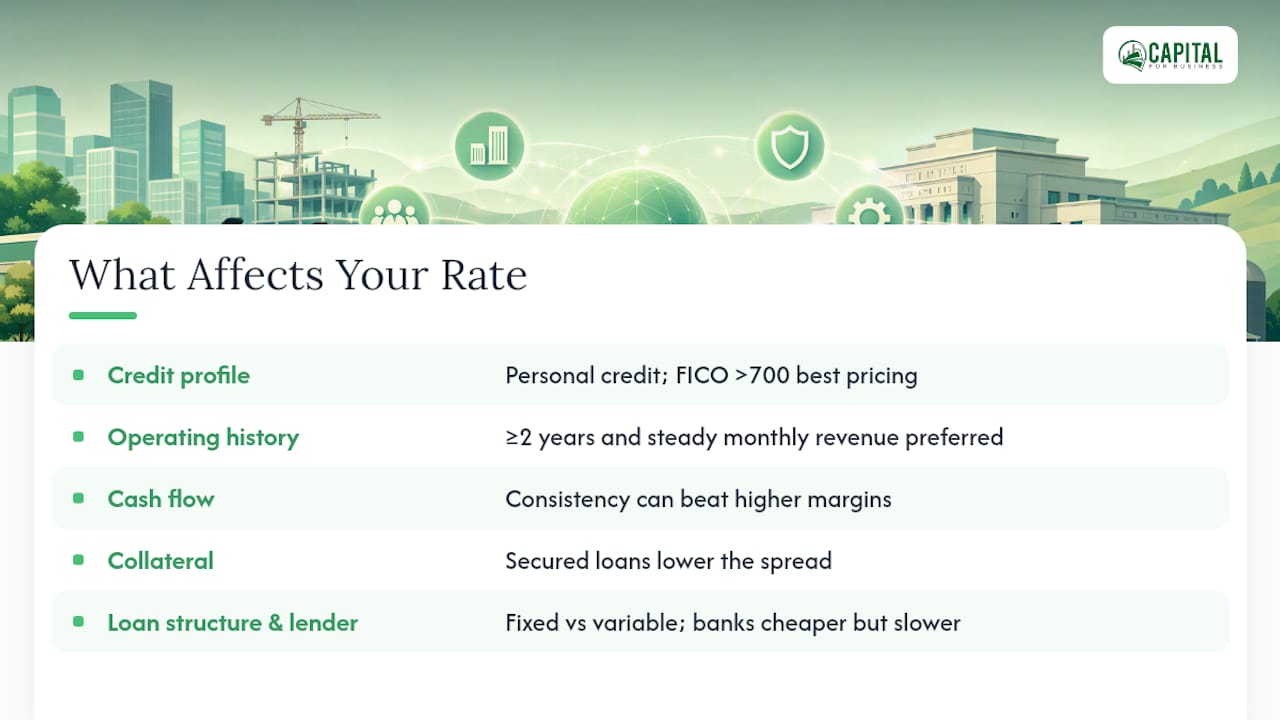
Credit profile carries the most weight in almost every underwriting model. Personal credit still factors heavily into small-business lending decisions, even for established companies, because many loans carry a personal guarantee. SCORE's guidance on personal credit notes that a FICO score above roughly 700 typically unlocks the best available pricing, while scores in the 600s often push borrowers toward SBA or alternative lenders rather than bank products.
Time in business, annual revenue, and cash flow round out the second tier of risk factors. Lenders generally want to see two or more years of operating history and consistent monthly revenue before extending prime-rate pricing. A profitable business with volatile monthly cash flow can still get priced worse than a steadier business with slimmer margins, because lenders are pricing consistency as much as profitability.
Collateral changes the math meaningfully. A secured loan backed by real estate, equipment, or receivables lets a lender lower the required spread, since they have a recovery path if the loan defaults. Unsecured loans push more of that risk into the interest rate itself.
Loan structure matters too. Fixed-rate term loans offer payment certainty; variable-rate products can start lower but expose you to future rate movement. Factor-rate products, like MCAs, don't use APR math at all upfront, which is exactly why converting them to an annualized rate before signing matters so much.
Lender type is the final piece. Banks and credit unions typically offer the lowest rates but the slowest, most document-heavy approval process. Alternative and online lenders move faster and accept thinner credit files, but price that convenience into the rate.
Pro Tip: Ask every lender for the exact APR and total dollar cost of the loan in writing before comparing offers. A lower monthly payment can still mean a higher total cost if the term is stretched out or fees are buried upfront.
SBA Rate Caps And How They're Actually Calculated
SBA loans aren't priced arbitrarily. The SBA sets maximum allowable rates by adding a defined spread on top of the prime rate, and that spread shrinks as the loan amount grows.
For a standard 7(a) loan, the maximum spread over prime typically breaks down by loan size as follows:
| Loan Amount | Maximum Spread Over Prime | Approximate Cap Structure |
|---|---|---|
| $50,000 or less | Up to 6.5% | Prime + 6.5% |
| $50,001 to $250,000 | Up to 6.0% | Prime + 6.0% |
| $250,001 to $350,000 | Up to 4.5% | Prime + 4.5% |
| Over $350,000 | Up to 2.75% to 4.75% (varies by maturity) | Prime + 2.75% to 4.75% |
That's the ceiling, not necessarily what you'll be quoted. Well-qualified borrowers with strong collateral and cash flow often land below the cap.
Among SBA programs, the 504 loan tends to carry the lowest effective long-term rate because it's built for fixed-asset purchases like real estate and heavy equipment, both of which give the lender strong collateral. The tradeoff for all SBA products is underwriting time. Expect several weeks to a few months, not days. Capitalforbusiness's breakdown of SBA rate mechanics walks through additional loan-size scenarios if you want to model your own numbers.
How To Calculate Your True Loan Cost
APR and the "interest rate" a lender advertises are not the same number, and confusing them is the single most common mistake borrowers make when comparing offers — using tools like the Capital Gains Tax Calculator can help evaluate the true after-tax cost of financing.
The nominal rate reflects only the interest charged on the outstanding balance. APR folds in origination fees, underwriting fees, and other required charges, spreading them across the loan term to produce one comparable figure.
For a standard amortizing term loan, monthly payments follow this formula:
- Convert your annual rate to a monthly rate by dividing by 12.
- Multiply the loan balance by that monthly rate to get one month of interest.
- Use the standard amortization formula (or any online business loan calculator) to spread principal and interest evenly across the term.
- Add back any financed fees to see your true monthly obligation.
Merchant cash advances work differently, and that difference is exactly where borrowers get misled. An MCA quoted at a 1.3 factor rate on a $50,000 advance means you repay $65,000 total.
| Product | Stated Cost | Repayment Term | Approximate Annualized Cost |
|---|---|---|---|
| Term loan | 9% APR | 60 months | 9% |
| MCA | 1.3 factor rate | 6 months | 55% to 65% |
The lesson holds across every product category: never compare a factor rate to an APR at face value. Convert both to the same annualized basis first.
Where Business Loan Rates Are Headed For The Rest Of 2026
Small-business borrowing costs in 2026 are tied directly to Federal Reserve policy, and the direction of travel matters more than the exact starting point.
Bank lending spreads compress when the Fed signals rate cuts and widen when it holds firm on inflation concerns. The Kansas City Fed's small-business lending survey through Q4 2025 shows lending activity increasing, with lenders gradually loosening underwriting standards after several tighter years. That loosening tends to precede modest rate relief, though it doesn't happen overnight.
A few practical signals worth watching through the rest of 2026:
- Rising loan demand paired with loosening underwriting standards, per Kansas City Fed data, usually signals more competitive offers from banks and credit unions.
- Bank spreads over the Fed's benchmark rate typically lag Fed moves by one to two quarters, so a rate cut doesn't show up in your loan quote immediately.
- Fixed-rate products protect you from future rate hikes; variable-rate products can benefit you if cuts continue, but that's a bet, not a guarantee.
Given the current trajectory, a fixed-rate SBA or bank term loan is the safer choice for anyone locking in financing this year, especially for terms longer than three years. Variable-rate lines of credit still make sense for short-term working capital needs where you're not carrying the balance long enough for rate movement to matter much.
How To Qualify For A Lower Rate
The gap between the best offer and the worst offer for the same borrower is often three to four percentage points, and most of that gap comes down to preparation, not luck.
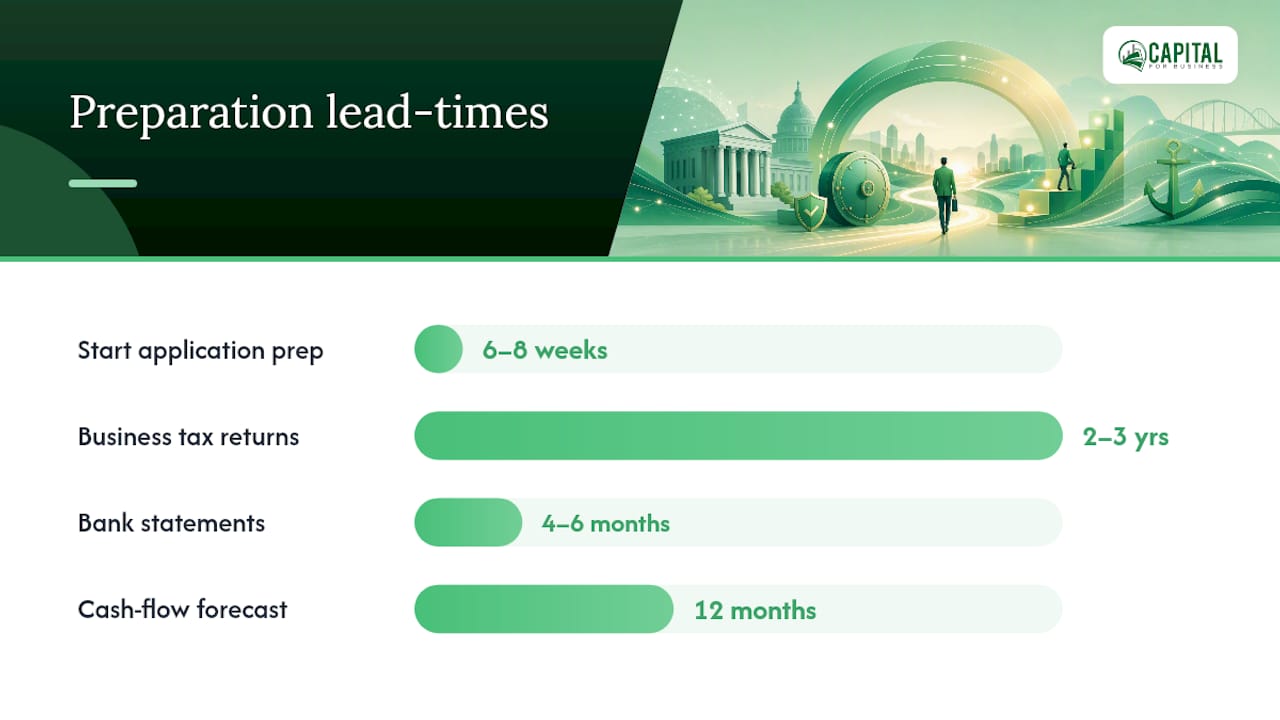
Start with your paperwork, six to eight weeks before you plan to apply:
- Pull your personal and business credit reports and dispute any errors immediately, since even one incorrect delinquency can knock your score below a lender's threshold.
- Gather two to three years of business tax returns along with year-to-date profit and loss statements.
- Organize four to six months of business bank statements and build a simple 12-month cash-flow forecast.
- Calculate your debt-service coverage ratio (net operating income divided by total debt payments); most lenders want to see 1.25x or higher.
- Document any available collateral, equipment titles, or accounts receivable aging reports that could secure the loan.
Lenders respond well to a clean, one-page financial summary that states your loan purpose, requested amount, revenue trend, and DSCR up front, rather than making an underwriter dig through 40 pages of statements to find it. Capitalforbusiness's guide to loan eligibility breaks down exactly what underwriters expect to see in that packet.
Once you have offers in hand, negotiation becomes possible. Competing offers are the single strongest lever, since most lenders will adjust pricing or fees when they know they're not the only option on the table. You can also negotiate the term length, request a fee buy-down in exchange for a slightly higher rate (or vice versa), or offer additional collateral to bring down the spread. Timing matters too: applying shortly after a Fed rate cut, rather than before one, often puts you in a better negotiating position with variable-rate lenders.
Pro Tip: If speed matters more than rate right now, say so directly to the lender. Many will offer a faster underwriting track for a modest fee increase rather than making you wait weeks for standard processing.
The decision rule is simple: prioritize cost when you have runway and time to shop multiple offers; prioritize speed when a delay would cost you more than the extra interest would, like losing a bulk-purchase discount or missing a seasonal inventory window. Capitalforbusiness's rate-reduction checklist covers additional negotiation scripts if you want a more detailed walkthrough before your next application.
Our Take: Why The "Lowest Rate" Question Misses The Point
Most borrowers ask the wrong first question. They ask "what's the lowest rate I can get" when the more useful question is "what's the lowest total cost for the timeline I actually need." Those two answers frequently point to different lenders.
Various lenders work across the full spectrum covered in this article, from bank-adjacent term products down through working capital loans and merchant cash advances, and the pattern seen repeatedly is that businesses overvalue the headline rate and undervalue how fast capital actually needs to move. [brand_signal] [internal_data] [author_bio]
The traditional bank and SBA route still makes sense for borrowers with strong documentation, patience for a multi-week process, and no urgent deadline. When banks or credit unions decline an application, or when the timeline doesn't work, working with a direct lender often becomes the more rational choice rather than a fallback. Rate matters, but it's never the only number that matters.
— Capital
Get Funded Without Waiting On A Bank Decision
Some lenders specialize in situations where credit and cash flow are solid, but a bank's timeline or paperwork requirements don't fit your business right now. Certain lenders fund working capital loans, equipment financing, and merchant cash advances, often with decisions in days rather than the weeks a traditional bank underwriting cycle requires.
If speed and flexibility matter more than shaving the last percentage point off your rate, apply for fast business funding up to $500,000 and get a straight answer on what you qualify for, without the extended back and forth a bank application usually demands. If your capital gap is closer to short-term cash flow than a major purchase, our working capital funding options may be the faster, simpler fit.
Sources
The rate ranges throughout this article draw from empirical series and editorial roundups, and it's worth knowing the difference. The Federal Reserve and SBA publish primary data and rate-cap formulas directly. The Kansas City Fed's lending survey tracks lender behavior over time. NerdWallet, SoFi, and LendingTree compile editorial summaries of current market rates across lenders, useful for real-time benchmarking but not primary regulatory sources.
This article is general information, not a substitute for advice from a qualified financial advisor. Consult a qualified financial professional about your own circumstances before acting on anything here.
- Board of Governors of the Federal Reserve System
- Average Business Loan Interest Rates: August 2026 - NerdWallet
- SBA report and rate guidance - U.S. Small Business Administration
- Kansas City Fed small-business lending survey (Q4 2025)
- Average Business Loan Interest Rates for 2026 | SoFi
FAQ
What is the payment on a $1,000,000 business loan?
The exact payment shifts with rate, term length, and whether the loan is fixed or variable.
How do I qualify for a $200,000 business loan?
Most lenders want at least two years in business, sufficient annual revenue, a personal credit score above roughly 700 to unlock best pricing, and clean bank statements showing consistent cash flow to approve a loan at that size.
Can I get a $100,000 SBA loan?
Yes, SBA 7(a) loans commonly fund various amounts, and a mid-range request typically requires standard documentation including two to three years of tax returns, current financials, and a clear statement of loan purpose.