
TL;DR:
- Loan eligibility is a set of minimum business criteria required to apply for financing.
- Meeting eligibility does not guarantee loan approval; full financial review is still necessary.
- Improving credit, revenue, and financial documentation increases chances of qualifying.
Roughly half of all small business loan applications in the US are declined each year, and many of those rejections happen not because the business is failing, but because the owner didn't fully understand what eligibility actually means. Loan eligibility is not just a credit score threshold or a revenue number. It is a combination of program-specific rules, business characteristics, and financial benchmarks that vary significantly across lenders and across borders. Whether you are running a startup in Texas or a growing operation in Ontario, knowing what lenders are truly looking for puts you in a much stronger position before you ever fill out an application. This guide walks through the core eligibility requirements in both the US and Canada, how lenders evaluate applicants, and what to do if you don't qualify today.
Table of Contents
- Defining loan eligibility: The basics for small business owners
- Core criteria in the US: SBA, banks, and online lenders
- Loan eligibility in Canada: CSBFP, BDC, and more
- How lenders assess your eligibility: Credit, cash flow, and business health
- What to do if you don't qualify: Alternatives and next steps
- Why loan eligibility is just the starting line: Expert perspective
- Secure funding for your small business: Explore your options
- Frequently asked questions
Key Takeaways
| Point | Details |
|---|---|
| Eligibility is foundational | Meeting eligibility criteria is needed before lenders will consider your business for funding. |
| US and Canada differ | Eligibility requirements and programs vary significantly between the US and Canada. |
| Credit scores matter | A stronger personal and business credit score raises your chances of approval for most loans. |
| Alternatives exist | If you don’t qualify at first, other lenders and steps can help you build eligibility and access working capital. |
Defining loan eligibility: The basics for small business owners
Loan eligibility is the set of minimum conditions your business must meet before a lender will even consider your application. Think of it as the entry requirement, not the final approval. Meeting eligibility criteria gets you in the door, but the lender still reviews your full financial picture before making a decision.
Most lenders, regardless of whether they are a bank, credit union, or online platform, evaluate several fundamental factors. According to SBA guidance, loan eligibility for small businesses in North America involves core criteria including business operation status, size standards, creditworthiness, revenue, time in business, ownership, citizenship, eligible use of funds, and exclusion of certain industries. These aren't arbitrary checkboxes. They exist to help lenders assess risk and ensure that public or private loan funds are used appropriately.
Here is a breakdown of the primary eligibility factors most lenders review:
- Business location and legal status: The business must be legally registered and operating in an eligible location, typically within the US or Canada.
- Business size: Many programs, especially government-backed ones, define "small business" using employee counts or annual revenue caps.
- Time in business: Most traditional lenders want to see at least one to two years of operating history. Some require more.
- Annual revenue: Lenders use revenue to confirm the business generates enough income to support loan repayments.
- Ownership and citizenship: SBA loans, for example, require that the primary owners be US citizens or permanent residents.
- Credit profile: Both personal and business credit scores are reviewed. A lower score doesn't always mean denial, but it affects terms.
- Eligible use of funds: Loans must be used for approved purposes such as equipment, real estate, inventory, or working capital.
- Industry type: Some industries, including gambling, adult entertainment, and certain non-profit categories, are excluded from specific programs.
Eligibility is only the starting line. Meeting the minimum requirements positions your business to apply, but lenders still conduct a thorough review of your financials, business plan, and repayment capacity before issuing a decision.
One of the most overlooked denial reasons is applying for an ineligible use of funds. A business owner might qualify on every other dimension but plan to use a loan for a purpose the program doesn't allow, such as refinancing existing personal debt or paying out equity to owners. Reviewing the loan considerations before applying can save you significant time and frustration.
If you are unsure how the application process works from start to finish, a step-by-step loan application guide can help you prepare each document and requirement in the right order. Understanding eligibility in advance makes the process significantly smoother.
Core criteria in the US: SBA, banks, and online lenders
With those basics in mind, let's zoom in on the main eligibility rules for US small business owners. Not all lenders operate under the same standards, so the type of lender you approach directly shapes the requirements you'll need to meet.
SBA loans
SBA loans require for-profit US-based businesses that meet SBA size standards, are owned by US citizens or nationals, demonstrate good character, and are unable to obtain credit elsewhere on reasonable terms. That last point, called the "credit elsewhere" rule, is often misunderstood. It doesn't mean you've been rejected everywhere. It means the SBA wants to confirm that conventional financing isn't a realistic option at fair terms for your business.
For the popular SBA 7(a) loan program, approval rates reached 62% in fiscal year 2022, compared to roughly 50% approval across all small business loan types. That gap reflects how program design matters. SBA loans are built to serve businesses that might not qualify through a traditional bank, which makes them a powerful option for many owners.
Traditional banks
Banks apply stricter standards. They typically require:
- At least two years of continuous business operation
- A personal credit score of 680 or higher
- Consistent annual revenue that supports debt repayment
- Collateral in many cases, especially for larger loan amounts
- A detailed business plan or financial projections
For SBA loan updates and how recent policy changes affect what banks are approving, staying current on program guidelines is essential.
Online and alternative lenders
Online lenders have lowered the barrier significantly. Many accept businesses as young as six months, credit scores as low as 550, and revenue starting around $10,000 per month. The tradeoff is cost. Interest rates from online lenders are often two to three times higher than bank rates. However, for businesses that can't qualify for traditional loans, they provide real access to capital.

| Lender type | Minimum credit score | Time in business | Typical rate range |
|---|---|---|---|
| SBA loan | 640-680+ | 2+ years | 6-10% |
| Traditional bank | 680+ | 2+ years | 5-9% |
| Online lender | 550-600+ | 6-12 months | 15-45% |
| Microloan programs | 575+ | Startup eligible | 8-13% |
If your credit score is a concern, it's worth exploring bad credit loan options specifically designed for business owners who don't meet traditional thresholds. For a broader look at how SBA programs support growth, SBA growth options outlines what different loan types can fund and who they are designed for.
Loan eligibility in Canada: CSBFP, BDC, and more
Just as in the US, Canadian loan programs have their own requirements. Here's what you need to know to qualify in Canada.
Canada's two most prominent small business lending programs are the Canada Small Business Financing Program (CSBFP) and the Business Development Bank of Canada (BDC). Each serves different business profiles and has distinct eligibility rules.
Canada Small Business Financing Program (CSBFP)
The CSBFP is a government-backed loan guarantee program that helps small businesses access bank financing. To qualify, your business must be Canadian-based with annual revenues under $10 million and the loan must be used for eligible purposes such as equipment purchases, leasehold improvements, or real estate. There is no government-mandated minimum revenue or time in business, but individual lenders (typically banks) set their own internal standards on top of program rules.
Business Development Bank of Canada (BDC)
The BDC serves startups and established businesses alike, but generally looks for 12 to 24 months of verifiable revenue and a credit score of 650 or higher. The BDC is known for being more flexible than traditional banks, particularly for businesses in growth phases or those in underserved industries.
Here is a comparison of key Canadian program criteria:
| Program | Min. revenue | Credit score | Time in business | Max loan amount |
|---|---|---|---|---|
| CSBFP | None (lender sets) | 650+ (lender sets) | None (lender sets) | $1.15M CAD |
| BDC | Verifiable (12-24 mo.) | 650+ | 12-24 months | Flexible |
| Private lenders | $10K+/month | 600-650+ | 6+ months | Varies |
Key eligibility factors Canadian lenders consistently review include:
- Legal business registration in Canada
- Canadian residency or citizenship of primary owners
- Use of funds restricted to eligible categories under the program
- Personal credit history of the business owner
- Business banking records and financial statements
Pro Tip: Before applying through the CSBFP, confirm with your bank that your intended use of funds qualifies under the program. A common denial reason is using loan proceeds for operating expenses, which are not eligible under the CSBFP's current rules.
For a full walkthrough of the loan application steps in Canada, including what documents to prepare, you'll find program-specific guidance helpful. If you want a broader overview of funding options in Canada, there are several alternative programs worth exploring alongside the CSBFP and BDC.
How lenders assess your eligibility: Credit, cash flow, and business health
Once you've found a program you qualify for, here's how lenders will review your application. Eligibility gets you considered. Your full financial profile gets you approved or denied.
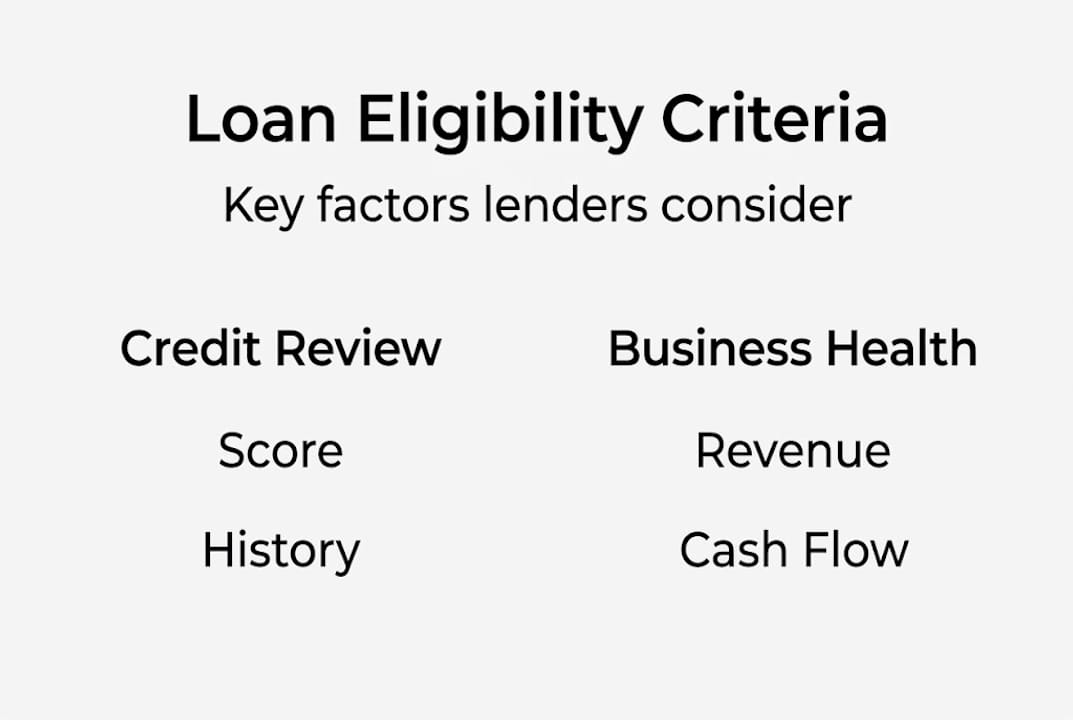
Lenders in both the US and Canada follow a consistent evaluation framework, though the thresholds vary. Lenders evaluate personal credit scores (roughly 680 or above in the US, 650 to 700 in Canada), business credit history, debt service coverage ratios, annual revenue, and years in operation. Each factor is weighted differently depending on the lender and loan type.
Here's what lenders typically examine in detail:
- Personal credit score: This is often the first filter. A score below the lender's threshold can result in an automatic decline regardless of other factors.
- Business credit score: Agencies like Dun and Bradstreet, Equifax Business, and Experian Business track how reliably your company pays its obligations.
- Debt Service Coverage Ratio (DSCR): This measures whether your business generates enough income to cover existing debt plus the new loan payment. Most lenders want a DSCR of at least 1.25.
- Cash flow consistency: Lenders prefer steady monthly revenue over seasonal spikes. Irregular cash flow raises flags about repayment reliability.
- Industry risk: Some sectors are considered higher risk by lenders, including restaurants, retail, and construction startups. This doesn't disqualify you, but it may affect terms.
- Time in business: Newer businesses represent higher risk. The longer you've been operating, the more data a lender has to assess your stability.
Pro Tip: Pull your personal and business credit reports before applying. Errors on credit reports are surprisingly common and can lower your score unfairly. Disputing inaccuracies before you apply gives your application a cleaner foundation.
Understanding how accounting for business loans works can also help you present your financials in the way lenders expect to see them, which reduces confusion during underwriting.
Common deal-breakers include recent bankruptcies within the past three to seven years, unpaid tax liens, delinquent accounts, and weak or negative monthly cash flow. If any of these apply to your situation, addressing them before applying is far more effective than hoping the lender overlooks them.
What to do if you don't qualify: Alternatives and next steps
But what if you're not eligible today? Here's how to keep your funding goals alive.
A denial is not a dead end. It is information. The most important step after being told you don't qualify is to find out exactly why, and then build a plan to address it. Business owners with credit scores above 700 saw approval rates exceed 55%, while those with lower scores faced dramatically lower odds. That gap is closable with the right strategy.
Here are concrete steps to take if you don't currently meet loan eligibility criteria:
- Request a detailed explanation. Lenders are generally required to provide a reason for denial. Use that reason as your action list.
- Improve your credit score. Pay down existing balances, resolve any delinquencies, and avoid new hard inquiries for several months before reapplying.
- Stabilize your monthly cash flow. If irregular income is the issue, focus on locking in steady contracts or recurring clients to show lenders a more predictable revenue pattern.
- Explore microloans. Programs like SBA Microloans (up to $50,000) and Community Development Financial Institutions (CDFIs) are designed for businesses that don't yet qualify for traditional loans.
- Look into bad credit-friendly loans. Some lenders specialize in working with lower-credit borrowers, often using alternative data to assess risk.
- Consider alternative financing structures. Invoice financing, merchant cash advances, and equipment financing all have different eligibility requirements than traditional term loans.
Pro Tip: Many business owners don't realize how much tech-driven lending platforms have changed the landscape. Some platforms use cash flow data, transaction history, and industry benchmarks instead of traditional credit scores to evaluate your application.
While you work on your eligibility, keep detailed records of your business performance. Documentation is one of the strongest signals you can send a lender, and having organized financials ready accelerates the approval process when you are ready to reapply. If you are exploring the full picture of what's possible, financing your dream outlines a range of approaches for businesses at different stages.
Why loan eligibility is just the starting line: Expert perspective
Having explored alternative paths, let's step back and look at loan eligibility from an expert's practical lens.
After working with business owners across hundreds of industries since 2009, we have seen a consistent pattern. The businesses that successfully secure funding are rarely the ones with perfect credit scores or flawless financials. They are the ones who walk in prepared, with a clear story about where their business is, where it is going, and why the loan accelerates that trajectory.
Eligibility means you are allowed to apply. It does not mean approval is automatic. Too many small business owners treat meeting the minimum threshold as the finish line, then feel blindsided when the lender still declines them after a full review. The strongest applicants treat eligibility as the floor, not the ceiling.
Denials, when they happen, carry real value. Every lender who declines an application is telling you something specific about what your business looks like from a risk perspective. That feedback, if you ask for it and act on it, is one of the most useful business development tools available. We have seen business owners get denied in January and approved with better terms in September, simply because they addressed the documented issues and came back with stronger evidence of business health.
Loan readiness is about telling your business story with confidence and evidence. Review future lending considerations so you understand what signing a loan agreement actually commits you to. That context makes you a more informed borrower and a more credible applicant.
Secure funding for your small business: Explore your options
Understanding loan eligibility is the first real step toward securing financing that fits your business. Whether you are navigating SBA requirements, Canadian programs, or exploring alternative lenders, the key is knowing which criteria apply to your situation and preparing accordingly.
At Capital for Business, we work with small business owners across the US and Canada to find funding solutions that match their actual eligibility profile, not just an ideal one. From different small business loan types to options specifically built for business owners with credit challenges, our team helps you identify the right path forward. If a traditional bank has already said no, that doesn't mean the conversation is over. Explore our bad credit business loans and browse our full range of custom business funding solutions to find what fits your business today.
Frequently asked questions
What is loan eligibility for a small business?
Loan eligibility means your business meets a lender's basic criteria, including industry, size, ownership, revenue, and credit profile, to apply and be considered for funding. As SBA standards outline, these criteria cover everything from business operation status to eligible uses of funds.
Do I need good credit to qualify for a business loan?
Most lenders look for a credit score of 650 or higher, though some online and alternative lenders accept lower scores if other factors such as revenue and time in business are strong. Lender benchmarks in both the US and Canada consistently reflect this range.
Why are small business loan applications denied?
The most common reasons include low credit scores, insufficient revenue, short time in business, or applying for ineligible industries or uses. Most lenders review credit scores, annual revenue, operation length, and industry type as primary denial triggers.
What's the fastest way to improve my loan eligibility?
Strengthen your credit score, increase business revenue, and organize your financial records to demonstrate stable cash flow. Lenders prefer documented stability over short-term spikes when making approval decisions.