
TL;DR:
- Success depends on matching the right loan type with your business stage and needs.
- Preparing complete, accurate financial documents and a clear business plan improves approval chances.
- Applying to multiple lenders simultaneously enhances options and negotiation power.
Applying for a small business loan in Canada can feel like navigating a maze with no map. You know funding could change everything for your business, but one wrong move, one missing document, or one mismatched loan type can delay your plans by weeks or even cost you the approval entirely. The good news is that the process is far more predictable than it seems. Successful applicants follow a clear sequence, prepare the right materials, and approach the right lenders. This guide breaks down every step so you can move forward with confidence, reduce costly mistakes, and give your application the best possible chance of approval.
Table of Contents
- Understanding loan types and eligibility
- Preparing your documents and financial profile
- Choosing the right lender and submitting your application
- Navigating approval, timelines, and funding
- Troubleshooting and maximizing approval odds
- The hard truths about small business loan applications
- Secure your business funding with expert support
- Frequently asked questions
Key Takeaways
| Point | Details |
|---|---|
| Know the loan options | Matching your needs to the right loan type in Canada is the essential first step. |
| Get your paperwork right | Complete business plans and clean financials are the biggest approval factors. |
| Apply broadly for best terms | Approaching multiple lenders can speed up results and secure better rates. |
| Avoid common mistakes | Incomplete info and unrealistic projections delay or derail many applications. |
| Prepare for review | Timely responses and clear communication keep your application on track from submission to funding. |
Understanding loan types and eligibility
With the overall process in mind, let's clarify what loan options you can choose and whether you're likely to qualify. Not every loan is built for every business, and applying for the wrong product wastes time and damages your credibility with lenders.
The standard step-by-step process for small business loan applications in Canada starts with assessing your funding needs and matching them to the right loan type. Getting this right from the start saves weeks of back-and-forth.
Here are the most common loan types available to Canadian small businesses:
- Canada Small Business Financing Program (CSBFP): Government-backed, ideal for purchasing equipment, real estate, or leasehold improvements. The CSBFP offers up to $1.15 million with an 85% government guarantee, making it one of the most accessible options for newer businesses.
- Term loans: Lump-sum loans repaid over a fixed period. Best for specific, one-time investments like expansion or equipment purchases.
- Business lines of credit: Flexible revolving credit for managing cash flow and day-to-day operational expenses.
- BDC loans: Offered by the Business Development Bank of Canada, focused on growth-oriented businesses that may not qualify at traditional banks.
You can explore the full range of types of small business loans to understand which product fits your stage of growth.
Eligibility basics for the CSBFP:
| Criteria | Requirement |
|---|---|
| Business location | Operating in Canada |
| Annual gross revenue | $10 million or less |
| Business type | For-profit only |
| Excluded sectors | Farming and certain religious organizations |
| Loan purpose | Equipment, real estate, leasehold improvements |
CSBFP vs. standard bank loans at a glance:
| Factor | CSBFP | Standard bank loan |
|---|---|---|
| Government backing | Yes (85%) | No |
| Max loan amount | $1.15 million | Varies |
| Collateral required | Asset-based | Full collateral often required |
| Best for | Startups and small businesses | Established businesses with strong credit |
Benchmark insight: Matching your loan type to your business stage is one of the most overlooked steps. A startup applying for a standard term loan without collateral will almost always be declined, while the same business might qualify for a CSBFP loan. Lenders want to see that you understand which product fits your situation.
Banks like TD, RBC, and BMO offer CSBFP loans directly. Credit unions are a strong alternative if you have a local relationship. The BDC fills the gap when traditional lenders say no, often offering more flexible terms for businesses with limited credit history.
Preparing your documents and financial profile
Once you've identified the right loan and checked your eligibility, the next critical step is gathering the documents that will make or break your application. Lenders are not just evaluating your idea. They are evaluating your ability to repay, your financial discipline, and your preparedness as a business owner.
The documents required for a strong application include a business plan with financial projections, recent financial statements, tax returns, credit history reports, and quotes for any assets you plan to purchase.
Here is a numbered checklist to follow:
- Business plan: Include an executive summary, market analysis, operational plan, and at least three years of financial projections.
- Financial statements: Profit and loss statements, balance sheets, and cash flow statements for the past two to three years.
- Tax returns: Both personal and business returns for the last two years.
- Credit reports: Personal credit score and business credit profile if applicable.
- Asset quotes: If purchasing equipment or property, include formal quotes from suppliers.
- Legal documents: Business registration, articles of incorporation, and any partnership agreements.
Document requirements by loan type:
| Document | CSBFP | Term loan | Line of credit |
|---|---|---|---|
| Business plan | Required | Required | Sometimes |
| Financial projections | Required | Required | Recommended |
| Tax returns (2 years) | Required | Required | Required |
| Asset quotes | Required | Sometimes | No |
| Personal credit check | Required | Required | Required |
Your business plan deserves special attention. Lenders read hundreds of plans. Yours needs to show that you understand your market, your costs, and your revenue path. Keep it clear and specific. Vague statements about "growing market share" without numbers will raise red flags.

Avoiding financing mistakes early in the process can save you significant time. One of the most common errors is submitting incomplete projections or skipping the cash flow forecast entirely.
Pro Tip: Always include your Debt Service Coverage Ratio (DSCR), which is your net operating income divided by your total debt payments, in your executive summary. A DSCR above 1.25 signals to lenders that your business generates enough income to cover loan repayments comfortably. This single number can shift a lender's confidence significantly.
You can also optimize your loan application by reviewing common formatting and content standards that lenders expect to see before you submit.
Choosing the right lender and submitting your application
With your documents in order, you're ready to approach lenders. Here's how to pick the right one and ensure your submission stands out.
Not all lenders are equal. Their approval criteria, interest rates, processing times, and loan products vary widely. Incomplete documents can delay your application by two to four weeks, so choosing a lender whose requirements you can fully meet is just as important as the application itself.
Where to apply:
- Major banks (TD, RBC, BMO, Scotiabank, CIBC): Best for established businesses with strong credit and clean financials.
- Business Development Bank of Canada (BDC): Ideal for growth-stage businesses or those who have been declined elsewhere.
- Credit unions: Good for businesses with local ties and a preference for relationship-based lending.
- Online lenders: Faster processing, often suited to smaller loan amounts and businesses needing quick decisions.
How to vet a lender before applying:
- Compare interest rates and total loan costs, not just monthly payments.
- Review their minimum credit score and revenue requirements.
- Ask about their average approval timeline.
- Confirm they offer the specific loan product you need.
- Check for prepayment penalties or hidden fees.
Step-by-step submission process:
- Research at least three lenders and compare their products side by side.
- Make initial contact by phone or online to confirm you meet basic eligibility.
- Gather and organize all required documents before submitting.
- Submit your application along with all supporting materials in one complete package.
- Follow up within five business days if you haven't received a confirmation.
Pro Tip: Submit to at least two lenders simultaneously. This gives you negotiating power if both approve you, and a backup if one declines. Just be aware that multiple hard credit inquiries within a short window can slightly affect your credit score.
During your lender meeting, expect questions about your industry experience, how you plan to use the funds, and how you'll handle repayment if revenue dips. Bring printed copies of all your documents. You can review a detailed breakdown of the full apply for business loans in Canada process to make sure you're covering all the bases.
Before you sign anything, review the loan considerations that matter most, including rate structure, repayment flexibility, and lender reputation. The CSBFP lender directory is a reliable starting point for finding approved lenders near you.
Navigating approval, timelines, and funding
After submitting your application, knowing what comes next can reduce anxiety and help you stay proactive.
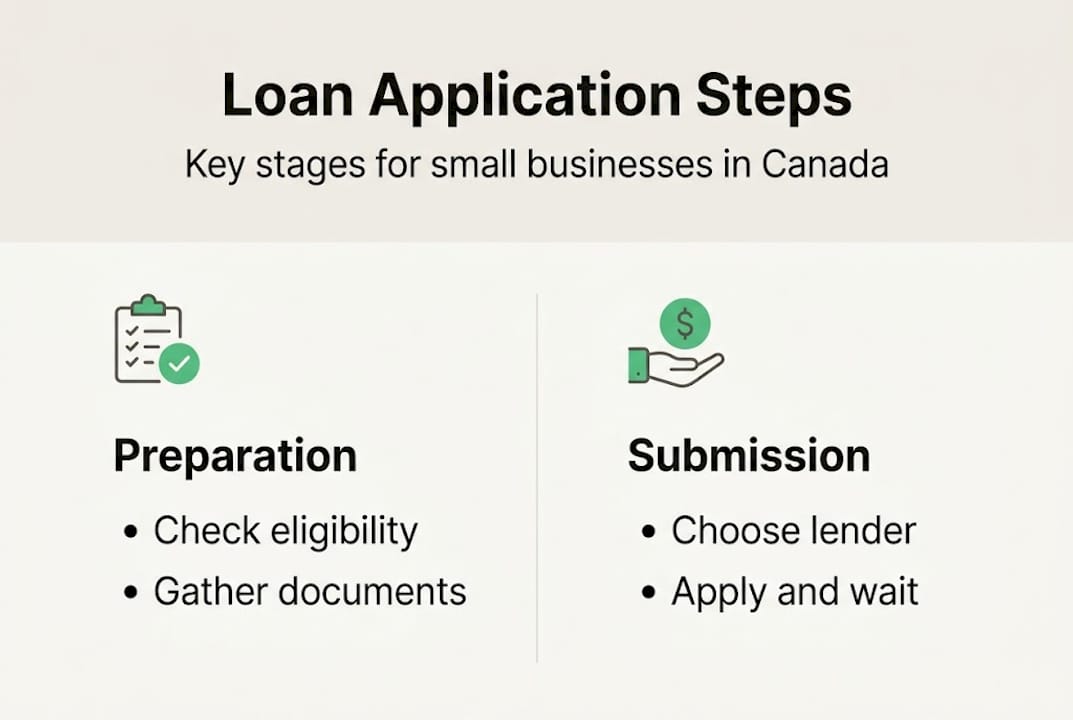
Once your application is in, the lender begins a structured review. They will verify your documents, run credit checks, assess your business viability, and may request additional information. This is normal. Respond to any requests quickly, because delays on your end directly extend your wait time.
What lenders review after submission:
- Credit history and score for both the business and the owner.
- Revenue trends and financial statement consistency.
- Strength and realism of your business plan projections.
- Collateral or asset value if applicable.
- Industry risk profile and market conditions.
Approval typically takes 2-6 weeks for most applications. Smaller loans under $100,000 to $250,000 processed through online platforms at lenders like BDC or TD tend to move faster, sometimes within days.
Industry benchmark: The average small business loan in Canada is approved within three to four weeks when all documents are submitted correctly on the first attempt. Applications with missing information or inconsistent financials take significantly longer and are more likely to be declined outright.
Once approved, your lender will issue a loan agreement outlining the terms. Read it carefully. Confirm the interest rate, repayment schedule, fees, and any conditions you must meet before funds are released.
Common reasons for delays or denials:
- Missing or incomplete documents at submission.
- Cash flow projections that don't align with your historical financials.
- Personal or business credit score below the lender's minimum threshold.
- Applying for a loan type that doesn't match your stated use of funds.
- Insufficient collateral for the loan amount requested.
You can review a detailed loan application workflow to understand each stage and what triggers delays. Avoiding common funding mistakes before and during the process is just as important as the application itself. The CSBFA review process outlines exactly what lenders assess during their internal review.
To ensure smooth disbursement once approved, confirm the bank account details on file are correct, sign all documents promptly, and meet any conditions outlined in the approval letter before the deadline.
Troubleshooting and maximizing approval odds
Even with everything in order, small missteps can harm your chances. Here's what to watch for and how to tip the scales in your favor.
Realistic projections and industry experience are the two factors lenders consistently cite as critical to approval. Incomplete documents remain the single most common reason applications stall or get declined.
Quick tips for boosting your approval odds:
- Clean up your personal credit before applying. Pay down balances and resolve any outstanding issues.
- Be specific about how you'll use the funds. Vague explanations raise concerns.
- Show industry experience in your business plan. Lenders want to see that you know your sector.
- Keep your financial statements current. Outdated documents signal disorganization.
- Avoid applying for more than you need. Oversized loan requests relative to revenue are a red flag.
- Maintain open communication with your lender throughout the process.
Pro Tip: Lead your business plan with results, not just vision. Instead of opening with your mission statement, start with your revenue track record, your customer base, and your growth rate. Lenders respond to evidence, not enthusiasm.
If your application is declined, ask the lender for specific feedback. Most will tell you exactly what fell short. Common issues include a credit score below their threshold, projections that seemed unrealistic, or a debt load that made repayment appear risky.
Before reapplying, address the root cause. Improve your credit, revise your projections with more conservative assumptions, or reduce existing debt. Reviewing common financing mistakes and financial practices to avoid in your business can help you identify what to fix before your next attempt.
Waiting three to six months before reapplying gives you time to strengthen your profile and shows lenders that you took their feedback seriously.
The hard truths about small business loan applications
Now that you've seen the specific steps, let's get real about what truly sets successful applications apart.
Most loan application failures are preventable. After working with business owners across hundreds of industries since 2009, we've seen the same patterns repeat. Applicants overestimate how much a polished business plan matters and underestimate how much clean, consistent financials move the needle. Lenders are not evaluating your vision. They are evaluating your risk.
Loan officers review dozens of applications every week. What makes yours stand out is not a compelling story. It's clarity. Clear numbers, clear use of funds, and clear evidence that you can repay. Applications that answer every lender question before it's asked almost always perform better.
Realistic cash flow projections beat grand revenue visions every time. A projection showing steady, modest growth backed by real data is far more persuasive than one showing explosive growth with no supporting evidence. Lenders have seen the optimistic version too many times.
If you've been declined, treat it as a diagnostic tool. The decline is rarely about the loan officer's judgment. It's almost always a signal that something in your business health, your credit, your cash flow, or your documentation needs attention. Fix the underlying issue, not just the application. Our business loan guide walks through exactly how to build the kind of financial profile that lenders want to see.
The businesses that get funded are the ones that prepare like the approval is not guaranteed, because it isn't.
Secure your business funding with expert support
Equipped with a step-by-step plan, you don't have to go it alone. Here's how to get even more support for your funding journey.
At Capital for Business, we've helped small business owners across Canada navigate the loan process since 2009. We know which lenders move quickly, what documents matter most, and how to position your application for the best possible outcome. The right support can save you weeks of back-and-forth and significantly improve your approval odds.
Whether you're just starting to explore loan options or you're ready to apply right now, our team is here to help you move forward with confidence. From working capital and equipment financing to business lines of credit, we offer solutions built for real businesses with real timelines. Visit Capital for Business today to speak with a funding specialist and find the right loan for your next stage of growth.
Frequently asked questions
What is the most common loan type for small businesses in Canada?
The CSBFP is the primary government-backed program, offering up to $1.15 million with an 85% government guarantee, making it the most widely used option for Canadian small businesses.
How long does loan approval usually take?
Approval typically takes 2-6 weeks, though smaller loans submitted through online platforms can be processed significantly faster, sometimes within a few business days.
What documents do I need for a loan application?
You need a business plan with financial projections, recent financial statements, tax returns, and credit history reports, as outlined in the CSBFP document requirements.
What are the top reasons loan applications get delayed or denied?
Incomplete documents can delay approval by two to four weeks, and unrealistic projections or a weak credit profile are the most common reasons for outright denial.
Can I apply to multiple lenders at once?
Yes, applying to multiple lenders is strongly recommended since criteria vary by institution, and having competing offers gives you better negotiating power and a backup if one declines.