
Typical equipment financing rates in 2026 fall between 4% and 45% APR, with the spread driven almost entirely by credit profile, time in business, and lender type. Well-qualified borrowers with credit scores above 740 typically see rates from 4% to 8%, according to EquipRates. Industry benchmarking from the Equipment Leasing and Finance Association confirms this dispersion is normal and reflects underwriting risk more than market interest rate swings.
Here's how that breaks down by borrower profile:
- Excellent credit (740+): 4% to 8% APR, typically from banks or captive finance companies.
- Average credit (620 to 679): 15% to 25% APR, often through online lenders.
- Challenged credit (below 620): 25% to 45% APR, usually requiring a larger down payment or shorter term.
Pro Tip: Pull your business and personal credit reports before you shop. A 20 point score improvement can sometimes move you into the next lower rate tier.
Your best move right now is to get quotes from at least two or three lender types (bank, online lender, and a specialty equipment lender) before signing anything. Comparing offers side by side, rather than accepting the first number you see, is the single biggest lever you control. You can check your likely rate and pre-qualify with Capital for Business in minutes without a hard credit pull.
Key Takeaways
| Point | Details |
|---|---|
| Know your rate tier | Excellent credit (740+) typically qualifies for 4% to 8% APR; challenged credit often sees 25% to 45%. |
| Compare APR, not rate | APR includes fees and reveals the true cost difference between similar-looking offers. |
| Match product to goal | Loans build equity, leases preserve cash flow, and SBA options often offer the lowest rates for patient buyers. |
| Documentation speeds approval | Tax returns, bank statements, and an equipment invoice are the core package nearly every lender requests. |
| Capital for Business as a next step | Equipment financing up to $250,000 with same day funding and access to a multi-lender network for faster comparison. |
Table of Contents
- What Equipment Financing Rates Look Like Right Now
- Loan, Lease, or SBA: Which Product Gets You the Best Rate?
- What Will Your Monthly Payment Actually Be?
- What Documents Do Lenders Ask For?
- How Do You Compare Offers and Spot a Bad Deal?
- Where Are Rates Headed in 2026?
- Why Comparison Shopping Beats Chasing the Lowest Advertised Rate
- Get an Equipment Financing Quote Without the Runaround
- Sources
- FAQ
What Equipment Financing Rates Look Like Right Now
Rate bands vary by lender type, with banks tending to offer the safest deals with generally lower APRs, while online and alternative lenders serve higher-risk borrowers at higher APRs, sometimes reaching around 30% or more, based on market data from Nautix Capital. Credit unions and captive finance arms (the financing divisions attached to equipment manufacturers) often sit somewhere in between, particularly for new equipment purchases.
Breaking it down by credit tier gives a clearer picture:
- Excellent (740+): 4% to 8% APR, mostly available through banks and captives.
- Good (680 to 739): 8% to 15% APR, available across most lender types.
- Average (620 to 679): 15% to 25% APR, typically online lenders and non bank finance companies.
- Challenged (below 620): highest APRs, often paired with a required down payment of 10% to 20%.
One distinction trips up more borrowers than any other: the difference between the nominal interest rate and the APR. The interest rate reflects only the cost of borrowing the principal. APR folds in origination fees, documentation charges, and other costs, spreading them across the loan term. Two offers with identical interest rates can carry very different APRs once fees are factored in, which is why APR, not the headline rate, is the number to compare across lenders.
Rate Benchmark: Equipment loan APRs generally span 4% to 45%, with rates under 10% typically reserved for borrowers with credit scores of 740 or higher, per EquipRates.
Several factors move your quote within these bands:
- Term length: Shorter terms (36 months) usually carry lower rates than longer terms (84 months) because the lender's risk window is smaller.
- Down payment: Putting 10% to 20% down often unlocks a meaningfully better rate, since it lowers the lender's exposure if the equipment is repossessed.
- Equipment age and value: New equipment with strong resale value tends to finance at lower rates than older or specialized machinery with a thin resale market.
- Business revenue and time in business: Lenders generally want at least two years in business and consistent monthly revenue before offering their best pricing.
- Personal and corporate credit score: This remains the single heaviest factor, particularly for businesses under five years old that lack a long credit history.
Pro Tip: If your credit sits in the "average" tier, offering a 15% to 20% down payment can sometimes offset the credit gap and pull your quote closer to the "good" tier pricing.
Loan, Lease, or SBA: Which Product Gets You the Best Rate?
The financing structure you choose shapes your effective cost as much as your credit score does. An equipment loan is a secured term loan where the equipment itself backs the debt; you own it outright once the loan is paid off, and it typically carries the most competitive rates for well-qualified borrowers. A capital lease functions similarly to a loan for tax and ownership purposes but spreads payments differently, while an operating lease keeps the equipment off your balance sheet and usually costs less per month, though you never build equity in the asset. SBA 7(a) and CDC/504 loans offer some of the lowest rates available, but they come with longer approval timelines and stricter documentation requirements, making them a better fit for planned purchases than urgent equipment needs.
| Product Type | Typical Rate Position | Best Fit |
|---|---|---|
| Equipment loan | Lowest for strong credit | Buyers who want ownership and tax depreciation benefits |
| Capital lease | Moderate | Businesses wanting ownership at term end with lower upfront cost |
| Operating lease | Moderate to low monthly cost | Equipment that gets upgraded frequently (tech, medical devices) |
| SBA-backed loan | Often lowest overall | Well-documented businesses that can wait weeks, not days, for funding |
For borrowers with weaker credit, leasing is often more accessible than a traditional loan since the lender retains ownership and reduces its risk. If you're still weighing ownership against flexibility, Capital for Business breaks down the leasing versus financing decision in more detail. The trade-off is straightforward: leases protect cash flow and simplify upgrades, while loans build equity and usually cost less over the full life of the equipment.
What Will Your Monthly Payment Actually Be?
Monthly payments follow a standard amortization formula: Payment = P × r / (1 − (1 + r)^−n), where P is the loan amount, r is the monthly interest rate (APR divided by 12), and n is the number of payments. Plugging in real numbers makes the abstract concrete.
- $25,000 loan at 8% APR over 36 months: roughly $783 per month, about $3,200 in total interest.
- $75,000 loan at 12% APR over 60 months: roughly $1,669 per month, about $25,140 in total interest.
- $250,000 loan at 18% APR over 84 months: roughly $5,481 per month, about $210,404 in total interest.
| Loan Amount | Term | APR | Est. Monthly Payment | Est. Total Interest |
|---|---|---|---|---|
| $25,000 | 36 months | 8% | $783 | $3,200 |
| $75,000 | 60 months | 12% | $1,669 | $25,140 |
| $250,000 | 84 months | 18% | $5,481 | $210,404 |
Here's why APR, not just the rate, decides your real cost: imagine two $75,000 offers over 60 months. Offer A ends up cheaper overall despite the higher advertised number, because the fee in Offer B is baked into the true cost of borrowing. This is exactly why lenders are required to disclose APR, and why comparing headline interest rates alone is one of the most common mistakes borrowers make.

What Documents Do Lenders Ask For?
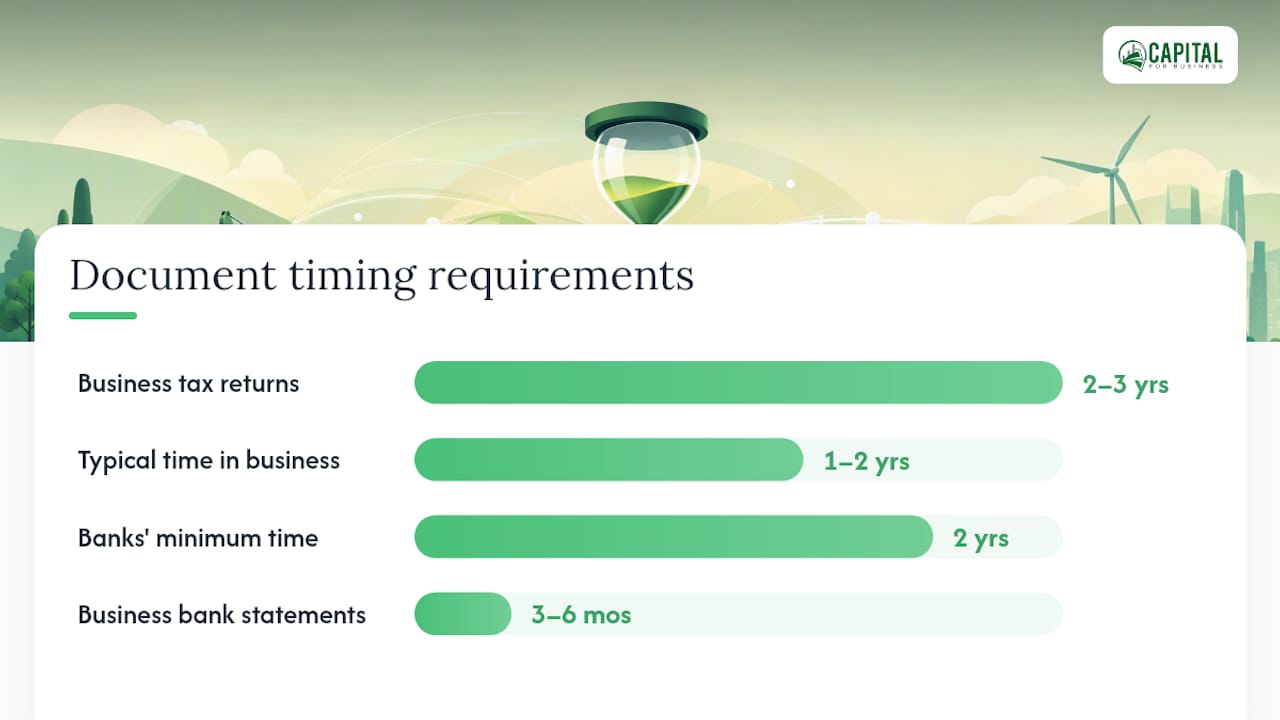
Lenders evaluate a fairly consistent set of qualifications before quoting a rate: personal and corporate credit scores, time in business (usually a minimum of one to two years, though some online lenders accept six months), and monthly or annual revenue thresholds. Banks tend to require at least two years in business and stronger revenue documentation, while alternative lenders and captives are often more flexible on time in business but charge more for that flexibility.
Have these ready before you request a quote:
- Two to three years of business tax returns (or personal returns for newer businesses)
- Three to six months of business bank statements
- An equipment quote or invoice from the seller
- Driver's license and Social Security number for the guarantor
- Business formation documents (articles of incorporation, EIN)
- Customer contracts or accounts receivable aging, if revenue is seasonal
Pro Tip: If you're financing used equipment, attach a recent appraisal or maintenance log to your application. It signals lower collateral risk and can help you avoid a larger down payment requirement. Capital for Business's step-by-step equipment financing guide walks through exactly what a complete application package looks like.
How Do You Compare Offers and Spot a Bad Deal?
Comparing equipment financing offers accurately means asking the same set of questions of every lender, not just eyeballing the advertised rate. Before signing anything, ask:
- What is the APR, not just the interest rate?
- What is the exact term length and amortization schedule?
- Are there origination, processing, or documentation fees, and how much?
- Is there a prepayment penalty if I pay the loan off early?
- What happens to the equipment if I default, and how is repossession handled?
Watch for these red flags:
- A lender who won't disclose APR upfront or buries it in fine print.
- Origination fees above 3% to 5% of the loan amount.
- Vague or missing language about repossession rights.
- A "fixed" rate that actually resets after an introductory period.
Negotiating is more realistic than most borrowers assume, particularly once you have a competing quote in hand. A shorter term, a larger down payment, or enrolling in auto-pay can each shave fractions of a point off your rate. Bundling equipment financing with an existing business line of credit relationship sometimes unlocks preferred pricing too, since the lender already has visibility into your cash flow.
When a lender pushes back on your ask, here's how to read the response:
- "That's our best rate" often means there's room if you shorten the term or add collateral.
- "We can waive the origination fee for a larger down payment" is a fair trade if you have the cash available.
- "No prepayment penalty" confirmed in writing is worth more than a slightly lower headline rate.
Lenders that use structured, transparent workflows (the kind supported by platforms like Clappia's loan management software) tend to move faster and disclose terms more clearly than lenders relying on manual, opaque processes.
Where Are Rates Headed in 2026?
Rate volatility defines the equipment financing market. Lenders adjust underwriting based on policy rates and demand cycles for equipment categories, while secondary market conditions for used equipment affect rates and down payment requirements, per the Equipment Finance Advantage trends toolkit.
Industry benchmarking from the Equipment Leasing and Finance Association shows that underwriting variation, not baseline policy rate shifts, accounts for most of the spread borrowers see between quotes.
The practical takeaway: macro rate moves shift the floor, but your credit profile and equipment type decide where you actually land above it.
Why Comparison Shopping Beats Chasing the Lowest Advertised Rate
Most borrowers fixate on finding the single lowest advertised rate, and that instinct is understandable but often counterproductive. The lowest headline rate frequently comes attached to the strictest qualification requirements, the shortest term options, or fees that erase the savings once APR is calculated honestly.
What tends to matter more than the number on the homepage is fit: does the term length match your equipment's useful life, does the down payment requirement match your available cash, and does the lender's documentation process match your timeline. A business that needs equipment running within a week has different priorities than one planning a purchase six months out, even if both qualify for similar credit tiers.
The overlooked variable is speed of funding relative to rate. A slightly higher rate from a lender that funds in 24 to 48 hours can cost less in lost opportunity than a marginally lower rate from a lender that takes three weeks to close, especially when equipment downtime or a missed contract deadline is the real cost driver. Borrowers who treat rate as the only variable routinely leave money on the table by ignoring timeline and documentation burden.
Get an Equipment Financing Quote Without the Runaround
Capital for Business has worked with small business owners across dozens of industries since 2009, matching them with financing when banks and credit unions say no. Our equipment financing product offers funding up to $250,000 with same day decisions in many cases, backed by a network of lenders rather than a single underwriting box you either fit into or don't.
Here's the practical advantage: instead of submitting separate applications to five different lenders and comparing five different fee structures on your own, you submit one application and let our network do the comparison work for you. That means less paperwork, fewer credit pulls, and a faster path to a funded deal. If leasing or an SBA-backed option turns out to be a better fit for your situation, we'll tell you that directly rather than force-fitting you into a loan that doesn't match your cash flow. Start your pre-qualification for equipment financing today and see your likely rate range before you commit to anything.
Sources
- Free Equipment Financing Calculator | Equipment Loan Payment Estimator | EquipRates
- ELFA — Industry overview
- Equipment Finance Advantage toolkit — 10 trends
This article is general information, not a substitute for advice from a qualified financial advisor. Consult a qualified financial professional about your own circumstances before acting on anything here.
FAQ
What Are Equipment Interest Rates Right Now?
Who Has the Best Equipment Financing?
The "best" option depends on your credit profile and timeline; banks often have the lowest rates for strong credit, while lenders like Capital for Business specialize in fast approvals and flexible terms for businesses that don't fit a traditional bank's box.
What Is the Current Interest Rate for a Machinery Loan?
What Is the Monthly Payment on a $50,000 Business Loan?
Is Leasing or Financing Cheaper for Equipment?
Financing an equipment loan usually costs less over the full term for buyers who plan to keep the equipment, since a loan builds ownership equity, while leasing typically offers lower monthly payments but no equity at term end.