
TL;DR:
- Manufacturers face a persistent cash flow gap due to timing mismatches between payments and collections. Flexible financing tools, such as reverse factoring and purchase order finance, align funding with operational cycles. Building these facilities proactively improves growth opportunities and strengthens supplier relationships.
Flexible financing is defined as a set of credit and liquidity tools that adjust to a manufacturer's operating cycle, revenue patterns, and capital needs rather than forcing fixed repayment schedules onto variable cash flows. Understanding why manufacturers need flexible financing starts with one structural reality: manufacturers pay suppliers weeks before customers pay them. That gap creates a working capital drain that standard bank loans rarely address. 93% of American manufacturers are small and mid-sized businesses operating with limited financial visibility, which means the problem is widespread and largely hidden inside receivables and inventory balances.
Why manufacturers need flexible financing: the cash flow gap problem
The cash flow timing mismatch is the defining financial challenge in manufacturing. A typical mid-sized manufacturer pays suppliers within 30–45 days but waits 60–90 days to collect from customers. That structural gap does not disappear when business grows. It gets larger.
The numbers make the cost concrete. A manufacturer with $40M in annual cost of goods sold and a 40-day working capital gap carries approximately $4.4M in net working capital, costing around $350,000 annually at an 8% capital cost. That $350,000 is not a loan payment. It is the invisible cost of running the business without the right financing structure in place.
Production managers often see this problem as a cash crunch rather than a structural issue. The distinction matters because a cash crunch suggests a temporary fix will work, while a structural issue requires a financing tool that matches the operating cycle. Treating a 90-day receivables lag with a 12-month term loan creates a mismatch that compounds over time.
The operational consequences are direct. When cash is tied up in unpaid invoices and raw material inventory, manufacturers cannot fund the next production run without drawing down reserves or delaying supplier payments. Both choices damage relationships and limit capacity.
| Cash flow stage | Typical timing | Risk without flexible financing |
|---|---|---|
| Supplier payment due | Day 30–45 | Strained supplier relationships, lost discounts |
| Production cycle | Day 1–60 | Inventory buildup, constrained throughput |
| Customer payment received | Day 60–90 | Receivables trap, idle working capital |
| Net working capital gap | 40–60 days average | $350,000+ annual implicit cost on $40M COGS |
Pro Tip: Before approaching any lender, calculate your own cash-to-cash cycle: days inventory outstanding plus days sales outstanding minus days payable outstanding. That single number tells you exactly how much working capital your business structurally requires.
What flexible financing options are available to manufacturers?
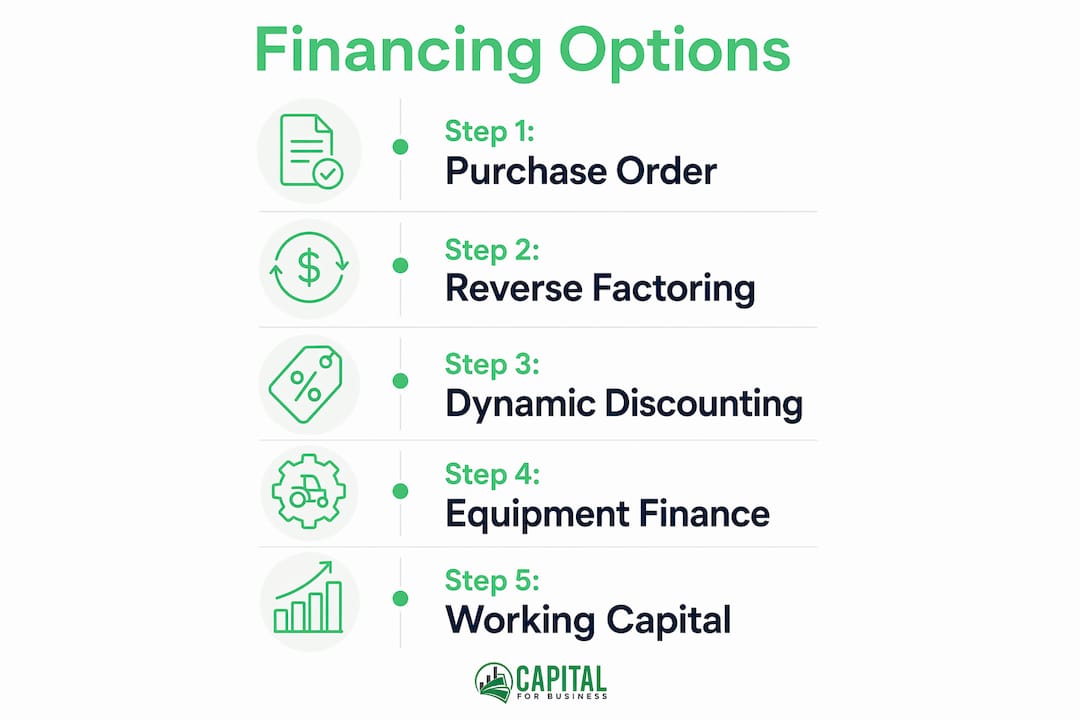
Supply chain finance is the recognized industry term for the category of tools that address manufacturing cash flow friction. Within that category, several instruments serve different points in the operating cycle.

Reverse factoring lets manufacturers pay suppliers early while preserving their own payment terms. The financing cost is priced against the buyer's credit rating, which is typically stronger than the supplier's. Suppliers receive early payment at a lower cost than they could access independently, and the manufacturer maintains its cash position. Both sides benefit without adding debt in the traditional sense.
Dynamic discounting works differently. It uses the manufacturer's own idle cash to offer early payments to suppliers in exchange for negotiated discounts. Automated platform workflows manage the offers and settlements, making the process practical at scale. This tool earns a return on cash that would otherwise sit idle, with no third-party financing required.
Purchase order finance funds production before a sale is complete. When a large or irregular order arrives and the manufacturer lacks the liquidity to fulfill it, purchase order finance covers production costs without drawing on existing credit lines. This is particularly useful for manufacturers handling seasonal demand spikes or new customer contracts.
Beyond supply chain instruments, two broader categories matter:
- Asset-based lending (ABL) and revolving lines of credit use receivables and inventory as collateral. The credit line expands as the asset base grows, making it naturally aligned with production volume. Manufacturers can draw and repay repeatedly, paying interest only on what they use.
- Equipment financing funds machinery and production assets separately from working capital. Equipment lasting 7–10 years should never be funded from operating cash or short-term working capital lines. Separating these two capital needs prevents the liquidity crunches that stall growing manufacturers.
Pro Tip: Match each financing tool to the specific cash flow phase it solves. Use purchase order finance for production funding, invoice factoring for receivables gaps, and equipment financing for long-lived assets. Mixing these up is one of the most common and costly mistakes in manufacturing finance.
The table below summarizes how each tool aligns with manufacturing cash flow needs.
| Financing tool | Best use case | Key benefit |
|---|---|---|
| Reverse factoring | Paying suppliers early | Lower financing cost based on buyer credit |
| Dynamic discounting | Earning returns on idle cash | Supplier discounts without third-party cost |
| Purchase order finance | Funding large or irregular orders | Liquidity without drawing on credit lines |
| Revolving line of credit | Ongoing working capital needs | Draw and repay as needed, interest on use only |
| Equipment financing | Machinery and production assets | Preserves working capital for operations |
| Invoice factoring | Accelerating receivables collection | Immediate cash from outstanding invoices |
Capitalforbusiness offers invoice factoring for manufacturers up to $2.5M and equipment financing up to $250,000 with same-day funding, covering two of the most critical points in the manufacturing cash cycle.
How flexible financing benefits manufacturers beyond cash flow
The benefits of flexible financing extend well past plugging a liquidity gap. The most direct secondary benefit is supplier relationship quality. When manufacturers pay on time or early, suppliers prioritize their orders, offer better pricing, and extend more favorable terms. That purchasing advantage compounds over time and directly reduces cost of goods sold.
Manufacturers with flexible facilities in place act quickly on demand spikes and avoid operational stalls. A competitor without a credit facility in place will pass on a large order or delay fulfillment. A manufacturer with a revolving line or purchase order facility can say yes immediately. That speed is a real competitive advantage, not a theoretical one.
Revenue-based financing structures add another layer of protection. Repayments that scale with performance automatically reduce during slow periods, which protects manufacturers from the fixed payment pressure that causes distress during seasonal downturns. A manufacturer running a 60-day slow season does not face the same cash pressure as one locked into fixed monthly loan payments.
The strategic benefits of adaptive financing include:
- Faster response to growth opportunities. Manufacturers can accept larger contracts, expand production capacity, and enter new markets without waiting for a bank approval cycle.
- Stronger supplier negotiations. Early payment capability gives manufacturers leverage to negotiate volume discounts and priority allocation.
- Reduced financial distress risk. Payments that flex with revenue prevent the fixed-cost spiral that forces manufacturers to cut staff or defer maintenance during slow periods.
- Improved financial visibility. Structured financing facilities require regular reporting, which forces manufacturers to track working capital metrics they often ignore.
- Preserved equity. Debt-based flexible financing avoids the dilution that comes with equity raises, keeping ownership and control intact.
Flexible funding transforms liquidity from a passive outcome into a strategic input. Manufacturers that treat financing as a tool rather than a last resort deploy capital aligned with real demand, not just available cash. That shift in mindset separates manufacturers that grow steadily from those that grow in bursts and stall.
You can read more about the structural factors that affect manufacturing liquidity in this guide on improving cash flow in manufacturing, which covers practical steps alongside financing strategies.
Common pitfalls when using flexible financing in manufacturing
The most damaging mistake manufacturers make is mismatching financing terms with asset life or operating cycle. Operating cash should not fund long-lived equipment. A CNC machine with a 10-year productive life financed from a 90-day working capital line creates a permanent liquidity drain. The machine generates value for a decade, but the cash is gone in three months.
The second common mistake is treating a structural working capital gap as a temporary problem. Manufacturers often take a short-term loan to cover a cash crunch, repay it, and then face the same crunch six months later. The cycle repeats because the underlying gap was never addressed with the right instrument.
- Quantify your working capital gap first. Calculate your cash-to-cash cycle before selecting any financing product. Quantifying working capital cost is the critical first step toward choosing the right structure.
- Separate equipment and working capital financing. Never use a revolving credit line to buy machinery. Use dedicated equipment financing and keep the credit line available for operational needs.
- Coordinate treasury, accounting, and lenders. Effective flexible financing requires coordination among these three functions to prevent compliance issues and maximize financial benefit. Siloed decision-making leads to duplicate borrowing, covenant violations, and missed opportunities.
- Avoid over-borrowing during growth. Manufacturers scaling rapidly often draw maximum credit during expansion, leaving no buffer for a demand slowdown. Keep 20–30% of available credit undrawn as a liquidity reserve.
- Review financing terms annually. Business conditions change. A financing structure that fit your operation two years ago may now be misaligned with your current cycle length, customer mix, or equipment base.
Pro Tip: Ask your lender for a covenant summary in plain language before signing any facility agreement. Covenants that restrict additional borrowing or require minimum cash balances can limit your flexibility exactly when you need it most.
Technology also plays a role in managing financing effectively. Digital reporting tools that connect accounting systems to lender portals reduce administrative burden and improve the accuracy of borrowing base certificates, which determine how much you can draw on an asset-based line. You can learn more about how technology in small business lending is changing access and administration for manufacturers.
The case for treating flexible financing as a long-term strategy
Most manufacturers come to flexible financing reactively. A large order arrives, cash is short, and they scramble for a solution. That reactive posture is expensive. Lenders price urgency into rates, and manufacturers accept worse terms because they have no time to negotiate.
The manufacturers that consistently outperform their peers treat financing facilities the same way they treat production capacity. They build it before they need it. Manufacturers that secure flexible financing in advance are better positioned to seize unplanned growth opportunities with speed and confidence. A credit facility costs nothing when it sits unused. It is worth everything when a $2M contract lands with a 30-day fulfillment deadline.
Flexibility is not a cost. It is a capability. Manufacturers that integrate adaptive financing into their annual planning cycle negotiate from strength, not desperation. They know their working capital gap, they have facilities matched to their cycle, and they can move when competitors cannot.
The shift from reactive to proactive financing is not complicated. It starts with calculating your cash-to-cash cycle, identifying the right instruments for each friction point, and establishing facilities before liquidity becomes urgent. That sequence takes months, not years, and the payoff compounds with every growth cycle.
— Capital
Capitalforbusiness financing solutions for manufacturers
Capitalforbusiness has worked with manufacturers across hundreds of industries since 2009, providing fast, accessible funding when banks and credit unions fall short.
Whether you need working capital funding to cover a receivables gap, equipment financing for new machinery, or a flexible credit line to handle seasonal demand, Capitalforbusiness offers manufacturing business loans up to $500,000 with straightforward qualification requirements. The application process is built for speed, and funding decisions come quickly. Explore the full range of small business loan types available to find the structure that fits your operating cycle and growth plans.
Key takeaways
Manufacturers that match financing tools to their operating cycle reduce implicit working capital costs and gain the speed to act on growth opportunities before competitors do.
| Point | Details |
|---|---|
| Cash flow gap is structural | The 60–90 day gap between supplier payments and customer collections creates a permanent working capital need. |
| Match tools to cash cycle phases | Use purchase order finance for production, invoice factoring for receivables, and equipment financing for long-lived assets. |
| Flexible repayment reduces distress | Revenue-based structures scale payments down during slow periods, protecting manufacturers from fixed-cost pressure. |
| Secure facilities before you need them | Manufacturers with credit lines in place act faster on growth opportunities and negotiate better financing terms. |
| Coordinate across departments | Treasury, accounting, and lenders must align to prevent compliance issues and maximize the value of any financing facility. |
FAQ
What is flexible financing for manufacturers?
Flexible financing is a category of credit and liquidity tools, including revolving lines of credit, invoice factoring, and purchase order finance, that adjust to a manufacturer's cash flow cycle rather than imposing fixed repayment schedules.
How large is the typical manufacturing working capital gap?
A manufacturer with $40M in annual cost of goods sold and a 40-day working capital gap carries approximately $4.4M in net working capital, costing around $350,000 annually at an 8% capital cost.
What is the difference between equipment financing and working capital financing?
Equipment financing funds long-lived machinery over terms matched to asset life, typically 7–10 years, while working capital financing covers short-term operational needs like inventory and receivables. Mixing the two causes liquidity problems.
How does reverse factoring benefit manufacturers?
Reverse factoring lets manufacturers pay suppliers early using financing priced against the buyer's stronger credit rating, reducing the supplier's financing cost while preserving the manufacturer's cash position.
When should a manufacturer apply for flexible financing?
Manufacturers should establish financing facilities before a liquidity need arises. Applying during a cash crunch limits negotiating power and typically results in higher rates and less favorable terms.