
TL;DR:
- Equipment financing spreads costs over time, preserving working capital for growth needs.
- It offers faster approval, higher acceptance rates, and ownership transfer after repayment.
- Financing supports business expansion, maintains cash flow predictability, and is accessible with lower credit.
Most small business owners assume that buying equipment outright is the financially responsible choice. Pay in full, own it immediately, and avoid debt. That logic sounds solid until you realize it can quietly drain the reserves you need to hire staff, cover payroll, or handle an unexpected slowdown. Equipment financing flips that script. Instead of tying up capital in a single asset, you spread the cost over time and keep your working capital available for the decisions that actually drive growth. As collateral-backed financing shows, this structure offers higher approval rates and faster funding than most unsecured alternatives, making it one of the most practical tools available to growth-focused small businesses today.
Table of Contents
- What is equipment financing and how does it work?
- Top reasons to choose equipment financing for your business
- Equipment financing vs. other business loan options
- How to qualify and apply for equipment financing
- Why equipment financing often outperforms cash purchases: Our perspective
- Find the right equipment financing for your business
- Frequently asked questions
Key Takeaways
| Point | Details |
|---|---|
| Faster approvals | Equipment financing offers higher approval rates and funding speed compared to unsecured loans. |
| Cash flow flexibility | Financing enables essential purchases without draining cash reserves, so you keep operating strong. |
| Supports growth | Business owners use equipment loans to scale faster, add capacity, and stay competitive. |
| Tax advantages | Many equipment financing agreements include tax-deductible interest and depreciation. |
What is equipment financing and how does it work?
Equipment financing is a funding arrangement where a lender provides capital specifically to purchase business equipment, and that equipment serves as collateral for the loan. This is different from a general business loan where your creditworthiness alone determines approval. Here, the asset itself backs the deal, which changes the risk calculation for lenders significantly.
Typically, lenders will finance between 80% and 100% of the equipment's value, depending on the asset type and your business profile. Repayment terms generally range from 12 months to 84 months, with interest rates that vary based on credit score, business age, and equipment type. Because the equipment secures the loan, lenders face less risk, and that benefit passes directly to you in the form of faster approvals and more flexible qualification standards.
Here is a simple comparison of how equipment financing stacks up against unsecured business loans:
| Feature | Equipment financing | Unsecured business loan |
|---|---|---|
| Collateral required | Yes (the equipment) | No |
| Approval speed | 1 to 3 business days | 1 to 2 weeks |
| Credit score flexibility | Higher approval rates | Stricter requirements |
| Loan-to-value ratio | Up to 100% | Based on creditworthiness |
| Interest rates | Moderate, asset-secured | Higher due to increased risk |
| Ownership | Borrower owns asset | No asset tied to loan |
The equipment financing details available through specialized lenders reflect this structure clearly. You make fixed monthly payments, the lender holds a lien on the equipment until the loan is paid off, and then ownership transfers fully to you.
Core features you should know before applying:
- Approval speed: Many lenders can approve and fund within one business day when documentation is complete
- Loan amounts: Financing can range from a few thousand dollars to several million, depending on the asset
- Ownership: Unlike leasing, a financing arrangement means you own the equipment outright once the loan is repaid
- Tax advantages: Interest payments and depreciation may be deductible, reducing your net cost
- Flexible terms: Repayment schedules can often be aligned with your cash flow patterns
For a deeper breakdown of how this works in practice, the equipment financing guide covers the full process from application to funding.
Pro Tip: Because equipment serves as built-in collateral, lenders are more willing to approve borrowers with lower credit scores or shorter business histories than they would be for unsecured products. If you have been turned down for a general business loan, equipment financing may still be within reach.
Top reasons to choose equipment financing for your business
Now that you know how equipment financing works, it is time to see why these features make it especially valuable for small businesses trying to grow without overextending their finances.
It supports business growth without draining reserves. When you finance equipment instead of buying it outright, you free up capital that can go toward hiring, inventory, marketing, or expanding your service area. Growth requires liquidity. Locking all your cash into a single machine or vehicle leaves you exposed if conditions shift.

Cash flow stays predictable. Fixed monthly payments are easier to plan around than a large one-time purchase. You know exactly what is going out each month, which makes budgeting simpler and reduces the risk of a cash shortfall during slower periods.
Accessibility is genuinely higher. As noted, higher approvals and faster funding are among the defining advantages of equipment financing over unsecured alternatives. This matters enormously for small businesses that may not have spotless credit histories but do have real operational needs.
Funding arrives quickly. When a contract comes in or an opportunity arises, speed matters. Equipment financing can often be approved and funded within 24 to 48 hours, compared to weeks for many traditional loan products.
Here is a quick look at the key reasons businesses choose equipment financing:
- Preserves working capital for daily operations
- Enables faster scaling when new contracts or clients arrive
- Offers tax deductions on interest and depreciation
- Provides ownership of the asset at loan completion
- Accessible even with less-than-perfect credit
- Flexible repayment terms that can match revenue cycles
You can explore a range of equipment financing options to find the structure that fits your specific industry and asset needs.
"Equipment financing delinquency rates sit at approximately 2.2%, one of the lowest among small business credit products. That figure reflects how manageable and low-risk this type of financing is for most borrowers."
That low delinquency rate is not just reassuring for lenders. It signals that businesses using equipment financing are generally able to manage repayments comfortably, which reflects well on the product's fit with real-world cash flow patterns. Understanding the small business loan benefits that extend beyond equipment can also help you build a broader financing strategy.
Equipment financing vs. other business loan options
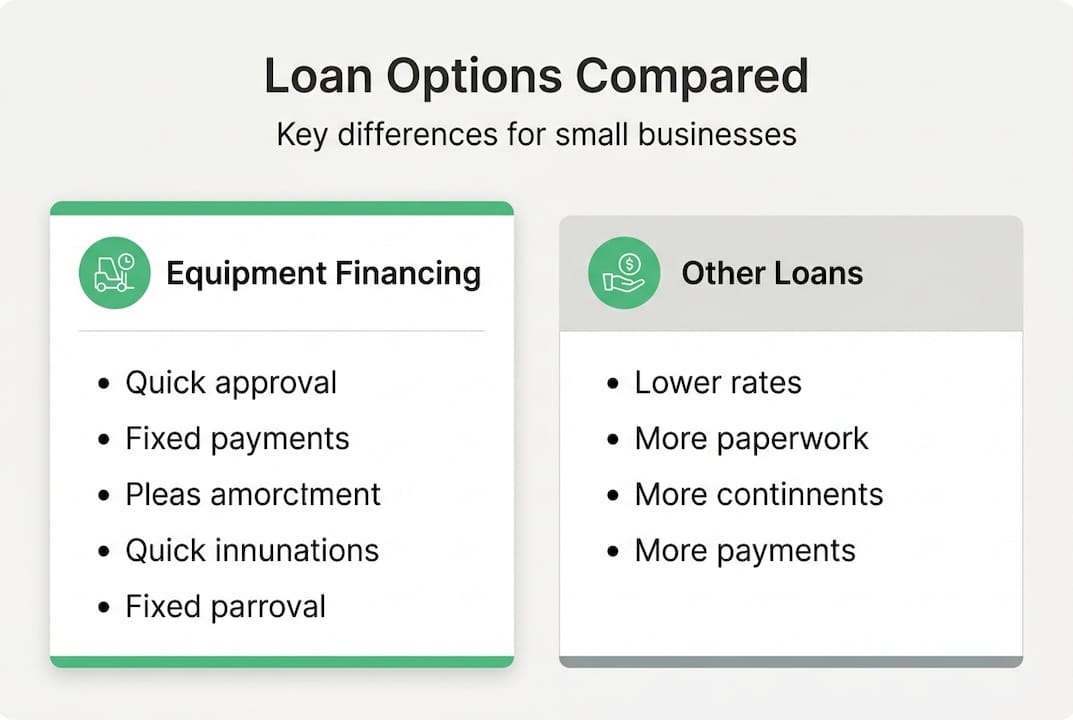
Understanding advantages is key, but comparing options head-to-head helps clarify where equipment financing truly excels and where other products might serve you better.
| Loan type | Interest rate | Approval speed | Credit flexibility | Collateral | Best for |
|---|---|---|---|---|---|
| Equipment financing | 6% to 20% | 1 to 3 days | High | Equipment | Asset purchases |
| SBA 7(a) or 504 loan | 6% to 8% | 30 to 90 days | Moderate | Varies | Long-term, low-rate needs |
| Unsecured business loan | 15% to 40%+ | 1 to 14 days | Low to moderate | None | Short-term working capital |
SBA loans offer some of the lowest rates available, but the tradeoff is significant. The application process is paper-heavy, approval can take months, and not every business qualifies. If you need equipment now to fulfill a contract or serve a new client, waiting 60 days for an SBA decision is not realistic.
Unsecured loans are faster but come with higher rates and stricter credit requirements. They work well for short-term needs but are not ideal when you are acquiring a major asset.
Here is a numbered decision framework to help you choose the right path:
- Assess your need. Is this a specific equipment purchase, or do you need general operating capital? Equipment financing is purpose-built for asset acquisition.
- Evaluate your collateral. If you have equipment to secure the loan, you immediately access better terms and faster approval.
- Consider your growth urgency. If speed is critical, equipment financing and some unsecured products outperform SBA options significantly.
- Review your cash flexibility. If preserving working capital is a priority, financing beats a cash purchase every time.
You can also review equipment leasing vs. financing if you are weighing whether to own or simply use the asset. For newer companies, startup loan options may offer additional paths worth considering. And if you want to understand SBA products in more detail, reviewing SBA loan programs can help you decide whether the longer timeline is worth the lower rate.
Pro Tip: SBA loans are excellent for established businesses with time to plan. But if you need equipment within the next two to four weeks, equipment financing is almost always the faster and more practical route.
How to qualify and apply for equipment financing
Once you know which financing fits your situation, securing approval is the final piece. Here is how to approach it confidently and improve your chances of a fast, favorable outcome.
Typical lender requirements include:
- Minimum time in business: usually 6 to 24 months
- Annual revenue: often $100,000 or more, though some lenders go lower
- Credit score: many lenders work with scores as low as 550 due to the collateral structure
- Equipment quote or invoice: most lenders require a vendor quote before funding
The strong market demand for equipment financing reflects how accessible this product has become, with lenders actively competing for qualified borrowers across a wide range of industries.
Here is a step-by-step application process:
- Prepare your documents. Gather recent bank statements, business tax returns, a current profit and loss statement, and a vendor quote for the equipment you want to purchase.
- Research lenders. Compare equipment financing lenders based on rates, terms, and industry experience. Specialized lenders often move faster and understand your sector better than general banks.
- Compare offers carefully. Look beyond the monthly payment. Evaluate the total cost of the loan, any prepayment penalties, and whether the lender reports to business credit bureaus.
- Submit your application. Most online lenders allow you to apply in under 30 minutes. Have your documents ready to upload to avoid delays.
- Review and accept terms. Once approved, review the loan agreement carefully before signing. Confirm the repayment schedule aligns with your cash flow.
For a detailed walkthrough of the process, the equipment financing tutorial provides step-by-step guidance from preparation to funding. If you are exploring government-backed SBA loans as a parallel option, those pages outline the documentation requirements and timelines in full.
Pro Tip: Have your equipment quote or invoice ready before you apply. Many lenders can fund same-day when all documentation is submitted together. Waiting to gather paperwork after approval is the most common cause of funding delays.
Why equipment financing often outperforms cash purchases: Our perspective
Beyond the mechanics, it is worth asking why the most growth-oriented small businesses consistently choose financing over cash purchases, even when they have the funds available. The conventional answer is cash flow preservation, and that is true. But the deeper reason is strategic.
When you pay cash for equipment, you are making a bet that stability today is worth more than opportunity tomorrow. That trade-off is rarely as favorable as it appears. Businesses that maintain healthy cash reserves consistently outperform competitors during downturns, not because they avoided debt, but because they had the flexibility to respond when conditions changed.
Financing turns a fixed asset into a scalable tool. You gain the equipment's productive capacity immediately while keeping capital available for the next hire, the next contract, or the next unexpected expense. That is not reckless. That is how growth-focused businesses actually operate.
"The businesses we have seen grow fastest are rarely the ones that spent everything on equipment. They are the ones that financed the equipment and invested the remaining capital in people, systems, and opportunities."
Cash purchases feel conservative, but they can quietly limit your ceiling. If you are ready to act quickly on a growth opportunity, same day equipment funding is a real option that removes the delay between decision and execution.
Find the right equipment financing for your business
If you are ready to act on the benefits of equipment financing, Capital For Business can help you secure your next essential asset without the delays or complications that slow most businesses down.
Since 2009, Capital For Business has worked with small business owners across hundreds of industries to provide fast, accessible financing when traditional banks fall short. Whether you have strong credit or a complicated history, we offer equipment financing solutions designed to move at the speed your business requires. You can also explore our full range of small business loan types or review all available funding solutions to find the product that fits your current stage and goals. Getting started takes minutes, and our team is ready to help you move forward.
Frequently asked questions
What types of equipment can I finance as a small business?
Most lenders allow financing for vehicles, manufacturing tools, computers, medical devices, and restaurant equipment. Collateral-backed financing applies to virtually any asset that is essential to your business operations.
How quickly can I get funding through equipment financing?
Approvals can happen in as little as one business day when all documentation is submitted together. This is significantly faster than most unsecured loan products, thanks to the collateralized structure that reduces lender risk.
Can I get equipment financing with poor credit?
Yes. Approval rates are generally higher for equipment financing because the asset itself secures the loan. This makes it more accessible than unsecured loans for borrowers with less-than-perfect credit histories.
Are there tax benefits to equipment financing?
Yes, many equipment loans allow for tax deductions on interest payments and depreciation over the asset's useful life. You should consult a tax advisor to understand how these deductions apply to your specific situation.
What documents do I need to apply for equipment financing?
Typical requirements include recent business bank statements, tax returns from the past one to two years, a current profit and loss statement, and a vendor quote or invoice for the equipment you plan to purchase.