
What is the financing approval ratio, and why does it matter?
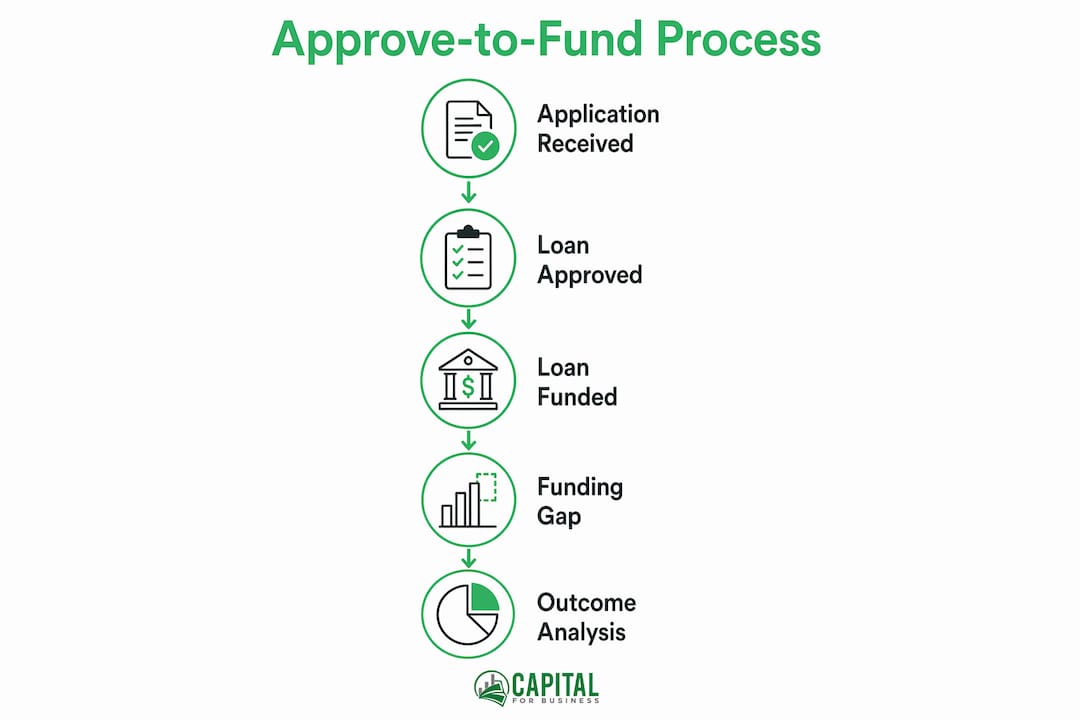
The financing approval ratio, known in lending as the approve-to-fund ratio, measures the percentage of approved loan applications that actually reach funding. Getting approved is not the same as getting funded. That gap between the two is exactly what this ratio tracks, and for small business owners, understanding it can change how you evaluate lenders and prepare your application.
The approve-to-fund ratio works as a key performance indicator for lenders, exposing where the lending pipeline runs smoothly and where it stalls. A high number of approved loans that never fund signals process problems, not just borrower issues.
Here is what the ratio captures at a glance:
- Approved applications: Loan files that passed underwriting review
- Funded loans: Applications that completed the full process and received disbursement
- The gap: Approvals that dropped off before funding, due to borrower withdrawal, documentation delays, or lender process failures
- The formula: (Funded Loans ÷ Approved Loans) × 100 = Approve-to-Fund Ratio
A lender with 100 approvals and only 70 funded loans carries a 70% approve-to-fund ratio. The remaining 30% represents lost revenue, frustrated borrowers, and wasted processing time.

Why this ratio matters to both lenders and borrowers
For lenders, an unfunded approval is revenue left on the table. Every stalled loan represents a borrower who waited, grew frustrated, and likely went elsewhere. The approve-to-fund ratio surfaces those losses in a single, trackable number.
For borrowers, the ratio tells a different story. A lender with a consistently low rate may have a slow or disorganized post-approval process, which means you could face delays even after receiving a conditional approval. That uncertainty is costly when your business needs capital quickly.
The ratio also reveals specific process gaps that hurt both sides:
- Unfunded approvals reduce lender revenue and inflate operating costs
- Post-approval delays damage borrower satisfaction and trust
- Communication breakdowns between underwriting and closing teams cause unnecessary drop-off
- Repeated document requests push borrowers to abandon the process entirely
- Low ratios often indicate systemic inefficiencies, not just individual borrower problems
Lenders who track this metric closely can identify exactly where borrowers exit the pipeline. Borrowers who understand it can ask better questions before committing to a lender.

What factors influence the financing approval rate, and what do benchmarks show?
Several forces shape the approve-to-fund ratio, and they fall into two broad categories: internal process factors and external market conditions.
Internal factors include document collection speed, communication between departments, system integration, and staff training. Operational inefficiencies such as manual data entry errors and fragmented system communications are among the most common causes of post-approval drop-off. When underwriting and closing teams operate in silos, borrowers fall through the cracks.
External factors include economic conditions, lender risk appetite, and borrower creditworthiness. Rising approval rates across the market often reflect lenders loosening credit standards. The auto loan approval rate rose notably in June 2026, signaling that lenders were actively taking on more risk. That kind of market shift affects small business lending conditions as well.
Benchmark Spotlight: The Equipment Leasing and Finance Association reported that the industry-wide average approval rate for capital expenditure financing jumped to 79.0% in May 2026, the highest since December 2021.
Full funding rates vary significantly by lender type. According to the Federal Reserve's 2026 Small Business Credit Survey, small banks led with a higher full funding rate in 2025 than large banks and online lenders. The overall rate across all lender types was moderate.
Partial funding adds another layer of complexity. The Federal Reserve's survey data shows that a significant share of approved borrowers receive less than the full amount requested, which means the gap between approval and full funding is wider than most borrowers expect. Partial funding can take the form of a reduced loan amount, a shorter term, or approval contingent on additional collateral.
Key factors that influence the ratio:
- Document delays: Incomplete applications slow the pipeline after approval
- Economic conditions: Tighter credit markets reduce lender willingness to fund borderline approvals
- Lender type: Small banks consistently outperform large banks and online lenders on full funding rates
- Risk appetite: Lenders with lenient approval standards may approve more but fund fewer, as borderline files collapse during closing
- Borrower preparedness: Applicants who submit complete, accurate documentation move through post-approval steps faster
How to interpret and use your approve-to-fund ratio effectively
A high approve-to-fund ratio, generally above 80%, suggests that a lender's post-approval process is working well and that borrowers are completing the steps needed to receive funds. A low ratio, particularly below 60%, points to bottlenecks worth investigating before you commit to that lender or before a lender invests in more marketing.
For borrowers, interpreting the ratio means asking the right questions. If a lender approves many applications but funds far fewer, the post-approval experience is likely frustrating. Borrower frustration often stems from outdated documentation requirements and slow follow-up, both of which are fixable process problems.
A higher approval rate does not automatically mean better terms, either. Lenders with lenient standards may approve more borrowers but charge higher rates, while stricter lenders may offer better terms to those who qualify. Always evaluate the ratio alongside the loan terms you are being offered.
Pro Tip: Track the approve-to-fund ratio over time, not just as a single snapshot. A lender whose ratio is improving quarter over quarter is actively fixing its process. One whose ratio is declining may be approving more applications than its operations can support.
Steps to use the ratio as a diagnostic tool:
- Compare a lender's full funding rate against the 57% industry average for small banks from the 2026 Small Business Credit Survey.
- Ask lenders directly how long the average post-approval process takes
- Review whether partial funding would still meet your capital need before accepting an offer
- Track your own application status at each stage to identify where delays occur
- Consider optimizing your loan application before submitting to reduce post-approval friction
Expert guidance from Capitalforbusiness on improving your approval-to-funding outcomes
Capitalforbusiness has worked with small business owners across hundreds of industries since 2009, and the patterns that lead to funding success are consistent. The approve-to-fund ratio improves when both lenders and borrowers take specific, deliberate steps.
For borrowers, the most common reason a funded loan stalls after approval is incomplete documentation. Submitting a thorough, organized application from the start reduces back-and-forth and keeps your file moving. Understanding what to consider before signing a loan also helps you enter the process with realistic expectations about timelines and terms.
Expert tips from Capitalforbusiness specialists:
- Prepare documents before applying: Tax returns, bank statements, and financial projections should be ready before you submit, not after approval
- Respond quickly to lender requests: Post-approval delays often start when borrowers take days to return requested documents
- Understand partial funding risk: If you receive less than requested, have a backup plan for the remaining capital need
- Choose lenders with strong full funding rates: Small banks and finance companies historically outperform online lenders on full funding outcomes, with small banks reporting a 57% full funding rate in 2025 while online lenders lagged at 38%.
- Use technology-forward lenders: Lenders who have invested in lending technology tend to process post-approval steps faster and with fewer errors
- Ask about average time to fund: A lender who cannot answer this question clearly may not track it, which is itself a warning sign
For business owners exploring their small business loan options, Capitalforbusiness offers funding up to $500,000 with a process built to move from approval to funding without unnecessary delays. Whether you need working capital, equipment financing, or a merchant cash advance, the goal is always the same: get you funded, not just approved.

Explore your small business loan options with Capitalforbusiness and find a funding solution matched to your business needs.
Key Takeaways
The approve-to-fund ratio is the most direct measure of whether a lender's approval process actually delivers capital to borrowers.
| Point | Details |
|---|---|
| Approval does not equal funding | Many borrowers receive partial funding or no funding despite an initial approval. |
| Small banks lead on full funding | Small banks posted a higher full funding rate in 2025 than online lenders. |
| Industry approval rates are rising | The capital expenditure finance sector hit a 79.0% average approval rate in May 2026. |
| Low ratios signal process problems | Post-approval drop-off usually traces to document delays and siloed lender communications. |
| Borrowers can improve their outcomes | Complete documentation, fast responses, and lender selection all affect whether an approval converts to funded capital. |
FAQ
What is the financing approval ratio in simple terms?
The financing approval ratio, or approve-to-fund ratio, measures the percentage of approved loan applications that actually receive funding. It is calculated by dividing funded loans by approved loans, then multiplying by 100.
How do you calculate the approval ratio for a loan?
Divide the number of approved applications by the total number of applications received, then multiply by 100. For the approve-to-fund ratio specifically, divide funded loans by approved loans and multiply by 100.
What does a 70% chance of loan approval mean?
A 70% approval rate means that 70 out of every 100 applications submitted to that lender are approved. It does not guarantee that all 70 will be fully funded, since partial funding and post-approval drop-off reduce the final number who receive capital.
What does 90% financing mean?
In most lending contexts, financing means the lender covers the majority of the total cost of a purchase or project, with the borrower responsible for a down payment or equity contribution.
Is a higher approval ratio always better for borrowers?
Not necessarily. Higher approval rates can reflect lenient credit standards that come with higher interest rates or less favorable terms. Borrowers should evaluate both the approval rate and the loan terms offered.