
TL;DR:
- Understanding commercial finance terminology helps small business owners make smarter borrowing decisions. Mastering key terms like APR, collateral, and DSCR enables better loan comparison, negotiation, and strategic planning. It is a vital business skill that improves funding options and financial literacy over time.
Commercial finance terminology is the specialized vocabulary businesses use to access, evaluate, and manage funding tailored to their growth, cash flow, and asset needs. Explaining commercial finance terminology clearly is the first step toward making smarter borrowing decisions. The Consumer Financial Protection Bureau confirms that financial literacy improves outcomes for borrowers who understand basic terms like interest, principal, and APR. Without that vocabulary, you cannot compare loan offers, negotiate terms, or spot a bad deal. This guide gives you the definitions, context, and practical examples you need to read any finance offer with confidence. Capitalforbusiness has worked with business owners across hundreds of industries since 2009, and the knowledge gap around finance terms is one of the most common obstacles to funding.
What are the fundamental commercial finance terms every small business owner should know?
Commercial finance is not one product. It is a spectrum of funding options built around specific business needs, from bridging cash flow gaps to acquiring property or purchasing equipment. Each product comes with its own vocabulary. Knowing these core terms puts you in control of every conversation with a lender.

Principal, interest, and APR
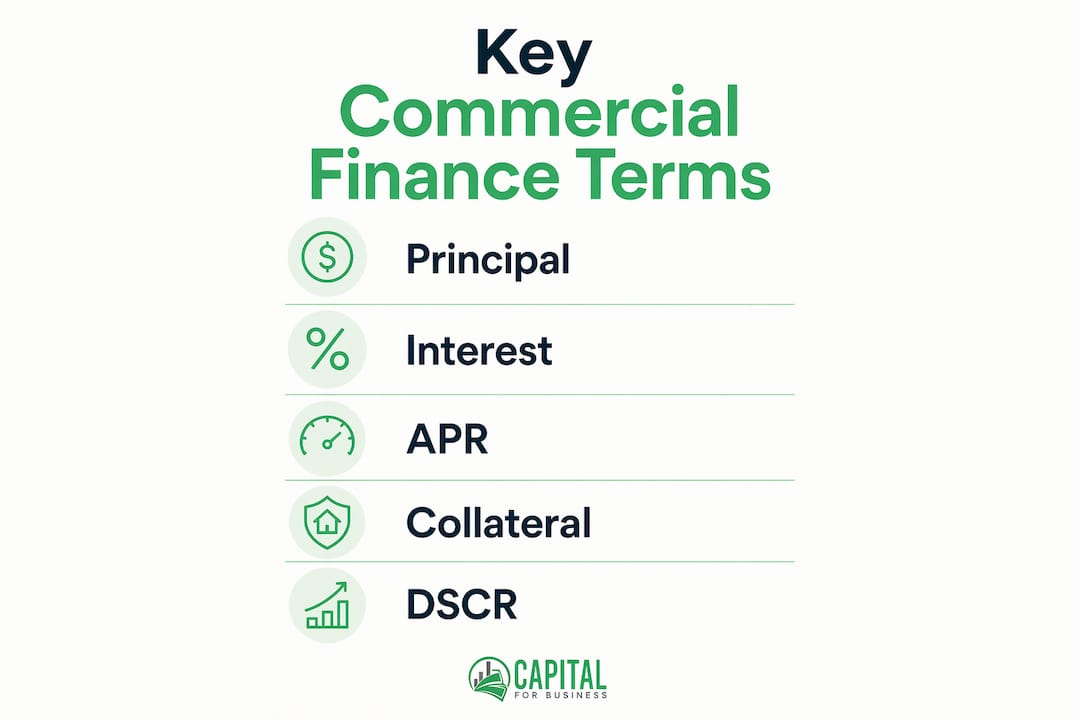
Principal is the original amount you borrow. If you take a $100,000 business loan, the principal is $100,000. Interest is the cost the lender charges for providing that money, expressed as a percentage of the principal. Annual Percentage Rate (APR) is the total yearly cost of borrowing, including interest and fees. APR is the most accurate number to compare across loan offers because it captures the full cost, not just the headline rate.
Collateral
Collateral is an asset you pledge to secure a loan. If you default, the lender can seize and sell that asset to recover the debt. Common collateral includes real estate, equipment, inventory, and accounts receivable. Secured loans backed by collateral typically carry lower interest rates than unsecured loans because the lender's risk is reduced.
EBITDA and operating cash flow
EBITDA stands for Earnings Before Interest, Taxes, Depreciation, and Amortization. EBITDA reflects true operating cash flow by stripping out financing decisions and accounting choices. Lenders use it to assess whether your business generates enough income to service debt, independent of how you structured your balance sheet. A business with strong EBITDA is a more attractive borrower, even if its net income looks modest after depreciation. You can read a deeper breakdown in this EBITDA guide for small businesses.
Asset finance, invoice finance, and bridging finance
- Asset finance lets you acquire equipment or machinery by spreading the cost over time, using the asset itself as security.
- Invoice finance converts your outstanding invoices into immediate cash. Instead of waiting 30 to 90 days for customers to pay, you receive a percentage of the invoice value upfront from a lender.
- Bridging finance is a short-term loan designed to cover a gap between two transactions, such as purchasing a new property before selling an existing one.
Pro Tip: When reviewing any loan offer, ask for the APR in writing. A low monthly rate can hide a high APR once origination fees and other charges are included.
How do different types of commercial finance products relate to terminology and business needs?
Commercial finance includes five main product categories: commercial mortgages, asset finance, invoice finance, bridging finance, and business loans. Each product has its own terminology, and understanding those terms tells you exactly how the product works and what it costs. The right product depends on the specific problem your business needs to solve.
-
Commercial mortgages are long-term loans secured against business property. Key terms include loan-to-value ratio (LTV), which measures the loan amount as a percentage of the property's appraised value, and amortization, which is the schedule for paying down both principal and interest over the loan term. Businesses use commercial mortgages to purchase or refinance office buildings, warehouses, or retail space. A detailed breakdown is available in this commercial real estate financing guide.
-
Asset finance uses terms like hire purchase, finance lease, and operating lease. In a hire purchase agreement, you pay installments and own the asset outright at the end. A finance lease keeps the asset on the lender's books while you use it. An operating lease is closer to a rental, with the lender retaining ownership throughout.
-
Invoice finance introduces terms like advance rate and recourse vs. non-recourse factoring. The advance rate is the percentage of the invoice value the lender pays upfront, typically 70–90%. Recourse factoring means you bear the risk if your customer does not pay. Non-recourse factoring transfers that risk to the lender, usually at a higher cost.
-
Bridging finance is defined by its term length and exit strategy. The exit strategy is the plan for repaying the bridge loan, such as a property sale or a long-term refinance. Lenders require a clear exit strategy before approving bridging finance.
-
Business loans come in two forms: term loans and revolving credit. A term loan provides a lump sum repaid over a fixed schedule. A revolving credit facility, like a business line of credit, lets you draw, repay, and draw again up to a set limit.
| Finance product | Primary use | Key term to know |
|---|---|---|
| Commercial mortgage | Property purchase or refinance | Loan-to-value ratio (LTV) |
| Asset finance | Equipment acquisition | Hire purchase vs. finance lease |
| Invoice finance | Cash flow from receivables | Advance rate |
| Bridging finance | Short-term gap funding | Exit strategy |
| Business loan | General working capital | Term loan vs. revolving credit |
Understanding which product fits your situation is the foundation of the commercial lending guide for small businesses.
What financial metrics and loan terms should small business owners understand?
Commercial finance underwriting relies on business cash flow and asset quality rather than personal credit factors alone. Lenders assess your business on its own merits. Knowing the metrics they use gives you the ability to prepare before you apply and to interpret any offer you receive.
Debt service coverage ratio (DSCR)
DSCR compares your net operating income to your total debt obligations. An ideal DSCR exceeds 1.2 for most lenders to approve a commercial loan. A DSCR of 1.2 means your business generates $1.20 in income for every $1.00 of debt it must service. A ratio below 1.0 signals that your business cannot cover its debt from operations alone, which is a red flag for any lender.
Business credit scores
Business credit scores differ from personal credit scores and affect loan eligibility independently. Some lenders use the Dun & Bradstreet PAYDEX score to evaluate business creditworthiness. PAYDEX scores range from 0 to 100, with scores above 80 considered low risk. Paying suppliers and vendors on time is the single most direct way to build a strong PAYDEX score.
Collateral valuation
- Lenders do not accept collateral at full market value. Collateral is typically valued at 70–80% of market value to account for the risk of a forced sale.
- This discount is called a "haircut." If you pledge equipment worth $100,000, the lender may count only $70,000–$80,000 toward your borrowing capacity.
- Real estate collateral is generally valued more favorably than equipment or inventory because it is easier to sell.
Repayment terms and fees
Repayment terms define the length of the loan and the payment schedule. Common fees include origination fees (charged upfront to process the loan), prepayment penalties (charged if you pay off the loan early), and late payment fees. Always calculate the total cost of borrowing, not just the monthly payment, before signing any agreement.
Pro Tip: Request a full fee schedule from any lender before you apply. Origination fees of 1–5% of the loan amount can significantly change the true cost of a loan, especially on shorter-term products.
How does understanding commercial finance terminology improve business financing decisions?
Misunderstanding financial jargon leads to suboptimal borrowing and potentially costly mistakes. Business owners who cannot parse a loan agreement are more likely to accept unfavorable terms, miss hidden fees, or choose a product that does not fit their actual need. The cost of that confusion shows up in higher interest payments, missed growth opportunities, and avoidable defaults.
The most common mistake is selecting a finance product before defining the business problem. Commercial finance should be selected based on a defined business problem, not the other way around. A business with a cash flow timing problem needs invoice finance or a revolving credit facility, not a 10-year term loan. Choosing the wrong product because you did not understand the terminology costs money from day one.
"Financial literacy bridges information gaps and reduces poor financing outcomes. Business owners who understand the terms in a loan offer are better positioned to negotiate, compare alternatives, and avoid products that do not serve their goals."
Terminology knowledge also improves your negotiating position. When you understand what a prepayment penalty means, you can ask for it to be removed or reduced. When you know your DSCR, you can present it proactively to a lender as evidence of creditworthiness. Plain-English glossaries linked to calculators increase effective decision making by translating specialized terms into operational examples you can apply immediately.
Pro Tip: Before meeting any lender, calculate your own DSCR using your last 12 months of net operating income. Lenders respect borrowers who arrive with their numbers ready.
The connection between terminology and strategy runs deeper than individual loan decisions. Business owners who understand finance terms can read their own financial statements more accurately, spot when a lender's offer is mispriced, and plan for future capital needs before they become urgent. Understanding business loan terminology is not a one-time exercise. It is an ongoing skill that compounds in value as your business grows. Research on microfinance and financial literacy consistently shows that business owners with stronger financial vocabulary make better capital allocation decisions over time.
Key Takeaways
Mastering commercial finance definitions directly reduces borrowing costs, improves loan eligibility, and gives small business owners the vocabulary to negotiate terms with confidence.
| Point | Details |
|---|---|
| APR is the true cost metric | Always compare APR across offers, not just the stated interest rate or monthly payment. |
| DSCR above 1.2 signals approval readiness | Calculate your debt service coverage ratio before applying to any commercial lender. |
| Collateral is discounted by lenders | Expect lenders to value pledged assets at 70–80% of market value, not full price. |
| Match the product to the problem | Choose invoice finance for cash flow gaps, asset finance for equipment, and mortgages for property. |
| Business credit scores matter independently | Build your Dun & Bradstreet PAYDEX score by paying vendors on time, separate from personal credit. |
Why terminology mastery is the most underrated business skill
Working with small business owners across hundreds of industries since 2009, Capitalforbusiness has seen one pattern repeat itself more than any other. Business owners who struggle to get funded are rarely struggling because their business is weak. They struggle because they cannot articulate their financials in the language lenders use.
The knowledge gap is real and specific. Most owners know what cash flow means in a general sense. Far fewer know how to calculate DSCR, explain their EBITDA to a lender, or identify whether a loan's collateral requirement is standard or aggressive. That gap costs money. Owners who cannot read a term sheet accept the first offer they receive instead of negotiating.
The fix is not complicated. A plain-English finance glossary, used consistently, closes most of the gap within weeks. The owners who make the best financing decisions are not always the ones with the strongest businesses. They are the ones who prepared before they walked into the conversation. Terminology is preparation. Treat it as a core business skill, not an afterthought.
— Capital
Funding solutions matched to the terms you now understand
Capitalforbusiness offers small business loans in multiple formats designed to match the specific finance problems this guide covers, from working capital and equipment financing to merchant cash advances and business lines of credit.

Since 2009, Capitalforbusiness has helped business owners across the United States and Canada access funding quickly when traditional banks fall short. Whether you need to cover a cash flow gap, purchase equipment, or build a credit facility, the team at Capitalforbusiness matches your business profile to the right product. Explore commercial business loan options or contact Capitalforbusiness directly to discuss which finance solution fits your current business needs.
FAQ
What is commercial finance in simple terms?
Commercial finance is a category of funding products designed for businesses rather than individuals. It includes loans, credit facilities, equipment financing, invoice finance, and property mortgages, each built around specific business needs.
What does APR mean for a business loan?
APR, or Annual Percentage Rate, is the total yearly cost of a loan including interest and fees. It is the most accurate number to use when comparing loan offers from different lenders.
What is a good DSCR for loan approval?
A DSCR above 1.2 is the standard threshold most commercial lenders require for loan approval. It means your business earns $1.20 for every $1.00 of debt it must repay.
How does collateral affect a commercial loan?
Collateral reduces the lender's risk and typically results in lower interest rates for the borrower. Lenders discount collateral to 70–80% of market value, so the asset you pledge must be worth more than the loan amount you need.
How is a business credit score different from a personal credit score?
A business credit score, such as the Dun & Bradstreet PAYDEX score, measures your company's payment history with vendors and suppliers. It is evaluated separately from your personal credit score and directly affects your eligibility for commercial financing.