
TL;DR:
- Commercial real estate financing involves obtaining loans to purchase or develop income-producing properties for business use. It primarily relies on property cash flow and asset value rather than personal income, with lenders emphasizing DSCR, LTV, and borrower experience. Different loan options suit various needs, but thorough preparation and understanding of loan terms are key to successful funding.
Commercial real estate financing is defined as the process of obtaining loans or capital to purchase, refinance, or develop income-producing properties used for business purposes. Unlike residential mortgages, commercial property financing is underwritten primarily on property cash flow, asset value, and borrower experience rather than personal income alone. Lenders typically require a minimum credit score of 680, a Loan-to-Value (LTV) ratio around 75%, and a Debt Service Coverage Ratio (DSCR) between 1.20x and 1.35x. The SBA, conventional banks, and private lenders each offer distinct programs suited to different business goals. Understanding these fundamentals gives you a clear path to securing the right funding for your next property move.
What is commercial real estate financing, and how does it work?
Commercial real estate financing covers loans secured by liens on income-producing properties used strictly for business purposes. These loans are issued to business entities such as corporations, trusts, real estate investment trusts (REITs), and partnerships. That structure differs fundamentally from a residential mortgage, where the lender focuses on the borrower's personal income and credit history.

The underwriting process centers on three core factors: the property's net operating income, the appraised value of the asset, and the borrower's track record managing similar properties. Property cash flow covers debt payments in a way that personal income verification simply cannot replicate for large commercial assets. A warehouse generating $200,000 per year in net operating income tells a lender far more about repayment capacity than a borrower's W-2 form.
Loan structures in commercial real estate often include balloon payments, meaning the borrower pays interest and partial principal over the loan term, then repays the remaining balance in a lump sum at maturity. Amortization schedules typically run 20–25 years, while the actual loan term may be only 5–10 years. That gap between amortization and term is one of the most misunderstood features of commercial property financing, and it directly affects your refinancing strategy.
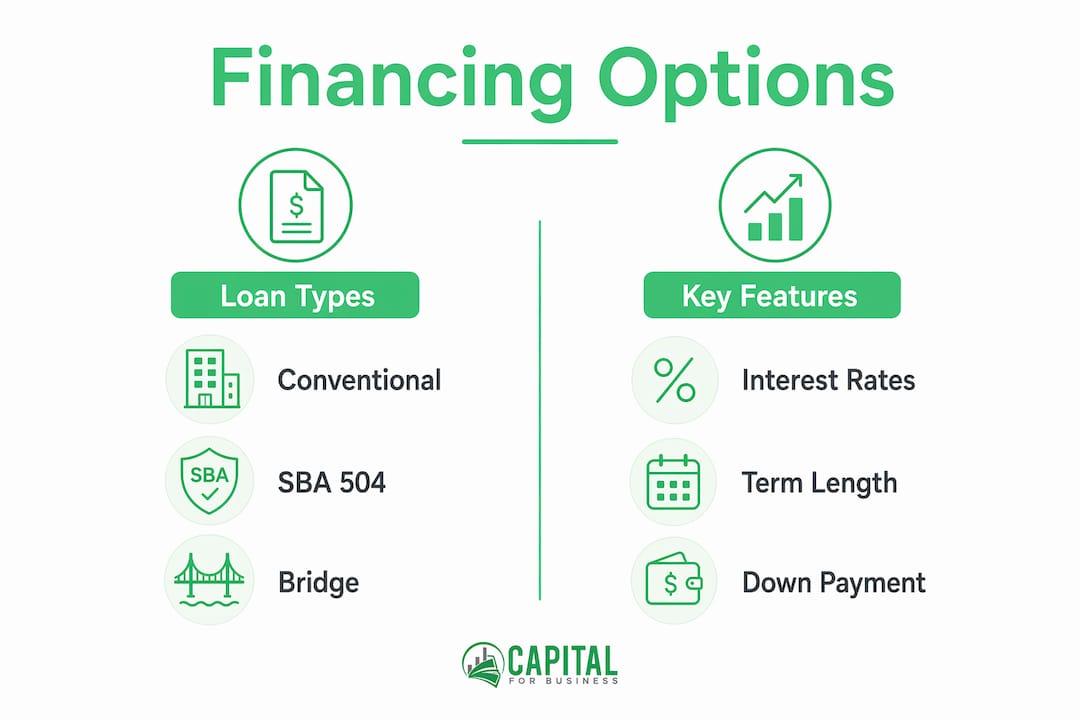
What are the main types of commercial real estate financing options?
The right financing type depends on your property's purpose, your timeline, and your financial profile. Each loan category carries distinct costs, qualification standards, and closing speeds.
Conventional bank loans
Conventional bank loans are the most common starting point for established business owners. Bank loan interest rates for commercial property in 2026 typically fall between 5.5% and 8%, with repayment terms of 5–25 years. Lenders require a minimum credit score of 680 and an LTV ratio around 75%, meaning you bring at least 25% as a down payment. Approval timelines run 30–60 days, which suits buyers who are not under time pressure.
SBA 504 and 7(a) loans
SBA programs exist specifically to help small business owners acquire owner-occupied commercial real estate. The SBA 504 program offers fixed-rate financing up to $5.5 million for major fixed assets, with down payments as low as 10%. Properties must be at least 51% owner-occupied to qualify. SBA loans carry longer processing times of 60–90 days or more, but the fixed rates and lower down payments make them worth the wait for qualifying businesses. You can review current SBA loan rates to compare them against conventional options before applying.
Bridge loans and hard money loans
Bridge loans close in 7–21 days, making them the fastest option when a deal requires immediate action. Hard money lenders focus almost entirely on the asset value rather than borrower creditworthiness. Both options carry higher interest rates, often ranging from 9% to 12% or more, and shorter terms of 12–36 months. They work best as temporary financing while you secure permanent funding or complete a renovation.
CMBS loans
Commercial Mortgage-Backed Securities (CMBS) loans are pooled, securitized, and sold to investors on the secondary market. They offer competitive fixed rates and are available for larger properties, but they come with strict prepayment penalties and limited flexibility for modifications. CMBS loans suit stabilized, income-producing assets rather than properties in transition.
Here is a quick reference for matching loan type to business need:
- Conventional bank loan: Best for established borrowers with strong credit and no time pressure
- SBA 504 loan: Best for owner-occupied purchases with limited down payment capital
- SBA 7(a) loan: Best for smaller acquisitions or mixed-use financing needs
- Bridge loan: Best for time-sensitive acquisitions or properties needing stabilization
- Hard money loan: Best when credit is challenged but asset value is strong
- CMBS loan: Best for large, stabilized investment properties
Pro Tip: If you are comparing SBA and conventional options, request a side-by-side term sheet from your lender. The difference in total interest paid over a 10-year hold can exceed six figures on a $1 million loan.
How do lenders evaluate and qualify borrowers for commercial real estate financing?
Lenders use a defined set of metrics to assess risk before approving any commercial real estate loan. Knowing these metrics in advance lets you address weaknesses before you apply.
DSCR: the most critical metric
The Debt Service Coverage Ratio measures how much net operating income a property generates relative to its annual debt payments. DSCR thresholds between 1.20x and 1.35x are the standard range lenders accept. A DSCR of 1.25x means the property generates $1.25 in income for every $1.00 of debt obligation. Falling below 1.20x is the primary reason lenders deny commercial loan applications. Many borrowers underestimate this metric and focus too heavily on credit score instead.
Credit score and LTV requirements
Most conventional lenders require a credit score of 680 or higher. SBA programs may accept slightly lower scores depending on the overall deal strength. The LTV ratio caps at approximately 75% for most conventional and SBA loans, meaning the lender finances no more than 75 cents of every dollar of appraised value. Hard money lenders may push LTV to 65% or lower because they rely entirely on the asset as collateral.
Borrower experience and banking relationships
Lenders weigh your track record managing similar properties heavily. A borrower who has successfully operated a retail strip center carries less risk than a first-time commercial buyer, even at the same credit score. Established banking relationships often result in preferential pricing and more flexible terms. If you already have a business checking account, line of credit, or existing loan with a bank, start your commercial real estate inquiry there first.
The key qualification factors lenders review include:
- Net operating income of the subject property
- DSCR (minimum 1.20x, preferred 1.25x or higher)
- Credit score (680+ for conventional, varies for SBA and hard money)
- LTV ratio (maximum 75% for most programs)
- Borrower experience with similar asset types
- Existing banking relationship depth
- Global cash flow (personal and business financials combined)
Pro Tip: Prepare a complete loan package before your first lender meeting. Include two years of property operating statements, a current rent roll, personal and business tax returns, and a property appraisal if available. Lenders move faster when documentation is complete on day one.
What are the typical loan terms, interest rates, and repayment options?
Understanding the financial structure of a commercial loan prevents surprises at closing and helps you model your returns accurately.
Interest rates in 2026
Commercial real estate loan rates are generally higher than residential loans, often ranging from 6% to 10% or more depending on loan type and borrower profile. Conventional bank loans in 2026 sit in the 5.5%–8% range for well-qualified borrowers. SBA 504 loans frequently offer below-market fixed rates because of the government guarantee structure. Bridge and hard money loans carry the highest rates, reflecting the speed and flexibility they provide.
Fixed vs. variable rates
Fixed rates give you predictable payments throughout the loan term. Variable rates, tied to benchmarks like the Secured Overnight Financing Rate (SOFR), can start lower but expose you to payment increases if market rates rise. For long-term holds, fixed rates reduce planning risk. For short-term acquisitions where you plan to refinance or sell within three years, a variable rate bridge loan may cost less overall.
| Loan Type | Typical Rate (2026) | Term | Down Payment | Closing Speed |
|---|---|---|---|---|
| Conventional bank | 5.5%–8% | 5–25 years | 25%–30% | 30–60 days |
| SBA 504 | Below-market fixed | Up to 25 years | 10% | 60–90+ days |
| SBA 7(a) | Variable or fixed | Up to 25 years | 10%–20% | 60–90+ days |
| Bridge loan | 9%–12%+ | 12–36 months | 20%–35% | 7–21 days |
| CMBS | Competitive fixed | 5–10 years | 25%–35% | 45–75 days |
Balloon payments and amortization
Most commercial loans amortize over 20–25 years but mature in 5–10 years. At maturity, the remaining principal balance is due as a balloon payment. Borrowers typically refinance at that point. Planning for the balloon date from day one is a best practice. If market rates rise significantly by the time your balloon comes due, refinancing costs more than you projected. Building a cash reserve or locking a longer fixed-rate term reduces that risk.
Pro Tip: Model your balloon payment scenario at two different refinance rates: the current rate and a rate 2% higher. If the deal still works at the higher rate, your investment has a real margin of safety.
How can business owners strategically use commercial real estate financing?
Securing a loan is only the first decision. How you structure and deploy that financing determines whether the property generates wealth or drains it.
Cash vs. debt: the opportunity cost question
Paying cash for a commercial property eliminates interest costs but ties up capital that could fund business operations, equipment, or additional acquisitions. Financial specialists advise carefully weighing opportunity costs of using cash versus financing, particularly in variable rate environments. A business owner who deploys $500,000 in cash to buy a property outright may miss a higher-return opportunity that the same $500,000 could have funded as equity across two leveraged acquisitions.
Matching financing type to business purpose
Owner-occupied buyers who plan to operate their business from the property should prioritize SBA 504 or 7(a) loans for their lower down payments and fixed rates. Investors acquiring stabilized rental properties fit conventional bank loans or CMBS programs. Buyers targeting value-add properties that need renovation before stabilization should use bridge financing first, then refinance into permanent debt once the property reaches target occupancy. Mixing up these categories is a common and costly mistake.
You can explore financing options for property investors to see how different loan structures apply to specific investment scenarios.
Common mistakes and how to avoid them
The most frequent errors business owners make when financing commercial real estate include:
- Ignoring DSCR: Focusing on purchase price without verifying the property generates enough income to meet lender thresholds
- Underestimating closing costs: Commercial loans carry appraisal fees, environmental reports, title insurance, and legal costs that can total 2%–4% of the loan amount
- Choosing speed over cost unnecessarily: Using a bridge loan when a conventional loan timeline is workable adds significant interest expense
- Neglecting the balloon date: Failing to plan for refinancing at loan maturity leaves borrowers exposed to unfavorable market conditions
- Skipping relationship banking: Applying cold to a new lender instead of working with an existing banking partner often results in worse terms
Pro Tip: Run your DSCR calculation before you make an offer on any property. Use the actual current rents, not projected rents. Lenders underwrite on in-place income, not your business plan.
Maintaining strong banking relationships also pays dividends beyond the first loan. Strong banking relationships improve loan terms and increase financing flexibility in competitive markets. A lender who knows your business history will move faster and price more favorably than one reviewing your file for the first time.
Key Takeaways
Commercial real estate financing works best when borrowers match the loan type to the property's purpose, prepare complete documentation, and plan for the full loan lifecycle including balloon payments and refinancing.
| Point | Details |
|---|---|
| DSCR drives approval | Lenders require a DSCR of 1.20x–1.35x; falling short is the top reason for denial. |
| Loan type must match purpose | Owner-occupied buyers benefit most from SBA programs; investors fit conventional or CMBS loans. |
| Speed has a price | Bridge loans close in 7–21 days but carry rates of 9%–12% or more. |
| Relationships reduce costs | Existing banking relationships consistently produce better pricing and faster approvals. |
| Plan for the balloon | Most commercial loans mature in 5–10 years; refinancing strategy should be set at origination. |
What I have learned from years of commercial financing
After working with business owners across hundreds of industries since 2009, one pattern stands out clearly: the borrowers who succeed in commercial real estate financing are the ones who treat preparation as a competitive advantage, not a formality.
Most lenders see dozens of loan requests each week. The files that move fastest and close at the best terms are the ones where the borrower arrives with a complete package, a clear understanding of the property's income, and a realistic exit strategy. That is not luck. That is preparation.
The DSCR conversation is where I see the most avoidable mistakes. Business owners fall in love with a property and then reverse-engineer the numbers to make the deal look viable. Lenders see through that immediately. The DSCR has to work on actual in-place income, not optimistic projections. If it does not, the right move is to negotiate a lower purchase price or walk away.
The other thing I would push back on is the instinct to always choose the fastest loan. Bridge financing has its place, but paying 10% or 11% interest when a conventional loan at 6.5% was available with a 45-day wait is a decision that costs real money. Speed is worth paying for when the deal genuinely requires it. Otherwise, patience is the cheaper option.
The 2026 rate environment rewards borrowers who lock fixed rates where possible and build cash reserves to handle balloon maturities without panic refinancing. The business owners who thrive in this market are not the ones chasing the lowest rate on day one. They are the ones who structure deals they can hold through a full market cycle.
— Capital
Capitalforbusiness commercial real estate funding solutions
Capitalforbusiness has worked with business owners and investors across the country since 2009, providing real estate business loans and a full range of funding solutions tailored to commercial property needs.

Whether you are purchasing an owner-occupied building, refinancing an existing commercial property, or funding a value-add acquisition, Capitalforbusiness offers programs designed to match your timeline and financial profile. The team works with borrowers in hundreds of industries, including those who have been turned away by traditional banks. Explore the full range of small business loan options available through Capitalforbusiness, or connect directly to discuss which commercial financing structure fits your next property deal.
FAQ
What is the minimum credit score for a commercial real estate loan?
Most conventional lenders require a minimum credit score of 680 for commercial real estate loans. SBA programs may accept lower scores depending on overall deal strength and property cash flow.
How does DSCR affect commercial loan approval?
DSCR measures property income against debt payments, with lenders requiring a ratio between 1.20x and 1.35x. Falling below 1.20x is the most common reason commercial loan applications are denied.
How long does it take to close a commercial real estate loan?
Closing timelines vary by loan type: bridge loans close in 7–21 days, conventional bank loans take 30–60 days, and SBA loans typically require 60–90 days or more due to government processing requirements.
What down payment is required for commercial property financing?
Conventional bank loans typically require a 25%–30% down payment. SBA 504 and 7(a) loans allow down payments as low as 10% for qualifying owner-occupied properties.
What types of properties qualify for commercial real estate financing?
Commercial real estate loans apply to income-producing properties used for business purposes, including office buildings, retail centers, industrial warehouses, multifamily properties with five or more units, and mixed-use developments.