
TL;DR:
- EBITDA measures operating profitability excluding non-operating costs and non-cash charges.
- It helps evaluate business performance, valuation, and financing capacity for owners, buyers, and lenders.
- EBITDA does not reflect cash flow or account for capital expenditures and working capital changes.
Your income statement says you made a profit last quarter, but your bank account tells a different story. This is one of the most frustrating experiences a small business owner can face, and it happens more often than most people realize. The gap between reported profit and actual cash on hand is real, and it can catch even experienced owners off guard. That's where EBITDA comes in. EBITDA measures operating profitability by stripping away non-operating costs and non-cash charges, giving you a cleaner view of how your business actually performs. This guide will walk you through what EBITDA means, how to calculate it, how lenders and buyers use it, and where it falls short so you can use it confidently in your financial decisions.
Table of Contents
- What is EBITDA and why it matters
- How to calculate EBITDA: Formulas, examples, and adjustments
- Using EBITDA for business valuation and loan applications
- EBITDA margins and benchmarking: How does your business stack up?
- Pitfalls and limitations of EBITDA for small businesses
- A smarter approach: What most guides miss about EBITDA
- Financial clarity drives smarter business growth
- Frequently asked questions
Key Takeaways
| Point | Details |
|---|---|
| EBITDA definition | EBITDA measures a company’s operational profitability by excluding non-operating and non-cash expenses. |
| Adjusted EBITDA matters | For small business valuations or loans, always adjust EBITDA for owner perks and unusual items. |
| Multiples drive value | Your industry’s EBITDA multiple is a key factor in determining your business’s valuation. |
| Limitations exist | EBITDA ignores cash flow realities, so never rely on it alone when making big financial decisions. |
What is EBITDA and why it matters
When you look at your financial statements, you see a lot of numbers. Revenue, expenses, net income, taxes. Each one tells part of the story, but none of them on their own captures how efficiently your business generates profit from its core operations. That's the job of EBITDA.
EBITDA stands for Earnings Before Interest, Taxes, Depreciation, and Amortization. It measures a company's operating profitability by excluding non-operating expenses and non-cash charges. In plain language, it shows what your business earns before accounting rules, financing choices, and tax strategies get involved.
Let's break down each component:
- Earnings: This is your net income, the starting point for the calculation.
- Interest: Excluded because it reflects how you financed your business, not how well you run it. Two identical businesses with different debt loads will show different interest expenses, making comparison difficult.
- Taxes: Excluded because tax obligations vary by location, structure, and strategy. Removing taxes creates a level playing field.
- Depreciation: A non-cash expense that reduces the book value of physical assets over time. Your equipment doesn't actually cost you cash each year after purchase, but depreciation makes it look that way on paper.
- Amortization: Similar to depreciation, but applied to intangible assets like patents, trademarks, or goodwill from an acquisition.
By removing these items, EBITDA gives you a number that reflects operational performance without the noise of financing and accounting decisions.
Why does this matter? Because when a lender reviews your application or a buyer evaluates your business, they want to know what the underlying engine produces. EBITDA helps them see past the variables that differ from one business to the next.
Here is what EBITDA does include:
- Revenue from core business operations
- Cost of goods sold
- Operating expenses like payroll, rent, and marketing
Here is what EBITDA does not include:
- Loan interest payments
- Federal or state income taxes
- Depreciation on equipment and property
- Amortization of intangible assets
- One-time or non-recurring items (in standard EBITDA)
For small business owners, EBITDA serves three practical purposes. First, it helps you understand your own operational performance without distortion from debt or tax decisions. Second, it becomes essential when you apply for financing, because lenders often use it to assess repayment capacity. If you're weighing debt vs. equity financing for your next growth phase, knowing your EBITDA gives you a stronger foundation for those conversations. Third, EBITDA is the primary metric buyers use when valuing a business for acquisition, making it critical if you ever plan to sell.
Understanding EBITDA is not just an accounting exercise. It's a practical tool that shapes how outsiders perceive your business and how you make decisions internally.
How to calculate EBITDA: Formulas, examples, and adjustments
Now that you know what EBITDA is, let's look at how to calculate it accurately for your business. There are two standard formulas, and both produce the same result when applied correctly.
Formula 1: Net Income + Interest + Taxes + Depreciation + Amortization
Formula 2: Operating Income + Depreciation + Amortization
The standard EBITDA formula uses net income as the starting point and adds back each excluded item. The alternative starts from operating income, which already excludes interest and taxes, then adds back the non-cash charges.
Here's a simple example. Suppose your business reports the following:
- Net Income: $120,000
- Interest Expense: $18,000
- Income Taxes: $22,000
- Depreciation: $15,000
- Amortization: $5,000
EBITDA = $120,000 + $18,000 + $22,000 + $15,000 + $5,000 = $180,000
That $180,000 is your standard EBITDA. But for small businesses, this number often needs further refinement.
Adjusted EBITDA for small businesses
Adjusted EBITDA adds back owner-specific items like excess compensation, non-recurring expenses, and personal perks run through the business. This is critical because small business financials frequently reflect the owner's personal decisions as much as the business's true performance.
Common add-backs for small businesses include:
- Excess owner salary above fair market compensation
- Personal vehicle expenses charged to the business
- One-time legal fees or settlement costs
- Non-recurring equipment repairs
- Family member salaries that exceed market rates
| Item | Standard EBITDA | Adjusted EBITDA |
|---|---|---|
| Net Income | $120,000 | $120,000 |
| Add: Interest | $18,000 | $18,000 |
| Add: Taxes | $22,000 | $22,000 |
| Add: Depreciation | $15,000 | $15,000 |
| Add: Amortization | $5,000 | $5,000 |
| Add: Excess owner salary | Not included | $30,000 |
| Add: Personal vehicle costs | Not included | $8,000 |
| Total EBITDA | $180,000 | $218,000 |
The difference between $180,000 and $218,000 is significant, especially when a buyer multiplies that number by an industry multiple to determine what your business is worth.
Pro Tip: Keep a running log of every personal or non-recurring expense you run through the business throughout the year. When it's time to apply for a loan or prepare for a sale, you'll have clean documentation for every add-back. Lenders and buyers who review accounting for business loans will want proof, not estimates.
Also, be honest with your adjustments. Inflating add-backs to boost your adjusted EBITDA can backfire during due diligence. Buyers and lenders have seen every trick, and credibility matters more than a higher number. For context on how working capital fits into your financial picture, reviewing working capital examples alongside your EBITDA gives you a more complete view of operational health.
Using EBITDA for business valuation and loan applications
With a solid grasp of the math, you'll now see how EBITDA fits into larger decisions like valuation and raising funds.

When someone wants to buy your business, they rarely start with your revenue. They start with your EBITDA. The reason is simple: EBITDA represents the cash-generating power of your operations before financing and taxes. Multiply that number by an industry-specific multiple, and you get a baseline valuation.
Valuation = EBITDA x Industry Multiple
So if your adjusted EBITDA is $218,000 and your industry multiple is 4x, your business might be valued at approximately $872,000. That multiple is not arbitrary. It reflects risk, growth potential, and how predictable your revenue is.
EBITDA multiples vary by industry, and here's a look at common ranges for 2026:
| Industry | EBITDA Multiple Range |
|---|---|
| Accounting firms | 4.5x to 6.5x |
| Auto repair | 3.5x to 5.5x |
| Dental practices | 5x to 7.5x |
| SaaS/Software | 6x to 10x |
| Retail | 2.5x to 4x |
| Manufacturing | 4x to 6x |
| Professional services | 4x to 7x |
Higher multiples go to businesses with recurring revenue, strong documentation, low owner dependency, and consistent growth. Lower multiples reflect higher risk, customer concentration, or inconsistent earnings.
Lenders use EBITDA differently than buyers, but the logic is similar. When you apply for a loan, lenders assess whether your business generates enough earnings to cover debt payments. A common metric is the Debt Service Coverage Ratio, which compares EBITDA to annual debt obligations. A ratio above 1.25 is generally considered healthy. Supporting working capital with the right loan structure becomes much easier when your EBITDA clearly demonstrates repayment capacity.
Pro Tip: If you're comparing loan vs. equipment leasing options, run the numbers on how each choice affects your EBITDA. Lease payments are operating expenses and reduce EBITDA, while loan interest is added back in the calculation. This distinction can meaningfully change how a lender or buyer views your business.
EBITDA margin is another useful tool here. It's calculated as EBITDA divided by total revenue, expressed as a percentage. A business with $218,000 in EBITDA and $1.2 million in revenue has an EBITDA margin of about 18.2%. This number lets you compare your profitability against industry peers regardless of size. Staying current on business tax compliance also protects your EBITDA from unexpected tax liabilities that could distort your numbers.
Owners who want to improve their multiple should focus on building recurring revenue streams, reducing owner dependency, and maintaining clean, auditable financial records. These factors signal stability to buyers and lenders alike.
EBITDA margins and benchmarking: How does your business stack up?
Valuation makes more sense when you know how your profit metrics compare to others in your field. EBITDA margin is the tool that makes that comparison possible.
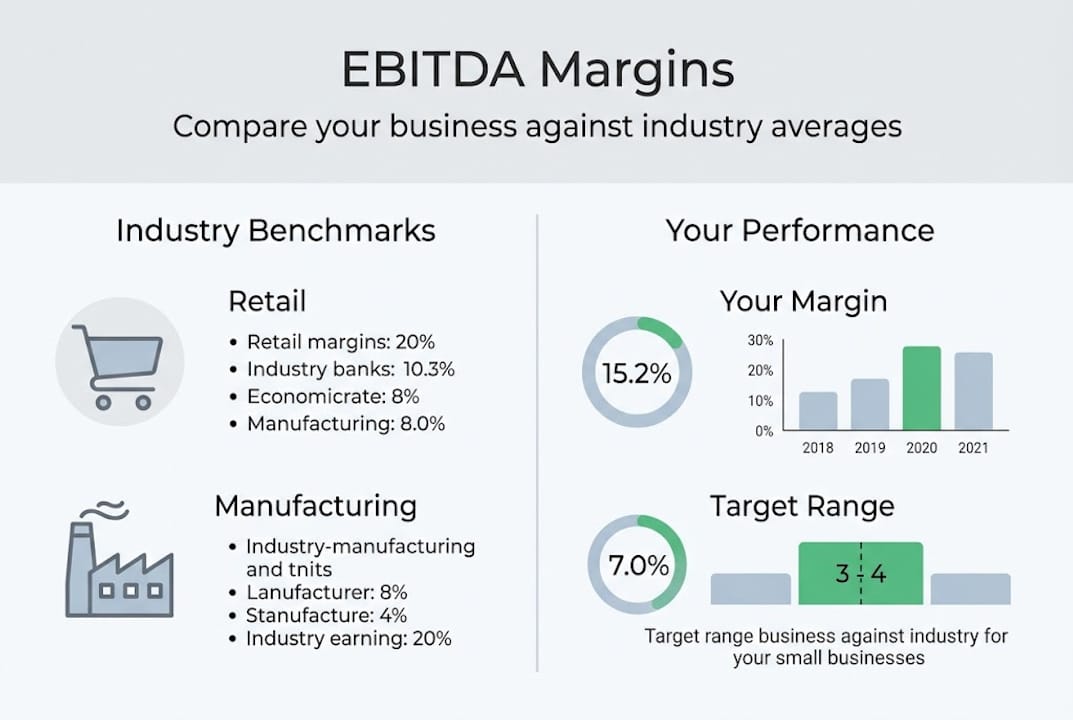
As a reminder, EBITDA margin = EBITDA divided by total revenue, multiplied by 100. If your EBITDA is $90,000 and your revenue is $750,000, your margin is 12%. That number tells you how much of every dollar in revenue converts to operating profit before financing and non-cash charges.
2026 industry benchmarks to know:
Industry median EBITDA margins: SaaS/Software at 15%, Professional Services at 14.5%, Manufacturing at 11.2%, and Retail at 7.5%.
These numbers give you a realistic target based on your sector. If you run a professional services firm with a 9% EBITDA margin, you're below the 14.5% median. That gap is worth investigating.
Factors that affect your EBITDA margin include:
- Pricing power: Businesses that can charge premium rates tend to have higher margins.
- Labor costs: Service businesses with high payroll relative to revenue often see compressed margins.
- Overhead structure: Fixed costs like rent and utilities reduce margin if revenue is inconsistent.
- Cost of goods sold: Retail and manufacturing businesses face tighter margins due to product costs.
- Revenue mix: Recurring or subscription-based revenue typically supports higher margins than project-based income.
Benchmarking your margin is not just about comparison. It's about identifying where your business leaks profit. If your margin is below industry median, it usually points to either a pricing problem, a cost control issue, or both.
To benchmark effectively, you should:
- Pull your EBITDA margin for the last three years and look for trends
- Compare against published industry data annually
- Set a realistic improvement target, such as increasing margin by 1 to 2 percentage points per year
- Track which expense categories are growing faster than revenue
Understanding working capital importance is closely tied to margin analysis. A business with strong EBITDA margins but poor working capital management can still struggle to pay bills on time. Margin and liquidity work together, not independently.
If your margin is strong, use that as leverage. It signals to lenders that your business is efficient and capable of servicing debt. It signals to buyers that your operations are well-managed. Both outcomes open doors.
Pitfalls and limitations of EBITDA for small businesses
No single metric is perfect. Before you start relying on EBITDA, be aware of its caveats.
The most important thing to understand is this: EBITDA is not cash flow. Many business owners treat it as a proxy for cash, and that's where problems start.
EBITDA ignores capital expenditures and working capital changes, meaning it does not represent true cash flow. In capital-intensive industries or businesses with slow collections, it can be actively misleading.
Here is what EBITDA leaves out entirely:
- Capital expenditures (capex): If you spend $80,000 on new equipment, that cash is gone, but EBITDA doesn't reflect it.
- Working capital changes: If your receivables grow because customers are paying late, your cash shrinks even as EBITDA stays flat.
- Debt repayment: Principal payments on loans reduce your cash but don't appear in the EBITDA calculation.
- Lease obligations: Depending on accounting treatment, lease costs may not fully show up in EBITDA.
- Inventory buildup: Purchasing more inventory than you sell drains cash without affecting EBITDA.
There's also a manipulation risk. Because EBITDA is a non-GAAP metric, there's no standardized definition. EBITDA can be manipulated through aggressive add-backs, reclassifying expenses, or timing adjustments. Wharton researchers have noted that while EBITDA is useful for comparisons, it's potentially misleading as a standalone liquidity measure.
For capital-intensive businesses like manufacturing, construction, or transportation, EBITDA can paint an overly optimistic picture. A trucking company with $300,000 in EBITDA but $200,000 in annual fleet maintenance and replacement costs has far less financial flexibility than that EBITDA suggests.
The practical advice here is to use EBITDA alongside, not instead of, a cash flow statement. Reviewing how CECL affects business loans also gives you context for how lenders are evolving their credit analysis beyond simple EBITDA-based metrics.
Use EBITDA to measure operational performance and facilitate comparisons. Use cash flow analysis to understand liquidity and real-world financial health. Neither metric alone tells the full story.
A smarter approach: What most guides miss about EBITDA
Most articles about EBITDA stop at the formulas. They explain the math, show you a table, and move on. What they don't address is the behavioral trap that catches so many small business owners: confusing a strong EBITDA with a healthy business.
We've worked with business owners across hundreds of industries since 2009, and one pattern shows up repeatedly. An owner prepares for a sale or a loan application, calculates an impressive EBITDA, and then is blindsided when a buyer or lender digs deeper. The adjusted EBITDA was padded with questionable add-backs, and the actual cash flow told a completely different story.
The fix is straightforward but requires discipline. Document every add-back with supporting receipts and a clear explanation. If you can't defend it in a five-minute conversation, don't include it. Then cross-check your EBITDA against your actual bank balances monthly. If EBITDA is growing but cash is flat or declining, something in your working capital or capex picture needs attention.
How technology in small business lending is evolving also matters here. Lenders increasingly use real-time bank data and automated cash flow analysis alongside EBITDA. That means your reported numbers and your actual cash activity need to align. The owners who thrive are those who treat EBITDA as one instrument in a full financial dashboard, not the only one.
Financial clarity drives smarter business growth
Understanding EBITDA gives you a real advantage when it's time to grow, borrow, or sell. Knowing your numbers means you can walk into a lender's office or a buyer's meeting with confidence, because you understand exactly what your business is worth and why.

At Capital for Business, we've helped small business owners across the country turn financial clarity into real funding opportunities. Whether you're exploring easy small business loans or comparing your business funding options, our team is ready to help you match your financial profile to the right solution. We work quickly, transparently, and with your growth in mind. Reach out today and let your numbers work for you.
Frequently asked questions
What is the difference between EBITDA and net income?
EBITDA excludes interest, taxes, depreciation, and amortization to show operating profitability, while net income includes all expenses and represents the actual bottom-line profit after everything is accounted for.
Is EBITDA the same as cash flow?
No. EBITDA ignores capital expenditures and working capital changes, so it does not represent true cash flow and should always be reviewed alongside a cash flow statement.
Why do banks and buyers focus on EBITDA?
Banks and buyers use EBITDA because it standardizes earnings across different businesses and financing structures, making it easier to compare performance and apply valuation multiples by industry consistently.
What are common add-backs in adjusted EBITDA for small businesses?
Common add-backs include excess owner salary above market rate, one-time legal or repair expenses, and personal benefits like vehicle costs that are run through the business.
What is a typical EBITDA multiple for small business valuation?
EBITDA multiples typically range from 3.5x to 7.5x depending on the industry, with higher multiples going to businesses that have recurring revenue, strong documentation, and lower owner dependency.
Recommended
- Working Capital Solutions for Small Businesses: Examples & Tips
- Commercial lending guide for small businesses: 2026
- Building A Budget: A Guide to Sourcing Funds for Expansion
- Debt vs. Equity Financing for Small Business Expansion
- What does tax audit mean? Guide for small businesses
- Profitability Optimization Guide for Lasting Business Growth