
TL;DR:
- Debt financing involves borrowing money that you agree to repay with interest over a set period, allowing you to maintain full control of your business. It offers tax advantages, access through SBA-backed loans, and flexible options like lines of credit and equipment financing suited for various needs, but requires careful management of covenants and repayment terms. Choosing the right product depends on purpose, cost, collateral, and cash flow, with a staged approach often optimizing growth and minimizing risks.
Debt financing means borrowing money you agree to repay, with interest, over a set period. The lender gets no ownership stake; you keep full control of your business. Use it when you need capital to grow, buy equipment, or cover a cash gap, and you have predictable enough revenue to meet scheduled payments.
- Tax advantage: Interest paid on business debt is generally tax-deductible, reducing your real borrowing cost below the stated rate.
- SBA backing: The SBA loan programs guarantee a portion of qualifying loans, making lenders more willing to extend credit to small businesses that might not meet conventional bank standards.
- Capitalforbusiness experience: Since 2009, Capitalforbusiness has helped small business owners across hundreds of industries access loans, lines of credit, merchant cash advances, and equipment financing, including for borrowers banks turned away.
Table of Contents
- How does debt financing work?
- What types of debt financing do small businesses use?
- How do debt and equity financing differ?
- What are the real advantages and disadvantages of debt financing?
- How do you choose the right debt product?
- What do debt financing typically cost, and how long does it take?
- What lenders actually look for when evaluating your application
- Are there alternatives to traditional debt financing?
- Key Takeaways
- A lender's perspective on using debt wisely
- Capitalforbusiness helps you find the right loan fast
- Useful sources
- FAQ
How does debt financing work?
A lender advances a lump sum or a credit line. You repay the principal plus interest on an agreed schedule, monthly in most cases. That repayment obligation exists whether your revenue is up or down, which is the central trade-off of borrowing.
Secured vs. unsecured debt
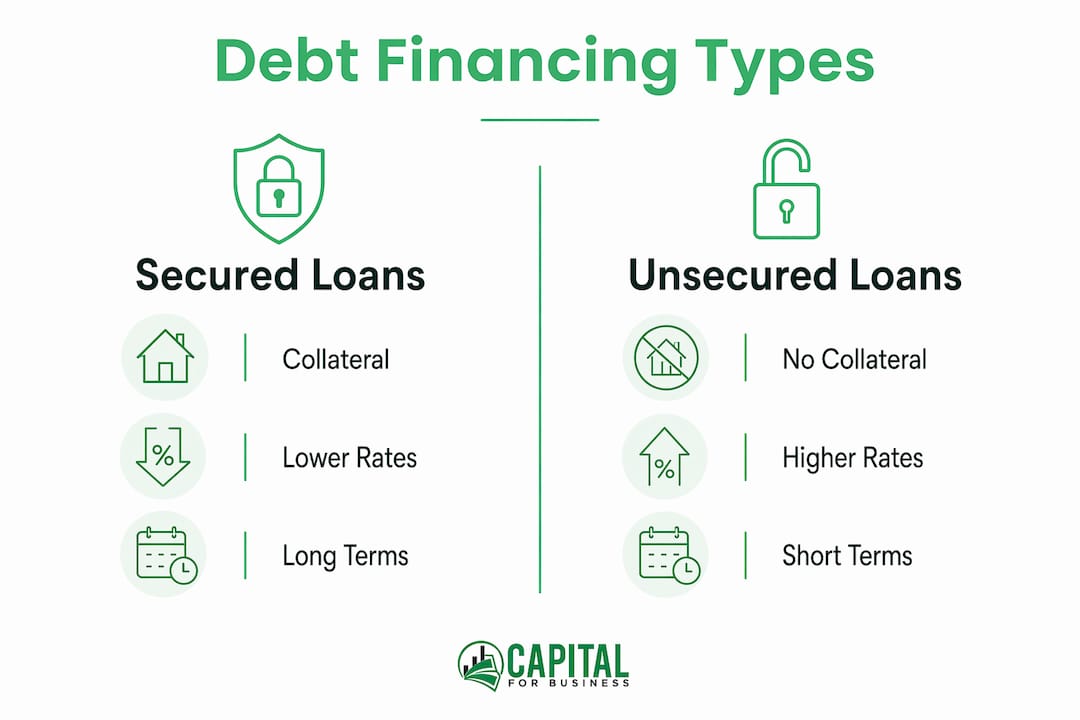
Secured loans require collateral: real estate, equipment, receivables, or inventory. Because the lender can seize the asset if you default, secured loans typically carry lower rates and longer terms. Unsecured loans rely on your creditworthiness alone and usually cost more. Most SBA loans are secured; many business credit cards and merchant cash advances are not.
Amortization and balloon payments
A standard amortizing loan spreads principal and interest evenly across the term. Each monthly payment is the same, and the balance declines predictably. An interest-only loan keeps monthly payments low but leaves the full principal due at maturity. That balloon payment can force a refinance at whatever rates exist then, a risk many borrowers underestimate when the monthly payment looks affordable on paper.
Covenants and personal guarantees
Most commercial loans include covenants — contractual tests the borrower must pass throughout the loan term. Maintenance covenants might require a minimum debt-service coverage ratio or a cap on total leverage. Violating a covenant can trigger technical default even when you have made every payment on time. Personal guarantees extend lender recourse to your personal assets, so a business loan can become a personal liability if the business cannot pay.
Pro Tip: Before signing any loan agreement, ask the lender to list every covenant test and the frequency of measurement. A covenant you cannot realistically maintain is a hidden default risk.
Documents lenders commonly request:
- Last 2–3 years of business tax returns
- Last 3–6 months of business bank statements
- Profit and loss statement and balance sheet (current year)
- Accounts receivable and payable aging reports
- Business license and formation documents
- Personal tax returns and personal financial statement (for guarantee evaluation)
- Equipment invoices or purchase agreements (for equipment loans)
What types of debt financing do small businesses use?
Matching the right product to the right purpose is the most practical decision you will make. Short-term credit should fund short-term needs; long-term loans should fund assets that generate returns over years. Using a high-cost short-term product to finance a five-year asset is one of the most common and costly mistakes small-business owners make.
Bank term loans and commercial loans
Best for equipment purchases, facility expansion, or any large, one-time capital need with a clear payback horizon. Banks typically want two or more years in business, strong credit (usually 680+), and auditable financials. Funding can take two to six weeks. Rates are generally the most competitive of any debt product, but qualification is the most demanding.

SBA loans
The SBA's loan programs partially guarantee loans made by approved lenders, which lowers lender risk and allows longer terms and lower rates than most conventional options. The SBA 7(a) program covers general business purposes with limits; the SBA 504 program targets fixed assets like real estate and heavy equipment. Qualification requires meeting SBA size standards, demonstrating repayment ability, and exhausting other financing options first. Funding timelines range from a few weeks to several months depending on the lender and loan type.
Business line of credit
A revolving credit facility you draw from as needed and repay on a flexible schedule. Ideal for managing seasonal inventory swings, bridging payroll between receivables cycles, or covering unexpected expenses. You pay interest only on what you draw. A business line of credit typically requires at least one year in business and moderate credit, and it can be secured or unsecured.
Business credit cards
Convenient for recurring small purchases, travel, and vendor payments where float matters. The best business credit cards offer rewards and 0% introductory periods, but carrying a balance at standard APRs (often 20%+) makes them expensive for anything beyond short-term use. They work best as a cash-flow management tool, not a capital source.
Merchant cash advances
An MCA provider advances a lump sum in exchange for a percentage of your future card receipts. Repayment is automatic: a fixed percentage of daily card sales until the advance plus factor fee is recovered. Because repayment scales with revenue, a slow week means a smaller payment, which can help cash-strapped businesses. The trade-off is cost: factor rates translate to effective APRs that are substantially higher than bank loans. MCAs suit businesses with strong card volume but limited collateral or credit history. Learn more about how merchant cash advances work before committing.
Invoice financing and factoring
Invoice financing lets you borrow against outstanding receivables, typically 70%–90% of the invoice value, and repay when the customer pays. Factoring goes a step further: the factor buys the invoices outright and collects directly from your customers. Both products improve cash flow for businesses with long payment cycles. They are especially common in construction, staffing, and wholesale distribution.
Equipment financing
Equipment loans and leases fund a specific asset, and the equipment itself serves as collateral. This keeps other assets free and often allows same-day or next-day funding for straightforward purchases. Equipment financing is available up to $250,000 through Capitalforbusiness, with terms matched to the useful life of the asset.
Asset-based lending
Asset-based lending (ABL) uses a business's receivables, inventory, or equipment as a borrowing base. It suits businesses with strong assets but inconsistent earnings, such as manufacturers or distributors with large inventory positions. ABL lenders focus on collateral liquidation value rather than traditional credit metrics, making it accessible when alternative financing is the only realistic path.
Comparison table
| Debt product | Best for | Typical size | Speed | Approx. cost | Typical term | Collateral | Key qualification criteria |
|---|---|---|---|---|---|---|---|
| Bank term loan | Equipment, expansion | $50K–$5M | 2–6 weeks | Lowest rates | 3–10 years | Often required | 680+ credit, 2+ years in business |
| SBA loan | Long-term, lower-rate growth | Up to $5M | Weeks to months | Low | — | Often required | SBA size standards, repayment ability |
| Line of credit | Working capital, seasonal | $10K–$250K | Days to weeks | Moderate | Revolving | Secured or unsecured | 1+ year in business, moderate credit |
| Business credit card | Small purchases, float | Up to $50K | Immediate | High if carried | Revolving | None | Personal credit |
| Merchant cash advance | High card-volume businesses | $5K–$500K | 24–72 hours | Highest | Until repaid | None | Card sales volume |
| Invoice financing | Receivables-heavy businesses | 70%–90% of invoices | Days | Moderate | Per invoice | Invoices | Creditworthy customers |
| Equipment financing | Specific asset purchase | Up to $250K | Same day–1 week | Moderate | Matches asset life | Equipment | Credit, time in business |
| Asset-based lending | Strong assets, variable earnings | $250K+ | 1–4 weeks | Moderate | Revolving or term | Receivables, inventory | Asset quality |
How do debt and equity financing differ?
Debt vs. equity financing comes down to one core trade-off: debt preserves your ownership but creates a repayment obligation; equity removes the repayment requirement but permanently transfers a share of your business to investors.
Debt is generally preferred by established businesses with consistent revenue. Equity tends to suit pre-revenue or high-growth startups that cannot service fixed payments but can offer investors a stake in future upside. A profitable restaurant expanding to a second location is a natural debt candidate. A pre-revenue tech startup burning cash to reach product-market fit is a natural equity candidate.
| Dimension | Debt financing | Equity financing |
|---|---|---|
| Ownership / control | Retained fully | Diluted by investor stake |
| Repayment | Fixed schedule, regardless of revenue | None; investors share in profits/exit |
| Cost | Interest + fees (tax-deductible) | Share of future value (no deduction) |
| Investor involvement | None beyond loan terms | Board seats, reporting, approval rights |
| Cash-flow impact | Fixed outflow each period | No fixed outflow; dividends optional |
| Best stage | Revenue-generating businesses | Pre-revenue or high-growth startups |
A staged approach often makes the most sense: use debt for capital expenditures once revenue is established, and reserve equity for higher-risk growth phases where fixed payments may threaten survival.
What are the real advantages and disadvantages of debt financing?
Advantages
- Ownership retention. Lenders have no claim on your equity or decision-making. Once the loan is repaid, the relationship ends.
- Tax-deductible interest. Business interest expense is generally deductible under U.S. tax law, which lowers the effective cost of borrowing. Reviewing self-employment tax deductions alongside your loan costs can reveal meaningful savings.
- Predictable payments. Fixed amortizing schedules make cash-flow planning straightforward.
- Lower cost than equity for established businesses. When a business generates consistent returns above its borrowing rate, debt is the cheaper form of capital because you are not giving away future profits.
Disadvantages
- Fixed payments regardless of revenue. Lenders have priority over shareholders on liquidation, and they expect payment whether business is good or slow.
- Default risk. Missing payments damages credit, triggers penalty rates, and can lead to asset seizure or legal action.
- Covenant risk. A technical default from a breached covenant can accelerate the entire loan balance even without a missed payment.
- Impact on financial ratios. Higher debt levels raise your debt-to-equity ratio, which can limit future borrowing capacity and affect how lenders and partners assess your creditworthiness.
- Personal guarantees. Many small-business loans require the owner to guarantee personally, blurring the line between business and personal financial risk.
Tax note: The IRS generally allows businesses to deduct interest paid on loans used for business purposes. This deduction applies to bank loans, SBA loans, lines of credit, and equipment financing. Consult a tax professional to confirm eligibility for your specific situation, as the Tax Cuts and Jobs Act introduced limitations on business interest deductions for larger businesses.
Pro Tip: Use debt only for projects where the expected return clearly exceeds the all-in financing cost. Borrowing to cover recurring operating losses accelerates the problem rather than solving it. Practical guidance on avoiding debt issues at your business can help you set the right guardrails before you borrow.
How do you choose the right debt product?
Start by matching purpose to product: working capital needs a line of credit or MCA, equipment needs an equipment loan, and a one-time expansion project needs a term loan. Then compare offers on cost, term, collateral, covenants, and speed.
Evaluation checklist
- Calculate the all-in APR. Include origination fees, closing costs, and any ongoing maintenance fees. A low stated rate with heavy fees can be more expensive than a higher rate with none.
- Confirm the amortization schedule. Know whether payments are fully amortizing, interest-only, or balloon-structured, and model the cash-flow impact of each.
- Read every covenant. List each test, the measurement frequency, and the consequence of a breach. Ask the lender what happens if you miss a covenant but not a payment.
- Check prepayment terms. Some lenders charge a penalty for early repayment; others allow it freely. If you expect to refinance or pay off early, this matters.
- Verify collateral requirements. Understand exactly which assets are pledged and whether a blanket lien covers all business assets.
- Review the personal guarantee. Confirm the scope: is it limited or unlimited? Does it survive the business entity?
- Assess lender reputation. Look for transparent fee disclosure, clear communication, and a track record with businesses in your industry.
Before applying, review considerations for small business loans to make sure you are prepared for what lenders will ask.
Red flags to watch for
- Fees disclosed only at closing, not upfront
- Mandatory arbitration clauses that limit your legal options
- Covenants set so tightly they are nearly impossible to maintain
- Pressure to sign quickly without time to review documents
- A personal guarantee on an unsecured product with no offsetting benefit
Documents to prepare before applying
- Current business bank statements (3–6 months)
- Business and personal tax returns (2–3 years)
- Current profit and loss statement and balance sheet
- Business debt schedule (existing loans and payments)
- Equipment invoices or vendor quotes (if applicable)
Pro Tip: Organize your documents before you approach any lender. Incomplete applications slow underwriting and signal disorganization. Lenders fund businesses that look prepared.
What do debt financing typically cost, and how long does it take?
The gap between a nominal interest rate and the true cost of borrowing can be significant once fees are included. Computing an all-in APR before comparing offers is the single most useful habit a borrower can develop.
Cost and timeline by product
| Product | Approx. interest / cost | Typical term | Funding speed |
|---|---|---|---|
| Bank term loan | 6%–12% APR | 3–10 years | 2–6 weeks |
| SBA 7(a) loan | Prime plus a premium rate | Terms can extend up to multiple years | Funding timelines vary from weeks to months |
| Business line of credit | 8%–24% APR | Revolving | Days to 2 weeks |
| Business credit card | 20%+ APR | Revolving | Immediate |
| Merchant cash advance | Factor rate (high effective APR) | Until repaid | 24–72 hours |
| Invoice financing | 1%–5% per month | Per invoice cycle | 1–5 days |
| Equipment financing | 6%–20% APR | 2–7 years | Same day–1 week |
| Asset-based lending | 8%–20% APR | Revolving or term | 1–4 weeks |
Worked example: $50,000 five-year term loan at 10% APR
A fully amortizing loan example illustrates how monthly payments and total interest accumulate over the loan term; origination fees also add to the true cost of borrowing. That is the number to compare against the return the borrowed capital is expected to generate.
Typical application-to-funding timelines
- Bank term loan: Application (1–3 days) → underwriting (1–4 weeks) → closing and funding (1 week)
- SBA loan: Application (1 week) → SBA review (2–8 weeks) → closing (1–2 weeks)
- Line of credit: Application (1 day) → approval (1–5 days) → funding (1–3 days)
- MCA: Application (hours) → approval (same day) → funding (24–72 hours)
- Equipment loan: Application (1 day) → approval (1–3 days) → funding (same day to 1 week)
What lenders actually look for when evaluating your application
Debt is a leverage tool: it makes sense when the return on the funded project exceeds the financing cost. Lenders know this, and their underwriting is designed to assess whether your business can generate enough cash to repay comfortably.
Underwriting priorities
- Cash flow. Debt-service coverage ratio (DSCR) is the primary test: net operating income divided by total debt service. Most lenders want a DSCR of 1.25 or higher, meaning the business generates $1.25 for every $1.00 of debt payment.
- Collateral. Secured lenders assess liquidation value, not book value. Equipment worth $100,000 on the balance sheet may be worth $60,000 in a forced sale.
- Time in business. Most conventional lenders want at least two years of operating history. Alternative lenders may accept one year or less.
- Card and deposit volume. MCA providers focus on monthly card receipts; online term lenders analyze bank deposit patterns over the last 3–6 months.
- Personal credit. For small businesses, owner credit score is often a tiebreaker when business financials are borderline.
Lenders also appreciate clean, organized submissions. Clear bank statements with consistent deposit patterns, reconciled bookkeeping, and current financial statements all signal a business that manages its finances well.
Pro Tip: If your DSCR is below 1.25, address it before applying rather than hoping the lender overlooks it. Paying down existing debt, cutting discretionary expenses, or waiting one quarter for revenue to recover can meaningfully improve your approval odds.
Covenant negotiation and refinancing
Covenants are negotiable, especially with relationship lenders. Push for maintenance tests set at levels your business can realistically sustain through a slow quarter, not just at current peak performance. On balloon-payment loans, ask the lender upfront about their refinancing policy at maturity: a verbal commitment is not binding, but a lender who refuses to discuss it is a red flag.
Capitalforbusiness works with small-business owners to identify the right product structure from the start, including businesses that have been declined by traditional banks. The goal is a loan structure that fits your cash flow, not one that strains it.
Are there alternatives to traditional debt financing?
When pure debt is too expensive or unavailable, and equity is not appropriate, several hybrid and alternative structures can fill the gap.
- Revenue-based financing (RBF). Similar to an MCA but typically used by software and subscription businesses. Repayment is a fixed percentage of monthly revenue until a multiple of the advance is repaid. No collateral, no equity dilution.
- Convertible notes. A loan that converts to equity at a future financing round, usually at a discount to the round price. Common in early-stage startups that expect a priced equity round within 12–18 months. It is debt today and equity tomorrow.
- Vendor financing and trade credit. Suppliers sometimes offer extended payment terms (net-60, net-90) or installment plans on equipment. This is effectively interest-free short-term debt and is often overlooked as a cash-flow tool.
- Grants and community lender programs. The SBA's Community Advantage program and CDFI (Community Development Financial Institution) lenders offer below-market loans to underserved businesses. Grants from state economic development agencies require no repayment at all, though they are competitive and often restricted by industry or geography.
- Debt consolidation and refinancing. If you are carrying multiple high-cost debts, consolidating into a single lower-rate loan reduces total interest expense and simplifies cash-flow management. Refinancing a maturing balloon loan before rates move against you is a proactive strategy worth planning 6–12 months ahead of the balloon date.
For businesses that fall between traditional bank standards and pure alternative lending, options for bridging the gap that a traditional loan will not cover are worth exploring before ruling out debt entirely.
Key Takeaways
Debt financing is the most cost-effective growth capital for businesses with consistent revenue, provided the return on the funded project exceeds the all-in borrowing cost.
| Point | Details |
|---|---|
| Match product to purpose | Short-term needs need short-term credit; long-term assets need term loans with matching repayment schedules. |
| Compute all-in APR | Include origination fees and closing costs; a $50,000 loan at 10% APR over five years costs considerable total interest and fees. |
| Understand covenants | Covenant violations can trigger technical default even without a missed payment; negotiate tests at realistic levels before signing. |
| Know your guarantee exposure | Personal guarantees extend lender recourse to your personal assets; treat a guaranteed loan as a personal liability, not just a business one. |
| Capitalforbusiness | Since 2009, Capitalforbusiness has funded small businesses across hundreds of industries, including borrowers banks declined, with loans, lines, MCAs, and equipment financing. |
A lender's perspective on using debt wisely
Most small-business owners approach debt financing as a last resort rather than a planning tool. That framing leads to bad decisions: borrowing under pressure, accepting unfavorable terms, and using short-term products to fund long-term needs. The businesses that use debt well treat it the way a contractor treats a tool: the right one for the right job, chosen before the project starts, not improvised mid-build.
The most common mistake Capitalforbusiness sees is not over-borrowing. It is borrowing the wrong product. A business with strong receivables takes an MCA at a high factor rate when invoice financing would cost a fraction as much. A seasonal retailer opens a term loan for inventory when a revolving line of credit would let them borrow only what they need and repay it as sales come in. The product mismatch costs more than the rate.
The second most common mistake is ignoring covenants until they are violated. By then, the options narrow quickly. Reading the covenant schedule at the term sheet stage, before you are committed, gives you the leverage to negotiate or walk away.
Debt financing works when the math works: the project funded must generate returns above the financing cost, and the payment schedule must fit within realistic cash flow. When those two conditions are met, borrowing is not a risk to manage. It is a growth strategy.
Capitalforbusiness helps you find the right loan fast
Small businesses that need capital quickly, or that have been turned down by a bank, often have more options than they realize. Capitalforbusiness connects business owners with the right financing product for their situation, whether that is a working capital loan, a business line of credit, an MCA, or equipment financing up to $500,000.
The process is straightforward. You submit a short application with basic business and financial information. Capitalforbusiness reviews your profile and matches you with the product and terms that fit your cash flow and purpose. Funding can happen in as little as 24 hours for MCA and equipment products, and within days for lines of credit. For businesses that need a longer-term loan or SBA product, the team guides you through documentation and lender requirements step by step.
To see which small business loan types you qualify for, start your application today at Capitalforbusiness.net. No obligation, no pressure, just a clear picture of what is available for your business.
Useful sources
- SBA Loan Programs: The Small Business Administration's official overview of guaranteed loan programs, including 7(a) and 504 products, eligibility standards, and lender matching.
- SBA Lender Match: The SBA's free tool for connecting small businesses with approved SBA lenders based on their financing needs.
- Debt Financing Overview (Corporate Finance Institute): Covers the mechanics of debt financing, secured vs. unsecured structures, and the tax-deductibility of interest for businesses.
- What Are Examples of Debt Financing? (Investopedia): Explains common debt products, lender priority on liquidation, and the repayment obligation structure.
- Debt Financing: A Founder's Guide (Carta): Practical coverage of covenants, personal guarantees, and how to evaluate debt terms from a founder's perspective.
- What Is Debt Finance? (ICAEW): Explains product-purpose matching, when alternative debt products are appropriate, and the debt vs. equity decision for different business stages.
- Debt Financing vs. Equity Financing (M&T Bank): Covers how to compute all-in APR, compare offers, and understand amortization and prepayment terms.
- What Is Debt Financing? (Ramp): Explains MCA repayment mechanics and how underwriting priorities differ across product types.
- IRS guidance on business interest deductions: The IRS provides official rules on deducting business interest expense. Search IRS.gov for Publication 535 (Business Expenses) for current rules, including limitations introduced by the Tax Cuts and Jobs Act.
FAQ
Is debt financing a good option for small businesses?
Debt financing is a sound choice for businesses with consistent revenue that need capital without giving up ownership. It works best when the funded project generates returns above the all-in borrowing cost and cash flow can support scheduled payments.
What is an example of debt financing?
An SBA 7(a) loan used to purchase equipment or fund an expansion is a common example. A business line of credit drawn to cover seasonal inventory is another. Both require repayment with interest and involve no transfer of ownership.
What are two disadvantages of debt financing?
Fixed repayment obligations exist regardless of revenue, which can strain cash flow during slow periods. Covenant violations can also trigger technical default even when payments are current, giving lenders significant leverage over the borrower.
What is term debt financing?
Term debt financing is a loan with a fixed principal amount, a set interest rate, and a defined repayment schedule over a specified period, typically one to ten years. Payments are usually monthly and may be fully amortizing or structured with a balloon payment at maturity.
Can Capitalforbusiness help if a bank declined my application?
Yes. Capitalforbusiness specializes in funding small businesses that do not meet conventional bank criteria, using products like merchant cash advances, asset-based lending, and equipment financing that rely on cash flow and assets rather than traditional credit scores alone.