
TL;DR:
- Asset-based lending provides loans secured by a company's balance-sheet assets, mainly receivables, inventory, or real estate, especially when cash flow is insufficient. It involves dynamic borrowing bases that fluctuate with collateral collection, requiring regular reporting, field exams, and cash dominion regulation. This financing suits asset-rich, fast-growing or seasonal companies but is less appropriate for asset-light startups or early-stage firms.
Asset-based lending (ABL) is a loan or revolving credit facility secured by a company's balance-sheet assets, typically accounts receivable, inventory, equipment, or real estate, and it works best when your business has substantial assets but uneven or insufficient cash flow to qualify for traditional financing. The SBA notes that ABL is generally easier to qualify for when a business can pledge meaningful collateral, though lenders can seize and liquidate those assets on default.
Quick scan: Is ABL worth exploring?
- Consider it if your business carries significant receivables or inventory and needs working capital now.
- Consider it if you are growing fast, running seasonal cycles, or in a turnaround situation.
- Pause if you are an asset-light service company or an early-stage startup with little collateral to pledge.
- Know that the monitoring requirements are real: expect regular reporting, field exams, and potentially lender control over incoming cash.
Table of Contents
- What is asset-based lending, exactly?
- How does asset-based lending work, step by step?
- Which assets do lenders accept, and what gets excluded?
- Who benefits most from asset-based financing?
- What are the real advantages and disadvantages of ABL?
- What does the ABL process look like, and what does it cost?
- How does ABL compare to other financing options?
- How do you decide if ABL is right for you?
- Key Takeaways
- When Capitalforbusiness recommends asset-based lending
- Capitalforbusiness helps you access working capital faster
- Useful sources
- FAQ
What is asset-based lending, exactly?
Asset-based lending provides capital against the liquidation value of specific balance-sheet assets rather than against projected earnings or credit scores. The lender establishes a borrowing base, which is the maximum amount you can draw at any moment, calculated as a percentage of eligible collateral. That percentage is called the advance rate, and it varies by asset type because lenders price it to the asset's liquidity.
A simple example makes this concrete. Suppose your business has $500,000 in eligible accounts receivable and $200,000 in eligible inventory. A lender might apply an 85% advance rate to receivables and a 50% rate to inventory:
- Receivables: $500,000 × 85% = $425,000
- Inventory: $200,000 × 50% = $100,000
- Total borrowing base: $525,000
That $525,000 is your ceiling, not a fixed loan amount. As you collect receivables and ship inventory, the base shrinks. As new invoices come in, it grows. This dynamic structure is what separates ABL from a standard term loan, where the balance only goes in one direction.
How does asset-based lending work, step by step?
Understanding the full lifecycle of an ABL facility helps you assess the operational commitment before you sign anything.
-
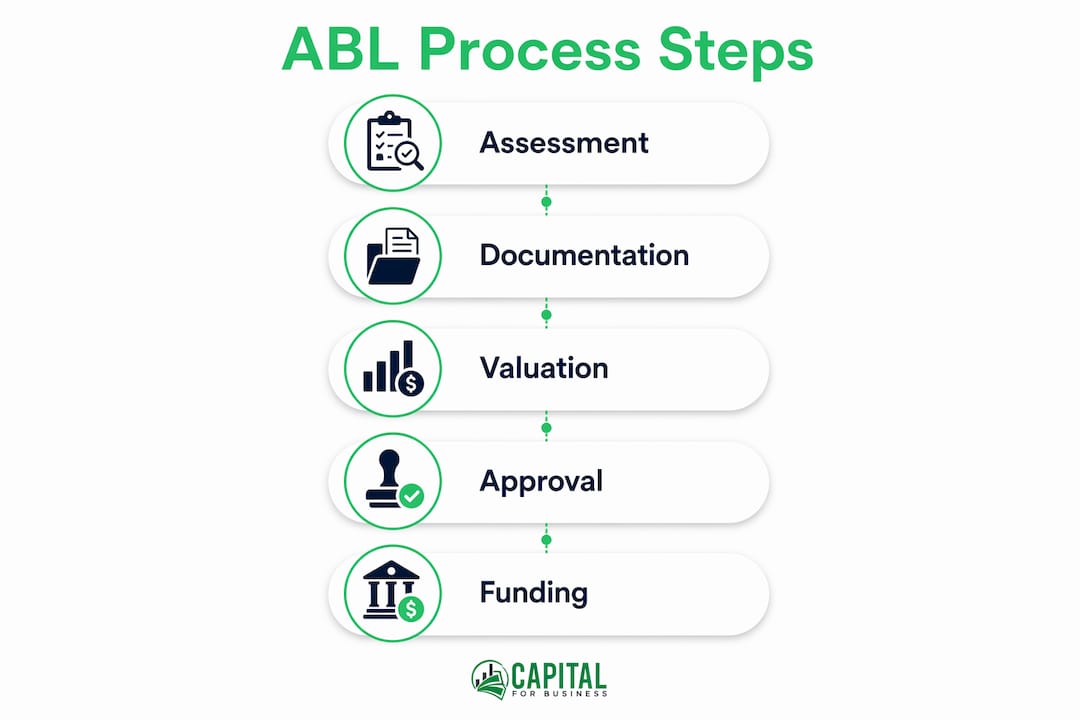
Application and initial underwriting. The lender reviews your accounts receivable aging, inventory listings, equipment appraisals, and financial statements. They assess collateral quality, not just your credit score or EBITDA.
-
Eligibility determination. Not all receivables or inventory qualify. Lenders exclude invoices past a certain age (commonly 90 days), receivables from related parties, and inventory that is slow-moving or obsolete. What remains is "eligible collateral."
-
Borrowing base certificate. You submit a borrowing base certificate, usually weekly or monthly, that reports current eligible collateral balances. Your available credit adjusts with each submission. The OCC's Comptroller's Handbook identifies this ongoing monitoring as the primary control mechanism in ABL.
-
UCC-1 lien filing. The lender files a UCC-1 financing statement to perfect its security interest in the collateral. This public filing establishes lender priority over those assets against other creditors.
-
Field examinations. Lenders conduct in-person audits to verify inventory counts and confirm receivable collectibility, typically once or twice a year. Third-party appraisers may also value equipment and real estate.
-
Ongoing draws and repayments. You draw against available credit as needed and repay as receivables are collected. The facility revolves continuously within the borrowing base.
-
Cash dominion. Some facilities require customer payments to flow into a lender-controlled lockbox account, which the lender applies to the outstanding balance before releasing remaining funds to you. This can be a continuous arrangement or a "springing" mechanism that activates only when you breach a covenant.
Pro Tip: Negotiate for springing cash dominion rather than continuous cash dominion if you can. Continuous dominion means the lender controls your incoming cash every day, which creates real friction in daily operations. Springing dominion only kicks in if you trip a covenant, giving you normal cash management unless something goes wrong.

Which assets do lenders accept, and what gets excluded?
Knowing what counts before you walk into a lender meeting saves time and shapes your collateral strategy.
Commonly accepted assets:
- Accounts receivable — the most preferred collateral. Advance rates of 80%–90% are typical for clean, current receivables from creditworthy customers.
- Inventory — accepted but at lower advance rates, often 50%–65%, because liquidating inventory takes more time and effort than collecting a receivable.
- Equipment and machinery — valued by appraisal at orderly liquidation value; advance rates commonly run 75%–85% of appraised value.
- Real estate — accepted as additional collateral, though it is less common as the primary ABL asset; advance rates vary widely by property type.
- Marketable securities — highly liquid assets like publicly traded securities can receive high advance rates, sometimes 90%+, because they convert to cash quickly.
Common exclusions and lower-value collateral:
- Receivables older than 90 days (or the lender's defined aging cutoff)
- Related-party or intercompany receivables
- Foreign receivables, unless the lender has cross-border experience and appropriate documentation
- Consigned goods and work-in-progress inventory, which carry uncertain ownership and completion risk
- Slow-moving or obsolete inventory, often excluded entirely or heavily reserved
- Intangible assets like patents, trademarks, or goodwill, which have uncertain liquidation value
Borderline cases come up often. Work-in-progress may be partially eligible if the lender can confirm a firm purchase order. International receivables from creditworthy foreign customers with credit insurance may qualify at a reduced advance rate. The key variable is always: how quickly and reliably can the lender convert this asset to cash if you default?
Who benefits most from asset-based financing?
Small- to mid-sized companies are the most common ABL borrowers, particularly those with meaningful collateral but cash-flow metrics that do not satisfy traditional bank underwriting. The structure fits several specific business profiles well.
Use cases where ABL tends to work:
- Rapid growth companies that need working capital to fund receivables and inventory ahead of cash collections.
- Seasonal businesses (retailers, agricultural suppliers, holiday manufacturers) whose borrowing needs spike and contract predictably.
- Manufacturers and distributors with large receivables and inventory balances that map directly to the borrowing base.
- Turnaround or distressed companies that cannot access unsecured credit but still hold valuable assets. The OCC explicitly notes that ABL serves both troubled and healthy companies.
- Businesses with high working-capital cycles, such as wholesale distributors buying in bulk and selling on net-30 or net-60 terms.
- Companies with limited unsecured credit options due to prior losses, thin margins, or recent ownership changes.
A manufacturer carrying a substantial amount in receivables and finished goods inventory can often access a sizable revolving facility under ABL when a cash-flow lender would decline the application entirely. A wholesale distributor with a seasonal peak in Q4 can draw heavily in October and November, then pay down the line as holiday payments arrive in January.
When ABL is probably not the right fit:
Asset-light service businesses (consulting firms, software companies, staffing agencies with thin AR) often lack the collateral base to make ABL practical. Early-stage startups without substantial receivables or hard assets face the same challenge. For those businesses, startup loan options or revenue-based financing may be a better starting point.

What are the real advantages and disadvantages of ABL?
ABL is not universally better or worse than other financing structures. The right answer depends on your collateral base, your tolerance for monitoring, and your cash management preferences.
Advantages:
- Access to capital even when cash-flow metrics are weak, because underwriting focuses on asset quality.
- Credit availability scales with your business: more receivables and inventory means more borrowing capacity.
- Fewer financial maintenance covenants in many ABL deals compared to cash-flow loans, which often include EBITDA and leverage ratio tests.
- Lower headline interest rates than unsecured alternatives in many cases, because the lender holds a secured position.
- Flexible structure: draw what you need, repay as cash comes in, repeat.
Disadvantages:
- Ongoing monitoring burden: weekly or monthly borrowing base certificates, field exams, and detailed reporting are non-negotiable.
- Cash dominion provisions can complicate daily treasury operations, especially in continuous structures.
- Collateral seizure risk on default is real. The lender can liquidate your receivables, inventory, or equipment to recover the outstanding balance.
- True cost of capital is higher than the headline rate once you add appraisal fees, field exam costs, and monitoring fees.
- Borrowing base fluctuations can reduce availability at the worst time, such as when receivables age out during a slow collection period.
Pro Tip: When comparing ABL offers, add up interest, origination fees, field exam costs, and annual monitoring fees to get a true annual cost figure. A lower interest rate with heavy monitoring fees can easily cost more than a slightly higher rate with minimal fees.
What does the ABL process look like, and what does it cost?
Documents lenders typically request:
- Accounts receivable aging report (current and 90-day history)
- Inventory listing with cost basis and aging
- Equipment list with serial numbers and estimated values
- Two to three years of financial statements and recent interim financials
- Accounts payable aging
- UCC lien search results on the business
- Business insurance certificates covering pledged assets
- Customer concentration analysis
Typical timeline: From letter of intent to closing, most ABL facilities take four to eight weeks. Complex collateral (international receivables, specialized equipment) or a first-time field exam can push that toward three months. Having clean, current records speeds the process considerably.
Cost breakdown:
| Fee Type | Typical Timing | Who Pays |
|---|---|---|
| Origination / closing fee | One-time at closing | Borrower |
| Field examination fee | One-time at closing, then annually | Borrower |
| Inventory appraisal fee | One-time at closing, refreshed periodically | Borrower |
| Interest on drawn balance | Ongoing, monthly | Borrower |
| Unused line / commitment fee | Ongoing, monthly or quarterly | Borrower |
| Monitoring / reporting fee | Ongoing, monthly | Borrower |
| Prepayment / exit fee | On early termination | Borrower |
The borrowing base adjusts monthly in most facilities, though larger or more complex deals may require weekly certificates. Understanding the cadence upfront helps you staff the reporting function appropriately, whether that is your controller, your CFO, or an outside accountant. Technology-enabled lenders are reducing some of this burden through automated data pulls, a trend worth asking about when you evaluate lenders.
How does ABL compare to other financing options?
ABL occupies a specific position in the financing spectrum. Knowing where it sits helps you triage your options.
ABL vs. cash-flow lending: Cash-flow lenders underwrite against EBITDA, debt service coverage, and leverage ratios. If your earnings are strong and predictable, a cash-flow loan often carries fewer operational strings. ABL is the better path when earnings are thin, volatile, or temporarily depressed but your balance sheet holds real assets. The unsecured line of credit is the simplest cash-flow product, but it requires solid credit and consistent revenue.
ABL vs. equipment financing: Equipment financing isolates a single asset and amortizes it over its useful life. If you need to acquire new equipment, dedicated equipment financing is usually cleaner and cheaper than pledging equipment under an ABL facility. ABL makes more sense when equipment is one component of a broader collateral package alongside receivables and inventory.
ABL vs. merchant cash advance: A merchant cash advance is repaid through a percentage of daily card sales, making it fast but expensive. It suits businesses with high card volume and short-term needs. ABL suits businesses with substantial receivables and inventory that need a larger, longer-term revolving facility.
ABL vs. invoice factoring: Factoring is a subset of receivables-based financing where you sell invoices outright to a third party. ABL pledges receivables as collateral but keeps them on your balance sheet. Factoring is faster and simpler; ABL typically offers lower cost and more flexibility at scale.
The right choice usually comes down to two questions: How predictable are your earnings? And how large and liquid is your collateral base? Strong earnings, simple structure. Weak earnings but strong assets, ABL.
How do you decide if ABL is right for you?
Before calling a lender, run through this checklist to assess fit and prepare for the conversation.
-
Inventory your eligible assets. Tally current receivables under 90 days, finished goods inventory, and appraised equipment value. Apply rough advance rates (85% AR, 50%–65% inventory) to estimate a borrowing base. If the number covers your capital need, ABL is worth pursuing.
-
Assess your reporting bandwidth. ABL requires regular borrowing base certificates and financial reporting. If your accounting function is thin, factor in the cost of upgrading it or outsourcing it before you commit.
-
Decide your cash dominion tolerance. Continuous cash dominion affects daily treasury operations. If that is a dealbreaker, negotiate for springing dominion before you accept a term sheet.
-
Model total cost of capital. Add interest, origination, field exam, and monitoring fees across a 12-month period. Compare that total against the cost of alternatives, not just the headline rate.
-
Prepare your questions for lenders. Walk into every lender meeting with these:
- What advance rates do you apply to each collateral type?
- How often do you require borrowing base certificates?
- What is your field exam cadence and fee structure?
- Is cash dominion continuous or springing, and what triggers it?
- Are there other UCC liens on our assets, and how do you handle priority?
- What are the prepayment or exit fee terms?
Getting clear answers to these questions before you sign lets you compare term sheets on a true apples-to-apples basis. For a broader view of how ABL fits alongside other products, the best lending options for small businesses resource from Capitalforbusiness covers the current landscape in detail.
Key Takeaways
Asset-based lending gives asset-rich businesses access to working capital by tying credit availability directly to the liquidation value of receivables, inventory, and equipment, making it one of the most flexible financing structures for companies with strong balance sheets but uneven cash flow.
| Point | Details |
|---|---|
| Borrowing base drives availability | Your credit limit moves with eligible receivables and inventory, not a fixed loan amount. |
| Advance rates vary by asset liquidity | Receivables typically get 80%–90%; inventory gets 50%–65%; less liquid assets get lower rates or exclusions. |
| True cost exceeds the headline rate | Field exam, appraisal, and monitoring fees add to interest, so compare total annual cost across offers. |
| Cash dominion is negotiable | Push for springing dominion to preserve normal cash management unless a covenant is breached. |
| Capitalforbusiness can help | Capitalforbusiness helps business owners evaluate ABL fit, model borrowing bases, and access working capital funding up to $500,000. |
When Capitalforbusiness recommends asset-based lending
The business owners Capitalforbusiness works with most often gravitate toward ABL when they are caught between two realities: their balance sheet is solid, but their income statement does not tell the full story. A seasonal distributor with $1.5 million in receivables during peak months, a manufacturer ramping up for a large contract, a wholesale company bridging a 60-day payment gap — these are the profiles where ABL consistently makes sense.
What most business owners underestimate going in is the documentation side. Lenders are not just checking a credit score; they are building a detailed picture of your collateral quality. Capitalforbusiness helps clients prepare AR aging reports, inventory schedules, and borrowing-base models before the first lender conversation, which shortens the underwriting timeline and avoids surprises at closing. The goal is to walk into that meeting with clean numbers, not scramble to produce them under deadline.
ABL is not the right answer for every business, and Capitalforbusiness is direct about that. But for asset-rich companies that have been turned down by traditional banks or need more flexibility than a standard term loan allows, it is often the most practical path to meaningful working capital.
Capitalforbusiness helps you access working capital faster
When your business has the assets but not the time to navigate complex lender requirements alone, Capitalforbusiness provides the guidance and access that makes the difference between a funded deal and a stalled application.
Since 2009, Capitalforbusiness has helped business owners across hundreds of industries secure financing when banks said no. For business owners evaluating asset-based financing, the team runs borrowing-base models, prepares documentation packages, and connects clients with appropriate lenders, all without the months-long wait of a traditional bank process. Funding solutions reach up to $500,000, and decisions move fast.
Ready to see what your collateral base could unlock? Request a consultation or explore working capital options to get a clear picture of what your business qualifies for today.
Useful sources
- OCC Comptroller's Handbook: Asset-Based Lending — The primary U.S. regulatory guidance on ABL structure, borrowing-base monitoring, and lender controls. Essential reading for understanding how banks underwrite and supervise these facilities.
- SBA: Asset-Based Lending — What Is the Upside and Downside? — Plain-language overview from the Small Business Administration covering eligible collateral, qualification criteria, and default risks.
- Investopedia: Asset-Based Lending — Accessible definition and mechanics overview, including advance rates, borrowing base, and cost components.
- J.P. Morgan: Asset-Based Loans — How They Work for Businesses — Practitioner-level explanation of field exams, borrowing base cadence, and cash dominion structures.
- Corporate Finance Institute: Asset-Based Lending — Covers advance rate logic and the relationship between asset liquidity and lender risk tolerance.
- Capitalforbusiness: Alternative Lending Options — Context on how ABL fits within a broader alternative financing strategy for growing businesses.
FAQ
What is meant by asset-based lending?
Asset-based lending is a financing arrangement where a business borrows against the value of specific balance-sheet assets, most commonly accounts receivable, inventory, equipment, or real estate, rather than against earnings or credit history alone. The maximum loan amount is determined by a borrowing base calculation that applies advance rates to eligible collateral.
What are the disadvantages of asset-based loans?
The main disadvantages are the ongoing monitoring burden (regular reporting, field exams, borrowing base certificates), the risk of collateral seizure on default, and a true cost of capital that is higher than the headline interest rate once appraisal and monitoring fees are included. Cash dominion provisions can also complicate daily cash management.
What is an example of asset-backed lending?
A wholesale distributor with $500,000 in eligible accounts receivable and $200,000 in eligible inventory could secure a revolving credit facility with a borrowing base of roughly $525,000, using an 85% advance rate on receivables and a 50% rate on inventory. As invoices are paid and new ones are issued, the available credit adjusts accordingly.
What is an example of an asset loan?
A manufacturer pledging $1 million in equipment at an appraised orderly liquidation value, with the lender advancing 75%–85% against that value, would receive term financing up to that range. The lender files a UCC-1 lien on the equipment and may require periodic appraisal updates to confirm the collateral still supports the outstanding balance.