
TL;DR:
- Alternative lending offers small businesses faster, more flexible capital sources outside traditional banks. It includes products like merchant cash advances, invoice factoring, and online loans, with approval times of hours to days. Careful product matching and total repayment calculations are essential to avoid higher costs and overborrowing risks.
Alternative lending is defined as business financing sourced outside traditional banks and credit unions, delivered through online lenders, fintech platforms, and community lenders. For small business owners who have been turned down by a bank or simply need capital faster than a bank can move, understanding alternative financing is not optional. It is the difference between seizing a growth opportunity and watching it pass. Products like merchant cash advances, invoice factoring, and online term loans from lenders such as Kabbage and OnDeck have made alternative lending options accessible to businesses that traditional institutions routinely overlook. This guide breaks down how each product works, what it costs, and how to choose the right one for your situation.
What is alternative lending and how does it differ from traditional bank loans?
Explaining alternative lending starts with one clear contrast: where the money comes from and how lenders decide to give it to you. Alternative lending refers to any financing provided outside the traditional banking system, typically by fintech companies, online lenders, or community development financial institutions.
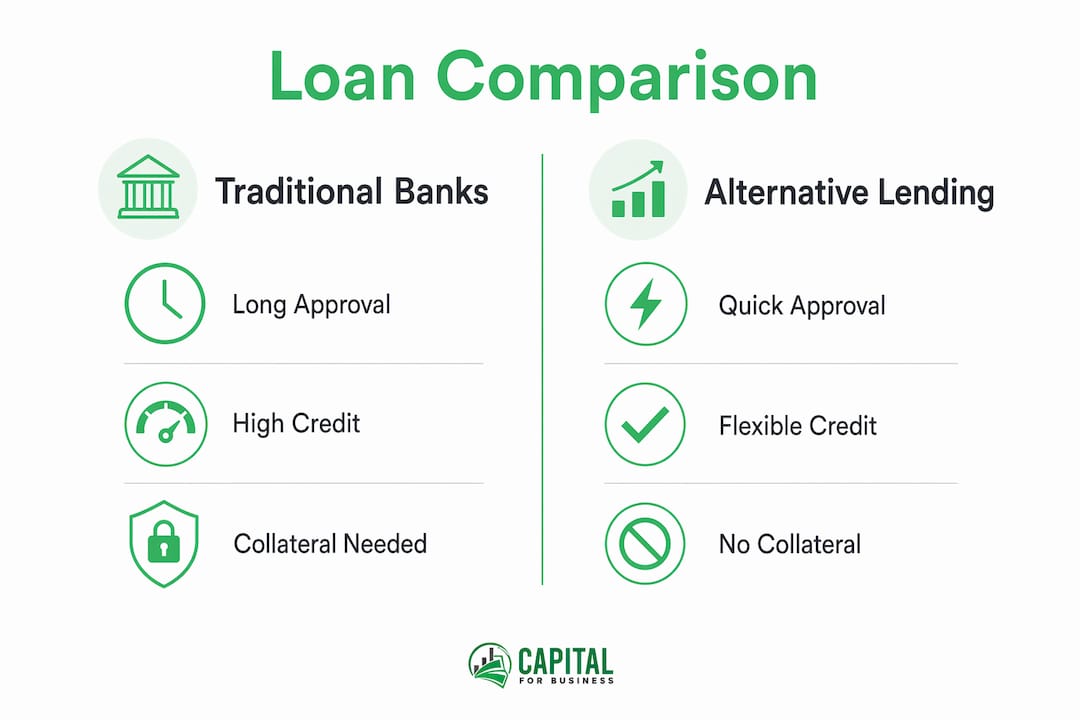
Traditional bank loans require two or more years of business history, strong personal credit, collateral, and weeks of paperwork review. Alternative lenders operate differently on every one of those points.
| Factor | Traditional bank loans | Alternative lenders |
|---|---|---|
| Approval time | Several weeks | Hours to a few days |
| Business history required | 2+ years | As little as 6 months |
| Credit score emphasis | High (FICO-driven) | Moderate (cash flow weighted) |
| Collateral requirement | Often required | Frequently unsecured |
| Application process | In-person, paper-heavy | Fully online |
| Documentation | Tax returns, financials, business plan | Bank statements, revenue data |
The speed gap is significant. Alternative lending decisions can take hours or days versus weeks for traditional banks, because technology-based underwriting reads real-time financial data instead of waiting for manual review. That speed matters when you need to cover payroll, buy inventory, or respond to a contract opportunity.
Alternative lenders also evaluate your business differently. They integrate with software like QuickBooks and Shopify to pull live cash flow data, which can outweigh a low FICO score in the approval decision. A business with consistent monthly revenue but a thin credit file has a real shot at approval that a bank would deny outright.

Pro Tip: Connect your accounting software to your lender's application portal before you apply. Lenders using QuickBooks or Xero integrations can often approve you faster and at better terms because they see your actual cash position, not just a snapshot.
What types of alternative financing are available for small businesses?
Common alternative lending products include online business term loans, merchant cash advances, invoice factoring, revenue-based financing, microloans, equipment financing, and purchase order financing. Each works differently and fits a different business situation.
Here is a plain-language breakdown of each:
- Online term loans: A lump sum repaid in fixed installments over a set period. Best for planned expenses like hiring, renovation, or inventory buildup.
- Merchant cash advances (MCAs): A cash advance repaid through a percentage of future daily sales. MCAs offer flexibility but can be costly when sales fluctuate, because the repayment percentage stays fixed regardless of revenue swings.
- Invoice factoring: You sell unpaid invoices to a factoring company at a discount and receive cash immediately. Best for B2B businesses waiting 30–90 days for client payments.
- Revenue-based financing: Repayment is tied to a percentage of monthly revenue until a fixed total is repaid. Payments rise when revenue rises and fall when revenue drops.
- Peer-to-peer lending: Loans funded by individual investors through online platforms. Learn whether peer-to-peer lending fits your business before applying.
- Equipment financing: The equipment itself serves as collateral, making approval easier. Ideal for purchasing machinery, vehicles, or technology.
- Microloans: Small loan amounts, often under $50,000, targeted at startups and underserved businesses. Frequently offered through nonprofit lenders and the SBA.
| Product type | Typical amount | Repayment method | Best for |
|---|---|---|---|
| Online term loan | $10,000–$500,000 | Fixed monthly payments | Planned growth expenses |
| Merchant cash advance | $5,000–$250,000 | % of daily sales | Retail, restaurants, high card volume |
| Invoice factoring | Up to 90% of invoice value | Invoice collection | B2B with slow-paying clients |
| Revenue-based financing | $10,000–$3,000,000 | % of monthly revenue | Subscription or recurring revenue businesses |
| Equipment financing | Up to $250,000 | Fixed monthly payments | Asset purchases |
| Microloan | Up to $50,000 | Fixed monthly payments | Startups, underserved businesses |
The right product depends on how your business generates and receives revenue. A restaurant with high card volume fits a merchant cash advance. A staffing agency waiting on net-60 invoices fits invoice factoring. Matching the repayment structure to your cash flow pattern is the most important decision you will make.
What are the benefits and drawbacks of alternative lending?
Alternative lending solves real problems for small businesses, but it comes with trade-offs worth understanding before you sign anything.
Main benefits:
- Faster funding. Decisions in hours or days mean you can act on time-sensitive opportunities without waiting weeks for a bank committee.
- Flexible eligibility. Alternative lenders accept shorter business histories, sometimes as little as 6 months, and weigh cash flow more heavily than credit scores alone.
- Unsecured options. Many alternative products require no collateral, so you do not need to put personal or business property at risk.
- Technology-driven decisions. Lenders assess real-time revenue, expense patterns, and cash flow rather than relying on a static credit snapshot from years ago.
- Product variety. From microloans to revenue-based financing, the range of products covers almost every business model and funding need.
Main drawbacks:
- Higher cost. Alternative lending products generally carry higher interest rates and fees than traditional bank loans because lenders take on more risk and fund faster.
- Shorter terms. Repayment periods are often months, not years, which increases the periodic payment burden.
- Risk of overborrowing. Easy access to capital can lead business owners to borrow more than their cash flow can comfortably repay.
- Less regulatory oversight. Some alternative lenders operate with fewer consumer protections than federally regulated banks, so reading the fine print matters more.
Alternative lending is the right call when you need capital quickly, have limited credit history, or cannot offer collateral. Traditional bank loans remain the better choice when you have time, strong credit, and want the lowest possible interest rate.
Pro Tip: Before accepting any alternative loan offer, calculate the total repayment amount, not just the monthly payment. Divide total repayment by the amount borrowed to get your true cost of funds. A 6-month loan with a 1.4 factor rate costs 40 cents per dollar borrowed, which is very different from a 6% annual rate.
How to choose the right alternative lending option for your business
Choosing the right product starts with an honest assessment of three things: how much you need, how your business generates revenue, and how quickly you can repay.
Work through these questions before you contact any lender:
- What is the funding for? Equipment purchases point toward equipment financing. Covering a cash flow gap points toward a line of credit or revenue-based financing. Bridging unpaid invoices points toward invoice factoring.
- How does your business get paid? High daily card sales support a merchant cash advance. Monthly invoices support factoring or a term loan.
- What is your credit profile? A credit score above 650 opens more options and lower rates. Below 600, focus on cash-flow-based lenders.
- How long have you been in business? Under 6 months, microloans or startup-focused lenders are your best path. Over 12 months with consistent revenue, most alternative products become available.
- What can you afford to repay monthly? Calculate your average monthly net revenue, then set a repayment ceiling at no more than 15–20% of that figure.
Once you know what you need, evaluate lenders on these criteria:
- Transparency of fees and factor rates (ask for the APR equivalent)
- Prepayment penalties or flexibility to pay early
- Integration with your accounting or payment platform
- Lender reputation and customer reviews
- Speed of funding and clarity of the application process
The technology behind small business lending has made it easier to compare lenders quickly. Use that to your advantage. Apply to two or three lenders simultaneously and compare actual offers, not just advertised rates.
Businesses can also combine alternative and traditional financing to build a more flexible capital structure. A bank line of credit for predictable expenses paired with an MCA for seasonal surges is a common and practical approach.
Key Takeaways
Alternative lending gives small businesses faster, more flexible access to capital than traditional banks, but the higher cost requires careful product selection and total-cost analysis before committing.
| Point | Details |
|---|---|
| Definition is clear | Alternative lending is any financing sourced outside banks, delivered by online lenders and fintech platforms. |
| Speed is the core advantage | Approval decisions take hours to days versus weeks at traditional banks. |
| Product match matters most | Align repayment structure to your revenue model: MCAs for card sales, factoring for invoices, term loans for planned expenses. |
| Cost is the main trade-off | Alternative products carry higher rates and shorter terms; always calculate total repayment before signing. |
| Eligibility is broader | Lenders accept as little as 6 months in business and weigh real-time cash flow over credit scores. |
What I have learned from 15 years of watching alternative lending evolve
The most important shift in alternative lending is not the speed or the products. It is the data. When Capitalforbusiness started working with small business owners in 2009, lenders were still making decisions based on tax returns and personal credit scores. Today, a lender connected to your Shopify or Stripe account can see your last 90 days of revenue in real time. That changes everything about who qualifies and on what terms.
What concerns me is that easy access to capital has made overborrowing a genuine risk. I have seen business owners stack multiple merchant cash advances on top of each other, each one repaying a percentage of daily sales, until the combined daily deductions leave almost nothing for operating expenses. The product is not the problem. The mistake is treating fast approval as a signal that the loan is affordable.
The businesses that use alternative lending well treat it as a tool with a specific job. They borrow for a defined purpose, calculate the total repayment cost before signing, and have a clear plan for how the capital will generate enough return to cover that cost. A $50,000 equipment loan that lets you take on $200,000 in new contracts makes sense. A $50,000 MCA to cover operating losses that have no clear resolution does not.
My honest advice: if a traditional bank loan is available to you at a reasonable rate, take it. If it is not, alternative lending is a legitimate and often excellent second path. Just go in with your eyes open on cost, and match the product to how your business actually generates cash.
— Capital
Capitalforbusiness: alternative financing built for small businesses
Capitalforbusiness has served small business owners nationwide and in Canada since 2009, providing fast and flexible financing when banks say no.
The product range covers the full spectrum of alternative financing options: small business loans, merchant cash advances, equipment financing up to $250,000, and business lines of credit up to $250,000. Applications are completed online, decisions come quickly, and funding can reach your account in as little as one business day. If your business has been operating for at least 6 months and generates consistent revenue, Capitalforbusiness has a product worth reviewing. The goal is straightforward: match you with the right financing for your actual business situation, not a one-size-fits-all loan.
FAQ
What is alternative lending in simple terms?
Alternative lending is business financing provided by non-bank lenders, including online platforms and fintech companies, using technology to make faster and more flexible approval decisions than traditional banks.
How fast can alternative lenders approve and fund a loan?
Most alternative lenders deliver approval decisions within hours to a few days. Funding can follow within one to three business days, compared to several weeks for traditional bank loans.
What credit score do you need for alternative lending?
Credit score requirements vary by lender and product. Many alternative lenders approve businesses with scores below 650 by weighting real-time cash flow and revenue data more heavily than credit history alone.
Are alternative loans more expensive than bank loans?
Alternative lending products generally carry higher interest rates and fees than traditional bank loans. The trade-off is faster access, broader eligibility, and more flexible repayment structures.
Can a small business use both alternative and traditional financing?
Yes. Businesses can combine alternative and traditional financing to build a more flexible capital structure, using each product for the purpose it fits best.