
An SBA export loan is a loan from a participating lender that the U.S. Small Business Administration partly guarantees, built for businesses that sell goods or services abroad. Two programs do most of the work. The Export Working Capital Program (EWCP) funds the cycle of an export sale, from purchase order to final payment. Export Express is a faster, smaller program for export development, with loans up to $500,000. Which one fits depends on whether you need cash to fill orders or capital to build your export business.
TL;DR
- EWCP finances export orders: inventory, production costs, foreign receivables and standby letters of credit. One loan can reach $5,000,000, with a guaranty of up to $4,500,000.
- Export Express supports export development, with revolving lines or term loans up to $500,000 and lender-led underwriting for quicker decisions.
- Collateral differs: EWCP needs a first security interest covering 100 percent of the loan, while Export Express has no collateral requirement up to $50,000.
- SBA guarantees the lender's risk, not your obligation. You still apply through a lender and still repay the loan.
- If an export program is not the right fit, other SBA and non-SBA options may cover the same cash flow gap.
Table of Contents
- What an SBA export loan is
- Who qualifies
- SBA Export Working Capital Program (EWCP)
- SBA Export Express
- EWCP vs. Export Express
- A worked example
- How to apply
- Perspective: what we see from small business owners
- Alternatives if an export program does not fit
- How Capital for Business can help
- Mistakes to avoid
- FAQ
- Sources
What an SBA export loan is
The SBA does not lend you the money. It guarantees a portion of a loan made by a bank or other approved lender, which lowers the lender's risk. That matters for exporters in particular. The SBA says most U.S. banks see export lending as risky, which makes financing harder for small businesses to find, and its guaranty programs exist to change that calculation for lenders. You can read that in the agency's own overview of trade tools for international sales.
The SBA provides export financing through its loan guaranty programs, as a Congressional Research Service report on SBA trade and export programs describes. For most small exporters, the two programs that matter are:
- Export Working Capital Program (EWCP): short-term working capital for the export transaction cycle.
- Export Express: a streamlined program for export development, covering lines of credit and term loans.
A third program, International Trade Loans, exists for longer-term needs such as fixed assets, but this guide concentrates on the two programs readers search for most.
Who qualifies
Eligibility starts with the same basics as other SBA loans: you run a for-profit small business operating in the United States. Export loans add a few requirements of their own.
Time in business. Under the SBA's rules, EWCP borrowers must have been in business for one full year. The SBA can waive that if you show enough export trade or managerial experience. The requirement appears in the federal regulations for the Export Working Capital Program. A company with ten months of operating history but a founder who spent years running export sales at a previous firm may have a case for a waiver.
Export activity. You need a real export purpose. That can mean selling directly to a foreign buyer, but it can also mean being an indirect exporter. SBA export finance materials note that indirect exporters, whose direct U.S. customers export the items or services bought from the borrower to a foreign buyer, may also qualify. The point is covered in an SBA export finance presentation hosted by trade.gov. A machine shop that makes components for a U.S. manufacturer that ships finished products overseas is a good example of the type of business that conversation is for.
Lender approval. Even if you meet the program rules, the lender makes its own credit decision. Cash flow, credit history, the strength of your foreign buyers and your export experience all play a part.
If you are still working out whether you meet general SBA criteria, our guide to SBA 7(a) requirements walks through eligibility, down payments and collateral. Our article on understanding loan eligibility covers the wider picture.
SBA Export Working Capital Program (EWCP)
EWCP is built around a simple problem. You win a purchase order from a foreign buyer, but you must buy materials, pay workers and ship the goods long before the buyer pays. EWCP is the loan that covers that gap.
What EWCP can pay for
The federal regulations list the permitted uses. EWCP proceeds may be used to:
- acquire inventory
- pay the manufacturing costs of goods for export
- buy goods or services for export
- support standby letters of credit
- provide pre-shipment working capital
- finance post-shipment foreign accounts receivable
These uses come from the eCFR rules for EWCP. SBA export finance materials add insurance, freight and transaction-related bank fees to the list of what an export order financing can include, as the trade.gov export finance presentation explains.
The CRS report describes EWCP as supporting the export transaction from purchase order through final payment, which is a useful way to picture it: the loan follows one sale, or a series of sales, from start to finish. See the Congressional Research Service summary.
How much you can borrow
The maximum for a single EWCP loan is $5,000,000. The SBA guaranty is 90 percent, not to exceed $4,500,000, according to the EWCP regulations. Most small exporters borrow far less. The right amount is tied to the size of your export orders and how long your cash is tied up between production and payment.
Collateral
EWCP requires a first security interest sufficient to cover 100 percent of the loan amount. The collateral must be located in the United States, its territories or possessions, per the same regulations. In practice, that often means export-related inventory, accounts receivable and other business assets in the U.S. Because foreign receivables are hard to collect on if a buyer defaults, exporters usually look at credit insurance or letters of credit to protect them. That is a conversation to have with your lender.
Interest rates
The SBA does not set the interest rate on an EWCP loan. It monitors rates for reasonableness, according to the Federal Register notice on export loan programs. So the rate you are quoted depends on the lender, your credit profile and the structure of the facility. Compare at least two or three offers before you choose.
SBA Export Express
Export Express is the lighter option. Instead of financing one transaction cycle, it supports the broader work of building an export business.
What Export Express can pay for
Proceeds must go toward export development. The Federal Register lists qualifying uses such as standby letters of credit, trade shows outside the U.S., translating product literature for foreign markets, export lines of credit, service contracts for foreign buyers, and real estate or equipment for export production. The details are in the Federal Register notice. It can also finance export orders, according to the SBA export finance presentation.
Loan size and guaranty
Export Express provides revolving lines of credit or term loans up to $500,000, as the SBA's lender resources page states. The maximum SBA guaranty is 90 percent for loans of $350,000 or less, and 75 percent for loans over $350,000 up to $500,000, per the same page.

Collateral
For Export Express loans of $50,000 or less, no collateral is required. For larger loans, lenders may apply their existing collateral policy, as long as they do not decline the loan solely for inadequate collateral. Both points come from the SBA lender resources. If collateral is a concern, our guides to SBA loan collateral and business loan collateral explain what lenders typically look at.
Speed
Export Express lenders can underwrite loans directly without getting prior approval from the SBA, which lets borrowers get capital faster, according to the SBA's trade tools page. The CRS report notes that the program shares the expedited approval characteristics of standard SBA Express. For a closer look at that speed on the domestic side, see our piece on SBA Express loans.
EWCP vs. Export Express
| Feature | EWCP | Export Express |
|---|---|---|
| Main purpose | Financing export orders and the transaction cycle | Export development and export-related needs |
| Maximum loan | $5,000,000 | $500,000 |
| Maximum SBA guaranty | 90 percent, up to $4,500,000 | 90 percent up to $350,000; 75 percent from $350,000 to $500,000 |
| Collateral | First security interest covering 100 percent of the loan, located in the U.S. | None up to $50,000; lender policy above that |
| Underwriting | Follows SBA program rules | Lender can underwrite directly without prior SBA approval |
| Typical fit | Manufacturers and distributors filling specific export orders | Businesses entering new markets, attending overseas trade shows or buying export equipment |
Sources for the table: the EWCP regulations, the SBA lender resources and the SBA trade tools page.
How to choose
A few questions usually settle it:
- Do you need cash to fulfill a specific order? EWCP is designed for that.
- Is your need under $500,000 and tied to growth activity, such as a trade show or translation work? Export Express is usually the simpler path.
- Can you pledge collateral covering the full loan? If not, Export Express (especially at $50,000 or less) may be easier to qualify for.
- Do you need a decision quickly? Lender-led underwriting under Export Express can shorten the wait.
A worked example
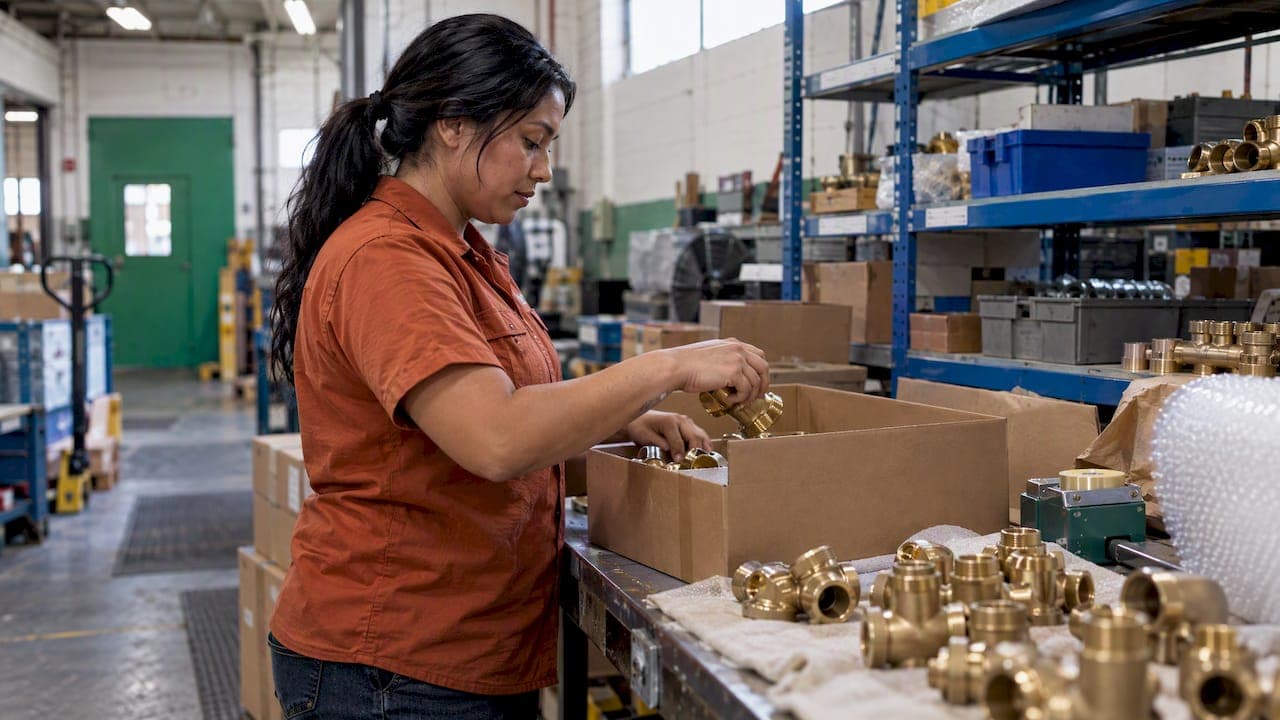
Say you run a small plumbing-fixture manufacturer in Ohio. A distributor in Canada orders $400,000 of product with payment 60 days after delivery. You need about $240,000 to buy brass stock, cover payroll for the production run and pay freight. That is the exact shape of a transaction EWCP was designed around: it funds pre-shipment costs and can carry you through the post-shipment receivable. The lender would look at the purchase order, your production capacity, your past performance and the buyer's reliability, then structure collateral around your inventory and receivables.
Now suppose a different company, a food producer, wants $75,000 to redesign labels for the European market and exhibit at a trade show overseas. Those are export development costs, which fit Export Express, and a loan of that size would be a candidate for a lender-led process.
These are illustrations of how the programs are structured, not offers or approvals. Real terms depend on the lender and your finances.

How to apply
The application path is similar for both programs because you apply to a lender, not to the SBA.
- Define the need. Write down what you are financing: a specific order, a revolving need, equipment, or market-development spending. Add amounts and timing.
- Gather documents. Lenders typically ask for business tax returns, financial statements, a debt schedule, the purchase order or export contract, and information about your foreign buyers. Your lender will give you its exact checklist.
- Talk to an SBA export finance manager. The SBA offers no-cost advice from local export finance managers on using SBA financing to support international sales, and they can point you to lenders active in export programs.
- Compare lenders. Ask each about rates, fees, collateral, how they handle foreign receivables and how fast they can close.
- Submit and respond promptly. Quick answers to lender questions often keep timelines shorter.
Perspective: what we see from small business owners
Most of the owners we talk to are not looking for a program name. They are looking for a way to keep cash moving while they grow, and exporting makes that harder because you pay for everything up front and wait for a foreign buyer to pay later.
Our view is that SBA export programs are strong tools when you have the time to work through the process and the order or plan to justify it. The guaranty can open doors that conventional bank lending does not. But they are not the only option, and they are not always the fastest. If a payment is due to a supplier next week, a structured SBA process may not line up with your calendar. In those cases, owners often use a short-term product to bridge the gap, then move to a longer-term SBA facility when the paperwork is ready.
We work with owners across hundreds of industries, and a few habits separate the smooth applications from the stressful ones: knowing the exact dollar need, having financials organized before the first call, and being honest about weak spots such as thin margins or a customer concentration. Lenders can usually work with a problem you disclose early. They struggle with one they discover late.
— Capital
Alternatives if an export program does not fit
Sometimes an SBA export loan is not the right match. Your timeline may be too short, you may not meet the time-in-business rule, or your lender may not offer the program. Here are the options we most often discuss with owners:
- SBA loans more broadly. Standard SBA financing can fund growth, equipment and working capital. Our SBA loans page starts at 6%, and the rate you receive depends on your profile and the loan structure.
- Business line of credit. A revolving line gives you flexibility to cover recurring costs while you wait on foreign payments. Lines of credit from us start at 1.2% per month.
- Working capital loans. For a short-term cash gap, working capital loans start at 1.5% per month.
- Equipment financing. If you are buying machinery to expand production for export, equipment financing starts at 0.8% per month.
- Invoice factoring. Factoring advances cash against outstanding invoices, at 0.69-4.9% per invoice with us. It can help when your customers are domestic exporters or distributors paying on terms.
The published rates are starting points. Your actual pricing depends on your credit profile, revenue and the product. Compare the monthly figures with the cost of the SBA programs on a total-cost basis, not rate alone, since monthly-rate products and annual-rate loans are not directly comparable.
How Capital for Business can help
Since 2009 we have worked with small business owners in hundreds of industries, including manufacturing, construction and wholesale. If you are weighing an SBA path, we can walk through our SBA loan options, and if a faster route suits your timing, we can look at working capital, a line of credit or equipment financing alongside it. Funding can come in as soon as 24 hours for some products, and we consider a broad range of credit profiles.
See our SBA loans page or browse all funding solutions to compare options side by side.
Mistakes to avoid
- Applying without a clear use of funds. Export Express proceeds must go toward export development, and EWCP proceeds toward the export transaction. Vague requests slow reviews.
- Ignoring the collateral rule. For EWCP, collateral must be in the U.S. and cover the loan in full. Count your eligible assets before you apply.
- Overlooking indirect export. If your customer exports your goods, you may qualify even if you never ship abroad yourself.
- Skipping the time-in-business check. One full year is the baseline. If you are short, prepare your export experience as a waiver case.
- Taking the first quote. Because the SBA monitors rather than sets EWCP rates, offers can differ between lenders.
FAQ
What is the difference between SBA EWCP and Export Express?
EWCP finances the export transaction cycle, including inventory, production costs and foreign receivables, with loans up to $5,000,000. Export Express supports export development, with lines of credit or term loans up to $500,000. Export Express also lets lenders underwrite directly without prior SBA approval.
Do I need collateral for an SBA export loan?
For EWCP, yes: a first security interest sufficient to cover 100 percent of the loan, located in the U.S. or its territories or possessions. For Export Express, no collateral is required up to $50,000. Above that, the lender may apply its existing policy but cannot decline the loan solely for inadequate collateral.
Can a business that does not export directly qualify?
Possibly. SBA export finance materials say indirect exporters may qualify when their direct U.S. customers export the items or services they bought from the borrower. Ask a lender or an SBA export finance manager to review your situation.
Does the SBA set the interest rate on export loans?
For EWCP, no. The SBA monitors rates for reasonableness but does not prescribe them, so rates vary by lender. Comparing offers from more than one lender is the best way to find a fair price.
How long must I be in business to get EWCP?
One full year, unless the SBA waives the requirement based on sufficient export trade or other managerial experience. If you are close to or under that mark, ask your lender whether a waiver request makes sense.
Sources
- eCFR: 13 CFR Part 120 Subpart C, Export Working Capital Program
- SBA export finance programs presentation (trade.gov)
- SBA: Trade tools for international sales
- Congressional Research Service: SBA trade and export promotion programs
- SBA lender resources: partnering with SBA loan programs
- Federal Register: Export Express, Export Working Capital and International Trade Loan Programs