
Collateral is any asset you pledge to secure a loan, and lenders typically accept cash, inventory, equipment, real estate, and accounts receivable. Offering it usually improves your approval odds, unlocks a larger loan size, and shaves points off your rate, because it shifts risk away from the lender. The type of asset matters just as much as its value, since some collateral is far easier for a lender to sell if you default.
TL;DR:
- Collateral types vary in liquidity and resale value, with cash equivalents and real estate being the most easily converted into cash for lenders.
- Loan-to-value ratios differ sharply by asset, with real estate often receiving the highest percentages, while equipment and inventory typically have lower caps due to depreciation and marketability issues.
- Proper preparation of ownership proof, recent appraisals, and clear titles can increase the loan amount offered and reduce underwriting delays.
- Pledging collateral exposes business owners to legal risks like lien claims and repossession, often requiring personal guarantees, especially for newer or less collateralized businesses.
- Collateral can improve approval chances and reduce interest rates but should be viewed as leverage that requires strategic management rather than just a compliance hurdle.
Table of Contents
- What Counts as Business Loan Collateral?
- How Lenders Actually Value Your Collateral
- Which Loan Products Actually Require Collateral
- How to Prepare Your Collateral Before You Apply
- What You're Risking When You Pledge Collateral
- Does Collateral Actually Get You a Better Rate?
- Our Take: Collateral Is Leverage, Not Just a Requirement
- Turn Your Assets Into Funding You Can Actually Use
- Sources
- FAQ
What Counts as Business Loan Collateral?
Lenders rank collateral by how fast they can turn it into cash if a loan goes bad. Cash equivalents like CDs and publicly traded securities sit at the top of that list because they need no appraisal and no buyer search. Real estate follows close behind, especially owned commercial property with clean equity, though lenders still factor in occupancy, location, and market conditions before setting a value.
Hard assets like equipment and vehicles qualify too, but depreciation eats into their worth every year, so the loan-to-value ratio a lender offers drops the older the asset gets. Inventory and accounts receivable are usable collateral for working capital and invoice financing, though lenders discount both heavily for spoilage risk, customer concentration, and how quickly the goods or invoices actually convert to cash.
Some lenders also require personal collateral, meaning your home, savings, or other personal assets, when your business lacks enough of its own or when you're a newer company without a financial track record.
- Cash and securities: CDs, savings, and publicly traded stocks
- Real estate: owned commercial property or home equity
- Equipment and vehicles: machinery, trucks, and specialized tools
- Inventory and receivables: goods on hand and unpaid customer invoices
- Personal assets: homes, vehicles, or savings pledged by the owner
Lenders generally steer clear of illiquid intellectual property, unmarketable licenses, or niche assets with no resale market, since lenders favor assets that convert to cash quickly and with less uncertainty like cash, vehicles, and heavy equipment.
How Lenders Actually Value Your Collateral
A lender's appraisal isn't a formality. It's the number that determines how much they'll actually let you borrow. Real estate and heavy equipment usually get a formal appraisal, while inventory and receivables are typically valued through the lender's own underwriting review rather than a third-party appraiser.
LTV ratios vary sharply by asset type. Equipment and inventory financing tend to carry lower loan-to-value ratios than real estate, with equipment often landing near 50% LTV and inventory or invoice-based lending ranging from 50% to 80% depending on how easily the goods or receivables can be sold.
- Real estate: often the highest LTV due to stable resale value
- Equipment: commonly around 50% LTV due to depreciation
- Inventory and receivables: 50% to 80%, depending on marketability
Cash flow matters just as much as the asset itself. Underwriters commonly look for a Debt Service Coverage Ratio around 1.25 or higher, which measures whether your business generates enough income to cover loan payments on top of existing debt. A property appraised at $500,000 with a 70% LTV caps your loan near $350,000, but a weak DSCR can pull that number down further regardless of what the appraisal says.
Which Loan Products Actually Require Collateral
Not every loan product treats collateral the same way, and matching your assets to the right product saves time in underwriting.
- SBA 7(a) and 504 loans: SBA-guaranteed loans often require collateral, but the lender decides the loan-to-value ratio, and some borrowers still get approved without full collateral coverage depending on the lender's discretion and the strength of the application.
- Equipment loans: the equipment itself is the collateral, with LTVs typically running lower than real estate loans because of depreciation.
- Invoice financing and factoring: lenders advance 50% to 80% of invoice face value, with the rate depending on customer concentration and payment history, and terms split between recourse and non-recourse structures.
- Lines of credit: may be secured by receivables or inventory, or unsecured for smaller limits with strong revenue history.
- Private lenders and merchant cash advances: collateral requirements vary widely, and many rely on daily revenue rather than a pledged asset at all.
Your equipment financing options often move faster than SBA products precisely because the collateral valuation is simpler: the machine you're financing secures the loan.
How to Prepare Your Collateral Before You Apply
Lenders move faster when your paperwork is ready before you submit an application. Missing documents are one of the most common reasons underwriting drags on for weeks instead of days.
- Gather proof of ownership: titles, bills of sale, and purchase records for every asset you plan to pledge.
- Get a recent appraisal or valuation, especially for real estate, equipment, or vehicles.
- Run a UCC search to confirm no other lender already holds a lien on the same asset.
- Pull maintenance records for equipment and machinery to support its condition and remaining useful life.
- Confirm insurance coverage reflects current replacement value, not the original purchase price.
- Assemble recent bank statements and accounts receivable aging reports if you're pledging cash flow or invoices.
Lenders typically request titles, bills of sale, appraisals, insurance records, and bank statements before they'll move a file to final underwriting, and a six-item checklist covering these documents can save several rounds of back and forth.
Pro Tip: A clean, well-organized collateral package, complete with clear title and a recent appraisal, often convinces a lender to offer a higher LTV than they'd otherwise approve, and it can shorten your underwriting timeline by days.
What You're Risking When You Pledge Collateral
Pledging an asset isn't a paperwork formality. It creates real legal exposure if your business hits a rough patch.
- A UCC-1 filing gives your lender a public claim on the pledged asset and can limit your ability to secure additional financing against the same collateral later.
- Repossession and liquidation timelines vary by state and asset type, but the process typically moves faster for vehicles and equipment than for real estate.
- Lenders often require a personal guarantee alongside business collateral, especially for newer companies, meaning your personal assets stay exposed even after the business collateral is exhausted.
- You can negotiate cure periods, carve-outs for specific assets, or subordination agreements before signing, and these terms are far easier to secure before closing than after.
- A default and repossession event reports to your business credit file and can restrict operations if the seized asset was actively generating revenue.
Does Collateral Actually Get You a Better Rate?
Collateral changes the math lenders run on your application in three concrete ways: lower risk usually means a lower rate, a larger approved amount, or both.
Pledging collateral tends to improve approval odds and loan terms for borrowers with limited credit history, since the pledged asset offsets the lender's uncertainty about repayment. A borrower with a 620 credit score and a paid-off delivery van, for example, may qualify for a secured term loan that an unsecured lender would decline outright.
Strong cash flow can substitute for collateral in some cases. Lenders that prioritize DSCR over raw asset value may extend funding to borrowers with thinner collateral if the business generates consistent, provable revenue.
- If you lack sufficient collateral, consider an SBA-guaranteed loan, where the government guarantee reduces the lender's exposure.
- Revenue-based financing and merchant cash advances skip traditional collateral entirely, relying on daily or monthly revenue instead.
- Unsecured lines of credit work for smaller amounts if your revenue history is strong enough.
- A co-signer with strong personal credit can sometimes replace the need for hard collateral altogether.
Match the product to what you actually have. A business with strong receivables but no real estate should look at invoice financing before chasing a secured term loan that doesn't fit its balance sheet.
Our Take: Collateral Is Leverage, Not Just a Requirement
Most guides frame collateral as a hurdle, something you clear on the way to approval. We see it differently. Collateral is leverage you already own, and the businesses that get the best terms are the ones that present it strategically rather than reactively.
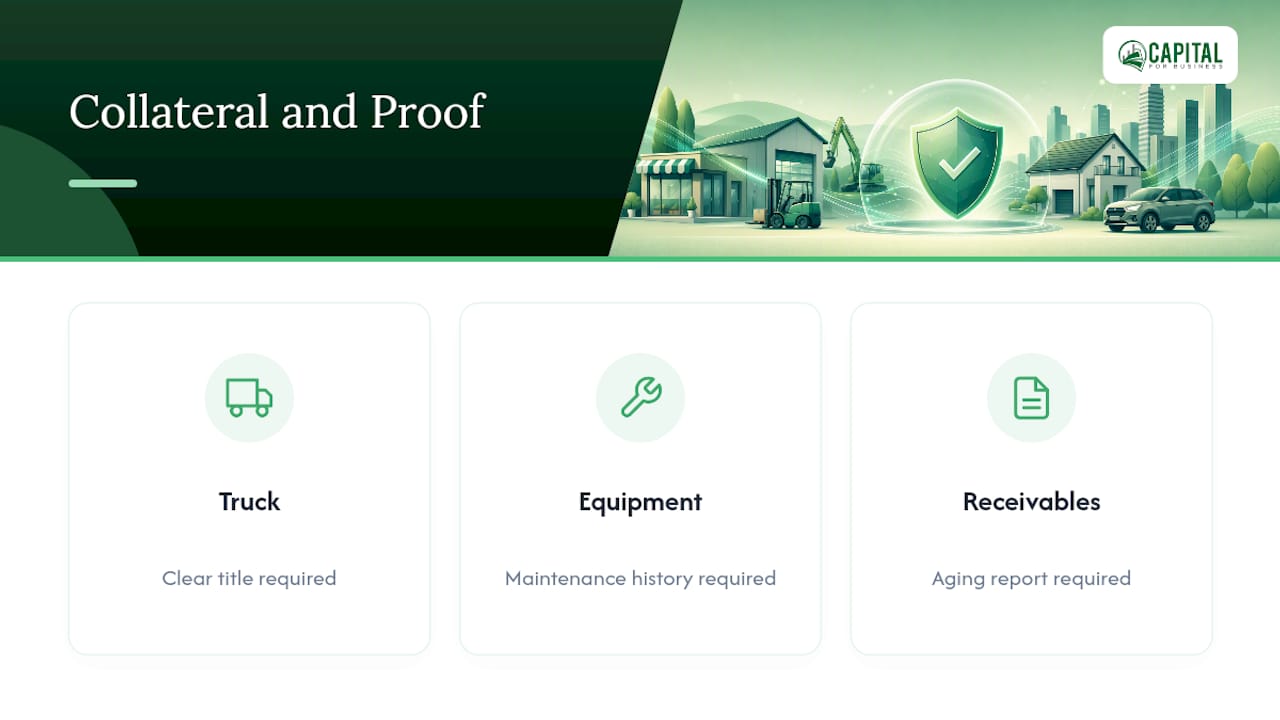
The owners who struggle most aren't the ones with thin balance sheets. They're the ones who show up with the right assets but the wrong paperwork, a truck with no clear title, equipment with no maintenance history, receivables with no aging report. That gap between what you own and what you can prove costs real money in rate and loan size.
Since 2009, we've worked with business owners across construction, transportation, retail, and dozens of other industries to match specific assets to the right financing product, whether that's equipment financing, a working capital loan, or a business line of credit. A restaurant owner with a fully paid espresso setup and a contractor with a fleet of trucks need very different products, even though both are technically pledging equipment.
If you're unsure whether your assets qualify or how far they'll stretch, talk to an advisor before you apply. If you already know what you're pledging, a direct application moves faster.
— Capital
Turn Your Assets Into Funding You Can Actually Use
Capitalforbusiness works with owners whose collateral doesn't fit neatly into a bank's checklist, whether that's aging equipment, uneven receivables, or a mix of both. We offer equipment financing, working capital loans, and merchant cash advances that weigh your actual cash flow and assets, not just a rigid formula that banks and credit unions often fall back on.

Before you apply, pull together your titles, recent bank statements, and any equipment maintenance records. That paperwork alone often speeds up the decision by days. If your business generates steady revenue but doesn't fit the collateral profile a traditional lender wants, start with a free funding consultation to see which product actually matches what you have on hand.
Sources
For program-specific details, the U.S. Small Business Administration outlines SBA loan guarantee rules directly. For a documentation walkthrough, review Securing a Business Loan: Step-by-Step Guide for a practical checklist lenders commonly request.
- Loans | U.S. Small Business Administration
- Forbes Advisor: Collateral Loans (article)
- Collateral Business Loans: What You Need to Know | Nav
- Securing a Business Loan in 2026: Step-by-Step Guide
FAQ
What Can Be Used as Collateral for a Business Loan?
Cash, real estate, equipment, vehicles, inventory, accounts receivable, and personal assets like a home can all serve as collateral, with lenders favoring assets that are easiest to appraise and resell.
What Is the Monthly Payment on a $1,000,000 Business Loan?
Payment depends on the rate, term, and structure, and a loan at a typical SBA or bank term with a mid-single-digit rate can have monthly payments that vary widely depending on the rate, term, and structure. Get a specific quote based on your actual terms rather than relying on a general estimate.
How Do You Qualify for a $200,000 Business Loan?
Qualification generally requires a solid DSCR, often 1.25 or higher, along with collateral or strong revenue history, and lenders will review your credit profile, time in business, and financial statements before approving that amount.
Can You Use an LLC's Assets as Collateral for a Loan?
Yes, an LLC's business assets, such as equipment, receivables, or real estate held by the company, can secure a loan, though lenders frequently also require a personal guarantee from the LLC's owner, especially for newer businesses.