

Lenders approve business loans based on five things: business eligibility, proof you can repay the debt, acceptable credit and guaranties, complete documentation, and, for SBA-backed loans, compliance with agency-specific rules. Meet all five and funding moves fast. Miss one, and you'll spend weeks going back and forth with underwriting instead of running your business. Every lender weighs these factors differently, and SBA programs layer on their own procedural requirements on top.
TL;DR:
- Most lenders prefer a minimum personal credit score of 650, but SBA loans might approve with scores in the low 600s if cash flow is strong enough.
- Demonstrating at least a 1.10 debt service coverage ratio is crucial, as falling below it significantly increases denial risk regardless of credit scores.
- Having two to three years of recent, reconciled tax returns, current financial statements, and detailed business documentation substantially speeds up approval.
- SBA loans vary: 7(a) offers flexible funding up to millions, 504 targets large fixed assets with higher down payments, and microloans provide up to $50,000 via nonprofits.
- A complete, specific loan application with clear use of funds reduces underwriting time and improves chances of faster funding.
Table of Contents
- What Do Lenders Look For in a Business Loan Application?
- Documents Needed for a Business Loan: The Practical Checklist
- How Do Credit Score and Cash Flow Affect Loan Approval?
- SBA 7(a), 504, and Microloan: Which Program Fits?
- What's the Business Loan Application Timeline?
- Why Do Business Loans Get Denied?
- What We've Learned Funding Small Businesses Since 2009
- Get Funded Faster: How Capital for Business Simplifies the Process
- Where to Verify Business Loan and SBA Program Rules
- Sources
- FAQ
What Do Lenders Look For in a Business Loan Application?
Before a lender talks numbers, they check whether your business even qualifies. That means operating for profit, being legally organized in your state, and holding whatever licenses your industry requires. Larger applicants also face size standards; if you're brushing up against SBA's affiliation rules, that's worth reviewing early rather than discovering it mid-underwriting.
Ownership matters just as much as the business structure. Lenders verify who owns the company, confirm identity, and typically require anyone with 20% or more ownership to sign a personal guaranty. For SBA loans, ownership rules now require owners to be U.S. citizens or nationals who principally reside in the country, following recent SBA policy notices.
Once eligibility clears, underwriting gets into the numbers:
- Ability to repay, measured through cash flow and debt service coverage ratio (DSCR).
- Revenue history, usually two to three years for established businesses.
- Existing debt load, since high leverage limits how much more a lender will extend.
- Management experience, particularly for larger loans or industries with high failure rates.
- Collateral or equity, which can offset weaker cash flow in some cases.
SBA lenders also apply a "credit elsewhere" test. If a business can get comparable financing on reasonable terms from a conventional source, the SBA guaranty may not apply. In practice, most lenders combine this baseline SBA rule with their own internal credit and collateral policies, which is why two lenders can look at the same file and reach different conclusions.
Documents Needed for a Business Loan: The Practical Checklist
Gathering paperwork before you apply, rather than scrambling once a lender asks, is the single biggest lever you control. Here's what to have ready:
- Business and personal tax returns. Most lenders want two to three years to establish income trends and verify what you've reported to the IRS matches what you're claiming on the application.
- Business bank statements. Typically the last three to six months, reconciled against your books, so underwriters can see actual cash movement, not projected cash movement.
- Profit and loss statement and balance sheet. These need to be current, not year-old numbers, especially if you're applying more than a few months into your fiscal year.
- Ownership and formation documents. Articles of incorporation, operating agreements, and business licenses confirm the entity is legitimate and who controls it.
- Government-issued IDs, lease or mortgage statements, insurance documentation, and a collateral schedule if you're pledging equipment or real estate.
- Lender-specific forms. SBA loans require SBA Form 1919, which captures borrower information and eligibility disclosures.
Startups and businesses buying another company need to add financial projections and a business plan, since there's no repayment history to underwrite against.
Pro Tip: Build your projections around a conservative revenue scenario, not your best-case one. Lenders discount optimistic numbers automatically, so a realistic forecast actually reads as more credible.
Owners moving from a personal loan mindset to business lending should also understand how business loans differ from personal loans in how documentation is weighted.
How Do Credit Score and Cash Flow Affect Loan Approval?
There's no single credit score that guarantees approval, but most lenders draw a practical line. Many conventional lenders want personal credit scores above 650, and some SBA lenders will work with scores in the low 600s if cash flow is strong enough to compensate.
SBA's procedural updates set a debt service coverage ratio floor of at least 1.10:1 for 7(a) small loans, meaning your business needs to generate at least $1.10 in operating income for every $1.00 of debt payment.
Fall below that ratio and your denial risk climbs sharply, regardless of how clean your credit report looks.
- Personal guaranties are standard for owners with 20% or more equity, and they follow you personally if the business defaults.
- Business credit (trade lines, payment history with vendors) increasingly factors into underwriting alongside personal credit.
- Borrowers with thin cash flow can sometimes offset it with collateral, a co-signer, or a shorter loan term that lowers the monthly payment.
- Applicants with weaker credit often have better luck with alternative products like a merchant cash advance or asset-backed financing than with a conventional term loan.
SBA 7(a), 504, and Microloan: Which Program Fits?
SBA doesn't lend directly. It guarantees a portion of loans made by approved lenders, and the three main programs serve different purposes.
- 7(a) loans are the most flexible, covering working capital, equipment, and real estate, with amounts reaching into the millions and guaranty percentages that vary by loan size, according to the SBA's program overview.
- 504 loans are built specifically for major fixed-asset purchases like real estate or heavy equipment, issued through Certified Development Companies (CDCs) rather than banks directly. Down payment expectations for 504 deals are worth reviewing before you apply, since equity requirements can be higher than borrowers expect.
- Microloans top out around $50,000 and are distributed through nonprofit intermediaries, aimed at newer or smaller businesses that don't need, or can't yet qualify for, a full-size 7(a) loan.
All three follow SOP 50 10, the SBA's origination rulebook covering eligibility, forms, collateral guidance, and lender obligations. Recent Federal Register updates have also loosened hazard insurance and collateral rules for smaller loan amounts, which helps very small borrowers clear underwriting more easily. If your numbers are strong and you don't need the guaranty, conventional or alternative financing often closes faster than an SBA path.
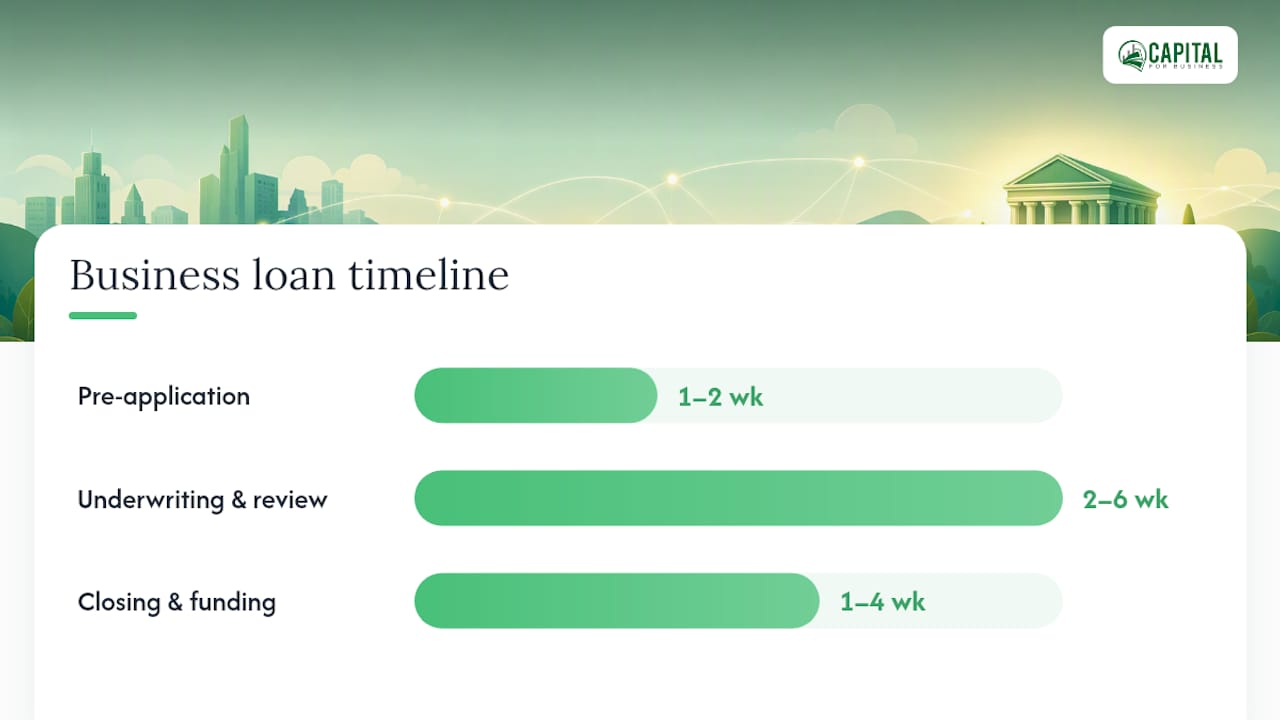
What's the Business Loan Application Timeline?
Expect a sequence, not a single event:
- Pre-application (1 to 2 weeks). Pull your credit reports, gather documents, and get any late tax filings current before you submit anything.
- Underwriting and review (2 to 6 weeks). Lenders verify income, request missing documents, and may come back at least once with follow-up questions.
- Closing and funding (1 to 4 weeks). Conventional loans move faster here; SBA loans add processing time for the guaranty itself.
Pro Tip: A complete package on the first submission, with a clear, specific use of proceeds, shaves real time off underwriting. Vague answers like "general business purposes" trigger extra questions almost every time.
Reviewing what to consider before signing up front helps you avoid mid-process surprises.
Why Do Business Loans Get Denied?
Most denials trace back to a handful of fixable problems: weak cash flow or a DSCR below the lender's floor, missing or inconsistent paperwork, poor personal credit, an ineligible use of proceeds, or ownership that doesn't meet program rules.
- Weak cash flow: tighten bookkeeping and consider a smaller loan amount or longer term to improve the ratio.
- Missing paperwork: amend prior tax filings if there are inconsistencies before you reapply.
- Poor credit: add a guarantor, pledge collateral, or use short-term alternative financing while you rebuild your score.
- Ineligible use of proceeds: revisit the program's rules or an SBA resource partner before resubmitting.
What We've Learned Funding Small Businesses Since 2009
Documentation gaps commonly trip up applicants across various industries: missing bank reconciliations, outdated financials, and vague projections. Owners who show up with a complete package and a specific plan for the money get faster answers and better terms, almost without exception. When a conventional term loan or SBA product doesn't fit the timeline or the credit profile, tools like a line of credit, an equipment loan, or a merchant cash advance often solve the same cash flow problem with less friction.
— Capital
Get Funded Faster: How Capital for Business Simplifies the Process
Some lenders exist to serve the needs of business owners when traditional banks say no or take too long. They may offer fast small business loans, working capital, merchant cash advances, equipment financing, and business lines of credit aimed at providing quicker answers.
Where SBA lenders rely on rigid credit and DSCR thresholds, some lenders consider the whole financial picture, including borrowers with marginal credit or limited trading history, and serve businesses nationwide. Before you apply, pull your last three to six months of bank statements and know exactly how you'll use the funds; that alone puts you ahead of most applicants. Ready to see what you qualify for? Explore the different types of small business loans we offer and start your application today.
Where to Verify Business Loan and SBA Program Rules
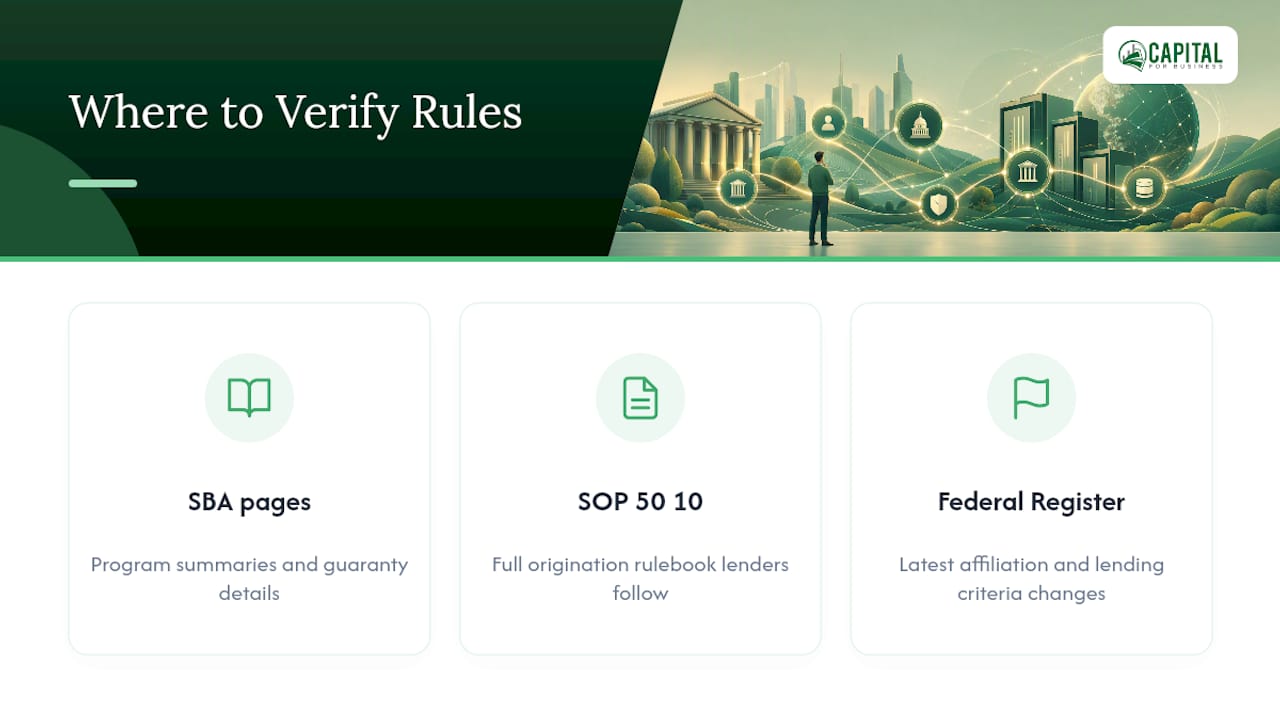
For the official rules behind everything in this guide, start with the SBA's loan program pages for program summaries and guaranty details, review SOP 50 10 for the full origination rulebook lenders follow, and check the Federal Register notice for the latest affiliation and lending criteria changes.
This article is general information, not a substitute for advice from a qualified financial advisor. Consult a qualified financial professional about your own circumstances before acting on anything here.
Sources
- Loans - Small Business Administration
- SOP 50 10 — Lender and Development Company Loan Programs (SBA)
- Affiliation and Lending Criteria for the SBA Business Loan Programs — Federal Register
FAQ
Can a New LLC Get a Business Loan?
Yes, though new LLCs typically need to lean on strong personal credit, a solid business plan, and financial projections since they lack the two to three years of tax returns most lenders prefer.
How Much Is the Monthly Payment on a $50,000 Business Loan?
It depends on the interest rate and term, but monthly payments vary depending on your specific rate and lender.
How Do You Qualify for a Business Loan?
You need an eligible, legally organized business, sufficient cash flow to cover debt payments (measured by DSCR), acceptable credit, and complete documentation including tax returns and bank statements.
What Credit Score Do You Need to Get a $30,000 Loan?
Many lenders look for personal credit scores above 650 for smaller loans like this, though some alternative lenders and merchant cash advance products work with lower scores if cash flow is strong.
Does Capital for Business Work With Applicants Who Have Marginal Credit?
Yes. Capital for Business evaluates the full financial picture rather than relying on a single credit threshold, which opens funding options like merchant cash advances for borrowers who don't fit conventional bank criteria.