
Most SBA borrowers need to put in at least 10% of total project costs as an equity injection, not a down payment in the traditional sense. Under SOP 50 10 8, effective June 1, 2025, that 10% minimum is now mandatory for startups and complete changes of ownership in the 7(a) program. For established businesses borrowing for non-acquisition purposes, many lenders still set their own thresholds, so the federal floor may not be the number that governs your deal.
Three things to do right now before you go further:
- Calculate total project cost, not just the purchase price. The SBA calculates the required injection on the all-in figure: purchase price, closing costs, prepaid working capital, appraisal fees, and any other costs rolled into the transaction.
- Ask your lender in writing how they treat seller notes, personal loans, and gifted funds. Lender policies vary, and some sources that seem acceptable are actually restricted under the current SOP.
- Start documenting and seasoning your funds. Lenders commonly require two months of bank statements showing funds were available before closing. Last-minute large deposits trigger additional source documentation and can delay underwriting.
Key Takeaways
| Point | Details |
|---|---|
| 10% baseline is mandatory | SOP 50 10 8 (June 1, 2025) requires a minimum 10% equity injection for startups and complete ownership changes in 7(a) deals. |
| 504 tiers go higher | SBA 504 borrowers pay 10% for established businesses, 15% for new businesses or special-purpose properties, and 20% when both apply. |
| Seller note limits are strict | Seller notes must be on full standby for the life of the loan and can cover at most 50% of the required injection under current SOP rules. |
| Calculate on total project cost | Include purchase price, working capital, closing costs, and all fees when computing the required injection dollar amount. |
| Season funds early | Lenders require two months of bank statements showing funds were available; last-minute large deposits trigger additional documentation. |
| Capitalforbusiness offers a path forward | Capitalforbusiness provides SBA loan packaging support and working capital solutions to help borrowers meet injection requirements and close on time. |
Table of Contents
- How much is the SBA loan down payment by program?
- What does 'equity injection' actually mean for SBA borrowers?
- What are the equity injection rules for each SBA loan type?
- When does the required equity injection percentage go up?
- How do lenders calculate the equity injection on your deal?
- What are the permitted sources for your SBA equity injection?
- What does the SBA loan application timeline look like?
- What changed with SOP 50 10 8 in 2026?
- A lender's perspective on equity injection mistakes
- Capitalforbusiness helps you close the equity gap
- Sources
- FAQ
How much is the SBA loan down payment by program?
The table below shows the typical equity injection range for each major SBA program, who it applies to, and the key conditions that push the percentage higher.
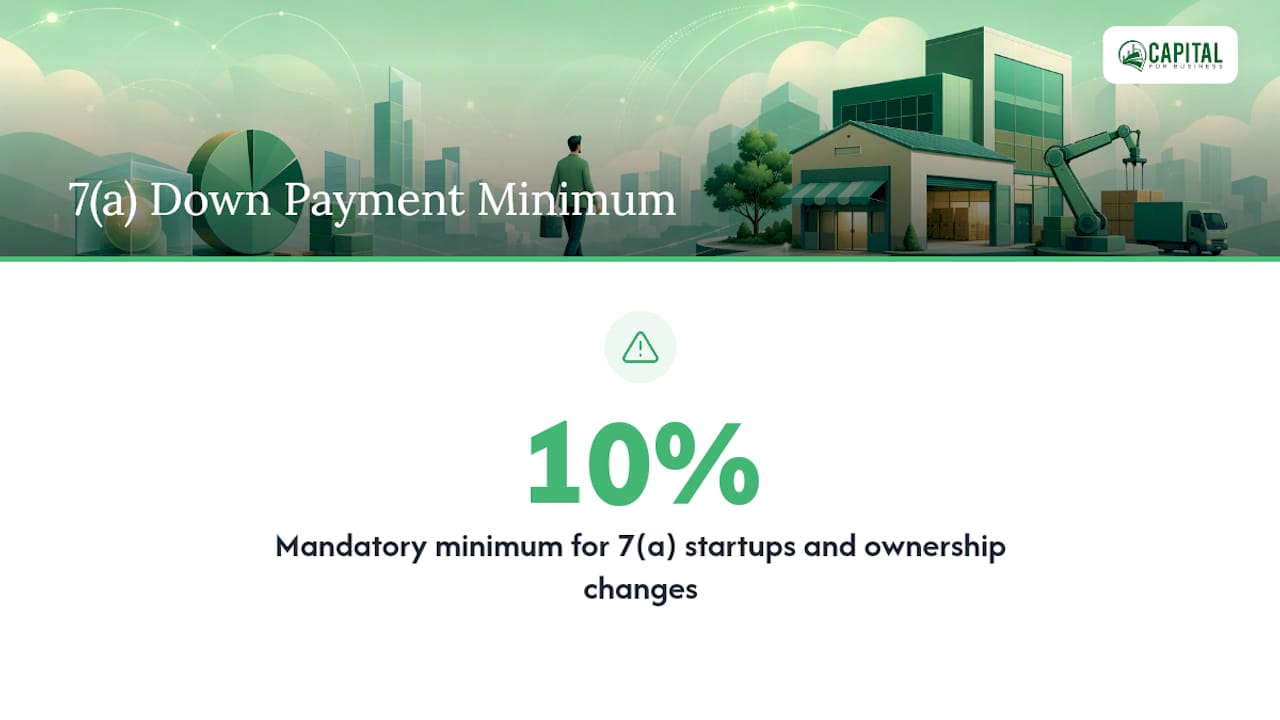
Note: SOP 50 10 8 (June 1, 2025) reinstated the 10% mandatory minimum for 7(a) startups and complete ownership changes. Lenders retain discretion on many non-acquisition 7(a) deals, so always confirm the specific requirement in writing with your lender.
What does 'equity injection' actually mean for SBA borrowers?
The phrase "SBA loan down payment" is widely used, but it can mislead borrowers into budgeting too little. The SBA's formal term is equity injection, and the distinction carries real financial consequences.
An equity injection is the borrower's new, at-risk capital added to the project. It is not loan proceeds, and it is not money that will be repaid from the business being acquired. The SBA and lenders treat it as proof that the borrower has genuine financial exposure in the deal, which reduces the risk of default. Practitioners stress this distinction: the equity injection signals real, at-risk capital the borrower contributes, and it functions as a risk-mitigation tool both lenders and the SBA enforce.
What "total project costs" includes:
- Purchase price of the business or property
- Closing costs and settlement fees
- Pre-funded working capital being financed as part of the deal
- Appraisal fees and environmental reports
- SBA guaranty fee and lender origination fees rolled into the transaction
- Dealer or vendor payables included in the deal structure
- Any other prepaid expenses the lender requires at closing
Acceptable injection sources:
- Personal cash and savings (most straightforward)
- Gifts, with a signed gift letter and donor bank statements
- Outside investor cash (note: investors receiving ownership may trigger additional guaranty requirements)
- ROBS (Rollover for Business Startups), when properly structured with ERISA counsel
- Seller notes on full standby, capped at 50% of the required injection under SOP 50 10 8
Sources that typically do not qualify:
- Borrowed funds that will be repaid from the target business's cash flow
- HELOCs or personal loans serviced from the acquired business's revenue
- Seller notes not on full standby for the life of the SBA loan
As industry underwriting guides note, lenders calculate the 10% on the all-in project figure, which can surprise buyers who budget only against the purchase price. Soft costs and initial working capital add materially to that base. Build an early all-in worksheet and plan a contingency buffer above the injected percentage, because the final closing figure almost always runs higher than the initial estimate.
Pro Tip: Tracking your project cost components in a single spreadsheet from day one, including estimates for appraisals, environmental studies, and lender fees, helps you avoid a funding shortfall at closing. Accurate cost documentation also speeds up underwriting. Manual accounting gaps at this stage can cost you time and money.
What are the equity injection rules for each SBA loan type?
SBA 7(a) loans
The SBA 7(a) program is the most flexible and widely used SBA product, which also means its equity injection requirements are the most variable. Under SOP 50 10 8, a 10% minimum applies to startups and complete changes of ownership. For other 7(a) purposes, such as working capital, equipment purchase, or refinancing, many lenders set their own thresholds and the federal minimum may not apply.
Delivery method matters here. Preferred Lenders (PLP) and lenders operating under delegated authority can approve and close deals faster, but they also apply their own underwriting overlays. A non-delegated lender submitting to the SBA for approval may face additional scrutiny and a longer timeline, but the equity injection rules are the same. Always ask your lender whether they are operating under delegated authority and what their specific injection policy is for your transaction type.
SBA 504 loans
The 504 program uses a structured financing split: roughly 50% from a conventional first-mortgage lender, 40% from a Certified Development Company (CDC) debenture, and 10% from the borrower.
The percentage increases in two common situations. A new business (operating less than two years) must contribute 15% equity; a special-purpose property (hotels, gas stations, car washes, and similar assets with limited alternative uses) also requires 15%.
Microloan program
SBA Microloans are administered through nonprofit intermediary lenders and carry no federally mandated equity injection percentage. Loan amounts go up to $50,000, and each intermediary sets its own credit and contribution requirements. Documentation expectations tend to be lighter than 7(a) deals, but borrowers should still expect to demonstrate personal investment in the project.
SBA Express and disaster loans
Express loans follow lender-specific underwriting, with no federal equity injection floor. Disaster loans are need-based and generally do not carry a down payment requirement. Both programs sit outside the standard equity injection framework that governs 7(a) acquisition and startup deals.
When does the required equity injection percentage go up?
Knowing which category your deal falls into before you apply prevents surprises during underwriting.
- Startups (businesses operating less than two years): Lenders and the SBA treat startups as higher risk because there is no historical cash flow to validate repayment capacity. The 10% minimum under SOP 50 10 8 is firm for 7(a) deals, and 504 lenders require 15%.
- Complete changes of ownership: When 100% of a business changes hands, the SBA requires the buyer to demonstrate real financial commitment. Partial acquisitions below certain ownership thresholds may not trigger the same requirement, but lenders often apply it anyway when debt-to-worth ratios are high.
- Special-purpose properties: Hotels, gas stations, car washes, funeral homes, and similar properties have limited alternative uses. If the business fails, the collateral is harder to liquidate, so lenders require more borrower equity to offset that risk. The 504 program sets this at 15%, and 7(a) lenders often follow a similar logic.
- High debt-to-worth ratios on partial acquisitions: Even when the federal minimum does not technically apply, lenders may require a higher injection if the deal leaves the business with a debt load that strains projected cash flow.
- Combined edge cases: A startup buying a special-purpose property is the most demanding scenario. Under the 504 program, that combination triggers the 20% tier.
Consider a concrete example. A buyer acquires an existing gas station for $800,000. The deal is structured as a 504 loan. The property qualifies as special-purpose, and the buyer has been operating a related business for 18 months, which the lender classifies as a new business. Total project costs, including closing costs and working capital, come to $875,000.
According to Forbes Advisor, lender expectations typically run 10%–30% depending on deal size, borrower profile, and transaction type, which reflects how much lender discretion shapes the final number.
How do lenders calculate the equity injection on your deal?
The math is straightforward once you know what goes into the base. The common mistake is using purchase price only. Underwriters use total project cost, so missing working capital and fees causes funding shortfalls at closing.
Sample calculation for a 7(a) business acquisition:
| Cost Component | Amount |
|---|---|
| Business purchase price | $500,000 |
| Working capital (pre-funded) | $40,000 |
| Appraisal and environmental fees | $5,000 |
| SBA guaranty fee (estimated) | $8,500 |
| Closing costs and legal fees | $6,500 |
| Total project cost | $560,000 |
| Required equity injection (10%) | $56,000 |

That gap can kill a deal.
How lenders verify injected funds:
- Two months of bank statements showing the funds were present and available
- Wire confirmations or copies of checks used to fund the injection
- Settlement statements from the closing agent
- Gift letters with donor identification and donor bank statements (for gifted funds)
- Seller note documentation including standby agreement terms
- Investor subscription agreements or ROBS paperwork, as applicable
Lender guides confirm that lenders trace large deposits and will ask for source documentation on any significant balance increase in the 30–60 days before closing. Moving money between accounts the week before closing does not satisfy seasoning requirements.
Document checklist for equity injection verification:
- Personal bank statements (two months minimum, all pages)
- Wire transfer confirmations or canceled checks
- Escrow instructions and closing settlement statement (HUD-1 or equivalent)
- Gift letter (if applicable) plus donor's bank statements
- Seller note terms and signed standby agreement
- ROBS plan documents and trustee confirmation (if applicable)
- Outside investor agreement and proof of funds transfer
Review your loan application workflow early to sequence these documents correctly, since lenders often request them in a specific order tied to their underwriting checklist.
What are the permitted sources for your SBA equity injection?
Raising the required injection is often the hardest part of closing an SBA deal. Here are the permitted sources, along with the documentation each one requires and the deal-breaking mistakes to avoid.
Permitted sources:
- Personal cash and savings: The cleanest option. Two months of statements showing the balance, plus wire confirmation at closing.
- Gifts from family or third parties: Allowed with a signed gift letter stating no repayment is expected, plus the donor's bank statements showing the source of funds.
- Outside investor cash: Permitted, but investors who receive an ownership stake may be required to sign personal guarantees on the SBA loan. Confirm this with your lender before bringing in equity partners.
- ROBS (Rollover for Business Startups): Allows retirement funds to be used without early withdrawal penalties when properly structured. Requires ERISA and tax counsel. The SBA permits ROBS, but lenders scrutinize the structure carefully.
- Assets injected at fair market value: Equipment or real property contributed to the project can count toward the injection when properly appraised and documented.
- Seller notes on full standby: Allowed under SOP 50 10 8, but restricted to full standby for the entire life of the SBA loan and capped at 50% of the required injection. This restriction is frequently commercially unacceptable to sellers, which effectively increases the buyer's cash requirement.
Common deal-breaking mistakes:
- Using a personal loan or HELOC that will be serviced from the acquired business's revenue. The SBA treats this as borrowed funds repaid from the target, which disqualifies it.
- Assuming a seller note on partial standby counts. Under SOP 50 10 8, partial standby is not sufficient.
- Moving funds from a retirement account without a properly structured ROBS plan. An early withdrawal used directly as an injection is taxable and penalized.
Pro Tip: Before finalizing your injection plan, ask your lender in writing whether they accept seller notes, ROBS, or gifted funds, and request their specific documentation requirements. Lender overlays vary, and some lenders decline certain sources even when the SBA permits them.
Many borrowers rely on outdated "no-money-down" claims from the COVID era. Since mid-2025, underwriting has become more conservative, and SOP 50 10 8 makes the 10% baseline firm for acquisition and startup scenarios. Budget accordingly.
What does the SBA loan application timeline look like?
Timing matters as much as the dollar amount. Funds that are not properly seasoned or documented can delay closing by weeks, and some deals fall apart entirely when the injection cannot be verified on schedule.
Typical timeline for an SBA 7(a) acquisition:
- Pre-application (2–4 weeks): Gather financial statements, tax returns, business valuation, and initial injection documentation. Begin seasoning funds if they are not already in place.
- Underwriting (3–6 weeks for delegated lenders; 6–10 weeks for non-delegated): Lender reviews all documents, orders appraisals and environmental reports, and verifies injection sources. Large deposits flagged during this stage require additional documentation.
- Conditional approval (1–2 weeks): Lender issues a commitment letter with conditions. Most conditions relate to title, insurance, and final injection verification.
- Closing (1–2 weeks): Escrow instructions issued, wire transfers confirmed, settlement statement prepared. Injection funds must be in escrow or confirmed before closing.
SBA process improvements announced in 2023 reduced some administrative steps for delegated lenders, but complex acquisitions and non-delegated submissions still run on the longer end of these ranges.
Extra closing costs to budget beyond the injection:
- SBA guaranty fee (varies by loan amount and term)
- Third-party report fees: appraisal, environmental Phase I/II, business valuation
- Lender origination and packaging fees
- Title insurance and escrow fees
- Legal fees for seller note standby agreements and closing documents
They are not optional, and they are not included in the SBA loan proceeds in most structures.
Before you sign anything, review the key considerations for small business loans to make sure your deal structure holds up under lender scrutiny.
What changed with SOP 50 10 8 in 2026?
The SBA's Standard Operating Procedure 50 10 8, effective June 1, 2025, reinstated underwriting standards that had been relaxed during the COVID era. The practical effects on equity injection are significant.
The tightened seller note rules are the most commercially disruptive change. A seller who previously accepted a partial-standby note as part of the deal structure can no longer do so under SBA guidelines. That shifts more of the cash burden to the buyer and often requires renegotiating deal terms.
Legal and advisory analysis from Whiteford, Taylor & Preston LLP confirms that SOP 50 10 8 also tightened owner-residency rules and increased documentation requirements across the board, returning the program to pre-2021 underwriting standards.
Capitalforbusiness has worked with small business owners across hundreds of industries since 2009. The SOP 50 10 8 changes represent the most significant shift in SBA equity injection rules in several years, and borrowers who prepared under older guidance need to recalibrate their injection plans before applying.
Immediate action step: Ask your lender in writing whether they accept seller notes, ROBS, or gifted funds as injection, and request the lender's complete documentation requirements before you begin assembling your application package.
A lender's perspective on equity injection mistakes
The most common mistake borrowers make is underestimating total project costs. By that point, the deal is already in motion and the shortfall creates real pressure.
The borrowers who close cleanly tend to model their injection scenarios against debt service coverage ratio (DSCR) early, before they are under contract. When you know your projected DSCR at different injection levels, you can see whether adding $20,000 to the injection improves the ratio enough to satisfy the lender's minimum, or whether a different deal structure makes more sense. That kind of early modeling turns a potential sticking point into a negotiating tool.
A typical case: a buyer was acquiring a service business for $620,000 with a 7(a) loan. After adding $35,000 in working capital, $7,000 in appraisal and environmental fees, and $9,000 in closing costs, total project cost came to $733,000. The required injection rose to $73,300. The buyer had $68,000 available. Rather than losing the deal, the buyer restructured the working capital ask, reducing it by $15,000 and sourcing a documented gift of $8,000 from a family member. The revised DSCR cleared the lender's threshold, and the deal closed on schedule.
Capitalforbusiness helps you close the equity gap
You need a lender who understands how to structure the injection, document the sources, and keep the deal moving when underwriting gets complicated.
Capitalforbusiness has been funding small business owners across the U.S. since 2009, with SBA loan programs and a full range of financing solutions designed for borrowers who need speed, clarity, and a lender who actually picks up the phone. If you need short-term capital to bridge an injection gap, working capital funding up to $500,000 is available with transparent terms and no surprise fees. Explore the types of small business loans available, or contact Capitalforbusiness today for a no-surprise funding assessment and get your SBA deal structured right the first time.
Sources
Verify current rules directly from primary sources before finalizing your application or discussing injection terms with a lender.
- 7(a) loans - Small Business Administration
- Do SBA Loans Require a Down Payment? Rules & Amounts - LegalClarity
- SBA 7(a) Equity Injection Requirements: 10% Rule (LenderAnalyzer)
When in doubt, request the lender's written policy on injection sources and compare it against the current SOP text. Lender overlays can be stricter than the federal minimum, and the SOP is the baseline, not the ceiling.
This article is general information, not a substitute for advice from a qualified financial advisor. Consult a qualified financial professional about your own circumstances before acting on anything here.
FAQ
How much down payment does an SBA loan require?
What is the 20% rule for SBA loans?
Are SBA loans structured as 10 years with 10% down?
SBA 7(a) loan terms vary based on the deal structure, and the equity injection percentage and loan term are set independently.
What is the current SBA loan limit?
The standard SBA 7(a) loan maximum is $5 million. The SBA 504 program also has a $5 million debenture limit per project, with higher limits available for certain energy and manufacturing projects. These limits are set by the SBA and are not affected by the SOP 50 10 8 equity injection changes.
Can a seller note count toward the SBA equity injection?
Yes, but only under strict conditions. Partial-standby seller notes no longer qualify, which often requires buyers to increase their personal cash contribution.