
TL;DR:
- Credit scoring helps lenders estimate the likelihood of loan repayment for small-business owners.
- It influences approval, interest rates, and review processes, but optimal preparation can improve outcomes.
Credit scoring is the standardized statistical shortcut lenders use to quickly estimate the likelihood your business will repay a loan. For small-business owners, understanding the role of credit scoring in lending is not optional — it directly shapes whether you get approved, how much you pay, and how fast you hear back.
Here is what that means in practice:
- Your personal FICO score and your business credit score are both in play, often simultaneously.
- A strong score routes your application toward automated approval and better rate tiers; a weak one triggers manual review or an outright decline.
- If your score is borderline, your best move is to pull both reports now, dispute any errors, and assemble bank statements covering about a year before you apply.
Table of Contents
- What is the role of credit scoring in lending decisions?
- How do lenders actually use credit scores for small-business loans?
- Which scores do lenders look at, and what thresholds matter?
- How are modern lenders combining scores with alternative data?
- How should you prepare before applying for a small-business loan?
- What timelines and costs should you expect?
- What are the risks of over-relying on credit scores?
- What is the bottom line for your funding strategy?
- Key Takeaways
- Why credit scores are only part of the picture
- Capitalforbusiness can help you move forward
- Useful sources
- FAQ
What is the role of credit scoring in lending decisions?
Credit scoring is a low-cost, standardized statistical method lenders use to estimate default risk quickly. It is not the same as credit analysis or underwriting, and mixing them up costs owners time and preparation.
Credit scoring produces a number — a FICO score for personal credit, or a bureau-based score for business credit — that ranks default probability. It is fast, consistent, and inexpensive to run.
Credit analysis is the analyst-driven step that follows. A credit analyst reviews financial ratios, cash flow projections, and collateral values to assess both the probability of default and the potential loss if it occurs. The debt service coverage ratio (DSCR) is central here: commercial lenders typically look for a DSCR at or above the benchmark level, indicating that the business generates sufficient cash flow to comfortably cover debt payments.
Underwriting is the final documented decision. The underwriter sets eligibility, loan amount, rate, and covenants after reviewing the score, the appraisal, and the full credit underwriting file.
The workflow runs in this order:
- Score pulled and compared to lender thresholds.
- Application routed: automated approval, decline, or referral to manual review.
- Credit analyst reviews financials, collateral, and management quality.
- Underwriter documents the final decision and sets loan terms.
For small-business loans, step 3 matters more than most owners expect. Because business loans are heterogeneous, a manual credit appraisal frequently supplements or overrides the score — especially for larger or more complex requests.
How do lenders actually use credit scores for small-business loans?
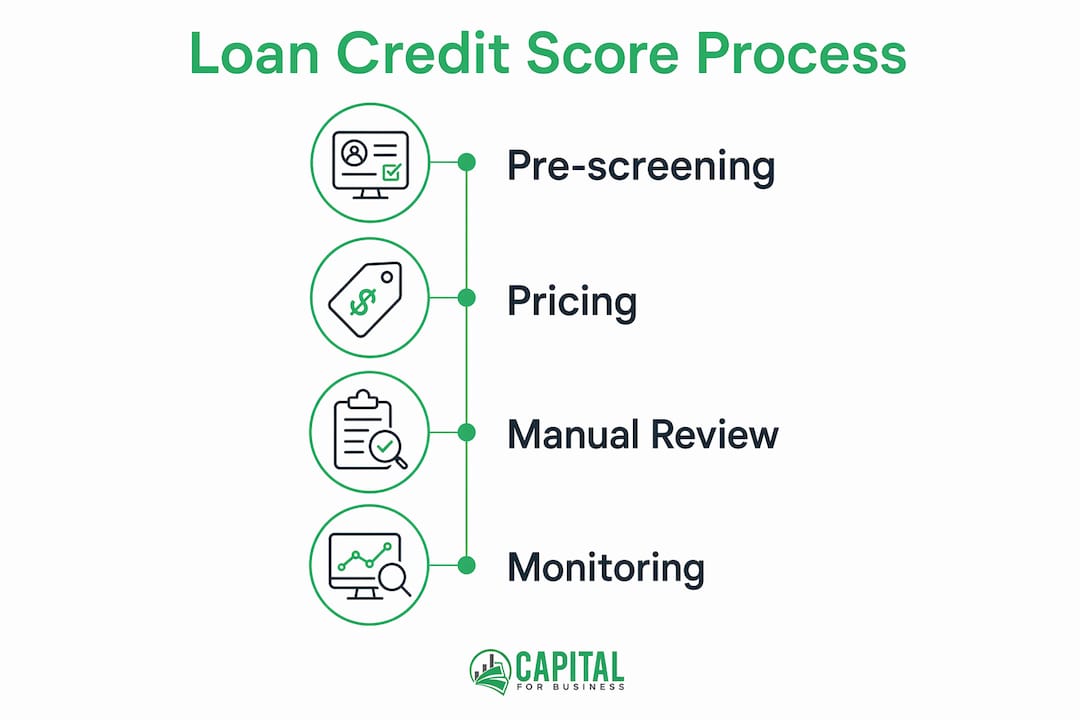
Lenders use scores at three distinct points: pre-screening, pricing, and ongoing monitoring.
Pre-screening is the first filter. Your score determines whether the system routes you to an automated approval, a manual review queue, or an immediate decline, before a human ever reads your application.

Pricing is where score bands translate directly into dollars. A higher score typically earns a lower interest rate and reduced origination fees. Dropping from a prime tier to a near-prime tier can add meaningful percentage points to your annual rate.
Ongoing monitoring is the part most owners overlook. Lenders may pull credit periodically after funding to manage portfolio risk and enforce covenants. A significant drop in your score post-funding can trigger a review or restrict your access to a line of credit.
Different lender types weight scores differently:
- Traditional banks apply the strictest score thresholds and rely heavily on DSCR and collateral alongside the score.
- Online lenders often use automated decisioning with lower score floors, supplemented by bank transaction data.
- Credit unions tend to apply more manual judgment, especially for members with established relationships.
Pro Tip: If your score is below a lender's automated threshold, request manual review and submit a one-page cash-flow summary, recent bank statements, and a short letter explaining any negative credit events. Lenders with manual review capacity can and do override scores when the operational picture is strong.
Which scores do lenders look at, and what thresholds matter?
Lenders typically examine two distinct signals:
- Personal FICO score: Required for most owner-guaranteed small-business loans. Scores above a commonly used threshold generally qualify for standard products; higher scores access better rate tiers, while lower scores often trigger declines at traditional banks.
- Business credit scores: Reported by bureaus such as Dun & Bradstreet, Experian Business, and Equifax Business. These reflect trade payment history, business age, and public records. A thin or absent business credit file pushes lenders back to the personal score.
For startups and thin-file businesses, small score differences carry outsized weight. A 10-point gap near a lender's cutoff can mean the difference between an automated approval and a manual review that adds days or weeks to the process.
The Federal Reserve's research confirms that credit scoring increases approval rates, reduces underwriting costs, and speeds decision-making — benefits that may flow to borrowers when lenders pass savings through as lower rates or faster access.
Statistic: The Federal Reserve found that credit scoring has increased the share of applications approved for credit, reduced underwriting costs, and accelerated decision-making — making it one of the most consequential technologies in modern lending.
How are modern lenders combining scores with alternative data?
Bureau scores alone miss a significant share of creditworthy small-business owners, particularly those with thin files or irregular income patterns. Modern decision engines address this by combining bureau scores with alternative data signals in real time.
Common alternative data sources include:
- Bank transaction cash flow (monthly deposits, volatility, and average daily balance)
- Payroll records and employee count trends
- Rent and utility payment history
- Merchant processing volume and chargeback rates
Platforms that integrate multiple data sources — bureau scores, bank feeds, identity verification, and KYB/KYC checks — can approve reliable borrowers who would be invisible under a bureau-only model. For owners with strong revenue but limited credit history, this shift is significant.
Model maintenance is the other side of this equation. Credit models require regular re-estimation to stay accurate; outdated models can misclassify applicants whose behavior no longer matches the training data. When you receive an unexpected decline, the issue may be model drift rather than your actual credit quality. Asking the lender whether alternative data review is available is a reasonable next step.
How should you prepare before applying for a small-business loan?
Preparation before you apply is where owners have the most control. Work through this checklist:
- Pull your personal credit report from all three bureaus (Equifax, Experian, TransUnion) and your business credit reports. Dispute errors before applying.
- Assemble 12–24 months of business bank statements. Lenders want to see consistent deposits and manageable volatility.
- Prepare recent tax returns (personal and business), a current profit and loss statement, and an accounts receivable aging report.
- Calculate your DSCR. Divide your net operating income by your total annual debt payments. A result of 1.2 or higher is the standard commercial benchmark.
- Reduce revolving credit balances where possible and avoid new personal credit inquiries in the 60–90 days before applying.
Additional evidence that strengthens a manual review:
- POS reports and merchant processing summaries
- Proof of recurring contracts or long-term customer deposits
- A short owner letter explaining any past credit events (medical hardship, a one-time revenue disruption)
Pro Tip: Time your application to avoid recent negative events appearing on a fresh pull. If you had a late payment or a collections notice resolved in the last 30 days, waiting another billing cycle before applying can keep that item from appearing as current.
Review the 5 Cs of credit — character, capacity, capital, collateral, and conditions — before you submit. Lenders evaluate all five, and your documentation should address each one.
What timelines and costs should you expect?
| Lender type | Typical decision time | Score impact on pricing |
|---|---|---|
| Online lender (automated) | Same day | Higher score = lower factor rate or APR |
| Credit union | 1–2 weeks | Score plus relationship history |
| Traditional bank | 2–4+ weeks | Score plus full underwriting package |
| SBA-backed loan | 3+ weeks | Score plus SBA eligibility review |
Common fees tied to credit risk include origination fees (typically a percentage of the loan amount, higher for lower-score borrowers), rate markups for subprime tiers, and security deposit requirements for lines of credit. For a commercial lending overview by lender type, the differences in process depth and timeline are substantial.
What are the risks of over-relying on credit scores?
Credit scores are useful, but they have real limits that can work against you.
- Thin or invisible files: A business with less than two years of trade history may have no meaningful business credit score, pushing the entire decision onto the personal score.
- Stale models: As noted above, models that haven't been re-estimated recently can produce unjust denials for borrowers whose risk profile has improved.
- Bureau variables that miss cash flow: A score built on payment history and utilization doesn't capture whether your business generated $40,000 in deposits last month.
- Multiple recent inquiries: Several hard pulls in a short window signal desperation to automated systems and can trigger automatic declines even when each individual inquiry was reasonable.
"Lenders that rely exclusively on bureau scores risk excluding viable borrowers whose repayment capacity shows up in their bank accounts, not their credit files. A score is a snapshot; cash flow is the movie." — Federal Reserve and Philadelphia Fed research both support the case for supplementing scores with operational financial data.
If you receive an unexpected decline, common bank decline reasons are worth reviewing before reapplying. Requesting manual review and submitting supplemental documentation is always a legitimate option.
What is the bottom line for your funding strategy?
Credit scores matter, but they are one input in a larger process. The practical approach:
- Optimize your personal score and build your business credit file over time.
- Prepare strong cash-flow documentation regardless of your score level.
- Match your application to the lender type whose process fits your profile — automated online lenders for speed, banks for larger structured deals, alternative lenders when your score is thin but revenue is solid.
When timing, speed, or nonstandard underwriting are priorities, Capitalforbusiness works with owners across hundreds of industries to find the right fit. The one-sentence action: order your reports, fix critical errors, assemble your documents, then apply to lenders whose process matches your situation.
Key Takeaways
Credit scores determine the speed, price, and path of a small-business loan application, but cash flow documentation and lender fit matter just as much as the number itself.
| Point | Details |
|---|---|
| Scores filter and price loans | Your score routes the application to automated approval, manual review, or decline — and sets your rate tier. |
| DSCR of 1.2 is the benchmark | Commercial lenders typically want $1.20 in cash flow for every $1.00 of debt payment due. |
| Alternative data fills the gap | Bank transaction history, merchant volume, and payroll records help thin-file owners qualify where bureau scores fall short. |
| Model drift causes false denials | Outdated scoring models can misclassify good borrowers; always ask about manual review after an unexpected decline. |
| Capitalforbusiness serves mixed-credit owners | Since 2009, Capitalforbusiness has helped owners with varied credit profiles access working capital, MCAs, equipment financing, and lines of credit. |
Why credit scores are only part of the picture
The conventional wisdom says "fix your credit score and you'll get the loan." That framing is too simple, and it leads owners to spend months chasing a number while ignoring the documentation that actually moves underwriters.
A score tells a lender how you've managed credit in the past. It says almost nothing about whether your business generated enough cash last quarter to cover a new payment. Experienced underwriters know this. That's why the role of credit analysis in commercial lending has always been to go beyond the score — reviewing DSCR, collateral, management quality, and industry conditions.
The owners who get funded fastest are not always the ones with the highest scores. They're the ones who walk in with clean bank statements, a clear DSCR calculation, and a one-page explanation of anything unusual in their file. That combination signals competence and transparency, which matters to a human underwriter even when the score is borderline.
Capitalforbusiness has worked with business owners since 2009 across industries where credit profiles are rarely textbook-perfect. The approach is to look at the full picture — score, cash flow, merchant receipts, and owner documentation — and match each owner to the product and process that fits their actual situation.
Capitalforbusiness can help you move forward
When your credit profile is mixed, your file is thin, or you simply need funding faster than a traditional bank can deliver, Capitalforbusiness offers a direct path to capital without the weeks-long wait.

Products available depending on your score and cash flow situation:
- Working capital loans for owners with steady revenue who need operating funds quickly — explore working capital options up to $500,000.
- Merchant cash advances for businesses with strong card or POS volume but limited credit history — the MCA product is underwritten primarily on revenue, not bureau scores.
- Equipment financing up to $250,000 for asset-backed purchases where the collateral reduces score dependency.
- Business lines of credit for owners who need flexible, revolving access to capital.
If you're unsure which product fits your profile, review the small business loan types Capitalforbusiness offers, or check whether you qualify through the bad credit business loan options page. The next step is straightforward: submit a pre-application, and a Capitalforbusiness specialist will review your full profile — score and cash flow together — to identify the best fit.
Useful sources
Key references used in this article:
- Federal Reserve — Credit Scoring and Its Role in Lending: Primary authority on how scoring affects approval rates, underwriting costs, and pricing consistency.
- Philadelphia Fed — What's the Point of Credit Scoring?: Explains when manual appraisal overrides scores in commercial lending.
- FRBSF — Credit Scoring Model Development and Maintenance: Documents model drift risk and the need for regular re-estimation.
- Alloy — Credit Underwriting Deep Dive: Covers alternative data integration and ongoing monitoring practices.
- Provenir — Essential Guide to Credit Underwriting: Explains automated decisioning trade-offs and inclusion risks.
- Investopedia — Credit Analysis: Defines DSCR and the analyst-driven appraisal process.
- Nortridge — What Is Credit Underwriting?: Defines the underwriting workflow and term-setting process.
- Stanford/RAND — The Impact of Credit Scoring on Consumer Lending: Research on how scoring changes approval rates and lender profitability.
- Capitalforbusiness.net: Educational resources on the 5 Cs of credit, working capital, and merchant cash advances.
FAQ
What credit score do you need for a small-business loan?
Most traditional banks look for a personal FICO score above commonly used thresholds for standard products, with the best rate tiers reserved for higher scores. Online and alternative lenders often work with scores below typical bank floors when bank transaction data or merchant volume supports the application.
Can a low credit score be overcome when applying for a business loan?
Yes. A manual credit appraisal can override a low score when cash flow, collateral, and management quality are strong. Submitting 12 months of bank statements, a DSCR calculation, and an owner letter explaining past credit events significantly improves the outcome.
How does credit scoring affect the interest rate on a business loan?
Lenders use score bands to set rate tiers: a higher score typically means a lower interest rate and reduced origination fees, while a lower score triggers rate markups that can add meaningful cost over the life of the loan.
What is the difference between credit scoring and credit underwriting?
Credit scoring produces a single risk number quickly and at low cost. Credit underwriting is the full documented process that follows — reviewing financials, collateral, and management quality before setting final loan terms. The score is an input to underwriting, not a substitute for it.
Does Capitalforbusiness work with owners who have thin or challenged credit?
Yes. Capitalforbusiness has served small-business owners since 2009, including those with thin files or below-average scores. Products like merchant cash advances and working capital loans are underwritten with cash flow and revenue data alongside bureau scores, giving more owners a realistic path to funding.