
TL;DR:
- Nearly 76% of small business owners are unaware of their business credit score, risking limited funding access. Building a strong, separate business credit profile enhances financing opportunities, supplier terms, and asset protection. Strategic credit management, including timely payments and diversified trade lines, is essential for long-term growth and financial health.
Nearly 76% of small business owners are unaware of their business credit score, which means most are making financing decisions without a full picture of where they stand. That knowledge gap can directly cost you access to funding, better supplier terms, and even personal asset protection. Business credit is not a complicated concept, but it is one that rewards business owners who learn it early. This guide walks you through what business credit is, how to build it strategically, and how to use it to get better financing outcomes.
Table of Contents
- What is business credit and why does it matter?
- How to establish and build your business credit
- How business credit scores work and why they matter for financing
- Common mistakes and how to avoid business credit pitfalls
- A smarter approach: What most guides overlook about business credit
- Next steps: Unlock financing opportunities with strong business credit
- Frequently asked questions
Key Takeaways
| Point | Details |
|---|---|
| Business credit is separate | Your business credit profile is distinct from your personal credit and deserves dedicated attention. |
| Establish through key steps | Form a legal entity, open accounts, use reporting vendors, and pay early to build strong credit. |
| Strong credit means financing power | High business credit scores improve your chances of approval for loans and better terms with suppliers. |
| Avoid common mistakes | Mixing finances or ignoring credit reports can undo your progress—be diligent for the best results. |
| Pros use nuanced strategies | Go beyond basics: pay large invoices early and build several vendor lines to maximize your financing opportunities. |
What is business credit and why does it matter?
Business credit refers to a company's ability to borrow money or obtain goods and services with the expectation of paying later, based on the company's financial track record and reputation. Think of it as a financial identity that belongs to your business, not to you personally. Understanding the business vs. personal credit differences is one of the first critical steps any small business owner should take.
According to the SBA, business credit is separate from personal credit and helps small businesses secure financing, better terms with suppliers, and protect personal assets. This separation is not just a technicality. It is a structural advantage that protects your personal finances from business risk and helps your business grow on its own creditworthiness.
Why business credit matters for your bottom line
Business credit touches nearly every aspect of how a company operates and grows. Here is a quick look at why it is worth building deliberately:
- Access to financing. Lenders evaluate your business credit profile when you apply for loans, lines of credit, or equipment financing. A strong profile increases your approval odds and can help you qualify for better rates.
- Favorable supplier terms. Vendors and suppliers often extend net-30 or net-60 payment terms based on your credit profile, giving you breathing room on cash flow without paying interest.
- Liability protection. When your business credit stands on its own, lenders have less reason to require a personal guarantee, meaning your home, personal savings, and other assets remain shielded.
- Business legitimacy. A verifiable credit profile signals to partners, investors, and suppliers that your business is organized and financially responsible.
- Better insurance premiums. Some commercial insurers use business credit data when determining coverage terms and rates.
Business credit vs. personal credit at a glance
| Feature | Business credit | Personal credit |
|---|---|---|
| Tied to | EIN (Employer Identification Number) | Social Security Number (SSN) |
| Scored by | Dun & Bradstreet, Experian, Equifax | Experian, Equifax, TransUnion |
| Score range | 0 to 100 (D&B Paydex), varies | 300 to 850 (FICO) |
| Public visibility | Can be viewed by businesses | Generally private |
| Protection of assets | Shields personal assets | Personal and business assets linked |
| Primary data source | Trade lines, public records | Credit cards, loans, mortgages |
Why separation matters: Mixing business and personal credit does not just create accounting headaches. It can make you personally liable for business debts, limit the amounts lenders are willing to offer, and hurt your personal credit score if your business hits a rough patch. Separating the two is one of the most practical financial health decisions you can make early on.
How to establish and build your business credit
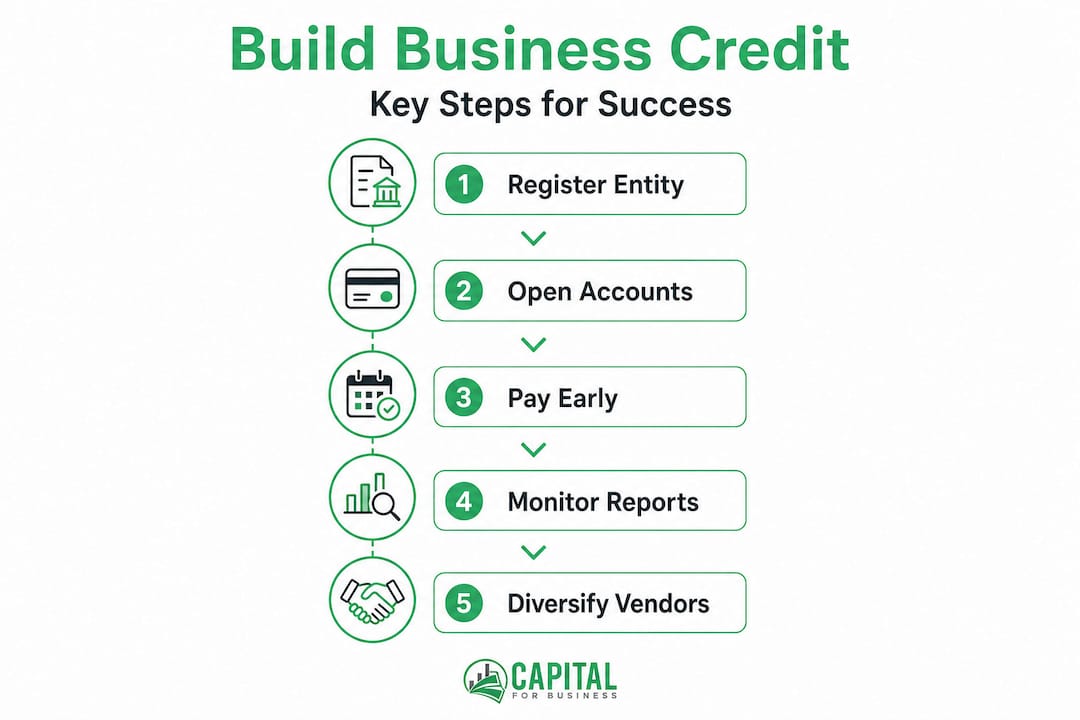
Once you understand why business credit matters, the next question becomes: how do you build it? The good news is that the path is clear and actionable. According to the U.S. Chamber of Commerce, there are eight key steps to establishing and building business credit effectively.
Step-by-step blueprint for building business credit
- Form a legal entity. Register your business as an LLC or corporation, not a sole proprietorship. This creates the legal separation between you and your business that is necessary for separate credit.
- Obtain an Employer Identification Number (EIN). Apply for an EIN through the IRS. This is your business's tax ID and functions like a Social Security Number for your company.
- Get a D-U-N-S number. Register with Dun & Bradstreet to get a D-U-N-S number. This is how D&B tracks and scores your business credit activity.
- Open a dedicated business bank account. Use it exclusively for business transactions. Mixing personal and business funds is one of the fastest ways to damage both your credit and your credibility.
- Apply for trade lines with net-30 vendors. Work with vendors who report payment history to business credit bureaus. These are called trade lines, and they build your credit profile the same way credit card payments build personal credit.
- Get a business credit card that reports. Use it for regular purchases and pay the balance on time. Choose a card that reports to at least one business credit bureau.
- Pay early or on time, consistently. Payment history is one of the most important factors in your business credit score. Even a single late payment can cause a measurable drop.
- Monitor your reports from D&B, Experian, and Equifax. Check for errors, update information, and track your progress regularly.
Following these business credit improvement tips will position your business for better financing options within months, not years.
Vendors that help build business credit
Some net-30 vendors actively report payment activity to business credit bureaus, making them strategic partners in your credit-building plan. However, not every vendor reports to every bureau, so it is worth confirming before you open an account.
| Vendor | Reports to D&B | Reports to Experian | Reports to Equifax |
|---|---|---|---|
| Uline | Yes | Rarely | Rarely |
| Quill | Yes | Occasionally | No |
| Grainger | Yes | No | No |
| Summa Office Supplies | Yes | Yes | Yes |
| Crown Office Supplies | Yes | Yes | Yes |
As confirmed by vendor reporting data, some vendors like Summa Office Supplies report to multiple bureaus, which accelerates your credit building. Always confirm directly with the vendor before assuming they report to all three.
Pro Tip: When you open a net-30 account, place a small order, pay early, and then repeat the cycle two or three times before you apply for a business loan. Lenders want to see consistent payment behavior, not just a single positive entry. Starting small and building a pattern is more effective than placing one large order and paying it off once.
It is also worth reviewing the pre-loan credit steps before you submit any financing application to make sure your profile is as strong as possible.
How business credit scores work and why they matter for financing
Understanding how your credit score is calculated helps you make smarter decisions that directly improve your financing outcomes. Business credit scores are not calculated the same way across all bureaus, so knowing the differences gives you a strategic edge.

How each bureau scores your business
Dun & Bradstreet (D&B) uses a score called the Paydex Score, which ranges from 0 to 100. It focuses almost entirely on payment history, specifically whether you pay your suppliers and vendors on time or early. A score of 80 is considered good and indicates payments made on time. A score of 100 means you consistently pay early.
Experian uses the Intelliscore Plus, which also runs from 0 to 100. This model incorporates payment history, credit utilization, company age, and public records like liens or judgments.
Equifax uses a Business Credit Risk Score (1 to 992) and a Business Failure Score (1,000 to 1,880). Both incorporate multiple factors including payment behavior, credit utilization, industry risk, and years in business.
Business credit score ranges and what they mean for financing
| Score range (D&B Paydex) | Rating | Impact on financing |
|---|---|---|
| 80 to 100 | Excellent | Access to most loan products at competitive rates |
| 50 to 79 | Good | Likely to qualify for standard products with some conditions |
| 20 to 49 | Fair | Limited options, higher rates, possible guarantees required |
| 0 to 19 | Poor | Significant difficulty qualifying for most financing |
The difference in outcomes is dramatic. Federal SBCS data shows that businesses with strong credit profiles achieve loan approval rates between 65% and 90%, while businesses with weak credit profiles see approval rates drop to near zero. That gap is not marginal. It is the difference between funding your next growth phase and running out of options.
What lenders actually evaluate
When a lender reviews your application, they look at more than just a credit score. Here is what they typically consider:
- Payment history. Are bills paid on time? Are there any past-due accounts or collections?
- Credit utilization. How much of your available credit are you using? Lower utilization signals better financial management.
- Years in business. Newer businesses are viewed as riskier, regardless of credit score.
- Revenue and cash flow. Lenders want to see that your business generates enough income to service debt.
- Public records. Liens, judgments, and bankruptcies will significantly hurt your application.
- Industry risk. Some industries are considered higher risk than others and may face stricter scrutiny.
- Number of trade lines. More active, reporting accounts give lenders more data to work with.
Understanding the business credit factors that lenders prioritize, and building your profile around them, is one of the most practical ways to improve your approval odds before you apply.
Pro Tip: Even new businesses with very little history can build what credit professionals call a "thin file" into a solid profile in six to twelve months. The key is opening at least three to five reporting trade lines, using them regularly, and paying early. Do not wait until you need funding to start this process.
For more guidance on preparing your application, review these business loan application strategies before you submit anything to a lender.
Common mistakes and how to avoid business credit pitfalls
Building business credit takes time and effort. Losing it can happen fast. Many small business owners unknowingly damage their credit profiles through habits that seem harmless at first. Knowing what to avoid is just as important as knowing what to do.
The most common business credit mistakes
According to Inc Authority, common business credit mistakes include mixing personal and business finances, using vendors that do not report, late payments, operating as a sole proprietor, too many credit inquiries, and ignoring your credit reports entirely. Here is a closer look at each:
- Mixing personal and business finances. Paying a business expense from your personal account, or vice versa, blurs the line between your credit identities and can void your liability protections. It also complicates your bookkeeping and tax reporting.
- Using non-reporting vendors. If your vendor does not report to a bureau, your on-time payments never make it onto your credit profile. You get no credit-building benefit from those transactions.
- Late payments, even by a few days. Business credit scoring, especially D&B's Paydex, is heavily weighted on payment timing. Paying even one or two days late can push your score down meaningfully. Always aim to pay before the due date.
- Operating as a sole proprietor. Sole proprietors cannot build a separate business credit profile because there is no legal separation between the business and the owner. Forming an LLC or corporation is a prerequisite.
- Applying for too much credit too quickly. Multiple credit inquiries in a short period signal financial stress to lenders and can lower your score. Space out applications and only apply for credit you genuinely need.
- Ignoring your credit reports. Errors on business credit reports are not uncommon. An incorrect late payment or a fraudulent account can quietly damage your score for months before you notice.
Review the financial practices to avoid in your early stages, as well as financing mistakes that can cost you when it is time to apply for a loan.
A key warning: Many business owners assume their credit is fine because they have never missed a payment. But fine is not the same as strong. A thin file with only one or two trade lines, or a file built entirely on non-reporting vendors, can still leave you with a score too low to qualify for the financing you need.
Managing your debt responsibly from the start is a straightforward way to prevent many of these pitfalls before they become costly problems.
Pro Tip: Set a monthly reminder to pull your business credit reports from all three bureaus. Dun & Bradstreet, Experian, and Equifax all offer monitoring services. Catching and disputing an error early can save your score and prevent a financing rejection further down the road. Monthly review takes less than fifteen minutes and can protect months of credit-building work.
A smarter approach: What most guides overlook about business credit
Most business credit guides focus on the basics: pay on time, open trade lines, do not mix finances. That advice is correct. But it leaves out some nuances that can make a real difference in how quickly your credit builds and how lenders actually perceive your profile.
One thing that often goes unmentioned is the value of paying large invoices early. According to 2025 small business data, business credit scoring models used by bureaus like D&B are dollar-weighted, meaning that large invoice early payments carry more influence than small ones paid on time. If you have the cash flow to do it, paying a substantial vendor invoice several days early can have an outsized positive effect on your Paydex score compared to making ten small purchases and paying them exactly on the due date.
Another overlooked reality is what happens with a thin file. A thin file means you have very few trade lines or a limited credit history, even if every payment you have made was perfect. Lenders interpret a thin file as limited data, not clean data. They may still decline your application or offer you less favorable terms simply because they cannot see enough history to feel confident. Many business owners are surprised to receive a loan rejection with no negative marks on their record. The issue was not bad credit. It was insufficient credit.
The practical fix is to start small and diversify. Rather than waiting to open a large account with one vendor, open three or four smaller accounts with different vendors that report to different bureaus. You build broader coverage and create more positive data points across your profile. Think of it as building a foundation with multiple columns rather than a single large beam.
Another tactic most guides skip is being strategic about which bureau a vendor reports to before you sign up. If your Experian profile is thin but your D&B Paydex is solid, prioritize opening accounts with vendors that report to Experian. Targeted credit building is faster and more effective than a scattered approach.
Finally, do not overlook the value of reviewing strategies for improving your business credit even when things are going well. Credit profiles are not static. Industry conditions, credit utilization changes, and even bureau data updates can shift your score without any action on your part. Proactive monitoring and deliberate strategy keep you in the best position when funding opportunities arise.
Next steps: Unlock financing opportunities with strong business credit
You now have the knowledge to build, protect, and use business credit as a strategic tool for growth. The next step is putting that knowledge to work. A strong credit profile does not just open doors to financing. It helps you negotiate better terms, manage cash flow more effectively, and position your business for long-term stability.

At Capital for Business, we work with small business owners at every stage of their credit journey. Whether you are just starting to build your profile or you are ready to apply for funding, we have solutions designed for businesses like yours. Explore easy business loan types that fit your situation, or visit our business funding solutions page to find the right product for your goals. If you need fast small business funding, we move quickly and work with you even when traditional lenders have said no. Let us help you take the next step.
Frequently asked questions
Can you build business credit as a sole proprietor?
No. Sole proprietors cannot build a separate business credit profile because there is no legal distinction between the owner and the business. You need to form an LLC or corporation first.
What are net-30 vendors and why are they important?
Net-30 vendors extend payment terms of 30 days and report your payment history to business credit bureaus. Vendors like Uline, Quill, and Grainger report primarily to Dun & Bradstreet, helping you build a credit profile with real payment activity.
How does business credit affect loan approvals?
A strong business credit profile substantially increases your approval chances. Federal SBCS data shows that businesses with high credit scores see approval rates between 65% and 90%, while those with weak scores see rates near zero.
What should I do if I find errors on my business credit report?
Dispute the error immediately by contacting the bureau directly and providing documentation. Regularly monitoring for errors ensures issues are caught and resolved before they affect your financing options.
Which agencies report and monitor business credit?
The three main business credit bureaus are Dun & Bradstreet, Experian, and Equifax. As outlined in the U.S. Chamber of Commerce guidance, you should monitor all three regularly to maintain an accurate and complete credit profile.