
TL;DR:
- A structured cash flow workflow for plumbing businesses includes invoicing, collections, expense tracking, and reserve management to ensure cash availability. Automating invoicing and payment collection reduces collection time and improves cash flow, while weekly reviews and a 13-week forecast help prevent shortfalls. Maintaining a cash reserve and managing receivables are essential for financial stability and business growth.
A plumbing cash flow management workflow is defined as the structured sequence of invoicing, collections, expense tracking, and reserve management that keeps operating cash available at all times. Most plumbing businesses fail not from lack of revenue but from poor timing between money coming in and money going out. Traditional plumbing businesses lose an average of $85,000 annually due to delayed payments and manual billing overhead. Getting this workflow right is the difference between a business that grows and one that stays permanently cash-strapped despite a full schedule.
What are the essential components of a plumbing cash flow management workflow?
A complete cash flow workflow covers four core areas: invoice management, accounts receivable tracking, cash reserve maintenance, and KPI review cadence. Skipping any one of these creates a gap that drains cash even when the business looks profitable on paper.
Invoice management and payment collection
Invoicing must happen the same day work is completed. Commercial work payment delays run 45–60 days while suppliers expect payment in 15–30 days, creating a cash gap that compounds fast. Closing that gap starts with same-day invoicing and on-site payment collection for residential jobs.
For large equipment replacement jobs, collect a deposit before scheduling the work. The standard practice is 30–50% upfront on major jobs to avoid financing the customer's purchase from your own operating cash. Progress billing at defined milestones protects you further on multi-day commercial projects.
- Send invoices digitally at job completion, not at the end of the week
- Collect deposits at job approval, not on the day work begins
- Offer multiple payment methods on-site, including card and ACH
- Set net-15 terms as your default for commercial clients, not net-30
- Flag any invoice unpaid past 10 days for immediate follow-up
Pro Tip: Set your field technicians up with mobile payment tools so customers can pay before the truck leaves the driveway. This single change eliminates most residential receivables problems.
Accounts receivable aging and KPI tracking

Accounts receivable aging (AR aging) is a report that groups unpaid invoices by how long they have been outstanding, typically in 0–30, 31–60, 61–90, and 90-plus day buckets. Review your AR aging report every week without exception. Any invoice in the 31–60 day bucket needs a phone call, not just an email.
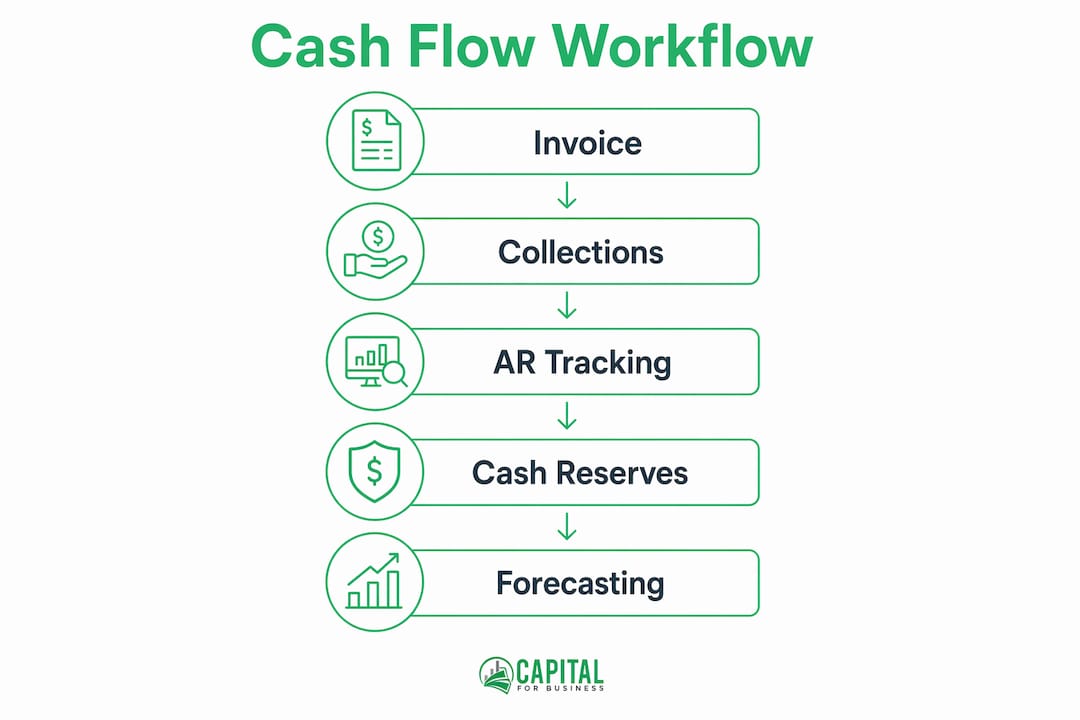
Weekly dashboards showing leading KPIs like call volume, close rates, profit and loss, and cash flow give owners the data they need to act immediately rather than react at month-end. Set a fixed time each Monday morning to review these numbers. Pair that weekly review with a monthly deep dive into your full profit and loss statement and balance sheet.
Cash reserve targets
Every plumbing business needs a dedicated cash reserve separate from its operating account. Companies earning $1M–$3M annually should maintain $30,000–$75,000 in reserves, covering roughly four months of fixed costs. Fixed costs include payroll, insurance, vehicle payments, and rent. This reserve is not a savings account. It is a survival buffer for slow seasons and unexpected equipment failures.
How to implement tools and automation for cash flow tracking
Automation cuts the time between completing a job and receiving payment. Automating pipeline-to-accounting workflows reduces payment collection time from 52 days to 19 days, accelerating cash inflow by over 60%. That is not a marginal improvement. It is the difference between making payroll comfortably and scrambling every other week.
Here is how to build an automated cash flow system step by step:
- Connect your field service app to your accounting system. Field service management apps that sync with QuickBooks Online create a direct line from job completion to invoice generation. The technician closes the job in the app, and the invoice appears in the accounting system automatically.
- Enable mobile payment collection at the job site. Technicians should collect payment before leaving. Card readers that connect to field service apps post payments directly to the customer account, eliminating manual entry.
- Set up automated payment reminders. Configure your system to send a reminder at day 7, day 14, and day 21 for unpaid invoices. Automated reminders remove the awkwardness of manual follow-up and improve collection rates without adding staff time.
- Build a weekly cash flow dashboard. Your dashboard should show cash on hand, AR aging totals by bucket, upcoming payables, and the sales pipeline value. Smart monitoring tools that track financial performance indicators in real time give owners a clear picture without digging through spreadsheets.
- Automate job costing reports. When your field service app, estimating tool, and accounting system share data, job costing happens automatically. You see actual labor and material costs against the estimate within hours of job completion.
Pro Tip: Do not buy separate tools for field service, estimating, and accounting if they do not integrate natively. A connected system that shares data automatically is worth more than three best-in-class tools that require manual data transfer.
The table below shows the impact of automation on key cash flow metrics:
| Metric | Manual process | Automated process |
|---|---|---|
| Average collection time | 52 days | 19 days |
| Same-day payment rate | Low | 94% |
| Annual loss from billing delays | $85,000 | Significantly reduced |
| Invoice generation time | End of week | Same day as job |
Integration of field service apps, sales platforms, and accounting systems enables real-time job profitability measurement and removes guesswork from cash flow management. Owners who have made this integration report knowing within 24 hours whether a job made money.
What financial controls and forecasting practices secure plumbing cash flow?
Financial controls are the rules and processes that prevent cash from leaking out of the business before it is needed. Forecasting is the practice of projecting cash inflows and outflows weeks ahead so you can act before a shortage hits.
The 13-week rolling cash flow forecast
A 13-week rolling cash flow forecast, updated every week, is the single most effective forecasting tool for plumbing businesses. It projects every expected payment in and every expected payment out for the next 90 days. Update it every Monday when you review your KPI dashboard. When the forecast shows a cash shortfall six weeks out, you have time to draw on a line of credit, accelerate collections, or delay a discretionary purchase.
Separating cash position from profit
Accrual accounting can show profit when cash is trapped in AR or inventory, creating a dangerous illusion of financial health. A business can be profitable on its profit and loss statement and still miss payroll. Managing both a cash flow statement and a profit and loss statement in parallel is not optional. It is the only way to know whether you can actually pay your bills this week.
The table below compares the two views:
| View | What it shows | When to use it |
|---|---|---|
| Profit and loss statement | Revenue minus expenses over a period | Monthly performance review |
| Cash flow statement | Actual cash in and out by date | Weekly operational decisions |
| AR aging report | Unpaid invoices by age | Weekly collections management |
| 13-week forecast | Projected cash position 90 days out | Proactive funding and planning |
Deposit and progress billing rules
Never start a large job without a deposit. The 30–50% deposit rule protects your working capital by ensuring the customer funds the material purchase, not your operating account. For jobs spanning multiple days or weeks, bill at defined progress milestones rather than waiting until completion. A common structure is 30% at signing, 40% at rough-in completion, and 30% at final inspection.
Pro Tip: Review your supplier payment terms annually. Negotiating net-30 or net-45 terms with your main suppliers gives you a buffer that aligns supplier payments with customer collections, reducing the cash gap significantly.
Managing credit limits and supplier terms
Set customer credit limits for commercial accounts based on their payment history, not just their job size. A commercial client who consistently pays in 60 days should carry a lower credit limit than one who pays in 20 days. This discipline prevents one large slow-paying client from tying up a disproportionate share of your receivables. Pair credit limit management with a formal collections escalation process: automated reminders at day 7 and day 14, a phone call at day 21, and a hold on new work at day 45.
How to troubleshoot common cash flow workflow challenges
Even well-run plumbing businesses hit cash flow problems. The causes are almost always the same, and the fixes are straightforward once you know where to look.
- The "profitable but broke" trap. This happens when invoicing lags behind completed work. The profit and loss statement looks healthy, but cash is sitting in uncollected receivables. Fix it by enforcing same-day invoicing and reviewing AR aging every week without exception.
- Seasonal revenue dips. Plumbing revenue drops in late winter and early spring in most markets. Build a maintenance membership plan that generates monthly recurring revenue year-round. A business line of credit provides a safety net for months when membership revenue alone does not cover fixed costs.
- Inaccurate job costing. Using a single blended labor rate for all technicians masks true job profitability. Burdened labor rates by pay tier allow you to price jobs correctly and identify which job types actually make money. A senior technician costs more per hour than an apprentice. Your pricing must reflect that difference.
- Slow commercial receivables. Commercial clients often push payment to 45–60 days regardless of your terms. Counter this by requiring a signed credit application before starting commercial work, setting clear late payment fees in your contract, and escalating to a collections call at day 30, not day 60.
- Using operating cash for equipment purchases. Buying a new service van or a hydro-jetter from operating cash depletes the reserve you need for payroll and materials. Use equipment financing to preserve working capital. The monthly payment is predictable and keeps your cash reserve intact.
- No formal AR follow-up workflow. Many plumbing owners rely on memory or informal reminders to chase unpaid invoices. Set up a documented AR aging follow-up workflow with specific actions tied to each aging bucket. Consistency in collections is more effective than intensity.
Addressing these issues one at a time, starting with invoicing timing and AR aging review, produces measurable improvement within 30 days. You do not need to fix everything at once. Fix the biggest cash drain first, then move to the next.
Key Takeaways
A structured plumbing cash flow workflow built on same-day invoicing, weekly AR review, automated collections, and a 13-week rolling forecast is the most reliable path to financial stability and growth.
| Point | Details |
|---|---|
| Same-day invoicing | Send invoices at job completion to close the gap between work done and cash received. |
| Cash reserve target | Maintain $30,000–$75,000 in reserves to cover four months of fixed costs. |
| Automate collections | Automation cuts collection time from 52 days to 19 days and drives same-day payment rates to 94%. |
| 13-week forecast | Update your rolling 90-day cash forecast weekly to spot shortfalls before they become crises. |
| Separate cash from profit | Track both a cash flow statement and a profit and loss statement to avoid the "profitable but broke" trap. |
What working with plumbing owners has taught me about cash flow discipline
The owners I see struggle most with cash flow are not the ones with the smallest businesses. They are often the ones growing fastest. Revenue is climbing, the schedule is full, and the bank account is somehow still tight every other week. The problem is almost always the same: the financial workflow has not kept pace with the business.
The owners who get it right treat their weekly KPI dashboard the way a pilot treats a cockpit. They check it every Monday, they know what every number means, and they act on what they see before it becomes a problem. They are not reacting to last month's profit and loss statement. They are managing this week's cash position.
The discipline of building a cash reserve feels unnecessary until the slow season hits or a major piece of equipment fails. I have seen businesses with $2M in annual revenue unable to make payroll in february because they had no reserve and a slow January. That is a solvable problem, but only if you build the reserve before you need it.
Technology integration is the part most owners resist longest and benefit from most. When your field service app, your estimating tool, and QuickBooks Online share data automatically, you stop guessing about job profitability. You know within a day whether a job made money. That knowledge changes how you price, how you schedule, and how you manage your team. For owners looking to grow plumbing revenue sustainably, financial visibility is the foundation everything else is built on.
— Capital
How Capitalforbusiness helps plumbing businesses manage cash flow gaps
Plumbing businesses with a solid financial workflow still face moments when cash reserves run thin. Seasonal slowdowns, a large equipment purchase, or a commercial client paying late can create a gap that disrupts operations even when the business is fundamentally healthy.

Capitalforbusiness has worked with plumbing business owners since 2009, providing small business loans for plumbers, equipment financing, and business lines of credit up to $500,000. A revolving line of credit gives you a buffer for slow seasons without committing to a fixed loan. Equipment financing keeps your operating cash intact when you need a new van or a specialty tool. Capitalforbusiness funds quickly, works with businesses banks have turned down, and structures financing around what your cash flow can actually support. Reach out to Capitalforbusiness to find the right funding option for your business.
FAQ
What is a plumbing cash flow management workflow?
A plumbing cash flow management workflow is the structured process of invoicing, collecting payments, tracking receivables, managing expenses, and maintaining cash reserves to keep the business financially stable. It connects field operations directly to financial outcomes.
How much cash reserve should a plumbing business maintain?
Plumbing businesses earning $1M–$3M annually should maintain a cash reserve of $30,000–$75,000, covering roughly four months of fixed costs to survive slow seasons and unexpected expenses.
How does automation improve plumbing cash flow?
Automating invoicing and payment collection reduces average collection time from 52 days to 19 days and drives same-day payment rates to 94%, significantly reducing the cash gap between completing work and receiving payment.
What is the 13-week cash flow forecast?
The 13-week rolling cash flow forecast is a 90-day projection of all expected cash inflows and outflows, updated weekly. It allows plumbing owners to identify cash shortfalls weeks in advance and arrange financing or adjust spending before a crisis occurs.
Why do profitable plumbing businesses still run out of cash?
Profitable plumbing businesses run out of cash when revenue is recognized on an accrual basis but cash is trapped in unpaid receivables. Managing both a profit and loss statement and a real-time cash flow statement prevents this gap from causing operational problems.