
TL;DR:
- Effective construction cash flow management connects billing, collections, forecasting, and payments into a disciplined weekly rhythm, ensuring money flows predictably. Automating documentation, follow-ups, and forecasting helps reduce delays and shortfalls, while consistent execution and timely funding fill remaining timing gaps. Proper tools, workflow discipline, and funding solutions are essential for maintaining liquidity and project success.
Running a construction business often means spending money weeks or months before a single payment arrives. Labor, materials, equipment rentals, and subcontractor mobilization costs all hit early, while owner payments lag behind billing cycles, approval processes, and retainage holdbacks. That timing gap is where construction businesses get into trouble. A disciplined construction cash flow management workflow closes that gap by connecting your billing, collections, forecasting, and payment processes into one coordinated system. This guide walks you through exactly how to build and execute that system, from foundational setup through daily workflow steps and the technology that makes it repeatable.
Table of Contents
- Key Takeaways
- Building your cash flow workflow foundation
- Step-by-step cash flow workflow execution
- Common workflow obstacles and how to fix them
- Tools and technology for cash flow visibility
- My take on where most construction teams get this wrong
- Strengthen your cash position with the right funding
- FAQ
Key Takeaways
| Point | Details |
|---|---|
| Timing is the core problem | Costs hit before payments arrive; a structured workflow makes that gap predictable and manageable. |
| Rolling forecasts need weekly updates | A 13-week cash forecast only works if you update it with actual figures every week without exception. |
| Documentation drives billing speed | Chasing sub pay apps and lien waivers is the biggest billing bottleneck; automation cuts it significantly. |
| AR classification unlocks faster collections | Segment receivables by billing type and dispute status to prioritize collections and recover cash sooner. |
| Funding options fill timing gaps | Working capital solutions and business loans complement workflow improvements when timing gaps are unavoidable. |
Building your cash flow workflow foundation
Before you can execute any cash flow management process reliably, you need the right financial and operational infrastructure in place. Skipping this step is one of the most common reasons construction companies find their cash flow forecasts are technically accurate but practically useless.
Start with your billing structure. Know whether each project uses milestone billing, progress billing tied to a schedule of values, or time-and-material invoicing. Each structure creates different cash timing patterns and requires a different collection cadence. Retainage terms also vary significantly by contract, so document the retention percentage, the release conditions, and the projected release date for every active project before the job starts.
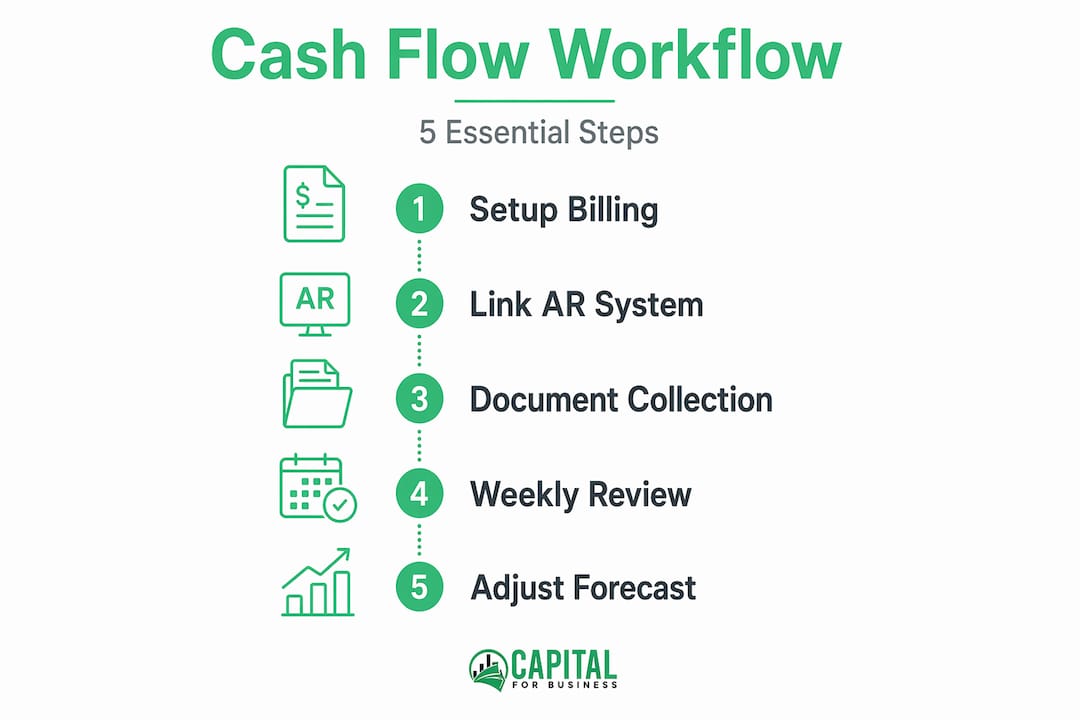
Clear documentation standards are non-negotiable. Every project needs a defined process for collecting lien waivers, submitting pay applications, and tracking approval status. Without these standards, billing becomes reactive instead of systematic, and cash timing stays unpredictable because retainage holds back earned cash while approval lags extend collection timelines.
Your accounts receivable and invoicing systems need to be connected directly to your project management data. When percent-complete figures, change order approvals, and stored material values live in one platform and your invoices are generated separately, errors and delays multiply. Tightly integrated systems remove that friction.
Capture subcontract commitments immediately at award. Subcontract-driven forecasts that link purchase orders and contract awards to projected payment timelines are significantly more accurate than forecasts built on general revenue estimates. Every commitment you delay entering is a gap in your cash picture.
Finally, establish your forecasting baseline. The standard tool for construction financial management is the rolling 13-week cash flow forecast. It gives you week-by-week visibility into inflows and outflows and a four-to-six-week window to act on problems before they become crises.
- Confirm billing type and retainage terms for every active contract
- Set documentation standards for pay apps, lien waivers, and approval workflows
- Connect your invoicing system to live project management data
- Log all subcontract awards and purchase orders immediately with payment timing
- Build your first 13-week rolling forecast before the project billing cycle begins
Pro Tip: Set up a simple project financial data sheet for each new contract the day it is signed. Include billing type, retainage percentage, release conditions, and GC or owner payment terms. That single document saves hours of back-tracking when billing disputes arise later.
Step-by-step cash flow workflow execution
With the foundation in place, the following workflow covers the recurring activities that keep cash moving consistently through your business. Think of this as your operating rhythm across daily, weekly, and monthly cycles.
-
Submit progress billing on time, every billing cycle. Use AIA G702/G703 forms for progress-billed contracts. The G703 updates your schedule of values with current percent-complete figures and dollar amounts, feeding the G702 application for payment. Project managers typically spend two to three days per project handling documentation and certification follow-up each billing period. Submit early in the billing window, not on the last possible day, to start the approval clock sooner.
-
Deliver invoices electronically and confirm receipt. Paper invoices introduce unnecessary delays. Send digitally, confirm receipt within 24 hours, and log the submission date in your AR system. The date of confirmed receipt is your baseline for tracking payment terms and following up.
-
Run AR aging reports weekly. Do not wait until an invoice is overdue to check its status. Weekly aging reports show you which invoices are approaching their due date, which are past due, and which are in dispute. Effective AR classification segments receivables by billing type, including current billings, stored materials, approved change orders, retainage, and disputed amounts, so you can prioritize collection efforts precisely.
-
Follow up systematically, not reactively. Build a defined escalation sequence: a reminder at 75% of the payment term, a formal follow-up at the due date, and a phone call or written notice within five business days of non-payment. Inconsistent follow-up is one of the most avoidable cash flow leaks in construction.
-
Track retainage release dates and automate reminders. Retainage is often forgotten until a job is substantially complete, then chased manually. Map each retainage release condition to a calendar date and set automated reminders. Tracking retainage release proactively prevents delays that can hold up cash for months after project completion.
-
Update your rolling 13-week forecast every week. This step is where most teams fall short. The 13-week forecast offers actionable liquidity visibility only when inputs reflect current actuals and updated projections. Roll it forward every week using the previous week's actual receipts and disbursements, then adjust the forward outlook based on any new commitments or billing approvals received.
-
Align subcontractor payments with incoming cash. Do not pay subcontractors ahead of receiving the corresponding owner payment unless your contract specifically requires it. Structure subcontractor payment terms to mirror your own collection cycle as closely as your contracts allow.
Pro Tip: Color-code your AR aging report by risk category: green for current, yellow for approaching due date, and red for overdue or disputed. It takes less than two minutes to scan and immediately shows you where to focus collection effort.
The following table shows how different billing activities map to their workflow timing and responsible parties.
| Billing activity | Frequency | Owner/responsible party |
|---|---|---|
| G702/G703 progress billing submission | Monthly | Project manager |
| Electronic invoice delivery and receipt confirmation | Per billing cycle | Accounting/PM |
| AR aging report review | Weekly | Controller/accounting |
| AR follow-up and escalation | Per escalation schedule | Accounting |
| Retainage release tracking and reminders | Ongoing with milestone triggers | Accounting |
| 13-week cash forecast roll-forward | Weekly | Controller/CFO |
| Subcontractor payment alignment check | Per pay cycle | PM/accounting |
Common workflow obstacles and how to fix them
Even well-designed systems run into friction. The obstacles below are the ones that most commonly derail construction cash flow in practice, and each one has a direct fix.
-
Documentation chase is the biggest time drain. Collecting subcontractor pay applications and lien waivers before you can submit your own billing consumes 60 to 70 percent of PM billing time. Automated reminder systems that send scheduled requests to subs and flag missing documents cut this workload substantially and prevent billing delays from cascading into payment delays.
-
Billing approval delays from the GC or owner. If an owner or general contractor sits on your pay application for two weeks before even reviewing it, your cash cycle stretches accordingly. Centralizing project status data in a shared platform reduces back-and-forth approval lag because the reviewer already has access to the documentation they need. Following up on approval status three to five days after submission is not aggressive; it is good practice.
-
Change order delays as a direct cash flow risk. Unapproved change orders represent work performed but not yet billable. Every week a change order sits in review is a week of cash you cannot collect. Build a change order status column into your weekly workflow review. If a change order has been pending more than two weeks without response, escalate it. Underbilling from unmanaged change orders is one of the most common causes of unexpected cash shortfalls in construction.
-
Stale forecasts that create false confidence. A 13-week forecast built three weeks ago and never updated is worse than no forecast at all because it gives you false certainty. Weekly roll-forward updates with actual receipts prevent this. Schedule the update as a fixed standing task on the same day each week, not a task that gets done when time permits.
-
Subcontractor payment timing misalignment. Paying subs from general operating cash when owner payments have not yet cleared creates unnecessary cash pressure. Review your subcontractor payment schedule against your incoming cash projection every two weeks.
Effective construction financial management is not primarily a math problem. It is a timing and discipline problem. The contractors who manage cash well are not necessarily the ones with the best forecasting models. They are the ones who execute the same billing, collection, and forecasting steps on the same schedule every single week.
Tools and technology for cash flow visibility
Technology does not replace a disciplined workflow, but it makes that workflow significantly faster and harder to skip.

Integrated accounting and project management platforms. Connecting accounting software like QuickBooks or Sage to project management platforms creates a live link between project cost data and financial reporting. When a project manager updates percent-complete in the field, the billing team sees the updated figure immediately without waiting for a weekly data transfer. This integration alone removes days of manual reconciliation from each billing cycle.
| Feature | Manual process | Automated process |
|---|---|---|
| Invoice generation | PM compiles data, accounting builds invoice | Triggered automatically from project completion data |
| AR follow-up reminders | Accounting staff manually tracks due dates | System sends scheduled reminders at defined intervals |
| Retainage release tracking | Tracked in spreadsheets, easy to miss | Automated alerts tied to project milestone completion |
| 13-week forecast update | Manual entry from multiple data sources | Auto-populated from actual cash transactions |
| Lien waiver collection | PM emails subs individually | Automated requests with tracking and escalation |
Automation for invoice generation and AR reminders delivers measurable results. Automated invoice timing cuts five to ten days off invoice-to-cash cycles, and systematic AR reminders recover payments fifteen to twenty days faster than manual follow-up processes.
A real-time cash flow dashboard is the connective tissue between all these tools. Rather than pulling reports from three different systems to understand your liquidity position, a single dashboard shows your rolling forecast, AR aging, retainage balances, and upcoming payment obligations in one view. Many modern construction ERP platforms include this as a standard feature.
Project Bank Accounts are worth understanding for larger projects. Project Bank Accounts hold funds in ring-fenced accounts where payments are released only when documented approval conditions are met. They improve cash certainty for all parties by separating the approval process from the disbursement process. Some public sector contracts in the US now require or encourage PBAs specifically because they reduce payment disputes and speed up fund distribution.
Pro Tip: Before purchasing any new construction management software, test whether it can export your AR aging data and cash forecast in the same report view. If it cannot, you will spend more time reconciling data between tools than the software saves you elsewhere.
Using construction management software to unify your project data, billing, and forecasting is one of the highest-leverage workflow investments available to a construction business of any size.
My take on where most construction teams get this wrong
I have seen construction businesses with tight margins run consistently profitable projects and stay solvent. I have also seen businesses with strong contracts and solid backlog get into serious cash trouble. The difference almost always comes down to one thing: timing discipline.
Most teams I work with understand the concept of a rolling 13-week forecast. Far fewer actually execute the weekly roll-forward with discipline. They build the forecast at the start of a project, reference it occasionally, and then wonder why their liquidity projection was so far off at month six. The forecast does not fail them. They fail the forecast by letting it go stale.
What I have found actually works is connecting billing, AR aging, retainage, and forecasting into one coherent operating rhythm rather than treating them as separate tasks assigned to different people on different schedules. When the PM who submits the billing is also reviewing the AR aging report each week and flagging unresolved change orders, the cash picture stays current. When those tasks are siloed, information gaps create cash gaps.
Automation is genuinely useful, and I would encourage any construction business managing more than three or four active projects to invest in it. But automation accelerates a good process. It does not repair a broken one. If your billing discipline is weak, automated invoice generation will just send inaccurate invoices faster.
The contractors who consistently manage cash well are not necessarily the most sophisticated. They are simply the most consistent. Same billing day. Same weekly forecast update. Same AR follow-up cadence. That consistency is harder to maintain than it sounds, especially during busy project phases, but it is what separates contractors who always seem to have cash available from those who are perpetually surprised by shortfalls.
— Capital
Strengthen your cash position with the right funding
Even the most disciplined cash flow workflow cannot eliminate every timing gap. Large material purchases, equipment needs, or unexpected billing disputes can all create short-term shortfalls that happen faster than your receivables can cover them.

That is where Capitalforbusiness can help. We work with construction business owners and project managers across the country to provide funding solutions that cover the timing gaps between when costs hit and when payments arrive. Whether you need working capital funding to cover a payroll cycle while waiting on a GC payment, or you are looking at small business loan options to support a larger project ramp-up, Capitalforbusiness has loan products built for the realities of construction. We also offer equipment financing and business lines of credit that let you preserve operating cash while acquiring the assets your projects require. Explore your construction funding options and find the solution that fits your project cycle.
FAQ
What is a construction cash flow management workflow?
A construction cash flow management workflow is a structured, repeatable process that connects billing submission, accounts receivable follow-up, retainage tracking, and cash forecasting into a coordinated operating rhythm. It replaces ad hoc cash management with scheduled, accountable steps that keep money moving predictably through a project.
How often should you update a 13-week cash flow forecast?
You should update a rolling 13-week forecast every week without exception. Weekly roll-forward updates using actual receipts and disbursements keep the forecast credible and actionable; forecasts updated less frequently produce false liquidity readings that lead to poor decisions.
What causes the biggest billing delays in construction?
The primary cause of billing delays is incomplete documentation collection, specifically subcontractor pay applications and lien waivers. Chasing this documentation accounts for 60 to 70 percent of PM billing time and directly delays when your invoice can be submitted, pushing the entire payment cycle back.
How does automating AR reminders improve cash flow?
Automated AR reminder systems send payment follow-ups on a defined schedule tied to each invoice's due date, removing the dependency on manual tracking. Systematic reminders recover payments 15 to 20 days faster than manual collection processes, which meaningfully shortens the average days outstanding on your receivables.
When should a construction business consider a working capital loan?
A working capital loan makes sense when a known cash timing gap, such as a retainage release delay or a large material purchase ahead of the billing cycle, cannot be covered by current receivables. Using a short-term working capital loan as a planned bridge tool is more cost-effective than allowing the gap to disrupt subcontractor payments or project schedules.