
TL;DR:
- Agency cash flow challenges stem from structural gaps between immediate payroll costs and delayed client payments. Implementing milestone billing, automated invoicing, and weekly cash reviews can stabilize finances and improve working capital management. Relying on systematic processes and flexible funding solutions like factoring enhances agency resilience and operational control.
Agency financial managers know the feeling well. Payroll lands on Friday regardless of whether three major clients have paid their invoices. Project-based agencies face structural cash flow challenges because fixed payroll outflows clash directly with Net 30 to 90 payment terms that clients routinely stretch even further. The result is a recurring cash gap that forces reactive decisions, strains vendor relationships, and limits your ability to take on new work. This guide walks you through a proven workflow to close that gap, stabilize your working capital, and operate from a position of financial control rather than constant catch-up.
Table of Contents
- Why agencies struggle with working capital
- What you need for an effective working capital workflow
- Step-by-step: The agency working capital workflow
- Troubleshooting: Common workflow pitfalls and expert fixes
- Verifying and optimizing your cash flow process
- Why traditional agency cash flow advice falls short—and what actually works
- Explore agency-focused working capital and funding solutions
- Frequently asked questions
Key Takeaways
| Point | Details |
|---|---|
| Agencies face structural cash gaps | Fixed payroll and delayed client payments require proactive cash flow management. |
| Workflow structure is essential | A systematic approach—deposits, milestone billing, automated reminders—keeps cash moving. |
| Leverage technology and automation | Adopt tools for invoicing, forecasting, and receivables to minimize collection delays. |
| Benchmark and improve regularly | Track DSO, maintain cash reserves, and update forecasts each week for financial health. |
| Flexible funding accelerates growth | Combine workflow optimization with financing to close gaps and support expansion. |
Why agencies struggle with working capital
The structural nature of agency billing is the root cause of most cash flow problems. You complete work, deliver it, invoice the client, and then wait. Depending on your payment terms and how promptly your client actually pays, you could wait 30, 60, or even 90 days to see money that you effectively earned weeks ago. Meanwhile, your team needs to be paid, your software subscriptions renew automatically, and your rent is due on the first of the month.
Lumpy project revenue creates predictable gaps that agencies can mitigate with retainer agreements, cash buffers, and milestone billing. But many agencies operate without these structures in place, leaving them vulnerable each time a large project wraps or a client delays payment.
Several compounding factors make this worse:
- Rapid growth increases payroll and overhead faster than new client revenue arrives
- Client concentration means one slow-paying anchor client can destabilize your entire operation
- Scope creep leads to billing disputes that delay cash collection even further
- No-deposit billing puts all financial risk on the agency until final delivery
- Weak payment terms allow clients to default to their own preferred schedules
"Marketing and creative agencies face a fundamental timing mismatch: labor costs are immediate and predictable, while revenue is delayed and variable. This mismatch is structural, not accidental, and it requires a structural response." — AgencyPro, Agency Cash Flow Management
The good news is that each of these pain points has a documented, practical solution. You do not need to overhaul your entire operation overnight. You need a systematic workflow that addresses each friction point in sequence. For context on how other small businesses are solving similar issues, reviewing examples of working capital solutions can offer useful framing before you build your own process.
Understanding these challenges is the first step toward building a resilient process. Let's look at what you actually need to get your workflow under control.
What you need for an effective working capital workflow
Before you can implement a repeatable process, you need the right tools and a clear picture of the metrics that matter. Most agencies already have some of these systems in place but have not connected them in a way that provides real-time visibility into cash position.
Core systems and tools your workflow requires:
- Automated invoicing software (such as QuickBooks, FreshBooks, or HoneyBook) that triggers invoices upon milestone completion or a recurring schedule
- Payment reminder automation set to send at defined intervals before and after due dates
- Rolling cash flow forecasting tools or a structured spreadsheet updated on a weekly cadence
- Project management and billing integration so that project completion triggers billing without manual intervention
- Segmented bank accounts for operations, payroll, and tax reserves to prevent commingling funds and maintain clear visibility
The importance of working capital management becomes obvious once you see how these systems interact. Without them connected, you are making financial decisions based on incomplete information.
Key benchmarks to guide your workflow targets:
Agency financial benchmarks include targeting a DSO (days sales outstanding) under 40 days as the healthy standard, with under 60 days still acceptable. Agencies should also maintain 3 to 6 months of operating expenses as a cash reserve, achieve 50 to 60 percent gross margins on projects, and generate 40 to 60 percent of total revenue from retainer agreements to create stability.
| Workflow component | Benchmark or target | Recommended frequency |
|---|---|---|
| DSO monitoring | Under 40 days (ideal), under 60 days (healthy) | Weekly |
| Cash reserve target | 3 to 6 months operating expenses | Monthly review |
| Gross margin per project | 50 to 60 percent | Per project |
| Retainer revenue share | 40 to 60 percent of total revenue | Quarterly review |
| Rolling cash flow forecast | 13 weeks forward | Updated weekly |
| Automated invoice triggers | Upon milestone completion or recurring date | Per project or monthly |
| Payment reminder cadence | 3 days pre-due, due date, 3/7/14 days post-due | Per invoice |
Pro Tip: Connect your project management tool directly to your billing platform. When a project milestone is marked complete, an invoice should generate automatically. This single integration removes days of billing lag and keeps your DSO moving in the right direction.
With the right foundation in place, you're ready to implement a repeatable, step-by-step workflow.

Step-by-step: The agency working capital workflow
A working capital workflow is only as strong as its consistency. The following steps reflect best practices for agency cash flow management and are designed to be implemented sequentially, from the moment a new client is onboarded to the weekly routines that keep your cash position stable.
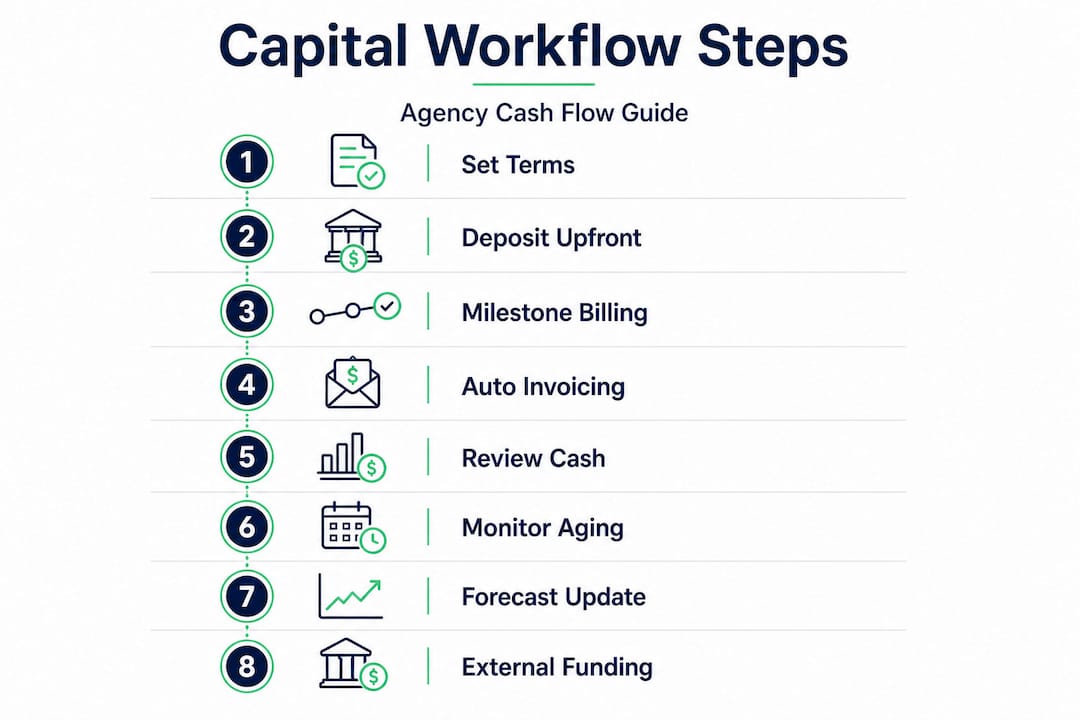
Step 1: Set terms during client onboarding Before any work begins, establish clear payment terms in writing. Use Net 15 as your standard. Include late fees, dispute resolution language, and deposit requirements in every contract.
Step 2: Require an upfront deposit Collect 30 to 50 percent of the total project value before work starts. This funds early-stage labor costs and signals a professional, structured engagement.
Step 3: Structure milestone billing Break every project into defined phases with billing triggers at each milestone. Milestone billing distributes your receivables across the project timeline rather than stacking them at the end.
Step 4: Automate invoicing triggers Set your invoicing software to generate and send invoices automatically when a milestone is completed or when a recurring retainer date arrives. Eliminate manual delays from the billing process entirely.
Step 5: Activate automated payment reminders Schedule automated reminders at three days before the due date, on the due date, and at three, seven, and fourteen days past due. Persistence through automation keeps payment top of mind without straining client relationships.
Step 6: Run a weekly cash review Every week, review your current bank balance, all outstanding invoices, upcoming payables, and your 13-week rolling cash flow forecast. Identify any potential shortfalls at least three to four weeks before they occur.
Step 7: Monitor receivables aging Segment your outstanding invoices by age (0 to 30 days, 31 to 60 days, 61 to 90 days, and over 90 days). Any invoice past 60 days should trigger a direct client call, not just another automated email.
Step 8: Update your forecast weekly A 13-week rolling forecast is only useful if it reflects current reality. Update it every Monday with actual receipts, confirmed project starts, and any changes in client payment behavior.
Step 9: Tap external funding when needed When a confirmed cash gap exists that you cannot close through collections alone, use tools like invoice factoring for agencies to accelerate receivables without waiting for client payment. Understanding the difference between your options is also important, so reviewing factoring vs invoice financing will help you choose the right tool for the situation.
Comparison: Common billing and collections approaches
| Approach | Pros | Cons |
|---|---|---|
| Invoice on project completion | Simple, single billing event | Long cash gap, high DSO, risk of disputes |
| Milestone billing | Distributes cash inflow, reduces gap | Requires contract structure, more admin |
| Retainer model | Predictable recurring revenue | Scope management required |
| Manual payment reminders | Personalized touch | Inconsistent, time-consuming, easy to skip |
| Automated payment reminders | Consistent, scalable, no effort | Can feel impersonal if not customized |
| No upfront deposit | Lower friction for client onboarding | All risk on agency, cash gap starts immediately |
| 30 to 50 percent deposit required | Immediate cash inflow, shared commitment | Some clients may push back |
Pro Tip: Keep your DSO under 40 days by making automation your first line of defense. Use factoring as a secondary tool when specific large invoices are sitting past 30 days and you need cash to fund incoming project costs.
Following these steps will put a reliable structure in place. But it's just as important to watch out for common mistakes that can set you back.
Troubleshooting: Common workflow pitfalls and expert fixes
Even well-designed workflows break down under real-world conditions. Recognizing where agencies most commonly fail helps you course-correct before a small gap becomes a genuine crisis.
The most frequent workflow mistakes agencies make:
- Invoicing only at project completion rather than at milestones, creating a single large receivable with a long wait attached
- Not enforcing payment terms because the relationship feels awkward, allowing clients to drift to 60 or 90 days as a default
- Skipping or delaying payment reminders because finance staff are focused on other tasks
- Ignoring the cash flow forecast until a shortfall is already visible in the bank account
- Mixing operating funds with tax reserves, which creates false confidence in your available cash position
- Treating all overdue invoices the same regardless of client history, size, or relationship value
Reactive financial decisions stem directly from invoicing only at completion, unenforced terms, and a lack of forward visibility. The fix is not more effort but better systems.
Expert fixes for each pitfall:
For delayed invoicing, restructure all active contracts to include milestone billing. If a client resists, frame it as a standard industry practice that protects both parties by confirming deliverables at each phase.
For unenforced terms, add late fees to your contract and apply them consistently. Clients respect firms that operate with clear financial policies. Inconsistency signals that your terms are negotiable.
For missed reminders, automate them entirely. Remove the human decision point from the follow-up process. Your billing platform should handle the cadence without requiring staff action after the initial setup.
For ignoring forecasts, assign weekly forecast review as a standing agenda item in your leadership meetings. It should take no more than 20 minutes but can prevent decisions worth tens of thousands of dollars.
Balancing collections with client relations requires nuance. Automated reminders handle the routine follow-up professionally, while direct conversations are reserved for accounts that are significantly overdue or where there is a dispute. Segmenting your bank accounts for operations, payroll, and tax reserves ensures that your day-to-day balance reflects only what is actually available for spending.
Using factoring for service providers is particularly effective when a client has a history of paying at 45 to 60 days but you have immediate payroll or vendor obligations. Rather than straining the client relationship with escalated demands, you sell the receivable at a small discount and meet your obligations on schedule.
"The agencies that consistently manage cash well are not the ones with the largest clients or the most revenue. They are the ones with the most disciplined weekly review habits and the fastest invoice-to-collection cycles." — Plotpath, Cash Flow Management for Digital Marketing Agencies
With these pitfalls addressed, you can expect significant operational improvements. Here's how to measure and ensure your workflow delivers the results you need.
Verifying and optimizing your cash flow process
Implementing the workflow is the first step. Verifying that it is working and continuously improving it is what separates agencies that consistently maintain healthy cash positions from those that cycle through the same crises year after year.
Key KPIs to monitor on an ongoing basis:
- DSO: Track this weekly. Any trend above 40 days should trigger a review of your invoicing and collections process
- Cash reserves: Compare current reserves against your 3 to 6 month target monthly
- Gross margin per project: Review at project close to identify scope creep or underpricing
- Retainer revenue as a percentage of total: Track quarterly and set a target to move toward 40 to 60 percent
- Forecast accuracy: Compare your 4-week-forward projections against actual outcomes to calibrate your model
Periodic audit and improvement tactics:
- Review weekly cash flow reports every Monday before any spending decisions are made
- Update your rolling 13-week forecast every week with actual data, not estimates carried forward
- Revisit deposit policies annually or whenever you notice a pattern of delayed first payments
- Audit your automated reminder sequences every quarter to ensure they are still triggering correctly
- Integrate your project management and billing tools so that project-level forecasting reflects real work status, not just calendar assumptions
- Set aside 5 to 10 percent of monthly profits into a dedicated reserve account systematically, as project-level forecasting and real-time PM integrations significantly improve forecast reliability over aggregate monthly reviews
A key statistic worth noting: Deloitte's working capital research shows that improved working capital strategy can free up 10 to 20 percent more working capital for firms that apply systematic optimization. Additionally, DSO reduction of 10 to 14 days is achievable through automation and process discipline alone, without changing client relationships or pricing.
That level of improvement translates directly into cash you can use to fund growth, reduce reliance on external credit, and build the reserves that give your agency real operational flexibility.
Most guides stop here, but let's look at why conventional agency wisdom is out of date and what really works in today's environment.
Why traditional agency cash flow advice falls short—and what actually works
Most cash flow advice aimed at agencies defaults to "invoice faster." It is not wrong. But it is incomplete to the point of being unhelpful for agencies that already have a billing process and still find themselves short on cash.
The real issue is not the speed of invoicing. It is the structure of the entire revenue-to-cash cycle, from contract terms to collections to reserve management. Invoicing at completion without forward visibility creates reactive decision-making that no amount of faster invoicing will solve. The same cash gap will appear with the same predictability, just with a slightly shorter lag.
What actually works is building project-level visibility into your financial process. Aggregate monthly reports tell you what happened. Project-level forecasting tells you what is about to happen. The difference is the difference between reading a history book and checking a weather forecast before a trip.
Rigid month-end billing cycles made sense when accounting was manual. Today, your billing software can trigger an invoice the moment a milestone is marked complete in your project management tool. There is no operational reason to wait until the end of the month to bill for work delivered on the 12th. That delay is a habit, not a requirement.
The other area where traditional advice falls short is its default recommendation to rely on a business line of credit as the primary cash flow tool. Lines of credit are useful, but they add debt to your balance sheet, require regular bank approval, and come with terms that may tighten exactly when you need them most. Choosing between factoring and invoice financing offers a better framework for agencies that need fast, flexible cash without the constraints of traditional credit.
Factoring, in particular, is well-suited to the agency model because it scales with your receivables. As your agency grows, your ability to access cash grows proportionally, without reapplying for a larger credit line or pledging additional collateral.
Pro Tip: Build processes that are modular enough to work when you have two large clients and when you have twenty smaller ones. A workflow that only functions at a specific agency size will require a full rebuild every time you hit a growth stage.
The agencies that thrive financially are the ones that treat their cash flow process as a core operational system, not an afterthought managed once a month by the bookkeeper. Weekly reviews, real-time integrations, project-level forecasting, and flexible external funding options are the actual levers. "Invoice faster" is just one of many.
Explore agency-focused working capital and funding solutions
Optimizing your workflow is the foundation. Pairing it with the right financial products takes your agency's cash flow resilience to the next level.

Capital for Business has worked with agencies and service-based businesses since 2009 to provide fast, practical funding when traditional banks move too slowly or set terms that don't fit the agency model. Whether you need to bridge a receivables gap, fund a growth phase, or build the reserves your workflow requires, there are solutions built for exactly this situation. Explore how supporting your working capital with the right products can complement your process improvements, review your full range of working capital funding options, or connect with a funding specialist at Capital for Business to find the right fit for your agency today.
Frequently asked questions
What is a typical DSO target for agency working capital health?
A good DSO target for agencies is under 40 days, with anything under 60 days still considered a healthy range for project-based firms.
How much cash reserve should an agency keep on hand?
Industry benchmarks recommend 3 to 6 months of operating expenses held in reserve, providing a buffer against late payments and seasonal revenue dips.
What steps immediately reduce agency cash flow gaps?
Switch to milestone billing with deposits, require 30 to 50 percent upfront on every project, and activate automated invoicing and payment reminders to accelerate your collections cycle right away.
Can factoring help agencies without increasing debt?
Yes. Factoring and invoice financing give agencies fast access to cash tied up in outstanding receivables without adding traditional debt to the balance sheet.
How often should agencies review their cash flow and forecasts?
Agencies should update and review their 13-week rolling forecast at least once per week, using actual receipts and confirmed project data to maintain accurate forward visibility.