
TL;DR:
- Hardware companies face cash flow challenges as growth increases working capital needs, especially with complex product mixes.
- Managing inventory, receivables, and payables actively through metrics like CCC can free up cash and improve liquidity.
- Automation and strategic supplier negotiations are key to sustaining working capital efficiency during rapid growth.
Hardware companies that grow quickly often discover a frustrating paradox: the faster you scale, the harder it becomes to keep cash available. A company posting 25% revenue growth may find it needs roughly 17% of that revenue locked up in working capital just to sustain operations. For hardware firms managing complex product mixes and long production cycles, that pressure compounds fast. This guide walks you through a practical, step-by-step process to assess, improve, and sustain your working capital efficiency so growth becomes an advantage, not a liability.
Table of Contents
- Understanding the working capital cycle in hardware companies
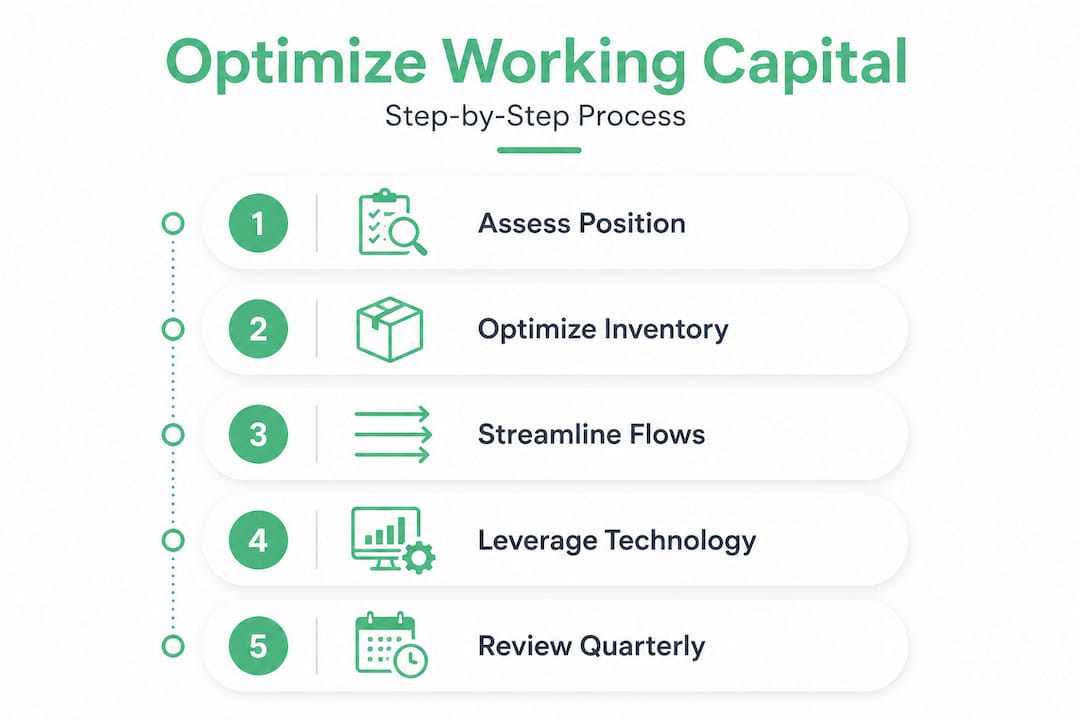
- Step 1: Assess your current working capital position
- Step 2: Optimize inventory management and procurement
- Step 3: Streamline receivables and payables for stability
- Step 4: Leverage automation and technology for sustained gains
- Troubleshooting: Common working capital mistakes in hardware companies
- Why great working capital management is a hardware company's unfair advantage
- Funding and technology: your working capital optimization partners
- Frequently asked questions
Key Takeaways
| Point | Details |
|---|---|
| Master the cash conversion cycle | Hardware companies need to track DSO, DIO, and DPO to control how much cash is tied up in daily operations. |
| Prioritize inventory and receivables | Actively manage inventory and receivables to prevent liquidity crises as the business grows. |
| Invest in automation and forecasting | Automation and AI forecasting can reduce working capital requirements by up to 60% and prevent costly scaling mistakes. |
| Avoid growth-driven cash traps | Rapid growth can dangerously lock up cash and drive a 'working capital death spiral' if not managed carefully. |
| Use funding to optimize processes | Strategic use of funding and modern tech solutions helps sustain working capital improvements and operational agility. |
Understanding the working capital cycle in hardware companies
Working capital is the difference between your current assets and current liabilities. It tells you how much liquidity is available to fund day-to-day operations. But the number alone doesn't tell the full story. What matters more is how fast that capital moves through your business, which is measured by the cash conversion cycle, or CCC.
The CCC formula for manufacturers is: CCC = DSO + DIO - DPO, where:
- DSO (days sales outstanding): How long it takes to collect payment after a sale
- DIO (days inventory outstanding): How long inventory sits before it's sold
- DPO (days payables outstanding): How long you take to pay your suppliers
A lower CCC means cash cycles through your business faster. A higher CCC means more cash is tied up and unavailable for other uses. Understanding the importance of working capital is the foundation for everything that follows.
Here's how these metrics typically look for a mid-size hardware firm:
| Metric | Industry average | High-performing firm | Impact on CCC |
|---|---|---|---|
| DSO | 45 days | 30 days | Lower is better |
| DIO | 60 days | 35 days | Lower is better |
| DPO | 30 days | 45 days | Higher is better |
| CCC | 75 days | 20 days | Lower is better |
Hardware companies face unique challenges here. High-mix, low-volume production, where you manufacture many product variants in small batches, can extend the CCC and lock up to 20% of revenue in working capital at any given time. That's a significant constraint on liquidity.
"Hardware companies that don't actively manage their CCC during growth phases often discover that profitability and cash availability move in opposite directions. Revenue rises while cash tightens."
For more context on how hardware firms navigate these dynamics, the working capital insights blog covers a range of real-world scenarios worth reviewing.
Step 1: Assess your current working capital position
With a solid grasp on the WC cycle, the next step is to determine exactly where your company stands and what's driving inefficiency. You can't improve what you haven't measured.
Follow this checklist to gather your baseline data:
- Pull your accounts receivable aging report. Calculate your current DSO. If it's above 45 days, you likely have a collections or invoicing bottleneck.
- Review your inventory turnover. Divide cost of goods sold by average inventory. Convert to DIO by dividing 365 by that number.
- Calculate your DPO. Divide accounts payable by (cost of goods sold / 365). This tells you how long you're taking to pay suppliers.
- Compute your CCC. Add DSO and DIO, then subtract DPO. This single number is your benchmark.
- Identify the largest contributor. Which metric is pulling your CCC highest? That's your first target.
- Set up a tracking system. If you're using spreadsheets, consider migrating to accounting software that calculates these metrics automatically.
Pro Tip: Benchmark your DSO, DIO, and DPO against industry peers. The National Association of Manufacturers publishes periodic benchmarks, and your industry association likely does too. A gap of 10 or more days in any metric signals a clear improvement opportunity.
High-mix production environments are particularly vulnerable. As noted earlier, complex production can lock up to 20% of revenue in working capital, so hardware firms with diverse product lines should prioritize DIO reduction first. Once you have your baseline, use cash flow forecasting tips to project how changes in each metric will affect your available cash over the next 90 days.
Learning to manage cash flows proactively, rather than reactively, is what separates companies that scale smoothly from those that hit repeated cash crunches.
Step 2: Optimize inventory management and procurement
Now that you know where cash is getting stuck, let's target one of the biggest culprits: inventory. For most hardware companies, inventory is the single largest consumer of working capital.
Research on smart hardware manufacturers shows that inventory overaccumulation creates direct liquidity pressure, and recommends just-in-time inventory, predictive analytics, and supply chain diversification as the core remedies. Here's how those approaches compare:

| Approach | Cash impact | Risk level | Best for |
|---|---|---|---|
| Traditional (buffer stock) | High cash tied up | Low supply risk | Stable, predictable demand |
| Just-in-time (JIT) | Minimal cash tied up | Higher supply risk | Consistent supplier relationships |
| Hybrid (analytics-driven) | Moderate cash tied up | Balanced | High-mix hardware firms |
For most hardware companies, a hybrid approach works best. You maintain lean buffers on high-velocity SKUs and use predictive analytics to manage low-volume, high-mix items more dynamically.
Practical steps to optimize inventory:
- Segment your SKUs by velocity. Fast-moving items can tolerate JIT. Slow-moving items need tighter reorder controls.
- Use demand forecasting software. Tools like NetSuite, Fishbowl, or even advanced Excel models can reduce overordering significantly.
- Diversify your supplier base. Relying on a single supplier creates both supply risk and pricing leverage problems. Two or three qualified suppliers per critical component is a reasonable target.
- Set reorder point triggers. Automate purchase orders when inventory hits a defined threshold rather than ordering on a schedule.
- Review procurement contracts annually. Volume commitments made during growth phases may no longer reflect actual demand.
Pro Tip: Use your point-of-sale and production data together. When sales velocity for a product line drops 15% over two consecutive months, that's an early signal to reduce procurement before excess inventory builds. Most hardware firms catch this too late.
Reducing inventory costs is also about smarter purchasing. Reviewing your approach to cutting supply chain costs can reveal savings that directly improve your DIO and free up working capital for growth.
Step 3: Streamline receivables and payables for stability
Inventory is just one leg of the cash conversion journey. The flow of receivables and payables can make or break your stability.
Dell's approach to working capital is the most cited example in hardware. Dell achieved negative working capital by combining build-to-order manufacturing, JIT inventory, fast receivables collection, and strategically delayed supplier payments. The result: customers paid Dell before Dell paid its suppliers, creating a self-funding growth engine.
"Dell's build-to-order model eliminated the need to hold finished goods inventory. Combined with disciplined receivables management and extended payables, the company operated with a negative CCC, meaning growth actually generated cash rather than consuming it."
Most hardware firms can't replicate Dell's exact model, but the principles are directly applicable. Here's a numbered action plan:
- Offer early payment discounts. A 2/10 net 30 term (2% discount if paid within 10 days) accelerates cash collection and reduces DSO meaningfully.
- Automate invoice delivery. Send invoices immediately upon shipment, not at month end. Each day of delay adds directly to your DSO.
- Implement a collections workflow. Set automated reminders at 7, 14, and 30 days past due. Consistent follow-up reduces average collection time.
- Negotiate extended payment terms with suppliers. Push DPO from 30 to 45 or 60 days where suppliers allow, but do it through conversation, not by simply paying late.
- Practice supplier relationship management (SRM). Communicate proactively with key suppliers. Suppliers who trust you are more likely to grant favorable terms.
Automation tools that support DSO and DPO improvement include:
- QuickBooks or Xero for automated invoicing and payment reminders
- Bill.com for payables workflow and approval routing
- Stripe or Square for faster digital payment collection
- ERP platforms like SAP or NetSuite for integrated AR/AP management
One critical warning: pushing DPO too aggressively without supplier buy-in can damage relationships and result in tighter terms, higher prices, or supply disruptions. The goal is balance, not extraction. Reviewing how an efficient manufacturing process integrates with payables management helps frame this balance correctly. You can also automate business processes across invoicing and payments to reduce manual errors and accelerate the entire cycle.
Step 4: Leverage automation and technology for sustained gains
After refining your manual processes, technology offers a multiplier for ongoing working capital efficiency. The gap between companies that use automation and those that rely on spreadsheets is measurable and significant.
Top-quartile firms achieve 40 to 60% lower working capital needs through automation, with DSO reductions of 20 to 30% and early payment discount capture rates of 80 to 90%. Those are not marginal improvements. They represent a structural cash advantage over competitors still managing these processes manually.
Core areas where automation delivers the most working capital impact:
- Automated billing and collections: Eliminates delays in invoice delivery and follow-up, directly reducing DSO
- Real-time inventory monitoring: Prevents overaccumulation by triggering reorder alerts based on actual consumption data
- Cash flow forecasting: AI-driven models project cash positions 30, 60, and 90 days out, enabling proactive decisions
- Payables scheduling: Optimizes payment timing to maximize DPO without damaging supplier relationships
- Reporting dashboards: Gives finance teams live visibility into CCC components so problems surface early
For hardware companies with complex product mixes, AI forecasting is especially valuable. Prioritizing AI-driven forecasting over manual processes improves accuracy in demand planning and reduces the inventory buffers needed to cover uncertainty. This directly lowers DIO.
A practical forecasting guide can help your team evaluate which forecasting tools are appropriate for your scale and complexity. The benefits of automation extend beyond working capital, but WC optimization is often where the ROI is fastest and most visible.
Troubleshooting: Common working capital mistakes in hardware companies
Even well-intentioned hardware companies fall into traps when scaling quickly. Here's how to dodge the most damaging ones.
Common working capital mistakes include:
- Overextending payables without supplier alignment. Paying late without agreement strains relationships and often leads to worse terms on renewal.
- Accumulating excess inventory during growth phases. Buying ahead of demand to secure supply is understandable, but it ties up cash and creates write-off risk if demand shifts.
- Ignoring automation until a crisis hits. Manual processes work at small scale but break down during rapid growth, creating the exact cash crunches they were meant to prevent.
- Failing to benchmark regularly. CCC metrics drift over time. Without quarterly reviews, small inefficiencies compound into large problems.
- Treating working capital as a one-time project. Optimization requires ongoing attention, not a single annual review.
The working capital death spiral is a real risk during hardware growth phases. It starts when rapid scaling increases inventory and receivables faster than payables can offset them. Cash tightens. The company stretches payables further to compensate. Suppliers push back. Procurement costs rise. The cycle accelerates.
Symptoms to watch for include: DSO climbing more than 5 days quarter over quarter, inventory turnover slowing without a corresponding increase in orders, and payables aging reports showing a growing percentage of invoices past 60 days.
Pro Tip: Schedule a quarterly working capital review with your finance team. Review DSO, DIO, and DPO against your benchmarks. Assign ownership for each metric to a specific person. Accountability drives improvement.
If you're already experiencing cash pressure, reviewing working capital solutions can help identify options quickly. For longer-term support, working capital loans provide a bridge while process improvements take hold.
Why great working capital management is a hardware company's unfair advantage
Most hardware companies treat working capital as a compliance exercise. They review it when the bank asks, fix the most obvious problem, and move on. That approach leaves significant competitive advantage on the table.
The companies that consistently outperform their peers treat working capital as a daily operational discipline. They assign metric ownership, review CCC components in weekly finance meetings, and make procurement and collections decisions with cash impact in mind. The difference in outcomes is not subtle.
Here's a perspective worth considering: most financial advice focuses on the risk of having too little working capital. That's a real risk, but it's often overstated. The more common problem for growing hardware firms is having too much cash tied up inefficiently, in slow-moving inventory, in uncollected receivables, in payables that could be extended. That trapped cash has a real cost. It limits investment in equipment, technology, and talent. It forces companies to borrow when they shouldn't need to.
Dell's negative working capital model is the extreme version of this thinking. Dell didn't just minimize cash tied up in operations. It engineered a model where growth generated cash rather than consuming it. Most hardware firms won't reach that point, but the directional goal is the same: every improvement to your CCC is capital freed up for better uses.
The companies we've seen support working capital most effectively are those that stop treating it as a finance department problem and start treating it as an operations priority. When sales, procurement, and finance are all aligned around CCC metrics, improvement happens faster and sticks longer.
Funding and technology: your working capital optimization partners
If you're ready to upgrade your working capital process, the right funding and technology can make your progress sustainable.
Implementing the strategies in this guide takes time, and cash flow gaps don't always wait for process improvements to take effect. That's where targeted funding solutions become valuable.

Capital for Business offers working capital loan options designed specifically for businesses navigating growth-phase cash demands. Whether you need a bridge while receivables catch up or capital to invest in automation tools, the right funding structure makes the difference. Explore business funding solutions tailored to hardware companies, and learn how technology and lending are changing what's possible for small and mid-size manufacturers. Fast approvals, flexible terms, and real support when banks say no.
Frequently asked questions
What is a healthy cash conversion cycle for hardware companies?
A healthy CCC is typically 60 to 90 days for manufacturers, though high-performing firms often achieve 20 to 30 days through disciplined DSO, DIO, and DPO management. Your target depends on your production mix and business model.
How can hardware businesses prevent overaccumulation of inventory?
JIT inventory, predictive analytics, and supplier diversification are the most effective tools for preventing excess stock and maintaining liquidity. Segmenting SKUs by velocity helps prioritize where to apply each approach.
What are the risks of extending supplier payment terms too far?
Overextending DPO can damage supplier relationships and lead to higher procurement costs or tighter terms on renewal, which offsets the short-term cash flow benefit. Always negotiate extensions rather than simply paying late.
How does automation help reduce working capital needs?
Top-quartile firms lower working capital needs by 40 to 60% through automation, primarily by reducing DSO and improving early payment discount capture. The gains are structural, not one-time.
Why do hardware firms face greater working capital challenges during rapid growth?
Rapid growth requires roughly 17% of revenue in working capital, and high-mix production can lock up to 20%. Without active management, inventory and receivables scale faster than payables, creating a cash gap that tightens as the business grows.