TL;DR:
- Equipment financing helps plumbing businesses purchase vehicles and tools using the assets as collateral. Proper preparation and understanding of options allow faster approval and better terms. Combining equipment loans with working capital financing supports growth and cash flow management.
Equipment financing for plumbing businesses is defined as a loan or lease structure that funds the purchase of vehicles, tools, and diagnostic systems using the equipment itself as collateral. This step by step guide to plumbing equipment financing covers every stage of the process, from identifying what you need to managing payments after funding. A fully equipped plumbing service van costs between $35,000 and $70,000, and specialized tools can push total startup costs well past $100,000. Financing those assets preserves your cash reserves and keeps your business competitive without requiring a large upfront payment. Capitalforbusiness has helped plumbing businesses across the country access the capital they need to grow since 2009.
What is the step by step guide to plumbing equipment financing?
Equipment financing for plumbers follows a structured path: assess your needs, gather documentation, apply, receive approval, and manage the funds. Each step builds on the last, and skipping one creates delays or denials. The industry term for this process is "commercial equipment financing," and it applies specifically to physical assets your business uses to generate revenue. Understanding the full path before you start saves time and reduces the risk of rejection.

What plumbing equipment and assets can be financed?
The range of eligible assets is broader than most plumbing business owners expect. Financing covers vehicles, specialized tools, and the upfitting required to make a service truck field-ready.
Vehicles and service vans
Service vans are the most common financed asset in the plumbing industry. A fully outfitted van costs $35,000 to $70,000, and that figure does not include shelving, pipe racks, or branded wraps. Lenders treat vehicles as strong collateral because they hold resale value and are easy to repossess if a loan defaults. Fleet expansion, meaning adding a second or third van, follows the same financing structure as the first.
Specialized diagnostic and repair equipment
Trenchless pipe repair machines cost $20,000 to $100,000. Sewer cameras run $5,000 to $15,000, and water jetting units range from $10,000 to $50,000. These are not optional tools for a growing plumbing business. They determine which jobs you can bid on and how efficiently you complete them. Financing these assets through a structured loan lets you acquire them now and pay for them with the revenue they generate.
Truck upfitting and specialty systems
Equipment financing covers upfitting as well as the base vehicle. That includes custom shelving, pipe storage systems, generator mounts, and onboard water tanks. Lenders bundle upfitting costs into the same loan as the vehicle when the work is done before delivery. This simplifies your payment structure and avoids the need for a separate personal loan to cover modifications.
Financing terms and collateral structure
Equipment financing terms generally range from three to seven years. The equipment itself serves as collateral, which means lenders do not require you to pledge personal assets or real estate. This structure makes financing accessible to small plumbing businesses that lack significant balance sheet assets. You can review the full range of equipment financing options at Capitalforbusiness to compare term lengths and funding amounts.
Pro Tip: Prioritize financing equipment that directly generates billable revenue, such as a sewer camera or jetting unit, before financing convenience items. Revenue-generating tools pay for themselves faster and strengthen your case with lenders.
What documentation do you need for plumbing equipment financing?
Lenders require a standard credit package before approving any equipment loan. The application typically includes financial statements, business information, and a credit application. Preparing these documents before you apply is the single fastest way to shorten your approval timeline.
What lenders evaluate
Lenders assess three things: your creditworthiness, your cash flow, and the value of the equipment being financed. A strong credit profile signals low default risk. Consistent cash flow proves you can service the debt. Equipment value determines how much the lender can recover if the loan goes sideways. All three factors influence your interest rate and loan terms.
Documentation checklist
The table below lists the documents most lenders require and what each one demonstrates.
| Document | What it shows the lender |
|---|---|
| Profit and loss statement (last 2 years) | Revenue trends and operating profitability |
| Balance sheet | Assets, liabilities, and net worth of the business |
| Business tax returns (last 2 years) | Verified income and tax compliance |
| Business credit report | Payment history and existing debt obligations |
| Bank statements (last 3–6 months) | Real-time cash flow and account stability |
| Equipment quote or invoice | Asset value and collateral basis for the loan |
| Business license and formation documents | Legal standing and years in operation |
Lenders typically require profit and loss statements, balance sheets, business tax returns, and credit reports. Having these prepared in advance accelerates approval. Missing even one document can push your decision back by days.
Business credit profile
Your business credit profile carries significant weight in the approval process. Lenders look at your Dun & Bradstreet PAYDEX score, your Experian Business score, and your personal credit score if the business is young. A score below 600 does not automatically disqualify you, but it will affect your rate. Paying existing suppliers and vendors on time is the fastest way to build a stronger business credit profile before you apply.
Pro Tip: Pull your business credit report at least 60 days before applying. Errors are common and take time to dispute. Fixing a reporting mistake before you apply can improve your rate significantly.
How do you apply and secure plumbing equipment financing?
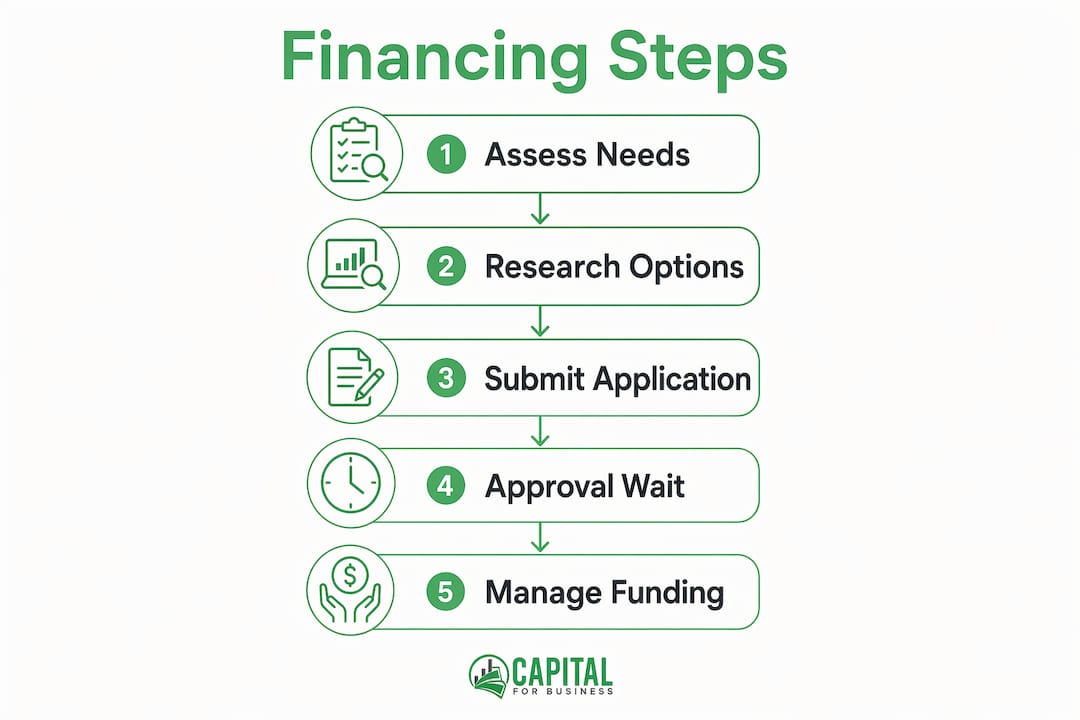
The application process for financing plumbing tools follows five clear steps. Each one has a specific purpose, and completing them in order reduces the chance of delays.
Step 1: Assess your financial needs and target equipment
Start by identifying exactly what you need and what it costs. Get a formal quote from the vendor or dealer. Calculate the monthly payment you can afford based on your current cash flow, not your projected revenue. Lenders underwrite based on what you earn now, not what you expect to earn after the equipment arrives.
Step 2: Research and compare financing options
Equipment financing for plumbers comes from several sources: banks, credit unions, online lenders, and specialty small business lenders like Capitalforbusiness. Banks offer lower rates but require stronger credit profiles and longer approval timelines. Online lenders move faster and accept a wider range of credit profiles. Specialty lenders understand trade businesses and structure terms around project-based cash flow. You can compare small business loan options to find the structure that fits your business.
If you are weighing a loan against a lease, the decision comes down to ownership. Loans build equity in the equipment. Leases keep payments lower but leave you without an asset at the end of the term. Capitalforbusiness has a detailed breakdown of loan vs. leasing tradeoffs if you need to work through that decision.
Step 3: Submit your application with complete documentation
Submit your full credit package in one batch. Incomplete applications are the leading cause of approval delays. Include the equipment quote, all financial statements, your business license, and your credit application. Double-check that every document covers the required time period. A profit and loss statement from three years ago does not satisfy a lender asking for the last two years.
Step 4: Understand approval timelines
Many plumbing businesses receive financing decisions within 24 to 48 hours when using online applications with complete documentation. Some lenders issue same-day offers. Traditional bank approvals take longer, often one to three weeks. Factor this timeline into your equipment acquisition plan. If you need a van on the road by a specific date, apply at least two weeks early to account for any back-and-forth on documentation.
Step 5: Manage funding and equipment acquisition
Once approved, funds are typically sent directly to the equipment vendor. Confirm the payment process with your lender before signing. Set up automatic payments immediately to protect your credit profile. Track the equipment as a business asset in your accounting records from day one. This matters for tax purposes, since Section 179 of the IRS tax code allows businesses to deduct the full cost of qualifying equipment in the year it is placed in service.
Pro Tip: Build a relationship with your lender before you need your next loan. Share quarterly financials, pay on time, and communicate early if cash flow tightens. Lenders extend better terms to borrowers they already know.
What are the most common mistakes in plumbing equipment financing?
Financing mistakes in the plumbing industry tend to follow predictable patterns. Common errors include overextending credit, mismanaging cash flow gaps, and failing to prepare proper documentation. Each one is avoidable with the right preparation.
The top five mistakes to avoid
-
Borrowing more than cash flow supports. A new van generates revenue, but it takes time to fill a new crew's schedule. Borrow based on current revenue, not optimistic projections.
-
Ignoring cash flow timing. Commercial plumbing contracts often pay 30 to 60 days after job completion. If your loan payment is due before the invoice clears, you face a gap. A working capital loan alongside your equipment loan solves this problem directly.
-
Submitting incomplete documentation. Missing a single document delays your approval and signals disorganization to the lender. Use the checklist in this guide before you submit.
-
Financing the wrong equipment first. Financing a new truck before you have the jobs to fill it creates debt without immediate revenue. Finance equipment that addresses your current bottleneck, not your future wish list.
-
Stacking too many loans at once. Taking on equipment financing, a working capital loan, and a business credit line simultaneously strains your debt service coverage ratio. Lenders see this and tighten terms or deny future applications.
Managing fleet expansion alongside working capital
Pairing equipment financing with working capital loans is the most successful growth path for plumbing businesses moving to multi-crew operations. Equipment loans fund the van and tools. Working capital loans cover payroll, materials, and operating costs between invoice payments. Working capital loans fill the gap that equipment financing was never designed to cover. Using both products together keeps your operation running without forcing you to choose between paying your crew and servicing your debt.
Key Takeaways
Plumbing businesses that follow a structured financing process, prepare complete documentation, and pair equipment loans with working capital funding grow faster and avoid the cash flow traps that stall single-truck operations.
| Point | Details |
|---|---|
| Equipment costs are significant | Service vans cost $35,000–$70,000; specialized tools add up to $100,000 more. |
| Terms favor small businesses | Financing runs 3–7 years with the equipment as collateral, no personal assets required. |
| Documentation drives approval speed | Submitting complete financial records upfront cuts approval time to 24–48 hours. |
| Pair financing types strategically | Combine equipment loans with working capital loans to cover cash flow gaps between invoices. |
| Avoid overextension | Borrow based on current revenue, not projected growth, to protect your debt service ratio. |
What I've learned from financing plumbing businesses over 15 years
The biggest mistake I see plumbing business owners make is treating equipment financing as a one-time transaction. They get the van, make the payments, and never think about the lender again until they need another loan. That approach costs them money every single time.
Lenders reward relationships. A plumbing business that shares quarterly financials, pays on time, and calls ahead when a slow month is coming gets better rates on the next loan. One that goes silent and misses a payment gets treated like a stranger. The difference in rate between a known borrower and an unknown one can be several percentage points over a five-year term. That adds up to real money on a $70,000 loan.
The second thing I have seen consistently is that combining equipment financing with working capital is not optional for businesses scaling past one truck. Commercial contracts pay slowly. Materials cost money upfront. Payroll does not wait for invoices to clear. Businesses that try to fund all of that from equipment loan proceeds run out of cash before the new crew generates enough revenue to cover costs. The ones that plan for this from the start grow steadily. The ones that don't often contract back to a single-truck operation within a year.
Scaling from one truck to three is not three times harder than starting. It is a different kind of challenge entirely, and financing structure is the part most owners underestimate.
— Capital
Capitalforbusiness financing solutions for plumbing businesses
Capitalforbusiness has worked with plumbing businesses since 2009, offering equipment financing up to $250,000 with same-day funding options for qualified applicants. The application process is straightforward, and decisions come fast, so you can get equipment on the road without waiting weeks for a bank response.
For plumbing businesses that need more than equipment funding, Capitalforbusiness also offers working capital loans, business lines of credit, and merchant cash advances. Each product is designed to fit the cash flow patterns of trade businesses, not the rigid structures banks impose. Visit the plumbing business loans page to see funding amounts, terms, and application requirements built specifically for plumbers.
FAQ
What does plumbing equipment financing cover?
Equipment financing for plumbers covers service vans, trenchless pipe repair machines, sewer cameras, water jetting units, and truck upfitting. The equipment itself serves as collateral, so no personal assets are required.
How long does it take to get approved for plumbing equipment financing?
Most plumbing businesses receive a financing decision within 24 to 48 hours when they submit a complete application online. Some lenders issue same-day offers for well-prepared applicants.
What credit score do I need to finance plumbing equipment?
Lenders evaluate both your business credit profile and personal credit score. A score below 600 does not automatically disqualify you, but it will affect your interest rate and loan terms.
Can I finance a plumbing truck and working capital at the same time?
Yes. Pairing an equipment loan for your vehicle with a working capital loan is the recommended approach for plumbing businesses managing project-based cash flow. The two products serve different purposes and are structured separately.
What documents do I need to apply for plumbing equipment financing?
Lenders typically require profit and loss statements, balance sheets, business tax returns for the last two years, bank statements, a business credit report, and a vendor quote for the equipment being financed.