
TL;DR:
- Securing working capital for plumbing businesses involves choosing the right financing options based on timing gaps and operational practices. Using invoice factoring, SBA loans, business lines of credit, and operational tactics like deposits and supplier negotiations helps manage cash flow effectively. Combining multiple strategies and maintaining operational discipline ensures sustainable growth and reduces reliance on emergency borrowing.
Working capital for plumbing businesses is defined as the liquid funds available to cover daily operational costs between the time you pay for labor and materials and the time your customers actually pay you. Knowing how to secure working capital for plumbing operations is the difference between taking on profitable jobs and turning them down because cash is tied up in unpaid invoices. The core solutions plumbing contractors rely on include invoice factoring, SBA 7(a) loans, business lines of credit, and operational tactics like deposit requirements and supplier term negotiations. In 2026, extended payment cycles, rising material costs, and technology-enabled AR automation have made strategic capital planning more accessible and more necessary than ever.
What are the primary financing options to secure working capital for plumbing?
Plumbing contractors face a structural cash flow problem. You buy materials, pay your crew, and complete the work weeks or months before the check arrives. The average Days Sales Outstanding for building equipment contractors sits at 57 days, with 82% of contractors waiting more than 30 days past their stated terms. That gap has to be funded somehow, and the method you choose determines your cost, your flexibility, and your risk.

Invoice factoring
Invoice factoring converts your outstanding invoices into immediate cash by selling them to a third-party factoring company. Platforms like Resolve Pay offer 100% non-recourse financing with AI-powered credit decisions and 24-hour funding, which directly addresses the 60 to 90 day payment cycles common in commercial plumbing. Non-recourse factoring means the factoring company absorbs the credit risk if your customer fails to pay, which is a meaningful protection when you are working with general contractors or property managers. Typical advance rates run from 70% to 90% of the invoice face value, with the remainder released minus fees once your customer pays.
SBA 7(a) loans
SBA 7(a) loans are the right tool for planned working capital needs, not urgent cash gaps. These loans offer terms up to 10 years for working capital, but the application-to-funding timeline runs 60 to 90 days. That processing time makes SBA loans poorly suited for covering a payroll shortfall next week. They work well for plumbing businesses that want to build a permanent capital base, fund a seasonal ramp-up months in advance, or finance a significant equipment purchase alongside working capital.
Business lines of credit
A business line of credit functions as timing insurance. You draw on it when collections lag and repay it when customers pay. The critical distinction, as Profitability Partners advises, is that a line of credit should cover timing gaps, not fund ongoing operating losses. Smaller plumbing contractors often struggle to qualify for a line large enough to be meaningful, particularly if they are asset-light and lack substantial collateral. Building a cash buffer first and using a line of credit as a secondary tool is the more sustainable approach.
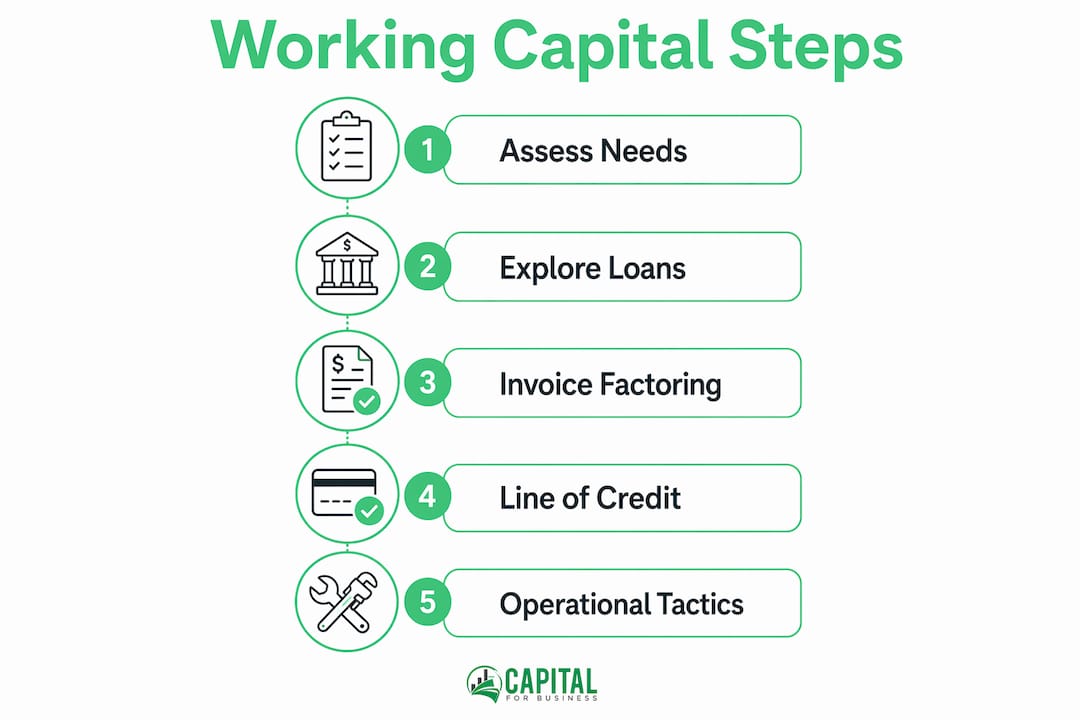
Operational capital tactics
Two non-debt tactics deserve equal attention alongside loan products. Requiring deposits of 30% to 50% on installations and larger service jobs puts cash in your account before you spend a dollar on materials. Negotiating extended supplier payment terms, moving from net 30 to net 45 or net 60, keeps your cash working longer. Moving supplier terms from net 30 to net 45 can free approximately $25,000 in cash on a $50,000 monthly materials spend. That is a zero-cost capital improvement that most contractors overlook.
Here is a direct comparison of the four primary options:
| Financing option | Best use case | Typical timeline | Cost range | Key risk |
|---|---|---|---|---|
| Invoice factoring | Bridging 60-90 day payment gaps | 24-48 hours | 1%-5% per 30 days | Customer concentration |
| SBA 7(a) loan | Planned capital needs, expansion | 60-90 days | 6%-10% APR | Long approval process |
| Business line of credit | Short-term timing gaps | 1-2 weeks | 8%-25% APR | Qualification difficulty |
| Deposits and supplier terms | Reducing cash outflow | Immediate | No direct cost | Client pushback |
Pro Tip: Combine two methods rather than relying on one. Use invoice factoring for immediate receivables gaps and negotiate deposits on new projects simultaneously. The two tactics address different parts of your cash cycle without stacking debt.
How do you prepare to qualify for plumbing financing?
Preparation determines whether your application succeeds and what rate you receive. Lenders and factoring companies evaluate your business differently, but several preparation steps apply across all funding options for plumbers.
-
Organize your financial records. Lenders require at minimum three to six months of business bank statements, a current profit and loss statement, and accounts receivable aging reports. Factoring companies focus heavily on the creditworthiness of your customers rather than your own credit score, so a clean AR aging report with well-known commercial clients is a strong asset.
-
Separate business and personal finances. A dedicated business checking account with consistent deposits signals operational stability. Mixing personal and business transactions is one of the fastest ways to trigger a denial or a higher rate.
-
Review and improve your credit profile. SBA loans and lines of credit rely on your personal and business credit scores. Pay down revolving balances, resolve any outstanding collections, and check your Dun and Bradstreet business credit file for errors before applying. A score improvement of even 20 to 30 points can shift you into a better rate tier.
-
Choose lenders with contractor experience. A lender familiar with construction payment cycles will not penalize you for high DSO figures or retainage-heavy balance sheets. Capitalforbusiness has worked with plumbing contractors since 2009 and understands the cash flow patterns specific to the trade. Generic bank underwriters often misread contractor financials and decline applications that specialist lenders approve routinely.
-
Time your SBA application correctly. Because SBA 7(a) processing takes 60 to 90 days, submit your application before you need the funds. Plumbing businesses that anticipate a busy spring or fall season should apply in January or July respectively to have capital available when project volume peaks.
-
Negotiate payment terms before signing contracts. Your financing cost drops significantly when you collect faster. Offering a 1% to 2% early payment discount to commercial clients, as Forbes recommends for AR optimization, can shorten your collection cycle by two to three weeks and reduce your dependence on borrowed capital.
Pro Tip: Before applying for any loan product, pull your business credit report from Dun and Bradstreet and Experian Business. Errors are common and correcting them costs nothing, but the improvement to your approval odds can be significant.
How can plumbing contractors use invoice factoring to bridge payment delays?
Invoice factoring is the most direct solution to the specific cash flow problem plumbing contractors face. The structure is straightforward: you complete work, issue an invoice, and sell that invoice to a factoring company for immediate cash rather than waiting 57 or more days to collect.
The commercial payment cycle in plumbing creates a compounding problem. You fund materials and labor upfront, then wait for pay application certification, then wait for the general contractor's payment cycle, and in many commercial jobs you also absorb retainage. Retainage typically runs 5% to 10% of the contract value, held until job completion, meaning a portion of every invoice is locked up for months beyond the invoice date. Factoring companies that specialize in construction understand this structure and can advance against invoices even when retainage is involved.
The distinction between recourse and non-recourse factoring matters for risk management. Recourse factoring requires you to buy back the invoice if your customer does not pay. Non-recourse factoring transfers that credit risk to the factoring company. For plumbing contractors working with multiple general contractors or commercial property managers, non-recourse options provide meaningful protection against customer insolvency.
Factoring companies that specialize in plumbing, such as Factor Funding Co., offer dedicated programs with 70% to 90% advances and handle lien rights and compliance management as part of their service. This matters because construction lien law varies by state, and a factoring company unfamiliar with mechanics lien requirements can create legal complications when collecting from general contractors. Choosing a specialist eliminates that risk.
AR automation tools integrated with factoring platforms reduce your Days Sales Outstanding further. Software like Housecall Pro automates invoice delivery and payment reminders, which shortens the time between job completion and invoice submission. Faster submission means faster factoring advances and a shorter overall cash cycle.
Pro Tip: When evaluating factoring companies, ask specifically whether they handle mechanics lien compliance in your state. A factoring partner that manages lien notices protects your right to payment on commercial jobs without requiring you to track deadlines separately.
Here is a breakdown of factoring structure for a typical plumbing invoice:
| Invoice scenario | Invoice value | Advance rate | Immediate cash | Reserve released | Total factoring fee |
|---|---|---|---|---|---|
| Standard commercial invoice | $20,000 | 85% | $17,000 | $2,600 | $400 (2%) |
| Retainage-inclusive invoice | $50,000 | 75% | $37,500 | $11,000 | $1,500 (3%) |
| Large GC project invoice | $100,000 | 90% | $90,000 | $8,000 | $2,000 (2%) |
What operational strategies optimize working capital beyond loans?
Financing tools solve the symptom. Operational discipline addresses the cause. The most effective plumbing businesses combine both, using financing to cover unavoidable gaps while systematically reducing those gaps through process improvements.
The starting point is billing discipline. Many plumbing contractors delay invoicing until the end of the month or until a project reaches a certain stage. Every day you delay billing is a day added to your collection cycle. Submit invoices the same day work is completed or a project milestone is reached. On larger commercial jobs, align your pay application submission dates with the general contractor's billing cycle to avoid a full month's delay.
Requiring deposits on new installations and service agreements is the single highest-impact operational change most plumbing businesses can make. A 30% to 50% deposit on a $10,000 water heater installation or repiping job covers your material cost before you spend it. Clients who push back on deposits are often the same clients who pay slowly, so the deposit requirement also functions as a customer quality filter.
Aligning subcontractor payment timing with your own collection schedule prevents cash from flowing out before it flows in. Pay subcontractors on net 15 or net 20 terms tied to when you expect to collect from the primary client. This is standard practice in commercial construction and protects your working capital without damaging subcontractor relationships.
Here are additional operational tactics that reduce your reliance on external capital:
- Automate invoice delivery and reminders. Software platforms reduce the time between job completion and payment by eliminating manual follow-up. Automated reminders sent at 7, 14, and 30 days past due recover a meaningful percentage of slow-paying accounts without requiring staff time.
- Build a 30-day cash buffer. Maintain enough cash in your business account to cover one month of fixed costs including payroll, insurance, and lease payments. This buffer prevents emergency borrowing at high rates when a large client pays late.
- Review your customer mix quarterly. If more than 40% of your revenue comes from a single commercial client with slow payment habits, you carry concentrated cash flow risk. Diversifying your client base reduces that exposure.
- Offer early payment incentives selectively. A 1% to 2% discount for payment within 10 days, as Forbes identifies as a proven AR tactic, is worth offering to commercial clients whose standard terms run 60 days or longer. The cost of the discount is almost always lower than the cost of factoring or a line of credit draw.
Pro Tip: Set up a simple 13-week cash flow forecast in a spreadsheet. Map your expected collections against your known expenses for the next quarter. This single exercise reveals cash gaps weeks before they become crises, giving you time to activate factoring or draw on a line of credit at planned rates rather than emergency rates.
Key takeaways
Securing working capital for plumbing businesses requires matching the right financing tool to the specific timing gap in your cash cycle, combined with operational discipline that reduces how large those gaps become.
| Point | Details |
|---|---|
| Invoice factoring for speed | Factoring delivers cash in 24 to 48 hours and is the fastest solution for 60 to 90 day payment gaps. |
| SBA loans require advance planning | SBA 7(a) loans take 60 to 90 days to fund, making them suitable for planned capital needs only. |
| Deposits reduce borrowing needs | Requiring 30% to 50% deposits on installations covers material costs before you spend them. |
| Lines of credit as backup only | Use a line of credit for timing gaps, not as a substitute for positive operating cash flow. |
| Operational tactics cut costs | Extending supplier terms and automating invoicing reduce cash gaps without adding debt. |
What I've learned from working with plumbing contractors on capital
At Capitalforbusiness, we have worked with plumbing contractors across the country since 2009, and the pattern we see most often is this: contractors come to us in a cash crisis that was visible on their books three months earlier. The invoices were aging, the materials bill was growing, and the line of credit was already drawn. By the time they call, their options are narrower and more expensive than they needed to be.
The contractors who manage capital well share one habit. They treat financing as a planned tool rather than an emergency response. They know their DSO, they know their peak material spend months, and they have a factoring relationship or a line of credit in place before they need it. When a large commercial job comes in with net 60 terms, they factor the invoices from day one rather than waiting to see if cash gets tight.
The other pattern worth naming is the over-reliance on a single tool. Contractors who use only invoice factoring sometimes pay more than necessary on invoices where a deposit or faster billing would have eliminated the gap entirely. Contractors who rely only on a line of credit eventually hit the limit during a growth phase and have no secondary option. The most resilient plumbing businesses layer two or three tools: operational tactics to shrink the gap, factoring for immediate receivables needs, and a line of credit as a true backstop.
Working capital is not a borrowing problem for most plumbing businesses. It is a timing problem. Solve the timing through a combination of operational discipline and the right financing products, and the cost of capital drops significantly. That is the practical reality we see across hundreds of contractor clients, and it is the framework that produces sustainable growth rather than a cycle of emergency borrowing.
— Capital
Funding solutions for plumbing businesses from Capitalforbusiness
Capitalforbusiness offers a full range of plumbing business loans designed specifically for contractors managing the cash flow demands of the trade. Whether you need a fast working capital advance to cover payroll during a slow collection period or a structured loan to fund a growth phase, the application process is straightforward and decisions are made quickly.

Explore working capital loans up to $500,000 built for small businesses, or review the types of small business loans available to find the product that matches your current need. Capitalforbusiness has served plumbing contractors since 2009, and the team understands the payment cycles, retainage structures, and seasonal patterns that define the trade. Apply online in minutes and get a funding decision without the delays that traditional banks impose.
FAQ
What is working capital in a plumbing business?
Working capital in a plumbing business is the difference between your current assets, primarily cash and receivables, and your current liabilities, including supplier invoices and payroll obligations. It measures your ability to fund daily operations while waiting for customers to pay.
How fast can a plumbing contractor access invoice factoring?
Platforms like Resolve Pay offer 24-hour funding with AI-powered credit decisions, making invoice factoring the fastest available option for plumbing contractors facing immediate cash gaps.
What credit score do I need for a small business loan for plumbing?
Requirements vary by lender and product. SBA 7(a) loans typically require a personal credit score of 650 or higher, while alternative lenders and factoring companies often prioritize your customers' creditworthiness over your own score.
Are deposits from customers considered working capital?
Yes. Customer deposits collected before work begins are immediately available cash and function as the lowest-cost form of working capital because they carry no interest or fees. Requiring 30% to 50% deposits on larger jobs is one of the most effective cash flow strategies available to plumbing contractors.
How do SBA loans compare to invoice factoring for plumbing businesses?
SBA 7(a) loans offer lower interest rates and longer repayment terms but require 60 to 90 days to fund, making them suitable for planned capital needs. Invoice factoring provides cash within 24 to 48 hours at a higher per-invoice cost, making it the better choice for bridging immediate payment gaps on commercial projects.