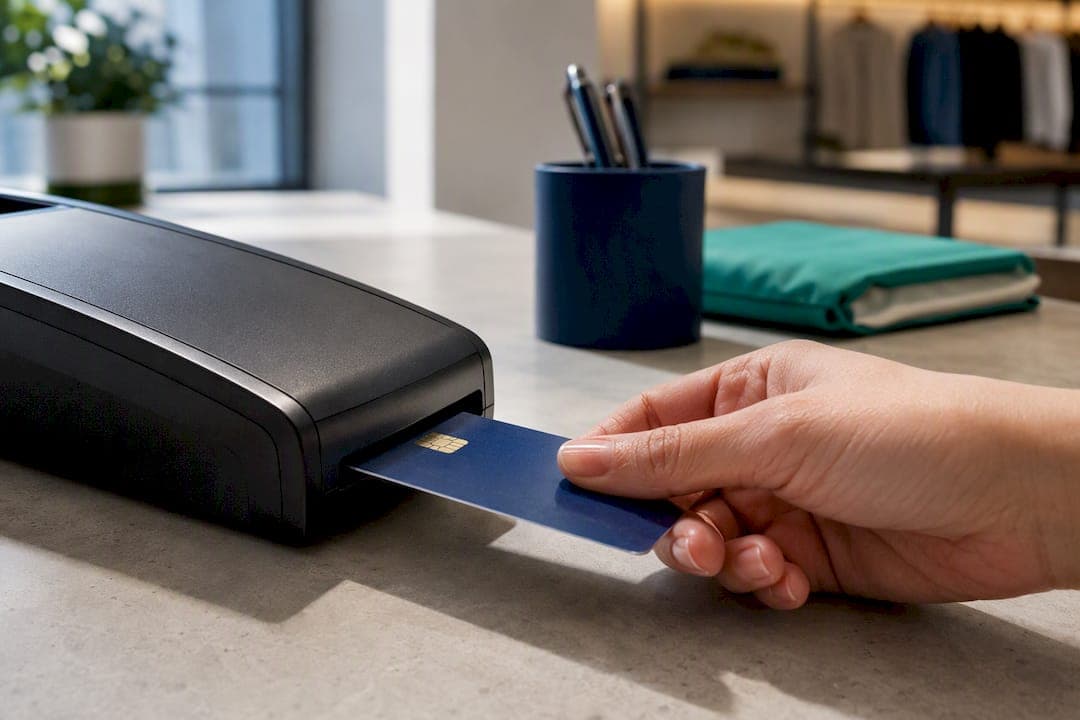
To obtain EMV liability protection, a merchant must use a terminal that is both chip-capable and chip-enabled, correctly configured with its acquirer so complete chip data reaches authorization and clearing. Meeting that standard shields merchants from most counterfeit card fraud losses at the point of sale, though it does nothing for card-not-present fraud or general data security. Before assuming compliance, business owners should confirm terminal approval, kernel and AID settings, and whether Data Element 55 is transmitted with each transaction.
TL;DR:
- Proper EMV liability protection depends on ensuring the terminal is both chip-capable and correctly enabled by the processor, not just physically installed.
- Verifying AID, kernel settings, and complete chip data transmission during test transactions is crucial to confirm genuine compliance.
- As online and card-not-present fraud are unaffected by EMV, merchants should implement additional security measures for those channels.
- Regularly updating terminal firmware, certificates, and configuration settings prevents accidental lapses in protection over time.
- Financing options like equipment loans or working capital assistance can facilitate EMV upgrades without disrupting cash flow.
Table of Contents
- What EMV compliance means for merchants
- Terminal and technical requirements: what your POS must support
- Liability shift, chargebacks, and merchant risk
- EMV vs PCI and P2PE: reducing your audit burden
- Step-by-step compliance checklist for verifying liability protection
- Costs, timelines, and common pitfalls that leave merchants exposed
- Publisher perspective: how Capital for Business helps merchants plan and finance EMV upgrades
- EMV certification process and required approvals
- Types of EMV cards and payment protocols
- Overview of EMV fraud prevention benefits and limitations
- How software updates and maintenance affect ongoing EMV compliance
- Regulatory or regional variations and updates in EMV requirements
- The gap between EMV compliance and real protection
- How Capital for Business can help with financing and processing
- Sources
- FAQ
What EMV compliance means for merchants
EMV compliance, at the merchant level, means accepting chip cards through hardware and software that meet the technical standards that card networks require, then keeping that setup current. It is a narrower concept than PCI DSS, which governs how businesses store, process, and transmit cardholder data across the entire payment environment, not just at the terminal.
EMV was built to stop one specific problem: counterfeit cards used in person. It does little against fraud that happens when a card number is typed into a website or phone order, since no chip is present to verify. That distinction matters when a business owner budgets for fraud prevention, because a chip reader alone will not stop online fraud.
- EMV protects against counterfeit, card-present fraud through chip authentication.
- PCI DSS governs cardholder data security across storage, processing, and transmission.
- Card-not-present fraud and account takeover require separate controls beyond EMV.
Adopting EMV is best understood as a risk-management decision. A merchant who accepts the upfront cost of chip terminals generally trades away a category of chargeback liability that would otherwise fall on their business.
Terminal and technical requirements: what your POS must support
A terminal being "chip-capable" only means the hardware has a chip reader installed. "Chip-enabled" means the acquirer or processor has activated EMV processing on that hardware, which is a separate step many merchants overlook. Liability protection depends on the second condition, not the first.
To confirm a terminal genuinely qualifies, work through this checklist with your processor or IT contact:
- Confirm the reader model appears on your card network's approved device list.
- Verify the correct Application Identifiers (AIDs) and kernels are loaded for the card brands you accept.
- Check that required data elements, including Data Element 55, are captured and sent in every authorization message.
- Confirm contact chip support is active, and add contactless support if you accept tap payments.
- Review whether the terminal operates online-only or supports offline authorization, since this changes risk exposure.
- Confirm PIN and signature handling match your card networks' current rules.
Behind these steps sit a few technical values worth knowing by name. Terminal Entry Capability (TEC), Terminal Verification Results (TVR), and Terminal Action Codes determine how a transaction is classified during processing, and inconsistent values in these fields can quietly erase chargeback protection even when the hardware looks compliant. Certificate and CRL (Certificate Revocation List) management also needs periodic attention, since expired certificates can cause declined transactions or unexpected fallback to magnetic stripe.
Pro Tip: Ask your processor for a sample authorization and clearing record so you can visually confirm the chip data fields are populating correctly, rather than assuming activation was completed.
Liability shift, chargebacks, and merchant risk
The October 2015 liability shift changed who absorbs the cost of counterfeit card fraud at the point of sale. Networks assign responsibility to whichever party, merchant or card issuer, lacks chip support for that transaction. A merchant using a properly enabled chip terminal is generally protected from these counterfeit chargebacks, even if the customer's card turns out to be fraudulent.
Real disputes usually follow a pattern:
- A counterfeit card is swiped rather than inserted, because the terminal allowed a magnetic-stripe fallback.
- A chip-capable terminal was never enabled by the processor, leaving the merchant exposed despite having modern hardware.
- Authorization data was incomplete, so the issuer cannot confirm chip use during a dispute.
A properly enabled EMV terminal is one of the more reliable protections against counterfeit card losses, according to U.S. Payments Forum guidance on the liability shift, though exact coverage still varies by network and transaction type.
To preserve representment rights during a dispute, merchants should retain transaction records showing TEC and TVR values along with confirmation that chip data was present in both authorization and clearing. This documentation is what allows a business to push back successfully when a chargeback is filed incorrectly. Practical prevention habits, covered in more detail in Capital for Business's chargeback prevention guidance, also reduce how often disputes reach this stage at all.
EMV vs PCI and P2PE: reducing your audit burden
EMV and PCI DSS solve different problems, and confusing them leads merchants to underinvest in one or the other. EMV secures the card-present authentication step. PCI DSS governs everything else: how cardholder data is stored, transmitted, and protected across your business.
One practical way to lighten the PCI side of that equation is pairing EMV terminals with a validated, PCI-listed Point-to-Point Encryption (P2PE) solution. When implemented correctly, this can qualify a merchant for the shorter SAQ P2PE self-assessment rather than a longer, more demanding questionnaire.
- Confirm your P2PE solution and devices appear on the official PCI-listed validated solutions directory.
- Follow the vendor's P2PE Instruction Manual (PIM) exactly, since deviations can void your reduced-scope eligibility.
- Avoid key-entered transactions or storing paper records containing card data, both of which disqualify merchants from SAQ P2PE.
Pro Tip: Keep a signed copy of your P2PE vendor's PIM on file, since assessors and acquirers will ask for it during any compliance review. Merchants exploring broader scope reduction strategies can also review Capital for Business's guide to shrinking PCI scope for additional detail.
Step-by-step compliance checklist for verifying liability protection
Getting EMV compliance right is less about buying new hardware and more about verifying every link in the chain actually works as intended.
- Contact your acquirer or processor and request written confirmation that your terminal model is approved and enabled for EMV processing.
- Ask for the AID and kernel configuration report to confirm it matches the card brands you accept.
- Run test transactions using both contact and contactless methods, then request the authorization and clearing records to confirm TEC, TVR, and Data Element 55 are present.
- Decide whether a validated P2PE solution fits your business, and confirm SAQ P2PE eligibility with your processor before assuming reduced scope.
- Keep the vendor's PIM, your Attestation of Compliance (AOC), and your terminal's Letter of Approval in a single compliance file.
- Train staff on chip insertion and tap flows, proper fallback handling when a chip fails to read, and basic inspection of the point-of-interaction device for tampering.
| Action | Owner | Why it matters |
|---|---|---|
| Confirm terminal enablement | Acquirer/processor | Chip-capable hardware without enablement offers no liability protection |
| Verify AID/kernel settings | Processor or IT contact | Wrong settings can misclassify transactions during disputes |
| Run contact and contactless tests | Merchant with processor support | Confirms chip data actually reaches authorization and clearing |
| Retain PIM, AOC, Letter of Approval | Merchant | Required documentation for audits and chargeback representment |
Costs, timelines, and common pitfalls that leave merchants exposed
Budgeting for EMV compliance typically involves several cost categories rather than one line item: terminal hardware itself, activation and configuration fees charged by the processor, integration and testing time if the terminal connects to a point-of-sale system, and potential non-EMV assessment fees for businesses that delay upgrading.
Timelines vary depending on how many locations and systems are involved, but most small merchants move through procurement, processor enablement, and test transactions within a matter of weeks, longer if custom POS integration is required.
The pitfalls that undo this work are consistent across the industry:
- Terminals left chip-capable but never enabled by the processor.
- Incorrect AID or kernel settings that misclassify transaction types.
- Missing or incomplete chip data in clearing records, even when authorization looked correct.
- Poor fallback procedures that allow repeated magnetic-stripe swipes when a chip fails to read.
Each of these mistakes can quietly negate liability protection even on modern hardware, which is why verification matters as much as the initial purchase.
Publisher perspective: how Capital for Business helps merchants plan and finance EMV upgrades
Experience in payment processing changes shapes financing conversations around equipment upgrades, since a terminal purchase rarely happens in isolation from other operational needs.
Merchants weighing EMV upgrades alongside other priorities can review our guidance on reducing credit card processing fees or explore our merchant processing services directly. When the upgrade itself needs funding, equipment financing and working capital loans offer a practical way to spread the cost rather than paying for hardware, activation, and integration all at once.
EMV certification process and required approvals
Getting a terminal to market involves layers of approval before a merchant ever sees it on a shelf. Manufacturers must first secure EMVCo certification, confirming the device's chip-reading hardware and kernel software meet the baseline technical specifications shared across card networks. That certification covers the terminal's ability to correctly process chip transactions at a technical level.

Card networks then run their own brand-specific approval process on top of the EMVCo baseline, since Visa, Mastercard, and other networks maintain their own device compliance requirements referenced in documents like the Transaction Acceptance Device Guide. A terminal can be EMVCo-certified without yet appearing on a specific network's approved list, which matters for merchants trying to confirm coverage for every card type they accept.
The final approval step happens at the acquirer or processor level. Even a fully certified, network-approved terminal needs the processor to complete activation, load the correct AIDs and kernels for the merchant's card mix, and confirm the connection is transmitting complete chip data. This is the step most often skipped or left incomplete, and it is the one merchants have direct ability to verify by requesting written confirmation and test transaction records from their processor.
Types of EMV cards and payment protocols
EMV cards fall into a few practical categories a merchant will encounter daily. Contact chip cards require physical insertion into a reader, and remain the most universally supported EMV format across networks. Contactless cards, often marked with a wave symbol, use near-field communication (NFC) to complete a transaction with a tap rather than an insertion, and require a terminal with contactless hardware and the corresponding kernel support enabled.
Mobile wallets, including phone-based and smartwatch-based payment methods, also rely on NFC and are processed through the same contactless infrastructure as tap-enabled cards. A terminal that supports contactless card payments typically supports mobile wallet transactions as well, though confirming this with your processor avoids assumptions.
Dual-interface cards, which include both a chip for insertion and an antenna for tapping, are increasingly common and require a terminal capable of handling both protocols correctly. Merchants accepting a broad customer base should plan for all three formats: insertion, tap, and mobile wallet, since customer preference varies and turning away a valid payment method at checkout creates friction with no upside.
Overview of EMV fraud prevention benefits and limitations
EMV's core benefit is straightforward: it makes counterfeit card fraud at the point of sale substantially harder to pull off, since the chip generates a unique transaction code that cannot be reused the way stolen magnetic-stripe data can. Industry analysis of U.S. EMV deployment points to a reduction in in-store counterfeit fraud following the technology's adoption, alongside a corresponding shift of fraud activity toward channels EMV does not cover.
That shift is the limitation merchants need to plan around. Card-not-present fraud, including online and phone orders, sees no benefit from a chip reader sitting at the register, since no physical card interaction occurs. Account takeover, where a fraudster gains control of a legitimate customer's account credentials, similarly falls outside what EMV addresses.
EMV also does nothing to protect stored cardholder data from a breach. A business can have a perfectly configured chip terminal and still suffer a significant data exposure if its point-of-sale system, network, or storage practices fail to meet PCI DSS standards. Treating EMV as the entire fraud prevention strategy, rather than one piece of it, is a common and costly misread of what the technology actually does.

How software updates and maintenance affect ongoing EMV compliance
EMV compliance is not a one-time achievement. Card networks periodically update their AID configurations, kernel requirements, and terminal action codes, and a terminal running outdated firmware can fall out of step with current requirements without any obvious warning sign at the register.
Certificate management is one of the more overlooked maintenance tasks. Terminals rely on certificates and certificate revocation lists to validate chip transactions, and an expired certificate can cause declined transactions or force an unwanted fallback to magnetic stripe, the very scenario that reintroduces liability exposure. Processors typically push these updates remotely, but merchants should confirm updates are actually being applied rather than assuming they happen automatically.
Kernel and AID updates deserve similar attention, particularly when a card network changes requirements or a merchant adds a new card brand to their acceptance mix. A terminal correctly configured at installation can become misconfigured over time if updates are missed, which is why the verification steps covered earlier in this article are worth repeating periodically, not just at initial setup.
Regulatory or regional variations and updates in EMV requirements
EMV requirements are not dictated by a single government regulation in the way some merchants assume. Instead, the framework comes from a combination of the global EMVCo technical specifications and each card network's own rules, layered on top of general data security obligations under PCI DSS. There is no single federal EMV law; the liability shift itself is a card network policy, not a statute.
That said, network rules can vary by transaction type and by card brand, and the specific configuration values a terminal needs, such as those covered in Visa's guidance for U.S. online-only terminals, including deferred authorization handling during host outages and the zero floor limit for chip transactions, are specific enough that merchants should not assume one network's rules apply automatically to another. Fuel dispensers, ATMs, and certain other terminal categories have historically had separate timelines and requirements from general retail, another reason to confirm specifics with your acquirer rather than relying on general industry summaries.
The gap between EMV compliance and real protection
The conventional advice on EMV compliance treats it as a purchase decision: buy a chip reader, install it, move on. That framing misses where the actual risk lives. The hardware is rarely the problem. Enablement, configuration, and data transmission are where merchants quietly lose the protection they assumed they had.
If this article's research supports one judgment above the others, it is this: verification matters more than procurement. A merchant with a properly enabled, correctly configured terminal from three years ago is better protected than one with brand-new hardware that was never fully activated by the processor. Yet most compliance advice online spends its attention on the purchase and almost none on the confirmation step.
The reader's priority should be simple. Before evaluating new hardware, request an authorization and clearing record from your current setup and confirm the chip data fields are actually populating. That single check reveals more about your real liability exposure than any terminal spec sheet.
— Capital
How Capital for Business can help with financing and processing
Upgrading terminals, integrating a new point-of-sale system, or adding contactless support all carry real costs, and spreading that expense rather than absorbing it in one payment is often the more manageable path for a growing business. Capital for Business offers financing built for exactly this kind of operational upgrade.

- Our credit card processing services can support merchants looking for processing help alongside their EMV upgrade.
Sources
Merchants should keep copies of Visa's Transaction Acceptance Device Guide, the U.S. Payments Forum's liability shift materials, Mastercard's Transaction Processing Rules manual, and PCI SSC's SAQ P2PE documentation on file. Retain your terminal vendor's PIM and Letter of Approval alongside these for audit and dispute support.
- Transaction Acceptance Device Guide (TADG), Version 3.3
- PCI DSS v4.0 SAQ P2PE
- Understanding the U.S. EMV fraud liability shifts
- Mastercard Transaction Processing Rules (TPR) manual — Terminal requirements
FAQ
What does EMV stand for?
EMV stands for Europay, Mastercard, and Visa, the three companies that originally developed the chip card specification. The term now refers broadly to the global standard for chip-based card payments used across most networks.
What are EMV specifications?
EMV specifications are the technical standards, maintained by EMVCo, that define how chip cards and terminals communicate during a transaction. They cover card and terminal interaction, application selection, and the security checks that make chip transactions harder to counterfeit than magnetic-stripe swipes.
Is EMV the same as NFC?
No, EMV and NFC (near-field communication) are related but different. EMV is the chip transaction standard itself, while NFC is the wireless technology that enables contactless "tap" payments, including many mobile wallet transactions, which then run on EMV-based protocols behind the scenes.
What are the laws that govern credit card compliance?
There is no single federal law mandating EMV adoption; the liability shift is a card network policy rather than a statute. Broader cardholder data protection instead falls under PCI DSS, an industry security standard, along with any applicable state data breach and privacy laws.
How can a small business become EMV compliant?
A small business becomes EMV compliant by installing an approved, chip-enabled terminal through its acquirer or processor, then verifying that chip data transmits correctly during authorization and clearing. Financing options like equipment financing through Capital for Business can help cover the hardware and integration costs involved.