
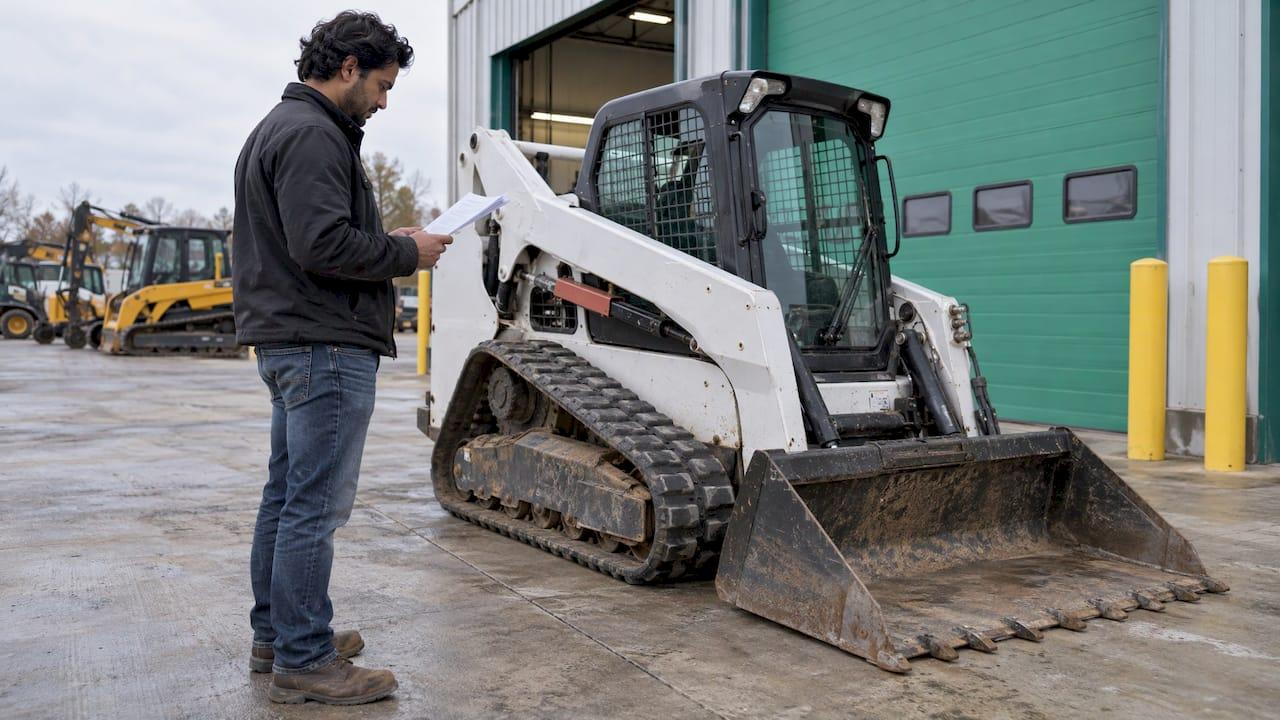
To finance construction equipment, a contractor generally needs to show four things: a legally operating, for-profit business, a credit profile the lender can work with, enough cash flow to cover the monthly payment, and a clear description of the machine being bought. Exact cut-offs differ by lender and by product, so the practical goal is to arrive with a complete file and a payment you can carry. At Capital for Business, equipment financing starts at 0.8% per month, and we have worked with business owners in hundreds of industries, construction among them, since 2009.
This guide is for contractors, electricians, plumbers, HVAC owners and other trades buying excavators, lifts, trucks, trenchers, tools or diagnostic gear. It explains what lenders look at, what to gather before you apply, and how to read an offer.
TL;DR
- Lenders weigh credit history, time in business, revenue or cash flow, and the equipment itself, which usually acts as collateral.
- Federal SBA rules, a useful reference point for any lender, ask that you are an operating, for-profit U.S. business, show a need for credit and are creditworthy.
- Prepare business details, tax ID, bank statements, financial statements and a vendor quote before you apply, so the review goes faster.
- A down payment is common on traditional loans. SBA 504 projects, for example, require 10% borrower equity, and it can rise to 20%.
- Compare the monthly payment, the term and the total cost, not only the headline rate.
Table of Contents
- What lenders are really checking
- The core requirements, one by one
- Down payment: how much to plan for
- Documents to gather before you apply
- Financing options for contractors and electricians
- What to compare in an offer
- How to apply, step by step
- Common reasons applications stall
- Our perspective
- Ready to finance your next machine
- FAQ
- Sources
What lenders are really checking
Every lender is answering one question: will this business repay the financing from its own earnings? Everything on the application feeds that answer. Equipment finance has one advantage over most borrowing. The machine you buy can secure the loan, so the lender has something to fall back on if payments stop. That is why equipment financing is often easier to qualify for than an unsecured loan of the same size.
The federal rulebook for SBA business loans is a good picture of the underlying logic. Under 13 CFR Part 120, an applicant must be an operating, for-profit business located in the United States, meet SBA size standards and demonstrate a need for the credit. The same regulation says the applicant must be creditworthy, and that lenders may consider credit score or history, earnings or cash flow, and equity or collateral.
The Office of the Comptroller of the Currency adds another view in its SBA lending bulletin. Lenders must consider conventional factors such as the applicant's industry, operating history, and a reasonable loan term based on actual or projected cash flow. Private equipment lenders are not bound by SBA rules, but they ask the same questions in their own words.

The core requirements, one by one
A legitimate, operating business
Expect to give your legal business name, entity type, street address (not a PO box), phone number, tax ID (EIN), the nature of your business and the date it started. Contractors should also be ready to show that the business is registered and, where your state requires it, licensed for your trade. A lender cannot fund a business it cannot verify, and mismatched names or addresses across documents are a common reason files stall.
Credit history
Lenders typically look at the owner's personal credit as well as any business credit, especially for companies that are young or small. A higher score usually means more options and a lower price. A lower score does not end the conversation: equipment financing is secured by the asset, so many lenders will look at the whole picture. Our guide to equipment financing credit scores explains how different score ranges tend to be treated. If your credit has taken hits, we also fund through our bad credit business loans, priced from 2.5% per month.
Time in business
A longer operating history gives a lender more data. Many programs want to see at least a year or two of operations, while some will consider newer companies when the owner has strong industry experience or when the equipment holds its value well. If you are a startup contractor, read our overview of business loans you should apply for as a startup to see which products fit an early-stage company.
Revenue and cash flow
This is where construction differs from many industries. Revenue is lumpy: a large job pays in milestones, retainage is held until completion, and a slow winter can thin out receipts. Lenders therefore look at several months of business bank statements to see average deposits, ending balances and any overdrafts. They are checking whether the monthly equipment payment fits inside your normal cash movement, including the slow months.
A quick self-test: take the estimated monthly payment and compare it with your average monthly deposits over the last six to twelve months. If the payment is a small share of typical deposits and the machine will earn revenue itself, the file looks stronger.
The equipment itself
The lender will want a vendor quote or invoice showing the make, model, year, condition (new or used), serial number if available, and price. Newer equipment from a known manufacturer is easier to value. Used machines are financeable, but the lender may look more closely at age and hours. Knowing exactly what you are buying also protects you on the job site: for a sense of what specialist machines involve, see this overview of concrete drilling equipment types, including their features and safety precautions.
Down payment: how much to plan for
Whether you need a down payment depends on the lender, the equipment and your profile. Traditional equipment loans often ask for some money down, and a stronger file may reduce or remove it. Leases and some financing agreements may be structured with little upfront cash.
The one official benchmark in this area is the SBA 504 program. According to the USDA and SBA loan comparison matrix (June 2021), a 504 project is split into a senior lender loan for 50%, an SBA-backed subordinate loan for 40% and borrower equity of 10%, which can reach 20% depending on business age and property type. The same document lists maximum terms of 10 years for equipment and 25 years for real estate, and an annual debenture service fee between 0.642% and 0.682%. Our comparison of SBA 504 vs 7(a) shows which one suits which purchase.
A worked example
Suppose you are buying a $100,000 skid steer package. Under 504 rules, your equity would be $10,000 (10%), the senior lender would provide $50,000 and the SBA-backed portion would provide $40,000. If the project were at the 20% end of the range, you would put in $20,000. Private lenders set their own terms, but the exercise shows how to plan: decide how much cash you can put in without draining the account you need for payroll and materials.

Documents to gather before you apply
A complete file is the single easiest way to speed things up. Our equipment financing checklist walks through this in five steps. The usual list looks like this:
- Government-issued photo ID for each owner.
- Business details: legal name, address, EIN, entity type, date started, description of your trade.
- Business bank statements, commonly the most recent three to six months.
- Financial statements: profit and loss, balance sheet and, for larger requests, tax returns.
- Equipment quote or invoice from the dealer or seller.
- Licenses and insurance relevant to your trade.
- Debt schedule: a list of current loans, leases and balances.
The OCC bulletin on SBA lending notes that the SBA honors about 97% of its guaranties, with repairs and partial denials making up most of the remainder. For borrowers, the lesson is that documentation matters at every level: lenders scrutinize files carefully because weak paperwork can cost them later, so clean records help you.
Financing options for contractors and electricians
The right structure depends on the equipment, how long you will use it and how your cash flow runs. Here is a plain overview of the main ways to pay for it.
| Option | Best for | Our published starting price |
|---|---|---|
| Equipment financing | A machine, truck or tool set you will use for years | From 0.8% per month |
| Business line of credit | Smaller, repeat purchases and parts or tool top-ups | From 1.2% per month |
| Working capital loan | Equipment plus mobilization costs for a new job | From 1.5% per month |
| Business term loan | Larger planned purchases with fixed payments | From 7% |
| SBA loan | Longer terms on bigger purchases when you can wait for the process | From 6% |
| Merchant cash advance | Fast access when receipts are steady | From 1.15 one-off |
Prices are as published on our site and depend on your profile. A few notes on how to choose:
- Equipment financing ties the loan to the asset, which is why it tends to carry the lowest starting price of the group. Our equipment financing page describes amounts up to $250,000 with same-day funding.
- A line of credit suits an electrician who buys meters, benders, tools and a van upgrade over the course of the year, because you draw only what you use. See our business line of credit page.
- A term loan or SBA loan suits a larger purchase where a longer repayment period lowers the monthly payment. The OCC bulletin notes that 7(a) loans can fund equipment, with a maximum guaranty of 85% on loans up to and including $150,000 and 75% above that. Our SBA 7(a) requirements guide covers eligibility, down payment and collateral.
- Leasing is another route when you want lower upfront cost. We explain the difference between leasing and financing in a separate guide.
What to compare in an offer
Two offers with the same headline rate can cost very different amounts. Before you sign, line up these figures:
- Monthly payment and whether it is fixed.
- Term length. A longer term lowers each payment but usually raises total interest. Matching the term to the machine's useful life keeps you from paying for equipment that is already worn out.
- Down payment and any fees at closing.
- Total repayment amount, which is the number that shows the real cost.
- Prepayment terms, meaning what happens if you pay it off early.
- Ownership at the end. A loan leaves you owning the machine; some leases do not.
Example: the payment test
Say you finance $60,000 of equipment and your average monthly deposits over the past year were $45,000. Ask whether the payment still leaves room for fuel, wages, insurance and materials in your slowest month. If the machine will let you take on jobs you currently turn down, include the extra revenue in your plan, but base the decision on the numbers you can document, not the ones you hope for.
Our article on how to finance construction equipment without hurting cash flow goes deeper on spreading payments across the seasons.
How to apply, step by step
- Pick the equipment and get a written quote. Know the make, model, year and price.
- Set your budget. Decide on a monthly payment and a down payment you can carry in a slow month.
- Gather your documents using the list above.
- Check your credit so nothing on your report surprises you.
- Apply with a lender that funds your trade. We work with construction, electrical, plumbing, HVAC and many other industries, and our funding can arrive as soon as 24 hours.
- Review the offer against the comparison points above and confirm the equipment details match the quote.
- Close and fund. The lender typically pays the seller or releases funds, and your payments begin on the agreed schedule.
For a longer walk-through, see our step-by-step equipment financing guide and the equipment financing tutorial.
Common reasons applications stall
- Incomplete or inconsistent paperwork, such as an address that differs between the bank statement and the application.
- Thin or irregular deposits with no explanation. A short note about seasonal work or a large pending job helps.
- A request bigger than the cash flow supports. Right-sizing the purchase, or choosing a longer term, can fix this.
- Unclear equipment details, such as a quote with no model or serial number.
- Existing debt the lender did not know about. List every obligation up front.
Most of these can be fixed in a day or two once you know about them.
Our perspective
Contractors do not struggle with equipment financing because they are bad borrowers. They struggle because banks and credit unions often judge a trade business on a template built for steady monthly revenue, and construction does not work that way.
Since 2009 we have worked with owners across hundreds of industries, and our approach is to meet the need when banks and credit unions fall short: quickly, efficiently and at a price a small business can afford. That means funding as soon as 24 hours, flexible terms and approval across a broad range of credit profiles, including bad credit.
The way we see it, the best equipment financing is the kind that matches the payment to the machine and the machine to the work. We offer equipment financing from 0.8% per month, lines of credit from 1.2% per month, term loans from 7% and SBA loans from 6%, so an owner can choose the structure that fits the purchase rather than forcing one product to fit every need.
Capital
Ready to finance your next machine
If you know what you need to buy, our equipment financing program offers up to $250,000 with same-day funding, starting from 0.8% per month. Other options, including working capital, lines of credit and term loans, are on our funding solutions page.
We serve small businesses across the United States and in Canada, and we work with contractors, electricians, plumbers, HVAC companies and many other trades. Have your quote and recent bank statements ready, and you can move from application to funding quickly.
FAQ
What is needed for construction equipment financing?
You need a legally operating business, an EIN, owner identification, recent business bank statements, financial statements and a quote for the equipment. Lenders also review credit history and time in business. A complete file shortens the process.
Do I need a down payment to finance construction equipment?
Often, yes, though it depends on the lender, the equipment and your profile. For reference, SBA 504 projects require 10% borrower equity, which can rise to 20% depending on business age and property type, according to the USDA and SBA comparison matrix. Ask what your specific offer requires before you commit.
Can a new contractor business qualify?
Possibly. Lenders prefer an operating history, but they also weigh the owner's credit, industry experience, deposits and the value of the equipment. Our guide to startup business loans outlines the products that fit younger companies.
Can I finance used equipment?
Yes, many lenders finance used machines and tools. Expect the lender to ask for the year, condition and price, and to value older equipment more conservatively. A written quote from the seller makes the review simpler.
Does the SBA lend directly for equipment?
No. The SBA guarantees a portion of loans made by participating lenders. The OCC bulletin on SBA lending explains that 7(a) loans can be used for equipment, with the guaranty reimbursing the lender's loss up to the guaranteed amount.
Sources
- 13 CFR Part 120, SBA Business Loans
- OCC Bulletin 2021-34, SBA Lending Risk Management
- USDA Rural Development and SBA loan comparison matrix
- Concrete drilling equipment types and safety