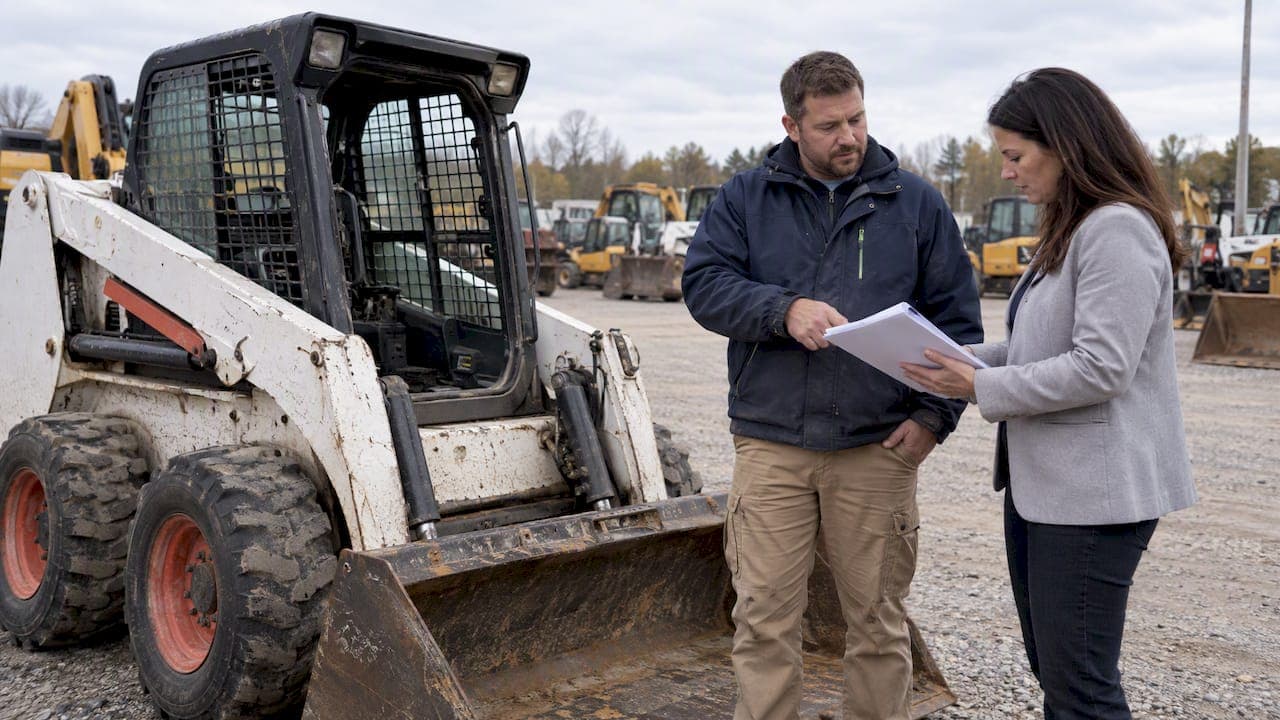
Most equipment lenders look for a personal credit score of 600 to 650 for standard approval, though some specialty programs accept scores in the 500s with stronger collateral or a larger down payment. Because equipment loans are backed by the asset itself, a lower score rarely disqualifies you outright. The practical next step is to gather your documentation and talk with a lender who evaluates the full file rather than the score alone.
TL;DR:
- Applicants with scores above 650 usually qualify for the best rates and most favorable terms, while those below 600 face stricter approval criteria.
- Equipment that retains resale value, like construction machinery or vehicles, allows lower-score borrowers to secure financing more easily than fast-depreciating assets.
- Providing a larger down payment, adding a guarantor, or offering collateral can improve approval chances for applicants with scores in the 500s or low 600s.
- Recent bankruptcy or collections do not automatically disqualify applicants but may require larger down payments, shorter terms, or stronger collateral.
- Improving credit before applying by correcting errors, reducing utilization, and assembling documentation can significantly increase approval likelihood, especially for borderline cases.
Table of Contents
- Typical credit score thresholds lenders use for equipment financing
- Other approval factors lenders weigh beyond your score
- Options if your credit score is low
- Steps to improve your approval odds before you apply
- What lenders ask for and realistic timelines to funding
- How bankruptcies and collections affect your eligibility
- How equipment type and depreciation shape score requirements
- Publisher perspective: how Capital for Business approaches credit and equipment financing
- Get equipment financing through Capital for Business
- FAQ
- Sources
Typical credit score thresholds lenders use for equipment financing
Lenders generally sort applicants into three rough bands, and where you land affects both approval odds and pricing. A score of 650 or above typically qualifies for the best rates and the widest selection of terms. Scores in the 600 to 649 range still get approved regularly, but often with a higher rate or a request for a down payment. Below 600, approval becomes more selective, and lenders lean harder on collateral value and cash flow to offset the credit risk.
Industry summaries point to this same general pattern: typical minimum score requirements cluster around 600 to 650 for standard equipment financing, with some lenders willing to work with scores near 500 when the collateral is strong. That source also notes a useful distinction: small, lower-dollar deals are frequently underwritten on an application-only basis, while loans above roughly $250,000 move into deeper financial review that looks well beyond the credit score.

A score in the 600s does not guarantee the lowest rate. Lenders still weigh time in business, revenue, and the resale value of the equipment, so two applicants with the same score can receive different offers.
Government-backed programs add another layer. The Small Business Administration has expanded simplified underwriting options for smaller 7(a) loans, allowing lenders to use the Small Business Scoring Service (SBSS) and alternative underwriting criteria. That shift can open approval paths for borrowers whose personal credit score alone would have triggered a decline under a lender's standard policy.
- Scores above 650: best pricing, most term options, minimal collateral stipulations.
- Scores from 600 to 649: fair approval odds with a likely rate premium or down payment request.
- Scores from roughly 500 to 599: possible approval through specialty or asset-focused programs, usually with added conditions.
Other approval factors lenders weigh beyond your score
Your credit score is one input in a larger underwriting picture, and the other pieces often carry just as much weight. Lenders read your file for signs that the loan will get repaid on schedule, regardless of what your score says on its own.
- Capacity: recent bank statements and cash flow trends show whether your business can absorb the new payment.
- Collateral: the loan-to-value ratio and the equipment's expected resale value reduce the lender's exposure if things go wrong.
- Time in business: newer companies face more scrutiny because they lack a payment track record, and seasonal industries may see extra questions about cash flow timing.
- Personal guarantees: when an owner signs a personal guarantee, the lender may pull that individual's consumer credit report rather than relying solely on a commercial report.
That last point has a legal backdrop worth knowing. An FTC advisory opinion on the Fair Credit Reporting Act explains that lenders typically treat commercial and consumer credit reports differently, but a signed personal guarantee can make pulling the guarantor's consumer report permissible. If you are asked to guarantee a loan personally, expect your personal score to enter the conversation even on an otherwise business-focused application.
Options if your credit score is low
A low score narrows your choices, but it rarely closes every door, especially for equipment purchases where the asset itself provides security.
- Asset-backed leases or loans. Because the equipment can be repossessed and resold, lenders can extend credit to non-prime borrowers when the asset holds solid resale value, a point echoed in J.P. Morgan's overview of equipment financing.
- Specialty lenders and alternative products. Merchant cash advances and revenue-based financing trade stricter credit requirements for shorter terms and higher costs, so they work best as a bridge rather than a long-term fit.
- Co-borrowers, guarantors, or a larger down payment. Adding a stronger personal guarantor or putting more money down directly offsets a thin credit file.
- SBA or SBSS-based underwriting. As noted above, some SBA-backed lenders use alternative scoring models that can approve deals a conventional lender's scorecard would reject.
Specialized lenders and products built for weaker personal credit do exist, though rates and terms are typically less favorable than what a prime borrower would receive. Our guide to qualifying for an equipment loan with a lower score walks through these tradeoffs in more detail.
Pro Tip: If your score sits in the 500s, lead with a down payment offer rather than waiting for the lender to ask. It signals commitment and often speeds up the decision.
Steps to improve your approval odds before you apply
A few weeks of preparation can shift your application from a marginal case to a straightforward approval.
- Pull your credit reports and dispute errors. Incorrect late payments or outdated balances are more common than most owners expect, and fixing them can lift your score before you apply.
- Lower your credit utilization. Paying down revolving balances, even temporarily, improves the ratio lenders see.
- Avoid new credit inquiries right before applying. Multiple hard pulls in a short window can drag your score down at the worst time.
- Offer a down payment or add collateral. Even 10% to 20% down can move a borderline file into approval territory.
- Assemble your documentation in advance. Having bank statements, tax returns, and the equipment quote ready removes delays once underwriting begins.
Our equipment financing checklist outlines the documents most lenders request, step by step.
Pro Tip: If your score is borderline and you have strong revenue, apply now with a down payment offer rather than waiting months to inch your score up a few points. The structural fix often works faster than the credit fix.
What lenders ask for and realistic timelines to funding
Most equipment lenders request a fairly standard packet: the equipment quote or invoice, recent business bank statements, and tax returns, plus a signed application. Each document answers a specific question: the invoice confirms the asset and price, the bank statements show cash flow, and the tax returns verify income over time.
- Equipment quote or invoice with make, model, and price.
- Three to six months of business bank statements.
- One to two years of business tax returns.
- Personal guarantee and, when applicable, authorization for a consumer credit pull.
Smaller deals, often under $100,000, can close in 24 to 72 hours when the paperwork is complete. Larger transactions that require fuller underwriting typically take one to four weeks. Working with a lender or broker who specializes in equipment deals tends to shorten this timeline, since they know which documents matter most for a given program.
How bankruptcies and collections affect your eligibility
A recent bankruptcy or a string of collections does not automatically eliminate your equipment financing options, but it does shift which lenders will consider your file. Conventional bank lenders tend to require more distance from a bankruptcy discharge, often a year or more, before they will approve a standard loan. Specialty and asset-based lenders take a different view: because the equipment itself secures the loan, some will still approve financing shortly after a bankruptcy discharge if the business shows stabilized revenue and the collateral value is strong.
Open collections are treated somewhat differently than a discharged bankruptcy. A collection account that is small, old, or already in a repayment plan tends to weigh less heavily than a large, recent, unresolved balance. Lenders reviewing your file will usually ask for an explanation and, in some cases, proof that a collection is being addressed.
The practical takeaway is that recent credit events raise the bar rather than closing the door. Expect to be asked for a larger down payment, a shorter term, or a personal guarantor with cleaner credit. Being upfront about the circumstances, rather than letting the lender discover it mid-underwriting, generally works in your favor and keeps the process moving instead of stalling it.
How equipment type and depreciation shape score requirements
Not all equipment is treated the same way by underwriters, and the asset's depreciation curve matters almost as much as your credit profile. Equipment that holds its value well, construction machinery, commercial vehicles, and certain medical devices among them, gives a lender more confidence that they could resell it if the loan went into default. That confidence often translates into a willingness to accept a somewhat lower credit score.
Fast-depreciating equipment, such as specialized computer hardware or certain restaurant equipment, carries less resale security. Lenders financing these assets tend to compensate by tightening score requirements, shortening the loan term, or asking for a larger down payment, since the collateral alone provides a thinner safety net.
This is also where insurance coverage on the financed equipment becomes relevant. Lenders frequently require proof of coverage for the life of the loan, and businesses that have not reviewed their commercial insurance options may find this is an easy gap to close before applying. A well-insured, slow-depreciating asset gives underwriters more room to work with a borderline credit score than a fast-depreciating one with no coverage in place.
Publisher perspective: how Capital for Business approaches credit and equipment financing
Since 2009, we have worked with small business owners across hundreds of industries, and credit score has never been the only factor we weigh. We offer equipment financing with funding available on qualifying deals, because we evaluate the asset, the cash flow, and the credit together rather than screening on score alone. That approach means a non-prime score paired with solid revenue or strong collateral can still move through underwriting favorably. If you are preparing to apply, have your equipment quote and recent bank statements ready. We can help match your file to the program that fits it.
— Capital
Get equipment financing through Capital for Business
We built our equipment financing program for business owners who need a practical path forward, not another credit-score gatekeeper. We look at your full file, the equipment's value, your revenue, and your credit together, which means a less-than-perfect score does not automatically end the conversation.
Here is what to have ready before you reach out:
- Your equipment quote or invoice with the make, model, and price.
- Three to six months of recent business bank statements.
- Basic proof of business, such as a tax return or formation document.
We offer equipment financing up to $250,000 with same-day funding on qualifying deals, and our broader funding solutions page covers additional options if a lease or loan structure isn't the right fit. Reach out and we will walk through which program matches your credit profile and timeline.
This article is general information, not a substitute for advice from a qualified financial advisor. Consult a qualified financial professional about your own circumstances before acting on anything here.
FAQ
Can you get financed with a 500 credit score?
Yes, some equipment lenders and specialty programs will consider a score around 500, particularly when the equipment holds strong resale value or the borrower offers a larger down payment. Approval is less certain than with a higher score, and the rate will typically run higher to offset the added risk.
Are equipment loans hard to get?
Equipment loans are generally easier to qualify for than unsecured business loans because the equipment itself secures the debt, giving the lender a way to recover losses if payments stop. Approval still depends on credit, revenue, and time in business, but the collateral reduces the lender's risk compared with an unsecured loan.
How do I qualify for equipment financing?
Lenders typically look for a credit score in the 600 to 650 range for standard approval, along with steady revenue, time in business, and documentation like bank statements and an equipment quote. Borrowers below that range can still qualify through asset-backed programs, a larger down payment, or a personal guarantor with stronger credit.
Can I get a business loan with a 400 credit score?
Scores in the 500s make most conventional business loans challenging to secure, though some asset-backed equipment financing or specialty lenders may still consider the application if the collateral value and cash flow are strong. Expect stricter terms, a higher rate, and likely a request for additional collateral or a guarantor.
Sources
- Advisory opinion: FCRA applicability (FTC)
- How credit scores impact business loan approval | QuickBooks
- Equipment loans & financing: how they work and their benefits (J.P. Morgan)
- Business loan program improvements (SBA)