
If your business is asset-rich or working through a turnaround, asset-based lending (ABL) is usually the better fit. If your business runs on predictable, strong EBITDA and holds few hard assets, a cash-flow loan typically makes more sense. Many growing companies eventually blend both, using an ABL revolver for daily liquidity and a cash-flow tranche for expansion capital.
TL;DR:
- Asset-based lending typically requires collateral valuation, with advance rates around 80-90% for receivables and 50-70% for inventory, resulting in lower costs.
- Cash-flow loans rely on earnings multiples, usually 2 to 6 times EBITDA, and involve stricter covenants and longer approval times, often 60 to 90 days.
- Under downturn conditions, ABL capacity shrinks with collateral values, while cash-flow loans risk default from dipped earnings even if assets remain strong.
- Hybrid structures are suitable for companies needing both liquidity flexibility and growth capital, with key concerns including collateral priority and covenant interactions.
- Preparing accurate financial records, stabilizing revenue, and understanding your asset or earnings profile improves chances of securing the right loan type.
Table of Contents
- Cash Flow vs. ABL: How the Two Structures Actually Differ
- What Is Asset-Based Lending and How Does It Work?
- What Is Cash-Flow Lending and How Does It Work?
- Cash Flow vs. ABL: A Side-by-Side Comparison
- How Do You Choose Between ABL and Cash-Flow Financing?
- How to Prepare Your Business Before You Apply
- When Does a Hybrid ABL and Cash-Flow Structure Make Sense?
- What Small Business Owners Get Wrong About This Decision
- Which Capitalforbusiness Product Fits Your Situation?
- Sources
- FAQ
Cash Flow vs. ABL: How the Two Structures Actually Differ
The core difference comes down to what the lender is actually underwriting. ABL lends against what you own. Cash-flow lending lends against what you earn. That single distinction shapes everything else: the paperwork you'll produce, how fast you can close, and how the loan behaves when your industry hits a rough patch. Business owners searching for a clean comparison between cash flow lending vs asset based lending are usually trying to answer one practical question: which one will actually approve my deal? The rest of this guide works through that question section by section, starting with how each structure is built.
What Is Asset-Based Lending and How Does It Work?
ABL financing turns your balance sheet into borrowing power. Instead of scrutinizing your income statement, the lender values specific collateral, accounts receivable, inventory, equipment, and sometimes real estate, and lends a percentage of that value.
Advance rates typically run about 80 to 90 percent of eligible accounts receivable and 50 to 70 percent of inventory liquidation value, according to ABF Journal's analysis of middle-market ABL structures.
Because the loan rides on collateral rather than earnings, monitoring is collateral-focused too:
- Monthly or weekly borrowing-base certificates listing eligible receivables and inventory.
- Periodic field exams where the lender's team verifies your AR aging and inventory counts in person.
- Formal appraisals for inventory or equipment, especially at closing and annually after.
Pricing tends to run lower than cash-flow loans since the collateral cushions the lender's risk. For a deeper walk-through of how borrowing-base mechanics work in practice, see Capitalforbusiness's asset-based lending explainer.
What Is Cash-Flow Lending and How Does It Work?
Cash-flow lending underwrites your business, not your assets. Lenders look at historical and projected EBITDA, then size the loan as a multiple of that earnings figure rather than a percentage of collateral value.
Investopedia notes that leverage in cash-flow deals commonly runs 2 to 6 times EBITDA depending on the borrower's stability and market conditions, and pricing typically sits higher than ABL because there's no hard collateral backing the loan.
Because there's no collateral to fall back on, lenders lean hard on covenants instead:
- Leverage ratio covenants (total debt divided by EBITDA) tested quarterly.
- Interest-coverage covenants confirming earnings comfortably exceed debt payments.
- Monthly or quarterly financial statements, often audited or reviewed annually.
Service firms, SaaS companies, and other businesses with steady margins and light physical assets tend to qualify here, since their real value lives in recurring revenue rather than equipment or inventory. Capitalforbusiness's cash-flow loan guide breaks down how this plays out for U.S. small businesses without daily debit structures.
Cash Flow vs. ABL: A Side-by-Side Comparison
The practical differences show up most clearly when you line them up feature by feature.
| Factor | Asset-Based Lending (ABL) | Cash-Flow Lending |
|---|---|---|
| Advance rates | ~80–90% of A/R, ~50–70% of inventory | Expressed as EBITDA multiple, often 2–6x |
| Pricing | Generally lower spread | Generally higher spread |
| Covenants | Light in ordinary times, springing covenants activate below thresholds | Leverage ratio and interest-coverage tests, tested regularly |
| Monitoring | Borrowing-base reports, field exams, appraisals | Periodic financial statements, covenant compliance reporting |
| Best-fit borrower | Asset-rich, turnaround, or seasonal businesses | Steady-margin, service, or recurring-revenue businesses |
| Typical time to close | Roughly 30–45 days | Roughly 60–90 days |
A few operational points matter beyond the numbers:
- Downturn behavior differs sharply. ABL availability shrinks as collateral values fall, since your borrowing base is directly tied to receivables and inventory worth. Cash-flow loans, by contrast, can trip covenant defaults quickly if earnings dip below the tested threshold, even when the business still has plenty of assets.
- Springing covenants sit in the middle. Many "covenant-light" ABL facilities still include a springing covenant that activates automatically once availability drops below a set percentage, according to Don Clarke Enterprises' comparison of the two structures. That covenant can appear with little warning if your borrowing base tightens.
- Diligence timelines reflect what's being verified. ABL closes faster because appraisers and field examiners can confirm collateral value in weeks. Cash-flow diligence takes longer because underwriters need multiple periods of financial history and forward projections before they'll commit to a multiple.
How Do You Choose Between ABL and Cash-Flow Financing?
Start with an honest inventory of what your business actually has to offer a lender: hard assets or consistent earnings. Most owners already know which one describes their company, but the checklist below forces the comparison into concrete terms.
- Map your collateral. List receivables, inventory, and equipment, then estimate what percentage a lender would consider "eligible" after excluding stale receivables or slow-moving stock.
- Check EBITDA stability. Pull three years of financials. If EBITDA has swung more than 20 to 30 percent year over year, a cash-flow lender will price that volatility into your terms or decline the deal outright.
- Account for seasonality. A business with predictable seasonal swings in receivables and inventory often fits ABL better, since the borrowing base naturally flexes with the cycle.
- Assess your reporting capacity. ABL demands frequent borrowing-base certificates; cash-flow lending demands clean, timely financial statements. Be honest about which one your bookkeeping can actually support.
Watch for red flags that rule out a path before you waste time applying. Volatile EBITDA sinks a cash-flow application fast, no matter how strong your revenue looks on paper. Weak accounts-receivable controls, uncollected aging, or a customer concentration problem, will just as quickly sink an ABL application, since the lender is trusting the quality of that collateral.
When you talk to a prospective lender, ask direct questions: What advance rate applies to my specific AR aging buckets? How often will you run field exams, and who pays for them? What triggers a springing covenant, and how far in advance will I know? If a hybrid structure is on the table, how do you handle intercreditor priority between the ABL revolver and the cash-flow tranche?
Pro Tip: If you're unsure which category you fall into, run both pitches. Package your financials once as an asset story and once as an earnings story. The version that gets a faster, more enthusiastic response from lenders usually tells you which structure fits.
How to Prepare Your Business Before You Apply
Preparation looks different depending on which structure you're targeting, but both start months before you actually need the money.
For ABL, clean up your accounts-receivable schedule, tighten collections on anything past 60 days, and document inventory counts consistently so appraisers aren't starting from scratch. For cash-flow lending, stabilize recurring revenue where you can, reconcile your profit and loss statement monthly, and build a rolling 13-week cash-flow forecast, a tool advisors recommend regardless of which loan type you pursue.
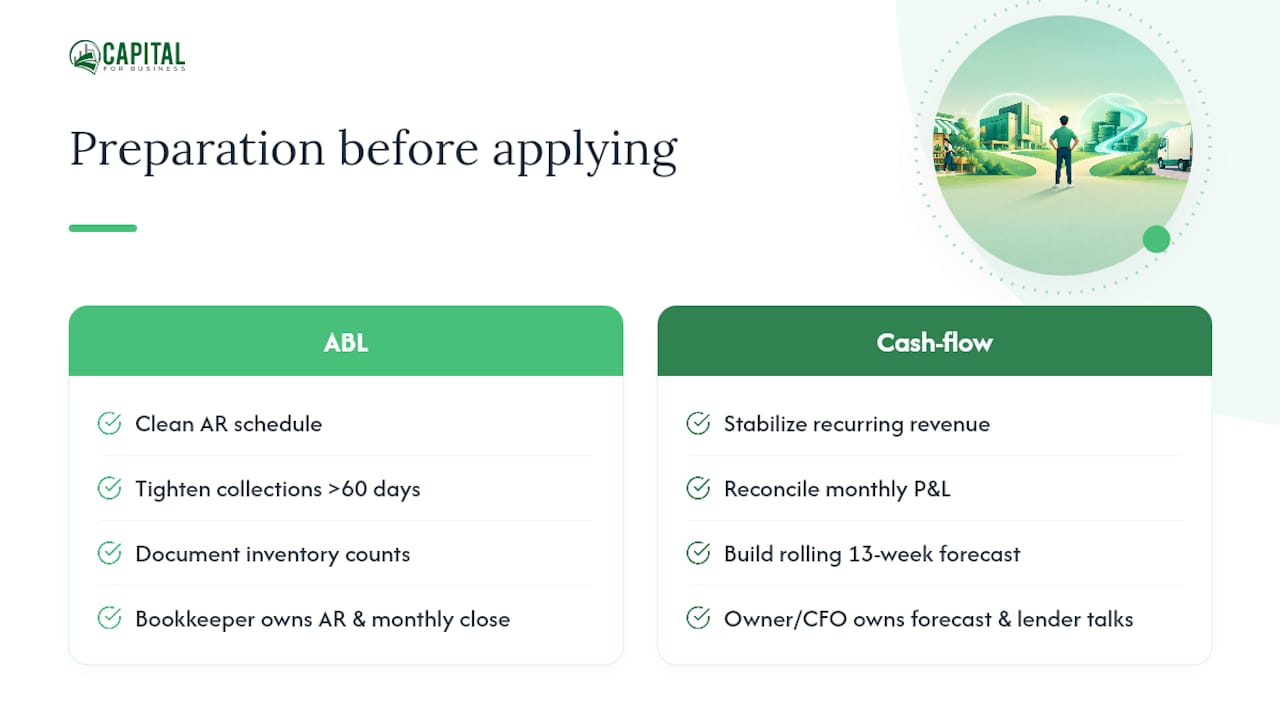
Assign ownership clearly: your bookkeeper or controller should own the AR schedule and monthly close, while an owner or CFO should own the forecast and lender conversations. Give yourself 60 to 90 days of clean records before shopping either option. Capitalforbusiness's step-by-step cash-flow management guide walks through the collections and forecasting fixes that most often unlock approval.
Pro Tip: Lenders read inconsistency as risk. A forecast that's updated sporadically raises more questions than one that's simply modest but current every week.
When Does a Hybrid ABL and Cash-Flow Structure Make Sense?
Hybrid structures have grown more common because they let borrowers capture the cheaper, lighter-covenant pricing of an ABL revolver while still accessing cash-flow capital for growth, according to ABF Journal's reporting on structure convergence in middle-market deals. Three situations come up repeatedly:
- A company uses an ABL revolver for day-to-day working capital and layers a cash-flow term loan on top to fund an acquisition or expansion.
- Sponsor-backed deals often combine both to balance leverage capacity with liquidity flexibility.
- Seasonal businesses use the ABL piece to smooth cash gaps during slow months while a cash-flow tranche funds longer-term investment.
The negotiation points that matter most are collateral priority (who gets paid first if things go wrong), how the two covenant sets interact, and exactly what triggers a springing covenant on the ABL side. For complex intercreditor priority questions, the U.S. Code provisions on secured transactions are worth reviewing with counsel before signing.
What Small Business Owners Get Wrong About This Decision
The mistake we see most often at Capitalforbusiness isn't a bad business. It's a good deal presented to the wrong type of lender. An owner with strong receivables pitches an earnings story to a cash-flow lender and gets declined, when the same numbers packaged as a collateral story would have sailed through as ABL. Building a 13-week forecast and tidying your AR aging before you shop either option fixes most of this. If you're unsure which lane fits your numbers, talk it through with a lender who works both sides. Matching the pitch to the structure is often the whole game.
— Capital
Which Capitalforbusiness Product Fits Your Situation?
Once you know whether your business leans toward collateral or cash flow, the next step is matching that answer to a real product instead of a theoretical one. Capitalforbusiness has spent years working with owners who fall on either side of this line, and often both at once.
If your gap is short-term and tied to receivables or inventory timing, a working capital loan from Capitalforbusiness, priced from 1.5% per month, gets cash moving without the multi-month diligence a bank ABL facility usually demands. If you need ongoing, revolving access rather than a one-time infusion, a business line of credit starting from 1.2% per month gives you draw-as-needed flexibility closer to how a revolver behaves, minus the field exams and appraisal fees. And if your receivables themselves are the asset you want to convert to cash fastest, invoice factoring at 0.69 to 4.9% per invoice turns unpaid invoices into working capital in days, not the 30 to 45 days a traditional ABL close often requires.
Before reaching out, pull together your last two years of financials, a current AR aging report, and a rolling cash forecast if you have one started. Visit Capitalforbusiness's funding solutions page to see current rates and start an initial assessment.
This article is general information, not a substitute for advice from a qualified financial advisor. Consult a qualified financial professional about your own circumstances before acting on anything here.
Sources
- ABL vs. cash flow lending: The convergence of structures in middle-market deals - ABF Journal
- Cash flow lending vs. asset-based lending - Investopedia
- The purpose and strategic value of a 13-week cash-flow forecast - CBIZ
- ABL vs Cash Flow Lending - Don Clarke Enterprises
FAQ
What Is an ABL in Finance?
ABL stands for asset-based lending, a financing structure where the loan amount is tied to the value of specific collateral like receivables, inventory, or equipment. Lenders monitor this collateral closely through borrowing-base reports and periodic field exams rather than relying primarily on your earnings history.
What Are the Three Types of Cash Flow?
The three types are operating cash flow (cash from core business activities), investing cash flow (cash from buying or selling assets), and financing cash flow (cash from loans, equity, or debt repayment). Lenders evaluating a cash-flow loan focus most heavily on operating cash flow and EBITDA trends.
What Is an ABL Advance Rate?
An advance rate is the percentage of collateral value a lender will actually lend against. For accounts receivable, that typically runs 80 to 90 percent, while inventory advance rates usually fall between 50 and 70 percent of liquidation value.
What Does ABL Mean for a Small Business?
For a small business, ABL means qualifying for financing based on what you own rather than how profitable you've been historically, which helps asset-rich companies or those in a turnaround access capital. Businesses considering this route can review Capitalforbusiness's working capital loans as one practical entry point.
Can a Business Use Both ABL and Cash-Flow Financing?
Yes. Hybrid structures combine an ABL revolver for daily liquidity with a cash-flow term loan for growth or acquisition capital, a combination that has become more common in middle-market financing. The key is negotiating clear collateral priority and covenant terms upfront so the two facilities don't conflict later.