
A cash flow based loan lets your business borrow against incoming revenue rather than physical assets, usually funding faster and requiring less collateral than a bank loan. Common types include business lines of credit, merchant cash advances, invoice financing, and revenue-based financing. The trade-off is straightforward: speed and access come at a higher effective cost, and repayment schedules tied to daily or weekly withdrawals can strain a business during slow stretches.
TL;DR:
- Cash flow loans are typically unsecured, approved quickly using bank and payment processor data, and suited for immediate needs like payroll or seasonal inventory.
- The most common types include lines of credit, short-term loans, merchant cash advances, invoice financing, and revenue-based financing, each fitting different revenue patterns.
- Costs are often expressed as factor rates, which should be converted to APR equivalents, since high effective rates and hidden fees can significantly increase the true cost.
- Loan approval depends on recent revenue trends, not just credit scores, and ongoing revenue drops can lead to declines or stricter repayment conditions.
- Prioritizing repayment cadence modeling over low rates is crucial, as flexible, sales-linked schedules prevent overdrawn accounts during slow months.
Table of Contents
- What Is a Cash Flow Based Loan, and How Does It Differ From Asset-Backed Lending?
- Common Types of Cash Flow Financing and When Each One Fits
- How Underwriting and Repayment Actually Work
- Costs, Factor Rates, and How to Compare Offers Honestly
- Who Typically Qualifies and What to Gather Before You Apply
- How to Choose the Right Cash Flow Loan
- Capital for Business: What Sets Our Approach Apart
- Typical Loan Terms and Repayment Structures
- How Cash Flow Fluctuations Affect Approval and Ongoing Compliance
- The Real Trade-Off Nobody Explains Clearly Enough
- Get a Straight Comparison Before You Borrow
- Sources
- FAQ
What Is a Cash Flow Based Loan, and How Does It Differ From Asset-Backed Lending?
A cash flow based loan is financing underwritten mainly on your revenue history and projected future income, not on equipment, real estate, or inventory pledged as collateral. Lenders look at what money comes into your business bank account, not what you own.
That distinction changes everything about the process. Cash flow based loans are typically unsecured and approved through automated review of bank data, which is why online and alternative lenders dominate this space while traditional banks and SBA programs still lean heavily on collateral, tax returns, and multi-week underwriting. A cash flow lender can often turn around a decision in one to two days; a bank or SBA lender frequently needs several weeks.
Business owners typically reach for cash flow financing to cover seasonal inventory buys before a busy quarter, bridge a payroll gap while waiting on client payments, or jump on a bulk-purchase discount that will not wait for a bank's timeline. It is financing built for timing problems, not necessarily for the lowest possible price.
Common Types of Cash Flow Financing and When Each One Fits
Cash flow financing is not one product. It is a category, and the differences between the options matter more than most borrowers realize.
- Business line of credit — a revolving credit limit you draw from and repay repeatedly, well suited to businesses with recurring, predictable cash gaps like payroll timing or inventory restocking.
- Short-term term loan — a lump sum repaid over a few months to two years, best for a single, defined need rather than ongoing shortfalls.
- Merchant cash advance (MCA) — an advance repaid as a percentage of daily card sales, the fastest option but usually the most expensive, and best matched to card-present retailers and restaurants with steady swipe volume.
- Invoice financing / factoring — you borrow against unpaid B2B invoices, a fit for businesses that wait 30 to 90 days on client payments.
- Revenue-based financing — repayment scales with a percentage of monthly sales, easing the burden during slower months.
Each product listed here comes from the same core list of cash flow financing types lenders offer nationally, and matching the product to your revenue pattern, not just your funding need, is what separates a manageable loan from a costly mismatch.
How Underwriting and Repayment Actually Work
Cash flow lenders build their decision around three to twelve months of business bank statements, payment-processor reports (Square, Stripe, or similar), revenue trend data, and basic ownership and time-in-business verification. Steady, predictable deposits carry more weight than a high credit score alone. Tools that centralize payment and invoicing data can make that revenue picture cleaner and faster for underwriters to verify.
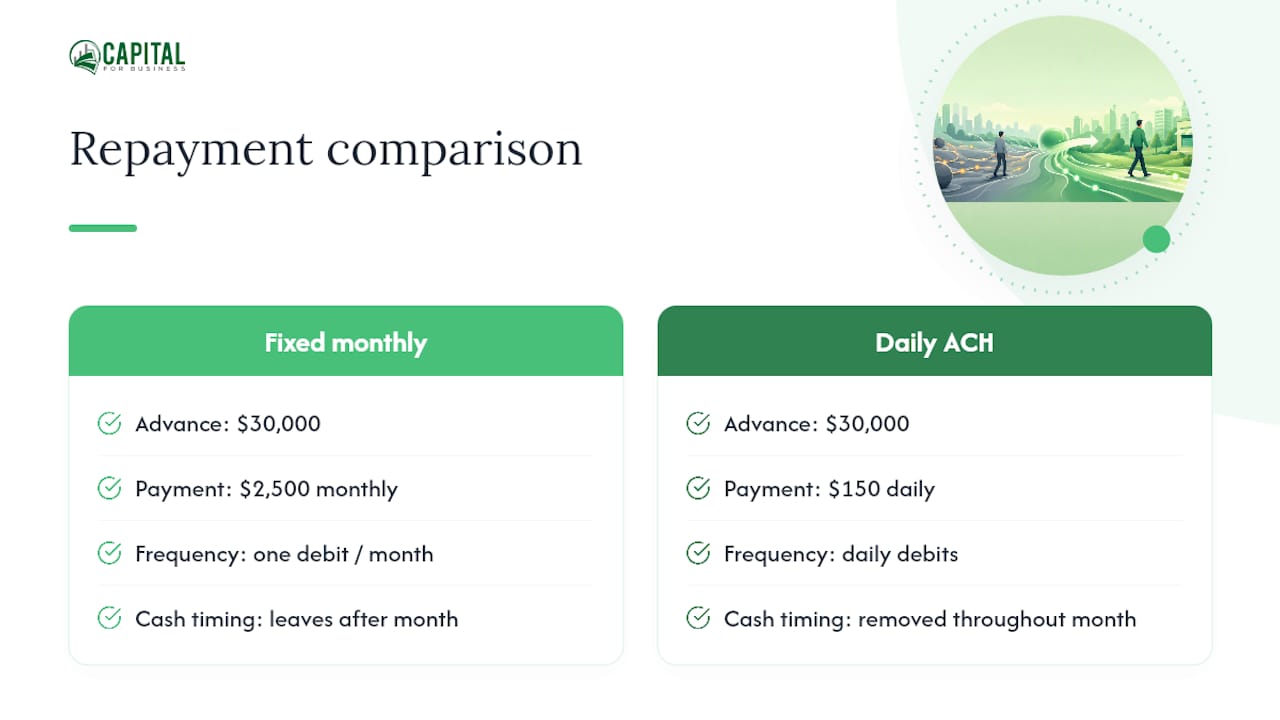
Repayment mechanics vary by product, and the difference has real cash implications. Some loans use fixed monthly payments, others use daily or weekly ACH debits, and revenue-based products remit a percentage of sales. A $30,000 advance repaid through a fixed $2,500 monthly payment behaves nothing like the same advance collected through a daily $150 ACH debit; the daily structure removes cash from your account before you have a chance to allocate it elsewhere.
Many cash flow loans also require a personal guarantee and a UCC lien filed against business assets. Neither means collateral was pledged upfront, but both give the lender legal recourse if payments stop, which is a real risk small business owners often underestimate when they read "unsecured" as "no consequences."
Costs, Factor Rates, and How to Compare Offers Honestly
A factor rate (commonly 1.1 to 1.5) is not an interest rate. It is a flat multiplier applied to the amount borrowed, and it does not account for how quickly you repay, which is exactly why converting it to an APR-like figure is the only honest way to compare offers.
Here is a worked example. Borrow $20,000 at a 1.3 factor rate, and you owe $26,000 total. Repay that over six months instead of twelve, and the effective annualized cost roughly doubles, because the same $6,000 fee gets compressed into half the time. Converting factor rates and fees into an APR-equivalent figure is the single most useful habit a borrower can build before signing anything.
Cash flow product costs commonly range from the mid-teens to well over 20% in effective annual terms, and merchant cash advances can push into triple-digit APR territory in the most expensive cases. Rate ranges vary by structure and lender, which is exactly why the sticker rate on a term sheet rarely tells the full story.
Watch for these warning signs before you sign:
- Triple-digit effective APRs disguised behind a "low" factor rate.
- Large origination fees stacked on top of the factor rate math.
- Fee disclosures that avoid stating a total repayment dollar amount or a clear APR equivalent.
Who Typically Qualifies and What to Gather Before You Apply
Eligibility footprints for cash flow financing tend to be wider than bank lending, but they are not universal. Most lenders want at least six months in business, monthly revenue in the five figures, and a personal credit score somewhere in the mid-500s or higher, though exact thresholds vary widely by lender and product.
Gather these documents before you start applications, since having them ready is often the difference between funding in one day versus one week:
- Three to twelve months of business bank statements.
- Payment-processor reports if you take card payments.
- Most recent business tax return.
- Business registration or formation documents.
- Government-issued personal ID for each owner with 20% or greater equity.
Before applying, reviewing your eligibility position and cleaning up your bank statements, reconciling stray personal expenses that show up on business accounts, and keeping deposits steady for a few months, can meaningfully improve the offers you receive. Lenders reward consistency more than they reward size.
How to Choose the Right Cash Flow Loan
Start with the nature of your cash need, not the fastest offer in your inbox. A recurring, predictable gap points toward a line of credit. A one-time purchase points toward a term loan. Sales that fluctuate seasonally point toward revenue-based financing or an MCA with a repayment structure that flexes with volume.
Ask every lender these questions before you sign anything:
- How exactly is the cost calculated, and what is the total repayment amount in dollars?
- Is there a prepayment penalty, or does paying early actually save money?
- What is the withdrawal cadence, daily, weekly, or monthly?
- Is a personal guarantee or UCC lien required, and what does that mean if I default?
- Can you show me a sample repayment schedule using my actual revenue numbers?
- What happens if a payment fails or my account runs low that day?
Red flags include automatic daily debits with no cap relative to your revenue, factor-rate math the lender won't walk you through in plain terms, pressure to renew or "stack" a second advance before the first is paid off, and any pressure to sign before you have reviewed full documentation.
Pro Tip: Before signing, run a lean-month scenario: take your worst revenue month from the past year and check whether the proposed daily or weekly debit would overdraw your account. If it would have, negotiate the structure or look at how the payment cadence affects timely repayment before you commit.
Capital for Business: What Sets Our Approach Apart
Since 2009, Capital for Business has worked with small business owners across dozens of industries, from contractors managing project timing to retailers riding seasonal swings, matching them to financing that fits their actual cash pattern rather than a one-size-fits-all product.
We help applicants compare a merchant cash advance against a term loan side by side, walk through how lenders now use connected bank and payment data to speed up decisions, and flag which structure will hold up against a slow month before you sign. . Our goal is a funding decision you understand fully, not one you accept because the clock ran out.
Typical Loan Terms and Repayment Structures
Terms vary sharply by product, and understanding the shape of a repayment schedule matters as much as the headline cost. Short-term cash flow loans commonly run three to eighteen months, with fixed weekly or monthly payments calculated to fully amortize the loan by the end date. Merchant cash advances rarely carry a fixed term at all; instead, repayment continues until the full advance amount (principal plus the factor-rate fee) is collected, which means a slow sales month simply extends the payback period rather than triggering default.
Lines of credit differ again: draws carry their own short repayment windows, often 6 to 24 months per draw, and the revolving limit resets as you pay down balances, letting you borrow, repay, and borrow again without reapplying each time.
Invoice financing terms track the invoice itself, usually 30 to 90 days, since the loan is designed to bridge the gap until your customer pays. Longer-term needs, equipment purchases, real estate, or major expansion, are better served by SBA loans or traditional bank term loans running five to twenty-five years, which is precisely why cash flow products and asset-backed loans exist as different tools rather than substitutes for one another.
How Cash Flow Fluctuations Affect Approval and Ongoing Compliance
Lenders do not just check your revenue once at approval. Most cash flow products, especially MCAs and revenue-based financing, monitor deposits or processor volume throughout the life of the advance, because repayment itself depends on that ongoing revenue.
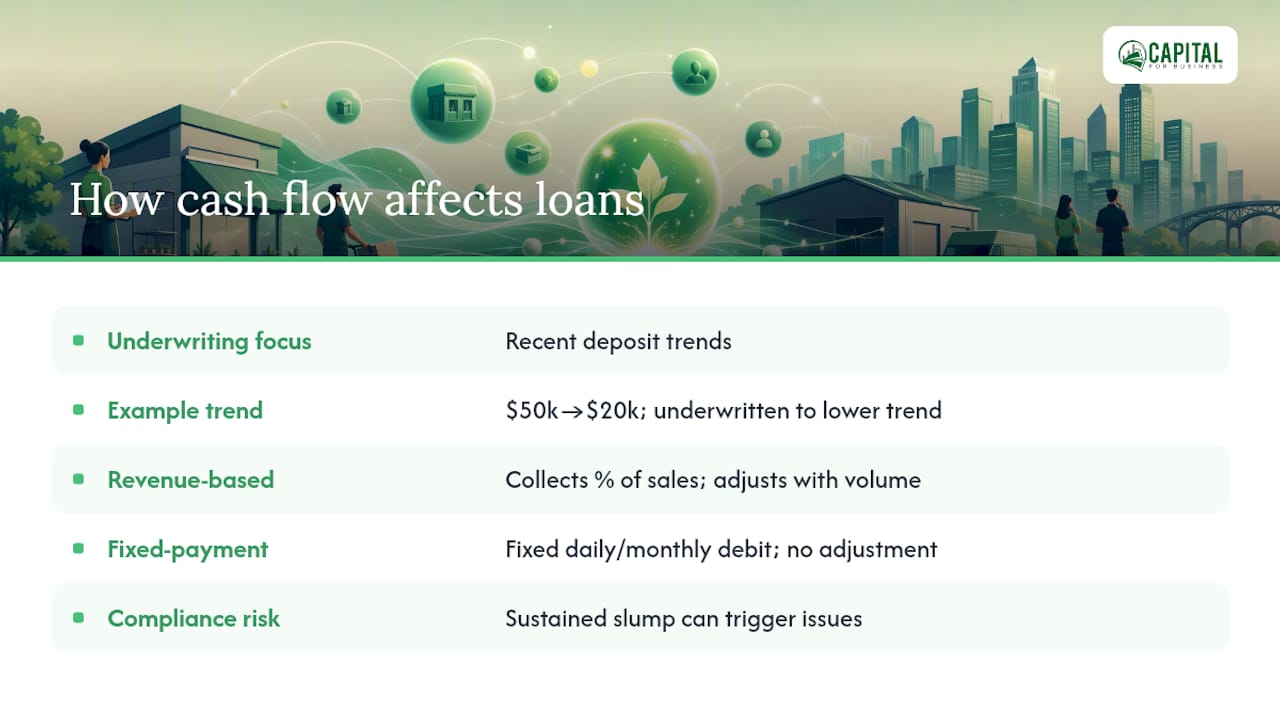
A sharp drop in monthly deposits before you apply is one of the fastest ways to get declined or offered a smaller amount than you expected, since lenders extrapolate recent trends forward rather than looking only at trailing twelve-month averages. A business that generated $50,000 a month for nine months, then dropped to $20,000 for the last three, will typically be underwritten against that recent, lower trend.
Once funded, a sustained revenue slump can also trigger compliance issues on percentage-of-sales products. If your processor volume drops and the lender is collecting a fixed percentage, your remittances shrink automatically, which is one advantage of revenue-based structures over fixed daily ACH debits that keep pulling the same dollar amount regardless of how business is going that week. Fixed-payment products carry no such cushion. A fixed monthly or daily debit does not adjust for a slow season, so a business with real seasonality risks its own default if it does not build a cash buffer before signing. That gap is exactly why matching repayment structure to your revenue pattern, not just chasing the fastest funding offer, decides whether a cash flow loan helps or hurts.
The Real Trade-Off Nobody Explains Clearly Enough
The conventional advice on cash flow financing tends to stop at "compare rates," which misses the actual decision small business owners are making. The real choice is not between cheap and expensive money. It is between paying more for speed and flexibility now, or waiting weeks for a bank or SBA loan that costs less but cannot solve a Tuesday payroll problem.
What gets underrated in most explainers is repayment cadence, not the headline rate. A 1.3 factor rate on a daily debit can wreck a business with irregular deposits far faster than a higher-rate loan with a single predictable monthly payment, because cadence determines whether the debit lines up with when money actually lands in your account.
If you take one thing from this article, prioritize modeling your worst realistic month against the proposed repayment schedule before you compare a single rate. A loan that survives your slowest month is worth more than a loan with a marginally better number on paper. Ask lenders for the total dollar repayment figure, not just the factor rate, and treat any hesitation to provide it as your answer.
— Capital
Get a Straight Comparison Before You Borrow
Some lenders work as direct funding sources rather than rate-shopping middlemen, which means you get a direct answer on cost and cadence instead of multiple offers to sort through yourself.

We offer working capital loans, business lines of credit, and merchant cash advances, and we build the comparison around your actual bank and revenue data rather than a generic credit-score cutoff. To move quickly, have your last three to six months of bank statements, payment-processor reports if applicable, and basic business registration documents on hand; most applicants get a funding decision within one to two business days once that paperwork is in. If you are weighing a line of credit against an advance for a seasonal cash gap or a payroll crunch, start with our working capital funding page to see current options, or reach out directly for a side-by-side comparison built around your numbers.
This article is general information, not a substitute for advice from a qualified financial advisor. Consult a qualified financial professional about your own circumstances before acting on anything here.
Sources
- Cash Flow Loan: What It Is & How It Works - NerdWallet
- Cash Flow Loans & How to Get One - Nav
- CFR reference on rates and underwriting (used here as a source for rate discussion)
FAQ
What Are Cash Flow Based Loans?
They are financing products approved primarily on your business's revenue history and bank deposits rather than physical collateral, and they include lines of credit, merchant cash advances, invoice financing, and revenue-based financing.
What Is an Example of a Cash Flow Loan?
A merchant cash advance is a common example: a lender advances funds against future card sales and collects repayment as a fixed percentage of daily transactions until the advance plus fee is paid off.
What Is the Difference Between a Cash Flow Loan and a Term Loan?
A cash flow loan is underwritten on revenue and often repaid through variable, sales-linked debits, while a traditional term loan is a fixed lump sum repaid on a set schedule, frequently backed by collateral and priced lower.
How Fast Can I Get a Cash Flow Based Loan?
Many alternative and revenue-based lenders can fund within one to seven days once bank statements and payment-processor data are submitted, compared to several weeks for SBA or bank term loans.
Does Capital for Business Offer Cash Flow Financing?
Yes. Some lenders provide working capital loans, business lines of credit, and merchant cash advances, often structured around a business's revenue pattern rather than a fixed collateral requirement.