
TL;DR:
- Small business owners can improve liquidity by implementing forecasting, receivables, payables, expense control, and working capital strategies. A 13-week rolling forecast and automation tools help detect cash shortfalls early, ensuring survival and growth. Effective management of cash flow often outweighs profitability in sustaining business operations.
Business cash flow strategies are the methods small business owners use to control the timing and volume of cash entering and leaving their operations to maintain liquidity and fund growth. Cash flow is not the same as revenue or profit. A business can show strong sales on paper while running out of cash to pay suppliers, employees, or rent. 82% of small business failures stem from poor cash flow management rather than lack of profitability. That single statistic reframes the entire conversation: survival depends less on how much you earn and more on when cash actually arrives. This guide covers the core strategies, forecasting methods, and working capital tools that give small business owners real control over their financial position.
What are the core business cash flow strategies small business owners should know?
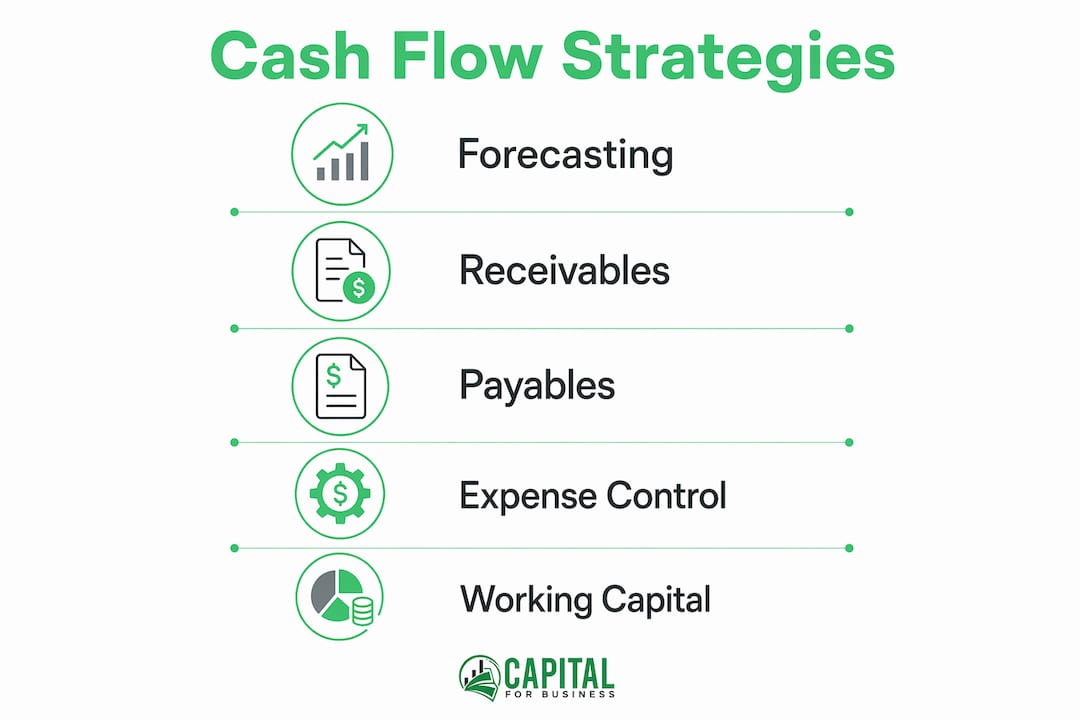
Business cash flow strategies explained at their most practical level come down to five disciplines: forecasting, receivables management, payables management, expense control, and working capital optimization. Each one addresses a different point in the cash cycle, and together they determine whether your business stays liquid through slow seasons, growth spurts, and unexpected expenses.
Cash flow forecasting
Forecasting is the foundation of every other strategy. Without a forward-looking view of cash inflows and outflows, you are reacting to problems instead of preventing them. Small businesses should prepare monthly forecasts and review actual cash flow weekly to catch shortfalls before they become crises. The discipline of weekly review forces you to reconcile what you expected with what actually happened, which sharpens your next forecast.
Accounts receivable management
Getting paid faster is the single most direct lever for improving cash flow. Send invoices the same day work is completed or goods are delivered. Use automated invoicing tools like QuickBooks, FreshBooks, or Wave to eliminate delays caused by manual processes. Invoice factoring advances up to 90% of invoice value upfront, transferring collection responsibility to a third party in exchange for a discount fee. This is a practical option when you need immediate liquidity without waiting 30 to 60 days for customer payments.

Accounts payable management
Paying bills strategically preserves cash without damaging supplier relationships. Negotiate extended payment terms of 45 to 60 days wherever possible. Pay on the last day terms allow, not early, unless an early payment discount makes the math work in your favor. Batch payments on a weekly schedule so you always know your exact cash position before funds leave the account.
Expense control
Prioritize cutting non-essential overhead costs like landscaping, cleaning services, or discretionary subscriptions before touching business-critical spending. The sequence matters. Cutting a $500 monthly software subscription preserves cash immediately without affecting operations. Cutting sales or customer service capacity to save money typically costs more in lost revenue than it saves.
Working capital optimization
The cash conversion cycle (CCC) measures how long cash is tied up between paying for inputs and collecting from customers. Shortening it by even a few days releases meaningful capital. The 10 proven ways to improve cash flow for small businesses consistently point to CCC reduction as the highest-return activity available without taking on new debt.
Pro Tip: Map all your recurring expenses on a calendar by due date. CEO Jen Millard of CNBC Select recommends this practice to reveal your true cash rhythm and identify the weeks where outflows cluster, so you can plan funding gaps in advance rather than scrambling when they arrive.
How does cash flow forecasting improve liquidity management?
Cash flow forecasting is the practice of projecting all expected cash receipts and disbursements over a defined future period to identify surpluses and shortfalls before they occur. It differs from budgeting in one critical way: a budget is a plan for revenue and expenses, while a forecast is a prediction of actual cash timing. A business can be on budget and still face a cash crisis if customer payments arrive two weeks late.
The 13-week rolling forecast
The 13-week rolling forecast is the gold standard operational tool for cash flow transparency. It covers a full quarter of weekly cash projections, updated every week as actuals replace estimates. The 13-week window is long enough to spot trends and plan financing, yet short enough to maintain accuracy. Finance teams and CFOs at growth-stage companies use this format because it forces weekly variance analysis and keeps management focused on near-term liquidity rather than annual targets that can mask short-term problems.
How to build an accurate forecast
Building a reliable forecast requires four steps:
- List all expected cash inflows by source and expected receipt date. Include customer payments, loan proceeds, tax refunds, and any other cash-generating events. Break AR down by individual customer when possible, since payment behavior varies significantly.
- List all expected cash outflows by payee and due date. Include payroll, rent, supplier invoices, loan repayments, tax payments, and owner draws. Align disbursements to actual payment dates, not invoice dates.
- Apply a conservative revenue buffer. Forecast only 80% of expected new revenue to account for payment delays, deal slippage, or customer defaults. This single adjustment prevents the most common forecasting error: assuming everything closes on time.
- Run stress test scenarios. Model what happens if your two largest customers pay 30 days late, or if a key supplier demands prepayment. Stress testing reveals the minimum cash reserve you need to survive realistic disruptions.
Pro Tip: Set a recurring 30-minute calendar block every Monday morning to update your forecast with the prior week's actuals. Businesses that skip weekly updates lose forecast accuracy within two to three weeks and miss the early warning signals the tool is designed to provide.
The table below shows how forecast accuracy changes based on update frequency:
| Update frequency | Typical forecast accuracy | Shortfall detection window |
|---|---|---|
| Weekly | High (within 5% variance) | 4 to 8 weeks ahead |
| Monthly | Moderate (10 to 20% variance) | 2 to 3 weeks ahead |
| Quarterly | Low (30%+ variance) | Reactive only |
AI-powered forecasting tools and real-time treasury dashboards are now accessible to small businesses through platforms like Float, Pulse, and Dryrun, shifting cash management from reactive to genuinely strategic. These tools connect directly to accounting software and update projections automatically as transactions post.
Comparing working capital strategies to unlock cash flow
Working capital is the difference between current assets and current liabilities. Managing it well is one of the highest-return activities available to a small business owner because working capital improvements create permanent liquidity without affecting your profit and loss statement. You are not earning more. You are simply holding less cash in unproductive places.
Understanding the cash conversion cycle
The Cash Conversion Cycle formula is DSO + DIO minus DPO, where DSO is Days Sales Outstanding, DIO is Days Inventory Outstanding, and DPO is Days Payable Outstanding. A lower CCC means cash moves through your business faster. A higher CCC means cash is tied up longer in receivables or inventory before it returns to your account.
For example, a business with a DSO of 45 days, DIO of 30 days, and DPO of 20 days carries a CCC of 55 days. That means every dollar of revenue takes 55 days to cycle back into usable cash. Reducing that to 50 days on a $5 million revenue business frees approximately $68,000 in cash without changing a single line on the income statement. That is the power of working capital optimization.
Key working capital levers and their impact
The table below compares common working capital strategies and their typical cash flow effects:
| Strategy | Before | After | Cash impact |
|---|---|---|---|
| Reduce DSO from 45 to 30 days | Slow collections | Faster payments | Significant cash release |
| Extend DPO from 20 to 45 days | Early payments | Optimized timing | Preserved outflows |
| Reduce DIO from 30 to 15 days | Excess inventory | Lean stock levels | Reduced tied-up capital |
| Require 25% customer deposit | No upfront cash | Partial prepayment | Immediate inflow |
| Invoice same day as delivery | Delayed invoicing | Immediate billing | Shorter collection cycle |
The importance of working capital management for small businesses goes beyond just avoiding a cash crunch. It determines how much of your own capital you need to fund growth versus how much you can generate internally by tightening your operating cycle.
Here are the seven working capital levers most accessible to small business owners:
- Reduce DSO by automating invoice delivery and following up on overdue accounts within 48 hours of the due date
- Extend DPO by negotiating net-45 or net-60 terms with key suppliers, particularly those you pay reliably
- Reduce DIO by moving to just-in-time ordering for non-critical inventory and liquidating slow-moving stock
- Require deposits of 25% to 50% on large orders or project-based work before starting
- Offer early payment discounts selectively, keeping in mind that a 2/10 net 30 discount costs roughly 36% APR equivalent if applied broadly
- Consolidate vendor payments to weekly batches to maintain visibility over outflows
- Review customer credit terms annually and tighten them for accounts with a history of late payment
What practical tactics can small business owners implement immediately to stabilize cash flow?
Stabilizing cash flow does not always require a major restructuring of your business model. Several tactics produce results within days or weeks and require no outside financing.
- Automate invoicing and collections. Tools like QuickBooks, Xero, and FreshBooks send invoices automatically on delivery and follow up with payment reminders at 7, 14, and 30 days past due. Automation removes the human delay that often extends DSO by two to three weeks.
- Offer early payment discounts strategically. A 1% discount for payment within 10 days accelerates cash collection. Use this selectively for large invoices where the cash timing benefit outweighs the discount cost.
- Negotiate longer payables terms. Call your top five suppliers and ask for extended terms. Most will agree for reliable customers. Moving from net-30 to net-45 on a $50,000 monthly payables balance adds 15 days of float to your cash position.
- Cut discretionary spending first. Before reducing headcount or marketing, review every subscription, service contract, and recurring expense under $1,000 per month. These small cuts add up quickly and are reversible when cash improves.
- Use invoice factoring as a bridge. When a large receivable is outstanding and you need cash now, invoice factoring converts that receivable into immediate working capital. It is not a long-term solution, but it prevents a short-term gap from becoming a crisis.
- Manage owner draws carefully. Many small business owners treat the business account as a personal account during good months, then face a cash shortfall when a slow month arrives. Set a fixed monthly owner draw based on your forecast, not on the current bank balance.
Pro Tip: Mapping expenses on a calendar by due date reveals the weeks where outflows cluster. Once you see that pattern, you can time large customer invoices to arrive just before those heavy outflow weeks, smoothing your cash position without changing your pricing or terms.
Key takeaways
Effective cash flow management requires forecasting discipline, working capital optimization, and consistent receivables and payables practices applied together.
| Point | Details |
|---|---|
| Cash flow beats profit as a survival metric | 82% of small business failures trace to poor cash flow, not low profitability. |
| Weekly forecasting is the standard | Review actuals weekly and update your 13-week rolling forecast to catch shortfalls 4 to 8 weeks ahead. |
| CCC reduction creates free cash | Cutting the cash conversion cycle by 5 days on a $5M business releases $68,000 without touching the P&L. |
| Receivables automation shortens DSO | Tools like QuickBooks and Xero reduce collection delays by removing manual follow-up gaps. |
| Invoice factoring bridges short-term gaps | Factoring advances up to 90% of invoice value immediately, providing liquidity without new debt. |
What working in small business finance has taught me about cash flow
At Capitalforbusiness, we have worked with small business owners across hundreds of industries since 2009, and the pattern is consistent. The businesses that struggle most are rarely the ones with bad products or weak markets. They are the ones that confuse a growing revenue line with financial health.
The most common mistake I see is treating cash flow management as a bookkeeping task rather than a strategic discipline. Owners check the bank balance, see a comfortable number, and assume everything is fine. Two weeks later, payroll is due, three large invoices are still outstanding, and the bank balance no longer looks comfortable. The problem was visible in the data two weeks earlier. Nobody looked.
The shift that changes everything is moving from reactive to forward-looking. A 13-week rolling forecast, updated every Monday, is not a complex financial model. It is a simple spreadsheet that forces you to think about next month before it arrives. That discipline alone separates businesses that survive cash crunches from those that do not.
Technology has made this easier than it has ever been. Platforms like Float and Dryrun connect to QuickBooks or Xero and build your forecast automatically from live data. There is no longer a valid excuse for not having a forward-looking cash view, regardless of your business size or accounting sophistication.
The other thing I would emphasize is that working capital optimization is underused by small businesses. Most owners think about financing when they need cash. The better question is: how much cash is already sitting in your receivables, inventory, or payables timing that you could release without borrowing a dollar? In most cases, the answer is more than you expect.
— Capital
Flexible funding options to support your cash flow needs

When forecasting reveals a gap that internal tactics cannot close fast enough, the right financing product can protect your operations and keep growth on track. Capitalforbusiness offers small business loan options designed specifically for owners who need fast, flexible access to capital without the delays and requirements of traditional bank lending. From working capital funding that bridges seasonal gaps to invoice factoring that converts outstanding receivables into same-day cash, the product lineup is built around the real-world cash flow challenges small businesses face. Capitalforbusiness has served business owners nationwide and in Canada since 2009, approving funding quickly and at terms that work for businesses at every stage of growth.
FAQ
What is the difference between cash flow and profit?
Profit is the difference between revenue and expenses on an income statement, while cash flow measures actual cash moving in and out of your bank account. A business can be profitable on paper but cash-flow negative if customers pay late or inventory ties up capital.
How often should a small business review its cash flow?
Small businesses should review cash flow weekly and prepare a monthly income and expense forecast. Weekly reviews catch shortfalls early enough to act, while monthly forecasts provide the broader planning horizon needed for supplier negotiations and financing decisions.
What is the cash conversion cycle and why does it matter?
The cash conversion cycle measures how many days it takes for cash to flow through your operations from payment to suppliers through collection from customers. A shorter CCC means faster liquidity. Reducing the CCC by just 5 days on a $5 million revenue business releases $68,000 in cash without changing profitability.
When should a small business use invoice factoring?
Invoice factoring is the right tool when you have outstanding receivables and need cash before customers pay. It advances up to 90% of invoice value immediately and is most useful for businesses with long payment cycles, large B2B invoices, or seasonal cash gaps that internal tactics cannot bridge quickly enough.
What is a 13-week rolling forecast?
A 13-week rolling forecast is a weekly cash flow projection covering the next quarter, updated every week as actuals replace estimates. It is the standard operational tool for maintaining cash flow transparency and detecting shortfalls four to eight weeks before they occur, giving businesses enough time to arrange financing or adjust spending.